Wayground logo

Free Printable Worksheets

Font size

S
M
L
XL
Worksheets

1st Quarter QA Review

Total questions: 45

Worksheet time: 30mins
Name
Class
Date
1.
When an organism of a species is born with a variation in a trait that gives it an advantage in its environment, we call that trait an adaptation.
a)
true
b)
false
2.
When an organism of a species has an adaptation, it will compete for resources better, survive longer and pass that adaptation on to it's offspring. This process is called
a)
evolution by natural selection
b)
artificial selection
c)
inbreeding
d)
outbreeding
3.

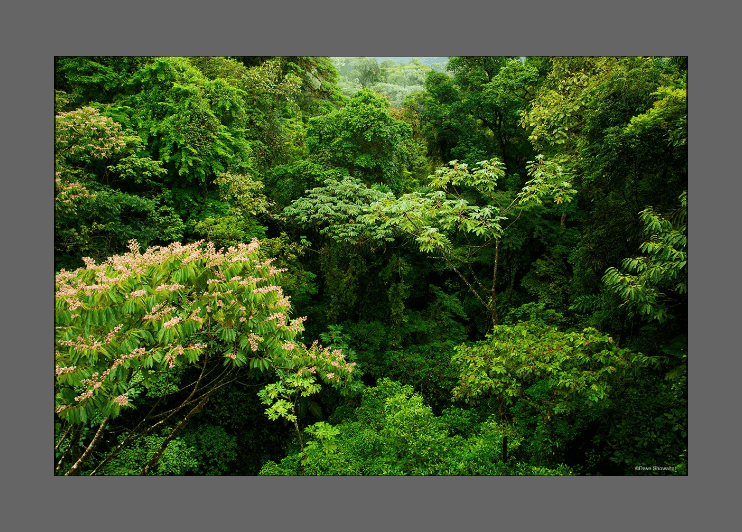
A yellow morph and green morph of an insect lives in the rainforest canopy. You would expect:

a)

the green population to increase and the yellow to decrease

b)

both populations should stay the same

c)

both populations will increase

d)

the green population to decrease and the yellow to increaseThis is a wrong answer

4.

How do you "win" at natural selection?

a)

survive

b)

go extinct

c)

survive & reproduce

5.

What word describes a trait that helps an organism survive in its environment?

a)

natural selection

b)

mutation

c)

camouflage

d)

adaptation

6.
Which organisms are most likely to survive?
a)
the best adapted
b)
the fastest
c)
the strongest
d)
the most domesticated (tamed)
7.
According to the law of superposition, the oldest fossils are found 
a)
At the top of the rock layers
b)
Near the bottom of the rock layers
c)
In the middle of the rock layers
d)
Somewhat near the surface
8.
Which rock layer in the diagram seems to be the oldest?
a)
F
b)
E
c)
B
d)
A
9.
An archaeologist made the following diagram of a dig site. What can be said about the pottery as compared to the skull found in the site?
a)
The rock layer with the pottery is more recent than the rock layer with the skull.
b)
The rock layer with the skull is more recent than the rock layer with the pottery.
c)
The rock layer with the skull is approximately the same age as the rock layer with the pottery.
d)
The rock layer with the skull has an absolute date of 17,000 years.
10.
Which animal is the youngest in site 1?
a)
bird
b)
ammonite 
c)
shell
11.
Which best describes the fossil record?
a)
The fossil record cannot provide evidence of evolution. 
b)
The fossil record provides evidence of a common ancestor to many species.
c)
The fossil record provides evidence that disputes the theory of evolution.
d)
The fossil record is inaccurate because scientists are not able to date fossils.
12.
In rock layers, jellyfish fossils are found lower than trilobite fossils, and trilobite fossils are found lower than ammonite fossils. What can be determined from this information?
a)
Trilobites existed before jellyfish and ammonites.
b)
Jellyfish existed before trilobites and ammonites. 
c)
Ammonites existed before trilobites and jellyfish.
d)
Jellyfish, trilobites, and ammonites lived together.
13.

Trilobite fossils are found in Cambrian rocks but not in Triassic rocks. Which statement best explains why trilobite fossils are missing from Triassic rocks?

a)

trilobites went extinct before the Triassic

b)

fossils did not form during the Triassic

c)

volcanoes and earthquakes destroyed only trilobite fossils during the Triassic

d)

trilobite fossils just haven’t been found yet

14.

Layer B on Site #1 (left) is a match to which layer on Site #2 (right)?

a)

z

b)

y

c)

w

d)

there is no match

15.

The fossil record gives us _____.

a)

accurate data on the number of life-forms that lived.

b)

accurate insight on how animals reproduced.

c)

information on past life and environments on Earth.

d)

information on past life and environments on Earth.

16.

Fossils of a now extinct dinosaur have been near the east coast of South America and the west coast of Africa. The dinosaur could not swim or fly. What does this suggest about the continents of South America and Africa?

a)

The continents were once connected.

b)

A land bridge once connected the continents.

c)

The same type of animals evolved on both animals.

d)

Prehistoric man transported the dinosaur between the continents.

17.

A fossil of a fern and other large-leafed plants were found in an area of Alaska. What does this suggest about this area in Alaska?

a)

A forest is now covered with snow.

b)

A farm was once located in the area.

c)

The area once had a warmer climate.

d)

Prehistoric man ate large-leafed plants.

18.

Fossilized tracks of dinosaurs have been found when layers of rock have eroded and exposed the prints. When analyzed, what can these tracks tell us about the creature that made them?

a)

how many legs the animal had

b)

how long the animal lived

c)

what the animal’s height was

d)

what the animal ate

19.
Which of the following happened in first?
a)
Deer
b)
Dog
c)
Human
d)
Bear
20.
Which of the following does the law of superposition tell scientists?
a)
Absolute age
b)
Relative age
c)
Exact age
d)
All of the answer choices
21.
The law of superposition states:
a)
each rock layer is older than the one above it
b)
each rock layer is younger than the one above it
c)
each rock layer is the same as the one above it
22.

Rock layer D is _______________ than rock layer A.

a)

older

b)

younger

23.

Rock layer B is _______________ than rock layer E.

a)

older

b)

younger

24.

Rock layer D is _______________ than rock layer C but _______________ than rock layer E.

a)

older, younger

b)

younger, older

25.

Which rock layer most likely contains fossils of the most recently evolved organisms?

a)

F

b)

E

c)

D

d)

C

26.

Suppose the blue star represents a certain fish species. When did this species go extinct at this location?

a)

at the end of the Cretaceous

b)

at the end of the Jurassic

c)

during the Permian

d)

at the end of the Triassic

27.

Which of the following best explains how the fossil record provides evidence of evolution?

a)

by documenting the conditions life forms lived in over time

b)

by documenting the reason life forms went extinct over time

c)

by documenting the exact number of life forms over time

d)

by documenting the changes in life forms over time

28.

The diagram shows several layers of sediment below the surface and some fossils that can be found in these layers. This diagram suggests that...

a)

amphibians are common ancestors of dinosaurs and trilobites.

b)

different species were abundant at different times in Earth's history.

c)

trilobites are the oldest living creatures on the planet.

d)

dinosaurs became extinct before the evolution of bony fishes.

29.

The striking molecular similarities that exist between Earth's many diverse species can best be explained by...

a)

the inability of the species to undergo evolutionary change over time.

b)

random changes that occur separately in each species' genetic code.

c)

species mating with other species to produce offspring.

d)

the sharing of common ancestors within the species' evolutionary history.

30.

Whales and hippos are thought to have evolved from a common ancestor around 54 million years ago. Which of the following is also true about these species?

a)

Whales and hippos have not changed in the past 54 million years.

b)

Whales and hippos are physically identical.

c)

Whales and hippos share many genetic similarities.

d)

Whales and hippos can interbreed to produce offspring.

31.

If two diverse species are genetically similar, the fossil record will likely show that...

a)

the species are physically identical.

b)

the species cannot undergo evolution.

c)

the species do not share any common ancestors.

d)

the species share a common ancestor.

32.
Which of the following is a fossil?
a)
a plant that has recently died
b)
a group of organisms that can reproduce
c)
a structure or organ that no longer functions
d)
a trace of an organisms that existed in the past
33.
In natural selection, the selective agent is the
a)
humans
b)
mutations
c)
breeders
d)
environment
34.
what did Charles Darwin observe in finch populations of the Galapagos Islands off the coast of South America?
a)
different species on different islands
b)
all species on one of the islands
c)
identical species on all the islands
d)
the same species as North America
35.
Mutations are important because they bring about
a)
death of the organism in which they develop
b)
genetic variation needed for a population to evolve
c)
benefits for the individual, not for the population
d)
Hardey-Weinberg equilibrium within a population
36.
What is the process in which humans breed organisms for certain traits?
a)
natural selection
b)
inheritance
c)
artificial selection
d)
descent withOUT modification
37.
Who is the father of evolution?
a)
Darwin
b)
Mendel
c)
Newton
d)
Einstein
38.

Select ALL that show evidence of evolution.

a)

DNA

b)

mutations

c)

fossils

d)

skeletal structures

39.
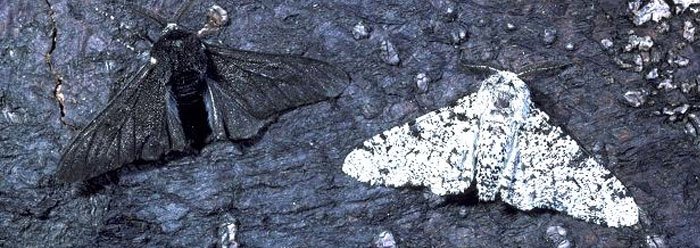
The environment around Manchester, England, changed during the Industrial Revolution.  How did this change affect peppered moths living in the area?
a)
Natural selection favored moths with dark wings because predators could not see them on the soot-colored trees.
b)
Natural selection favored moths with white wings that were easy for predators to see.
c)
Natural selection favored moths with white wings because predators could not see them on the soot-colored trees.
d)
Natural selection caused moths with white wings to become extinct.
40.
The example of the peppered (brown) moths living near English industrial cities demonstrates that
a)
A change in an environment can result in the evolution of species living there
b)
Evolution occurs so slowly that is it not possible to determine that it has happened in less than a million years
c)
The environment near these cities has always favored dark colored moths
41.
Why are advantageous traits more likely to be passed onto offspring?
a)
Because they are more likely to survive and reproduce.
b)
Because they come from dominant alleles.
c)
Because they come from recessive alleles.
d)
Because the trait is an acquired phenotype.
42.
The trees these moths used to live on were white, but have been covered in soot from coal factories. Which moth will be more successful in this environment?
a)
Dark moth
b)
Light moth
c)
Both will be equally successful
d)
Neither will be successful
43.
Since the 1800s humans have stopped burning coal, and the trees have returned to their original color. Which moth will be more successful in this environment?
a)
Dark moth
b)
Light moth
c)
Both will be equally successful
d)
Neither will be successful
44.
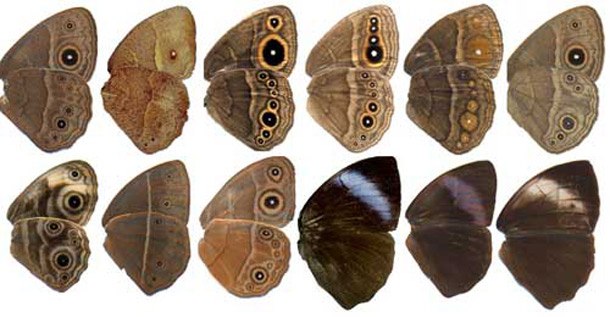
These moths are all the same species. The differences between their wings is an example of ________________
a)
Natural Selection
b)
Variation
c)
Homeostasis
d)
Extinction
45.
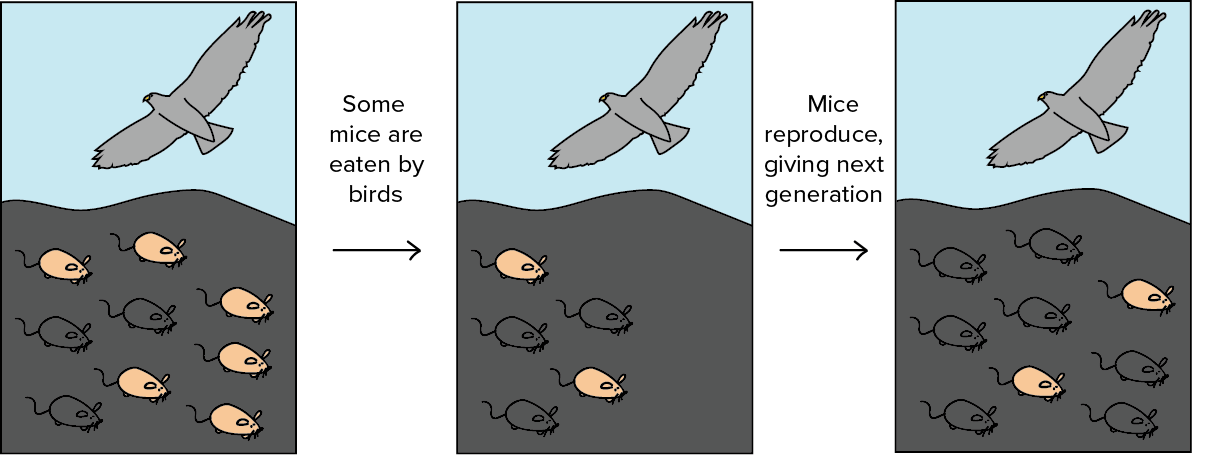
Why is the mouse population changing over time?
a)
The light mice can reproduce more successfully than the dark mice
b)
The hawks eat more dark mice than light mice because the dark mice taste better
c)
The hawks eat more light mice than dark mice because they can see the light mice more easily
d)
The hawks eat more dark mice than light mice because they can see the dark mice more easily