
 Worksheets
Sci 9 Surface Water Movement
Total questions: 68
Worksheet time: 35mins
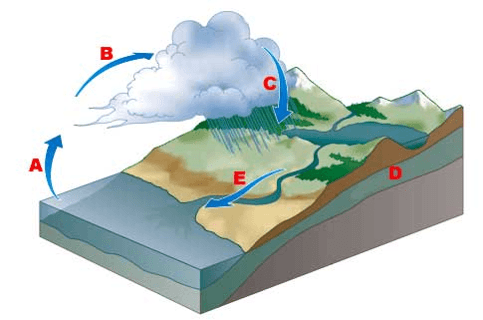

What percentage of the world's water is found in the Oceans?
25%
50%
75%
97%
99%
What is a polar molecule?
It is a negative charge
It has a positive charge
It is positive on one side, negative on the other
It is positive on the outside, negative on the inside
How can flash floods occur in the desert?
The rainstorm can be far away
The soil may not accept water seepage
The soil may not have much vegetation
All of these may be contributing factors
How does water leave the atmosphere? Give the most complete answer.
Rain
Sleet
Precipitation
Hail
Salt is what
Suspended load
Dissolved load
Bed load
Stream load
A rock
Suspended load
Dissolved load
Bed load
Stream load
How water leaves plants is what?
Persperation
Evaporation
Transpiration
Evapotranspiration
Movement of water through the soils of Earth is what?
Diffusion
Infiltration
Exfoliation
Precipitation
What happens when water evaporates into a gas?
Energy is destroyed
Energy is released
Energy is absorbed
Nothing happens
What happens to your hand, if water vapor condenses into liquid water on it?
Your hand will become colder
Your hand will not change temperature, not even a bit
Your hand will become very dry
Your hand will become warmer
In which of the following are the molecules of H2O the closest together?
Gas
Water
Solid
All are the same
In which of the following are the molecules of H2O moving the fastest?
Gas
Liquid
Solid
All are the same
What percentage of the world's water is found in the Oceans?
25%
50%
75%
97%
99%
How can flash floods occur in the desert?
The rainstorm can be far away
The soil may not accept water seepage
The soil may not have much vegetation
All of these may be contributing factors
How does water leave the atmosphere? Give the most complete answer.
Rain
Sleet
Precipitation
Hail
Salt is what
Suspended load
Dissolved load
Bed load
Stream load
A rock
Suspended load
Dissolved load
Bed load
Stream load
How water leaves plants is what?
Persperation
Evaporation
Transpiration
Evapotranspiration
Movement of water through the soils of Earth is what?
Diffusion
Infiltration
Exfoliation
Precipitation
Which of these shows a diagram of a Drianage Basin?


Which of these shows a river channel?


The _________ is where streams/rivers begin.
Source
Confluence
Tributary
Mouth
A _________ is a smaller stream/river that contributes to the main river a drainage basin.
Tributary
Mouth
Watershed
Source
_________ is where streams/rivers meet each other.
Confluence
Tributary
Mouth
Watershed
The _________ is an area of land that separates water flowing into different drainage basins.
Watershed
Source
Confluence
Tributary
The _________ is where the main river will eventually drain all its water into.
Mouth
Watershed
Source
Confluence
The _________ is an area of land that separates water flowing into different drainage basins.
Watershed
Source
Confluence
Tributary

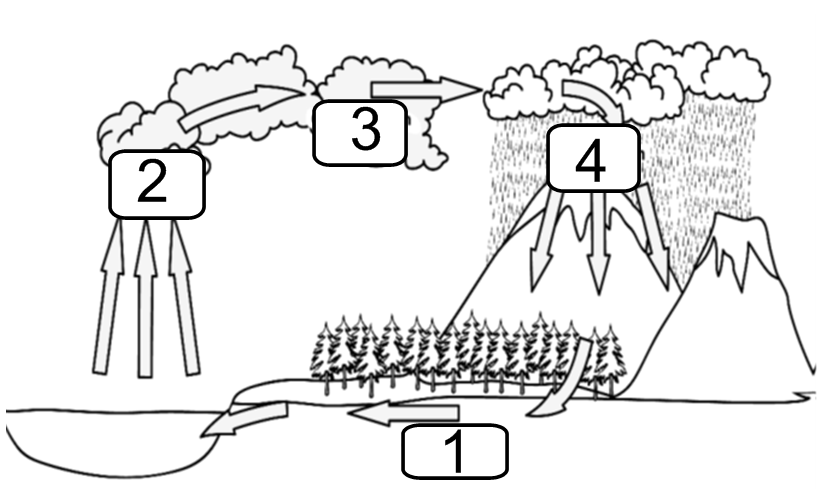
Which stage does the arrow below #2 show in the diagram?
condensation
evaporation
precipitation
run off
What is the energy source for the hydrological cycle?
the Sun
the Earth
water
the Moon
What is an area of land drained by a main river and its tributaries?
Watershed
Bath Tub
Drainage Basin
Water Cycle
What marks the boundary between two drainage basins?
A fence
A river
A watershed
A confluence
3% of the Earth's water is fresh.
True
False


The arrow shows rain water soaking into the ground. This is an example of
Runoff
Infiltration
erosion
impervious surface
An area of land where all streams/rivers flow toward the same body of water is called a
watershed
floodplain
delta
confluence
A floodplain can be found on...
High-lying, steep ground
Low-lying, steep ground
High-lying, flat ground
Low-lying, flat ground
A floodplain is an area that...
is covered in water when a river overflows it's banks.
is permanently covered in flood water.
is the river channel between it's banks.
is the watershed.
The natural embankments caused by the deposition of large material next to the river channel are called...
Dams
Bankful widths
River Walls
Levees
Sediment is distributed across the floodplain...
Evenly
Heaviest material closest to the channel, lightest material further away.
Lightest material closest to the channel, heaviest material further away.
Randomly
River deltas are found...
at river mouths and estuaries.
on river floodplains.
next to meanders.
all of the above
Deltas are landforms of...
Erosion
Transportation
Deposition
All of the above.
Water flowing downslope along Earth's surface is called ___.
water fall
runoff
water shed
stream
Infiltration of water into the ground depends on the number of open ________.
divide
holes
fissures
pores
All the land area that drains into a stream system is the system’s _________.
runoff
bed load
watershed
discharge
Elevated land areas called __________ separate one watershed from another.
mountains
divides
water splits
water falls
A stream’s __________ is the material the stream carries.
load
bed
carrying
discharge
Sediments that are transported by streams, but too large to be held up in suspension.
bed load
discharge
gravel
rock
The narrow channel carved over time by the water of a stream into sediment or rock layers.
stream channel
rejuvenation
lake
eutrophication

