
 Worksheets
Electronics Unit 4 Review
Total questions: 61
Worksheet time: 34mins


what type of device is this?
it is a transistor
it is a diode
it is an amplifier
it is a power supply

what is this?
it is a transistor
it is a diode
it is a capacitor
it is a resistance
Reverses its direction many times a second at regular intervals
Pulsating Direct Current
Alternating Current
Direct Current
One directional flow of electric current
Alternating Current
Direct Current
Pulsating Direct Current
Changes in value but never changes direction
Alternating Current
Direct Current
Pulsating Direct Current
Direct current is used in
cell phones
lap tops
anything that has a circuit board
all of these
Electric charge moves from the negative side of the battery to the positive side
Conventional Current Flow
Actual Current Flow
Electric charge moves from the positive side of the battery to the negative side
Conventional Current Flow
Actual Current Flow
This device is used to reduce current flow, adjust signal levels, to divide voltages, bias active elements, and terminate transmission lines
resistor
solenoid
switch
relay
This device controls the flow of electrical current within a circuit. It can be used to both inhibit the flow of the current or to initiate it.
resisitor
diode
capacitor
switch
This device acts as a one way switch for current
switch
transistor
diode
relay
A device whose resistance is dependent on temperature.
potentiometer
solenoid
thermistor
photocell
This device converts electrical energy into mechanical work.
solenoid
generator
electromagnet
commutator
This device is an electrically operated switch that opens and closes circuits by receiving electrical signals from outside sources.
integrated circuit
transistor
relay
capacitor
These devices measure a physical quantity in order to convert it into an electronic signal
sensors
solenoids
switches
transistors

Identify the electronic symbol.
Diode
Photodiode
Reflective diode
Light Emitting Diode

NAME THIS SYMBOL
(a)

NAME THIS SYMBOL
(a)

NAME THIS SYMBOL
(a)

NAME THIS SYMBOL
(a)

What circuit element is this?
Fixed Resistor
Wire
Power Supply
Capacitor
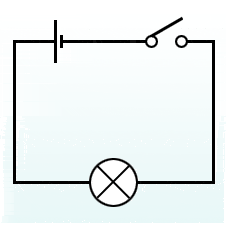
This circuit is .....?
open
parallel
closed
This device stores electrical energy in an electric field.
diode
capacitor
relay
battery
This device is a collection of electronic components resistors, transistors, capacitors connected together to achieve a common goal
capacitor
integrated circuit
sensor
relay
What element is used in transistors?
copper
silicon
aluminum
uranium
What do transistors do in a circuit? Select 2 answers.
resist
amplify
divert
switch
The three leads on a transistor are _____. Select 3 answers.
base
collector
emitter
diverter
Transistors in hearing aids act as
resistors
switches
amplifiers
capacitors
In a transistor the _____ current switches on the one larger one.
larger
smaller
alternating
direct
The leg on a transistor that is the gate controller device for the larger electrical supply.
emitter
base
collector
The leg of the transistor that is the larger electrical supply.
base
collector
emitter
The leg of the transistor that is the outlet for the electrical supply.
base
collector
emitter
The work of the emitter is to ______ charge to the collector via the base.
use
supply
amplify
divert
The size of the base is always kept _____ so that the charge carriers coming from the _____ and entering base will not recombine in the base region and will be directed towards the _____ region.
big, emitter, collector
consistent, base,
emitter
small, emitter, collector
The collector region is slightly ____ than emitter region because all the charge carriers coming from the emitter recombine at base and ____ is released in this process.
smaller, light
bigger, heat
smaller, heat
bigger, light
At the center of the bulb is a wire (known as a _____) of pure _____.
filament, tungsten
coil, copper
wire, aluminum
In a low-oxygen environment, the filament becomes red hot and emits a great deal of _____ when _____ is run through it.
heat, current
light, electricity
light, water
An electric motor uses _____ to create motion.
axles
magnets
rotors
armatures
In an LED an electrical ____ passes through a _____, which illuminates the tiny light sources we call LEDs and the result is visible _____.
pulse, diode, current
current, microchip, light
surge, filament, sound
Speakers convert ____ into ____.
current, sound
light, sound
current, noise
Alternating current changes direction ___ times per second.
1
10
100
60
Which of the following can provide direct current? Select all the correct answers.
batteries
power plants
fuel cells
solar cells
The electricity supplied to homes is _____ current.
alternating
direct
The current that comes from a power plant is _____.
alternating
direct
Electric current can flow in two directions.
True
False
Why is a capacitor used in circuits?
to interrupt electrical supply
to smooth out electrical supply
to divide electrical supply
How do you know which side of a capacitor has a negative charge?
It has a longer leg.
It has a stripe.
The rating
The capacitance of a capacitor is measured in


How can you safely discharge a capacitor?
Attach it to a multi-meter.
Use a magnet
Connect it to a resistor.
It will discharge on it's own.
A transistor can be compared to a
diode
switch
power supply
LED
In a transistor, the depletion region/layer acts as a barrier and repels electrons.
True
False
Transistors can be made smaller with no limits on size.
True
False

I know which pin is pin 1.
True
False

What is this device?
diode
integrated circut
tranistor
poentiometer

This device is a
transisitor
capacitor
resistor
diode

The rating on this capacitor is
16
2200
85
40

Which schematic circuit matches this circuit picture?



