wayground logo

Free Printable Worksheets

Font size

S
M
L
XL
Worksheets

Cells and Classification Review

Total questions: 69

Worksheet time: 52mins

Name
Class
Date
1.

Which organelle controls what goes in and out of the cell?

a)

nucleus

b)

nucleolus

c)

cell membrane

d)

nuclear membrane

2.

This organelle digests dead cell parts and contains enzymes

a)

lysosome

b)

golgi body

c)

smooth ER

d)

Rough ER

3.

What organelle is represented by this image?

a)

rough endoplasmic reticulum

b)

smooth endoplasmic reticulum

c)

ribosome

d)

nucleus

4.

The jelly-like material inside the cell

a)

ribosomes

b)

lysosome

c)

granum

d)

cytoplasm

5.

Which organelle contains DNA and controls the cell?

a)

Cell membrane

b)

nucleus

c)

nucleolus

d)

lysosme

6.

Proteins are produced at this organelle.

a)

golgi body

b)

ribosome

c)

cytoskeleton

d)

cilia

7.

This organelle makes useable energy for the cell

a)

chloroplast

b)

mitochondria

c)

ribosome

d)

nucleolus

8.

In _______ cells, the vacuole is large and located in the center of the cell.

a)

plant

b)

animal

c)

both plant and animal

d)

all

9.

Which of the images below represents a chloroplast?

a)
b)
c)
d)
10.

This structure provides protection to plant cells and is made of cellulose.

a)

chloroplast

b)

cell membrane

c)

cell wall

d)

cytoplasm

11.

Which organelle is this?

a)

Golgi Apparatus

b)

Mitochondria

c)

Nucleus

d)

Chloroplast

12.
Where can you find the chloroplast? 
a)
Only Plants
b)
Only Animals
c)
Plants & Animals
d)
Animals & Bacteria
13.
What organisms have a cell wall? 
a)
Only Plants
b)
Only Animals
c)
Plants & Animals
d)
Animals & Bacteria
14.
What does the cell wall do for the cell?
a)
Allows things in and out
b)
Provides protection and structure
c)
Controls the cell
d)
Makes protein 
15.
If a cell had the following organelles: nucleus, mitochondria, ribosome, and cell membrane. And DID NOT have a chloroplast and cell wall, what kind of organism is the cell found in? 
a)
Animals only
b)
Plants only
c)
Both plants and animals
d)
Bacteria
16.

packages and distributes proteins

proteins may be modified here

a)

golgi body

b)

chloroplast

c)

ribosomes

d)

lysosome

17.

contains DNA, which has the information on how to make the cell's proteins

control center for the cell

a)

nucleus

b)

lysosome

c)

mitochondria

d)

endoplasmic reticulum

18.

The pigment found in chloroplasts.

a)

chlorophyll

b)

green

c)

starch

d)

cellulose

19.
This scientist concluded that animals and, in fact, all living things are made of cells:
a)
Hooke
b)
Leeunwenhoek
c)
Schleiden
d)
Schwann
20.
This scientist was the first to identify cells and name them:
a)
Hooke
b)
Leeunwenhoek
c)
Schleiden
d)
Virchow
21.
This scientist proposed that all cells come from other cells:
a)
Leeunwenhoek
b)
Schleiden
c)
Schwann
d)
Virchow
22.
All organisms are made of:
a)
organelles
b)
cytoplasm
c)
DNA
d)
cells
23.
All existing cells are produced by other
a)
living cells
b)
dead cells
c)
atom cells
d)
animal cells
24.
This is the most basic unit of life
a)
atom
b)
cell
c)
nucleus
d)
DNA
25.
Which of the following statements is not part of the cell theory?
a)
Cells are the basic unit of structure and function in all living things.
b)
All cells are produced from other cells.
c)
Only animal cells are composed of cells.
d)
All living things are composed of cells.
26.
Which organism is made up of cells that have both a cell membrane and a cell wall?
a)
desert mouse
b)
human 
c)
maple tree
d)
zebra
27.
A new organism is produced from one parent organism.
a)
Sexual Reproduction
b)
Asexual Reproduction
28.
How many daughter cells are produced in mitosis?
a)
1
b)
2
c)
4
d)
6
29.

How many chromosomes does a human body cell have?

a)

42

b)

46

c)

23

d)

64

30.
Most single-celled organisms...
a)
reproduce asexually
b)
reproduce sexually
c)
have complex tissues
d)
can be seen without a microscope
31.

Which of these are part of Mitosis?

a)

Metaphase

b)

Prophase

c)

Anaphase

d)

Telophase

e)

Cytokines

32.

What are the "X" shaped things in the drawing.

a)

PMATs

b)

Chromosomes

c)

Ribosomes

d)

Telophase

33.

During what phase of Mitosis do the chromosomes line up in the Middle

a)

Metaphase

b)

Prophase

c)

Telophase

d)

Anaphase

34.

PMAT helps us remember the correct order of the phases of Mitosis. Which of the following has the phases of Mitosis in the correct Order

a)

Interphase, Mitosis, Cytokinesis

b)

Prophase, Metaphase, Anaphase, Prophase

c)

Anaphase, Telophase, Prophase, Telophase

d)

Prophase, Metaphase, Anaphase, Telophase

35.

Which of the following is the correct order of the Cell Cycle?

a)

Interphase, Mitosis, Cytokinesis

b)

Mitosis, Cytokinesis, Mitosis, Interphase

c)

Prophase, Metaphase, Anaphase, Telophase

d)

Interphase, Prohase, Cytokinesis

36.

In which phase of Mitosis do the Chromosomes pull Apart

a)

Metaphase

b)

Prophase

c)

Anaphase

d)

Telophase

37.

What is the purpose of Mitosis?

a)

Growth of an organism and Repair of damaged tissue

b)

To help the body get rid of extra cells

c)

To increase the amount of classwork you have to do

d)

To get rid of the nucleus

38.
How many daughter cells are produced at the end of meiosis?
a)
1
b)
2
c)
3
d)
4
39.
How many chromosomes are in the new cells of meiosis?
a)
46
b)
23
40.

At the end of mitosis you have _____ cells.

a)

identical

b)

different

c)

identical twins

d)

variety

41.

If the carrots have 18 chromosomes in their body cells, how many chromosomes are in their sex cells?

a)

18

b)

9

c)

27

d)

36

42.
Which of the following is the correct order of organization in living things from most basic (simple) to most complex?
a)
a.  Organism, cell, tissue, organ, organ system
b)
a.  Organ system, organ, tissue, cell, organism
c)
a.  Cell, tissue, organ, organ system, organism
d)
a.  Cell, organ, tissue, organ, organism, organ system
43.
A group of similar cells that come together to perform a specific function is a/an
a)
organ
b)
organism
c)
organ system
d)
tissue
44.
The smallest level of organization of life in an organism
a)
tissue
b)
cell
c)
organ
d)
organ system
45.

How do the particles move in diffusion?

a)

From a region of low concentration to a region of high concentration

b)

From a region of high concentration to a region of low concentration

c)

From a region of low concentration to a region of low concentration

d)

From a region of high concentration to a region of high concentration

46.

What does a 'region with high concentration' mean?

a)

An area with a SMALL number of particles

b)

An area with a LARGE number of particles

c)

An area with an UNEVEN number of particles

d)

An area with no particles

47.

When does diffusion stop?

a)

After a day and a night

b)

When the particles reach equilibrium

c)

When there are no particles left

d)

When all the particles leave the system
48.
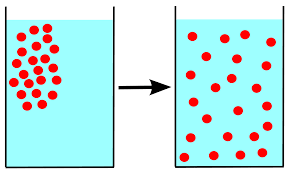
The picture below is an example of _________________.
a)
osmosis
b)
isotonic
c)
diffusion
d)
active transport
49.
During osmosis
a)
water moves from high to low concentration
b)
large or oddly shaped molecules move across a cell membrane
c)
water moves when energy is used
d)
proteins are built
50.

Which of the following identifies the levels of classification in the correct order?

a)

domain, kingdom, phylum, class, order, family, genus, species

b)

genus, species, domain, kingdom, phylum, class, order, family

c)

domain, kingdom, genus, species, phylum, class, order, family

d)

genus, species, phylum, class, order, family, domain, kingdom

51.
What are the three domains?
a)
Plant, Animal, Fungi
b)
Eukarya, Archaea, Animal
c)
Eukarya, Archea, Eubacteria
d)
Eukarya, Archaea, Bacteria 
52.

Which domain contains cells which all contain a nucleus?

a)

Bacteria

b)

Archaea

c)

Eukarya

53.

Kingdom with the following characteristics: eukaryotic cells, unicellular or multicellular, autotrophic or heterotrophic

a)

Fungi

b)

Animalia

c)

Protista

d)

Plantae

54.
Type of nutrition that produces its own organic matter
a)
Food
b)
Autotrophic
c)
Heterotrofic
d)
carnivorous
55.
Kingdom with the following characteristics: eukaryotic cells, unicellular or multicellular and heterotrophic 
a)
Protoctista
b)
Fungi
c)
Animal
d)
Plant
56.
Kingdom with the following characteristics: eukaryotic cells, multicellular tissues, and heterotrophic 
a)
Fungi
b)
Animal
c)
Protoctista
d)
Monera
57.
Which of the following is/are true of animals?
a)
They are multicellular.
b)
They are eukaryotic.
c)
They are heterotrophs.
d)
All choices are correct.
58.
Identify this animal.
a)
sponge
b)
cnidarian
c)
roundworm
d)
flatworm
59.
To which phylum do vertebrates belong?
a)
Chordata
b)
Cnidaria
c)
Echinodermata
d)
Arthropoda
60.
Organisms, like sponges, lacking body tissues and body symmetry belong to which of the following phyla?
a)
Cnidaria
b)
Mollusca
c)
Nematoda
d)
Porifera
61.
Mollusks include which of the following?
a)
Octopus, Squid, Slugs, Snails
b)
Fish, Squid, Jellyfish, Sea cucumbers
c)
Sea stars, Sea cucumbers, sea urchins
d)
Oysters, Fish, Whales, Sponges
62.
Which of the following are examples of echinoderms?
a)
Jellyfish, Hydrozoa, Squid
b)
Slugs, Snails, Mussels
c)
Sea stars, sea urchins, sea cucumbers
d)
bony fish, cartilaginous fish
63.
Animals that are segmented and have jointed appendages and an exoskeleton are members of the phylum
a)
platyhelminthes
b)
arthropoda
c)
annelida
d)
cnidaria
64.

What is Binomial Nomenclature

a)

The Genus and Species names

b)

Family and Kingdom

c)

Domain and Kingdom

d)

Kingdom and Order

65.
In a properly written scientific name, which part is lowercase?
a)
species
b)
genus
66.

Why is the most specific taxonomy category?

a)

Kingdom

b)

Domain

c)

Species

d)

Order

67.

What would the scientific name of this organism be?

Kingdom: Animalia

Phylum: Chordata

Class: Reptilia

Order: Crocodila

Family: Alligatoridae

Genus: Alligator

species: mississippiensis

a)

alligator Mississippiensis

b)

Crocodila chordata

c)

Alligator mississippiensis

d)

Reptilia crocodila

68.

What would the scientific name of this organism be?

Kingdom: Animalia

Phylum: Chordata

Class: Aves

Order: Charadriiformes

Family: Laridae

Genus: Thalasseus

species: maximus

a)

thalassues maximus

b)

Anamalia maximus

c)

Aves chordata

d)

Thalassues maximus

69.

Who created the system of Taxonomy?

a)

Albert Einstein

b)

Carolus Linnaeus

c)

Aristotle

d)

Copernicus