
Font size
 Worksheets
Work Power and Energy Mixed Practice
Total questions: 48
Worksheet time: 54mins

The ability to do work
Power
Force
Energy
Motion
Combines all of the kinetic and potential energy in a system
Mechanical Energy
Mechanical Advantage
Power
Work
This requires a force that causes motion
Work
Energy
Inertia
Gravity
Mark the two things that affect gravitational potential energy
Mass
Weight
Height (distance)
Power
If a piece of wood contains 500 joules of chemical potential energy, how many joules of light and thermal energy can it produce when it is burned?
100 joules
500 joules
1000 joules
0 joules
The rate of work or how fast work gets done
Power
Force
Energy
Inertia
What two factors affect an object's kinetic energy?
area and volume
mass and weight
weight and height
mass and speed
Increasing an object's mass will increase its kinetic energy.
true
false
Increasing an object's speed will increase its kinetic energy.
false
true
What is the correct unit for energy?
meters (m)
kilogram meters per second (kg m/s)
Newtons (N)
Joules (J)

Lilly's cat ran through your yard. The cat has a mass of 5 kg. He is running at a speed of 3 m/s. What is the kinetic energy of the cat as he runs? (KE = 1/2mv2)
8.5 J
45 J
7.5 J
22.5 J

Alice kicks a soccer ball with a mass of 2.1 kg. The ball leaves the ground moving 30 meters per second. What is the kinetic energy of the soccer ball? (KE = 1/2mv2)
567 J
900 J
945 J
30 J
If the 1.2 kg basketball rolls at 3 m/s, what is it's kinetic energy? (KE = 1/2mv2)
2.7
5.4
3.6
9
what is the unit of work?
Newton
Joule
Watt
meter
Fred kicks a ball with a force of 20N to George, who is 5M away. How much work was done to the ball?
25J
100J
4J
75J
Newtons are the unit for _____________.
Work
Distance
Acceleration
Force
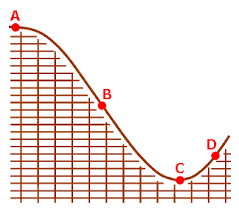

Bobby lifts a book to the second floor in 20 seconds. Carol lifts the same book to the second floor in 10 seconds. Who did more work?
Bobby
Carol
They did the same amount of work
Not enough information
A girl weighs 400 N. She runs up a flight of stairs of height 5 m in 4 seconds. Her power is:
320 W
400 W
500 W
2 000 W
Water stored in a dam possesses
(a) no energy
(b) electrical energy
(c) kinetic energy
(d) potential energy
If 150 Joules of work is needed to move a box 10 meters, how much force was used?

50 J of work is done lifting a 20.0 N book in the air. How high was it lifted?
2.5 m
3.5 m
0.4 m
25 m

Two workers use 100 N of force to move a sofa 2 meters in 2 seconds. How much power is required?
100 watts
400 watts
104 watts
50 watts
When is energy lost?
During transformations only
During transformations and transfers
During transfers only
During GPS outages
A kettle uses 100J of electrical energy to produce 7J of sound energy and 93J of thermal energy. How efficient is the kettle?
100%
7%
93%
95%
A washing machine uses 250J of electrical energy to produce 125J of useful energy. How efficient is it?
5%
50%
55%
100%

What best describes potential energy?
The energy that an object has because of its motion
The energy stored in an object
The energy released when an object is heated
What best describes gravitational potential energy?
The energy an object has due to its position
The energy an object has due to the moon
The energy an object has due to falling.
An object is traveling with a total kinetic energy of 500 joules. It starts to go uphill. On the way up the hill, it gains 200 joules of potential energy.
How much total energy does it have?
500j
700j
300j
100000j
An object is traveling with a total kinetic energy of 500 joules. It starts to go uphill. On the way up the hill, it gains 200 joules of potential energy.
Where did the 200 joules of potential come from?
It was created by gravity as it went up the hill.
It was transformed from kinetic energy as it went up the hill.
It was stored in the hill when the object got there.
An object is traveling with a total kinetic energy of 500 joules. It starts to go uphill. On the way up the hill, it gains 200 joules of potential energy.
How much kinetic energy does it have?
500j
200j
700j
300j


When a car burns gasoline it creates hot air to move the pistons in the engine, which causes the car to move. What energy transformation occur from the fuel to the movement of a car?
thermal energy to mechanical energy
thermal energy to chemical energy to mechanical energy
chemical energy to thermal energy to mechanical energy
chemical energy to electrical energy

