wayground logo

Free Printable Worksheets

Font size

S
M
L
XL
Worksheets

Review for physics summative

Total questions: 55

Worksheet time: 41mins

Name
Class
Date
1.
What is a force?
a)
a push or pull
b)
speed or acceleration 
c)
potential or kinetic energy
d)
balanced or unbalanced force
2.
When objects remain in the same place, it is called...
a)
gravity
b)
friction
c)
balanced force
d)
unbalanced force
3.
What is the force that causes everything to be pulled down to the Earth?
a)
friction
b)
gravity
c)
balanced
d)
unbalanced
4.
Force is measured in....
a)
Galileos 
b)
Newtons
c)
Di Vincis
d)
Einsteins 
5.
An unbalanced force is when objects move in one direction because the force is greater from that direction.
a)
true
b)
false
6.

If there was no friction, objects in motion would stay in motion forever.

a)

true

b)

false

7.
Is this and example of a balanced or unbalanced force?
a)
balanced
b)
KITTIES!
c)
unbalanced
d)
pshhh
8.
What is speed?
a)
how far you go
b)
how much distance is covered over a period of time
c)
how fast you accelerate
d)
the change in the location of a object
9.
What is velocity?
a)
the quickness of an object
b)
the location of an object
c)
acceleration
d)
speed in a specific direction
10.
65 miles per hour North is an example of an objects what?
a)
Speed
b)
Velocity
c)
Average Speed
d)
Constant Speed
11.
On a distance vs. time graph, the steeper the slope _____
a)
the slower the speed
b)
the faster the speed
c)
less acceleration
d)
greater acceleration
12.
Speed is different from velocity because
a)
Velocity has a direction
b)
Speed uses Distance /Time
c)
Velocity doesn't include time
d)
Velocity doesn't include distance
13.
Total distance divided by total time is
a)
average speed
b)
constant speed
c)
instantaneous speed
d)
acceleration
14.
Acceleration is defined as the CHANGE in 
a)
time of motion to another place. 
b)
velocity 
c)
distance 
d)
speed
15.

When a pendulum swings, at which point is potential energy at its greatest?

a)

1

b)

2

c)

3

d)

4

16.
Energy due to motion is ____________ energy. 
a)
Potential 
b)
Energy
c)
Kinetic
d)
Friction
17.
The faster an object moves, the ________ kinetic energy it has. 
a)
more
b)
less
c)
none of the above
d)
all of the above 
18.
Energy can not be created or destroyed, only converted from one form to another.
a)
true
b)
false
19.

Which law? A gingerbread man kicks a football through some goal posts with their foot and their toes are left stinging...and possibly detached...

a)

Newton's 1st Law

b)

Newton's 2nd Law

c)

Newton's 3rd Law

20.

The white car hit the gray car, yet both cars were damaged. Why is that?

a)

An object at rest will remain at rest unless acted on by an unbalanced force.

b)

If you apply more force to an object, it will accelerate more.

c)

For every action, there is an equal and opposite reaction.

21.
What is the speed of an object that travels 20 meters in 4 seconds?
a)
80 m/s
b)
0.2 m/s
c)
5 m/s
d)
24 m/s
22.
If a 10 kilogram object accelerates suddenly at 15 m/s2, how much force was applied to the object?
a)
150 Newtons
b)
15 Newtons
c)
150 kilograms
d)
100 kilograms
23.
What law of motion does this picture represent 
a)
Newtons law of gravity 
b)
Newtons 1st law 
c)
Newtons 4th law
d)
Newtons 3rd law 
24.
What Newtons law does this picture represent
a)
Newtons 2nd law 
b)
Law of gravity 
c)
Newtons 1st law
d)
Newtons 5th law
25.
An object that changes speed or direction or both (velocity) is said to be -
a)
accelerating
b)
speeding
26.
How much time did it take for an animal to run 20 miles if it ran at 10 miles/hour?
a)
2 hours
b)
200 hours
c)
0.5 hours
d)
30 hours
27.
Shona cycles at an average speed of 8km/h. How far has she traveled if she cycles for 4 hours?
a)
55km
b)
32km
c)
43km
d)
32miles
28.
The momentum of an object depends upon the object's ___________&_____________.  
a)
size and shape
b)
mass and speed
c)
mass and veloctiy
d)
mass and energy
29.
Determine the momentum of 1000-kg car moving northward at 20 m/s......... 
a)
20000 N
b)
20000 Joules
c)
20000 Kg * m/s
d)
20000 kg * m/s north
30.
The definition of momentum is
a)
Mass in Motion
b)
The size of an object
c)
The velocity of an object
d)
A comparison between two objects
31.
The equation to calculate momentum is
a)
p=mv
b)
p=1/2mv2
c)
p=mgh
d)
p=mg
32.
A 9 kg blob moving at 5 m/s collides and sticks to a second blob with a mass of 5 kg. If the two bobs stick together, what will the velocity of the two blobs move at?
a)
3.57 m/s
b)
3.2 m/s
c)
10.0  m/s
d)
9.0  m/s
33.
When the speed of an object is doubled, its momentum
a)
remains unchanged in accord with the conservation of momentum.
b)
doubles
c)
quadruples
d)
decreases
34.
Which type of energy increases when you compress a spring?
a)
elastic potential energy
b)
kinetic energy
c)
radiant energy
d)
sound energy
35.

Energy stored because of gravity is called:

a)

Gravitational Potential Energy

b)

Kinetic Energy

c)

Mechanical Advantage

d)

Chemical Energy

36.

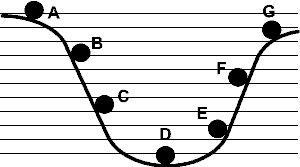
At which point does the ball has the greatest gravitational potential energy (GPE)?

a)

A

b)

G

c)

D

d)

C

e)

G

37.

Which would have the LEAST gravitational potential energy (GPE)?

a)

A ball sitting on the ground

b)

Moon viewed from the Earth

c)

An airplane flying 30,000 feet above the ground

d)

A rock sitting on top of Mt. Everest

38.

What is kinetic energy?

a)

The energy an object has due to its position or condition

b)

The energy an object has due to its motion

c)

The energy an object has due to its chemical composition

d)

The energy an object has due to its atomic structure

39.

When does an object have no kinetic energy?

a)

When it's at rest.

b)

When it's moving very slowly.

c)

When the only force that's acting on it is gravity.

d)

When it has no electrical charge.

40.

Which is the best synonym for potential energy?

a)

Stored energy

b)

Energy of motion

c)

Energy due to gravity

d)

Mechanical energy

41.

The ability of a system to do work; required for changes to happen within a system

a)

Force

b)

Mass

c)

Energy

42.

When energy is stored within the matter itself (for example, energy is stored in a battery)

a)

Elastic potential energy

b)

Magnetic potential energy

c)

Chemical potential energy

43.

All of the pictures are examples of what type of energy?

a)

gravitational potential energy

b)

elastic potential energy

c)

chemical potential energy

d)

kinetic potential energy

44.

Gravitational potential energy depends on which two factors?

a)

mass and height above the ground

b)

distance and speed

c)

speed and height above the ground

d)

mass and speed

45.

Which object has elastic potential energy?

a)

a hanging leaf

b)

a burning coal

c)

a rolling ball

d)

a stretched bow

46.

What type of potential energy does this automobile battery contain?

a)

gravitational potential energy

b)

elastic potential energy

c)

chemical potential energy

d)

kinetic potential energy

47.

Which 2 things affect kinetic energy?

a)

Mass

b)

Sound

c)

Light

d)

Velocity

48.

The energy transformation on a roller coaster is

a)

chemical potential to thermal

b)

sound to kinetic

c)

gravitational potential to kinetic

d)

kinetic to chemical potential

49.

What is the unit for mass?

a)

kilogram (kg)

b)

meter (m)

c)

Newton (N)

d)

Joule (J)

50.

What is the unit for energy?

a)

kilogram (kg)

b)

meter (m)

c)

Newton (N)

d)

Joule (J)

51.

What is the formula for kinetic energy?

a)

distance / time

b)

mass x acceleration

c)

velocity / time

d)

½(mass) x (velocity)2

e)

(mass) x (acceleration of gravity) x (height)

52.

What is the formula for gravitational potential energy?

a)

distance / time

b)

mass x acceleration

c)

velocity / time

d)

½(mass) x (velocity)2

e)

(mass) x (acceleration of gravity) x (height)

53.

What is the formula for force?

a)

distance / time

b)

mass x acceleration

c)

velocity / time

d)

½(mass) x (velocity)2

e)

(mass) x (acceleration of gravity) x (height)

54.

What is the formula for speed?

a)

distance / time

b)

mass x acceleration

c)

velocity / time

d)

½(mass) x (velocity)2

e)

(mass) x (acceleration of gravity) x (height)

55.

What is the unit for force?

a)

kilogram (kg)

b)

meter (m)

c)

Newton (N)

d)

Joule (J)