
 Worksheets
12 chem unit 3 & 4 review
Total questions: 193
Worksheet time: 5hrs 30mins
A stress placed on a system at equilibrium will
use up the reactants
cause the product(s) to be used up.
shift to offset the stress.
Stresses on a system at equilibrium include all of the following EXCEPT
changes in reactant or product concentration.
temperature changes.
addition of a catalyst.
pressure changes.

energy + N2(g) + O2(g) <−> 2NO(g)
If O2(g) is removed, the concentration of N2 will _______.
Rewrite the above equation with energy as a reactant or product:
heat + N2(g) + O2(g) <−> 2NO(g)
If the heat is removed to the chemical system, the equilibrium will _______.
N2 (g) + 3 H2 (g) <−> 2 NH3 (g)
If the pressure in the system is increased, the reaction will __________________.
ΔHrxn= -453 kJ/mol
If the [B] is decreased then the reaction is will shift to the _______.
2SO3(g) ⇋ 2SO2(g) + O2(g)
2 NO(g) + O2(g) ⇌ 2 NO2(g)
Raising the pressure, by decreasing the volume of the container, will...

SO2 (g) + NO2 (g) <=> SO3 (g) + NO (g)
had reached a state of equilibrium, was found to contain
0.40 mol L-1 SO3 , and 0.30 mol L-1 NO,
0.15 mol L-1NO2 , and 0.20 mol L-1 SO2.
Calculate the equilibrium constant for this reaction.
Fe3O4(s) + 4H2(g) <=> 3Fe(s) + 4H2O(g)
Kc =
H2 (g) + Cl2 (g) <=> 2HCl (g) + heat
If the pressure in the system is increased, the equilibrium position will _______.

Which of the two graphs reaches equilibrium?
Neither
The left
Both
The right
HCl, HBr, HI
--sulfuric acid--
--nitric acid--
pH is the measure of the concentration of ______.
Acids
H+ ion
OH- ion
Bases
According to Bronsted-Lowry, what is the definition of an BASE?
a substance that donates a hydrogen (H+) ion
a substance that donates a hydroxide (OH-) ion
a substance that accepts a hydrogen (H+) ion
a substance that accepts a hydroxide (OH-) ion
What is being donated/accepted between conjugate acid-base pairs?
a hydrogen (H+) ion
a hydroxide (OH-) ion
water
a neutron

What is the conjugate base in the following reaction?
HCO3-
HCl
H2CO3
Cl-

For a solution, pH + pOH =
7
14
1.0 x 10⁻¹⁴
-log (1.0 x 10 -14)
If the pH of a solution is 4.0, what is the pOH?
4.0
10.0
1.0 x 10 -4
cannot be determined from the information
The pH of a solution is 8.43. What is the [H3O+]concentration?
3.7 x 10 -9
1.0 x 10-8.43
2.7 x 10⁻⁶
1.0 x 10⁻¹⁴
If the [H3O+] of a solution is 1 x 10⁻³ M, the pH is
11
-3
3
1
If the [OH-] of a solution is 2.7 x 10⁻⁴ M, the pOH of the solution is
10.44
1.00
3.57
-4.43
If the [H3O+] of a solution is 9.3 x 10⁻³ M, the pOH of the solution will be
2.03
1.02
11.97
12.98
A solution of KOH is 2.5 x 10⁻⁵ M. What is the [H+] concentration? (Hint: Find pOH, then pH, then [H+].)
4.60
9.40
3.98 x 10⁻¹⁰
1.0 x 10-4.60
The pH of a 0.001 M solution of HCl is
11
3
2
4
Acetic Acid (HC2H3O2) is a weak monoprotic acid. It's concentration is 0.20M and it's Ka value is 1.8x10⁻⁵. Calculate it's pH value.
0.698
2.72
11.28
None of the answers are correct
Which of these pKa values corresponds to the strongest acid?
1.2
1.4
1.6
1.8
Which of these pKa values corresponds to the weakest (least strong) acid?
5.6
5.2
4.8
4.4
Which of these Ka values corresponds to the weakest (least strong) acid?
9 x 10⁻¹⁰
5 x 10⁻⁴
6 x 10⁻⁸
7 x 10⁻²
Which of these Ka values corresponds to the strongest acid?
8.4 x 10⁻¹⁰
5.0 x 10⁻⁴
9.8 x 10⁻⁸
1.0 x 10⁻³

What does the equation in the image correspond to?
pKa
Ka
pH
[H+]
How would you calculate Kb for the formate ion (HCOO–), given that the Ka for formic acid (HCOOH) is 1.8 × 10⁻⁴? (Kw=1.0 × 10⁻¹⁴)
Kb = Ka × Kw
Kb = Kw / Ka
Kb = Ka / Kw
Kb = Kw + Ka
The magnitude of Kw indicates that ______________.
water autoionizes very slowly
water autoionizes very quickly
water autoionizes only to a very small extent
the autoionization of water is exothermic
What is the [OH-] if the pH is 4.9? : Kw= 1 x 10-14 mol2 dm-6
7.94 x 10⁻¹⁰ mol dm-3
1.0 x 10⁻⁴ mol dm-3
7.94 x 10⁻¹⁴ mol dm-3
4.9 x 10⁻¹⁰ mol dm-3

Which of the following statements ARE TRUE about buffer solution?
(you may choose more than one answer)
pH of buffer solution will never change despite addition of small amount of base or acid
Buffer can be made by mixing weak acid and salt of its conjugate base or by mixing weak base with salt of its conjugate acid
Buffer has acid and base components that can work specifically to resist pH change
the closer the ratio of concentration weak acid/base to the concentration of salt of its conjugate base/acid, the less effective the buffer to resist pH change
Which solution can turn phenolphthalein pink?
NaOH(aq)
CH3COOH(aq)
CH2OH(aq)
HCl(aq)
Which solution would turn litmus red?
KOH(aq)
NaCl(aq)
HCl(aq)
NH3(aq)
At what pH will bromthymol blue, thymol blue, and bromcresol all be yellow?
4
2
7
5

3 LiOH + H3PO4 →
What is the solution of unknown concentration, but known volume, called?
Analyte
Titrant
Indicator
Titration
In a titration, the point at which moles of H+ = moles of OH- is called the
End point
Equivalence point

Which of the following best approximates the Ka value for this weak acid?
1 x 10⁻⁴
1 x 10⁻⁵
5x 10⁻⁶
5 x 10⁻⁷
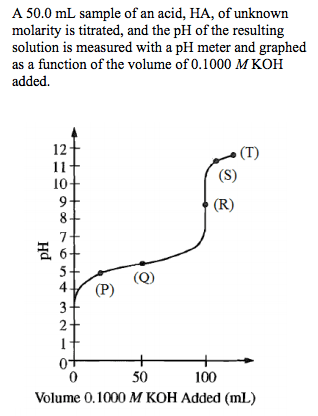
Which point on the titration curve corresponds to the point at which the moles of the added strong base are equal to the moles of the weak acid initially present?
Q
R
S
T
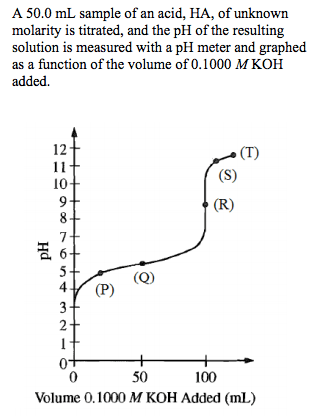
At point P in the titration, which of the following species has the highest concentration?
HA
A–
H3O+
OH–
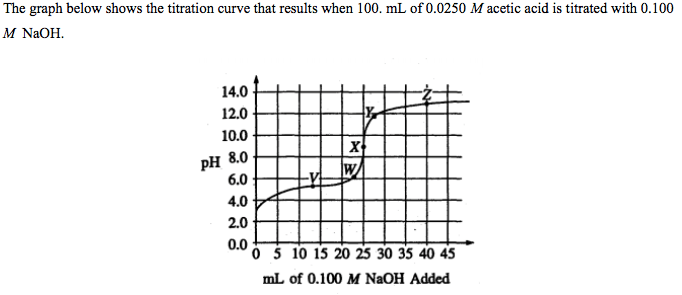
Which of the following indicators is the best choice for this titration?
Methyl orange (pH range of color change is 3.2 - 4.4)
Methyl red (pH range of color change is 4.8 - 6.0)
Bromothymol blue (pH range of color change is 6.1 - 7.6)
Phenolphthalein (pH range of color change is 8.2 - 10.0)
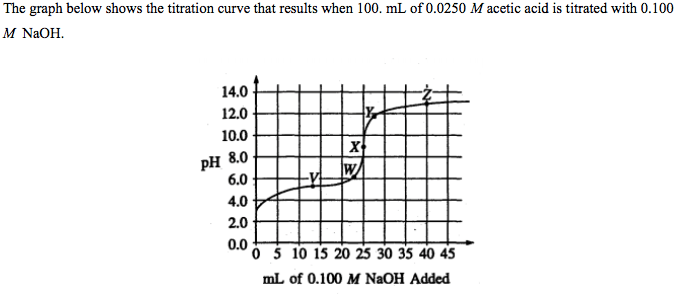
What part of the curve corresponds to the optimum buffer action for the acetic acid/acetate ion pair?
Point V
Point Z
Along all of section WY
Along all of section YZ
calculate the Ka of a solution with a pKb of 3.38
3.38x10⁻¹¹
6.76x10⁻¹¹
2.40x10⁻¹¹
2.39x10⁻¹¹
Defined as the loss of electrons.
oxidation
reduction
redox
OIL RIG
Defined as the gain of electrons.
oxidation
redox
reduction
LEO GER
Cl2 + 2e- --> 2Cl - is an example of:
a chemical reaction
redox
oxidation
reduction
These keep track of the movement of electrons.
(+) and (-) signs
oxidation numbers
coefficients
subscripts
An increase in oxidation number.
more acidic
reduction
less basic
oxidation
A decrease in oxidation number.
concentrated
reduction
oxidation
dilute
What is the oxidation number of C in SrCO3?
-4
+2
-6
+4
What is the oxidation number of Cr in Cr2O72- ?
+14
+6
-6
-14
Substance that oxidizes another substance by accepting its electrons.
reducing agent
oxidation number
combustion
oxidizing agent
Substance that reduces another substance by losing electrons.
reducing agent
half-reaction
electronegative atom
oxidizing agent
What is a half-reaction of this equation, Na + Cl --> NaCl ?
Cl + e- --> Cl-
Cl - e- --> Cl-
Na --> Na + e-
Na° + Cl°--> Na+1Cl-1
which element, if any, is oxidized?
WRITE THIS OUT ON PAPER, YOU MAY USE THE ANSWER TO THIS PROBLEM AGAIN IN ANOTHER QUESTION:
Balance the following ACIDIC reactions using the half-reaction method.
MnO4−(aq) + H+(aq) + I− (aq) → Mn2+(aq) + I2(s)
Water is a product of this reaction. What is the coefficient of water in the final balanced equation?
8
5
2
16
WRITE THIS OUT ON PAPER, YOU MAY USE THE ANSWER TO THIS PROBLEM AGAIN IN ANOTHER QUESTION:
Balance the following reactions using the half-reaction method.
MnO4−(aq) + H+(aq) + I− (aq) → Mn2+(aq) + I2(s)
How many electrons did you cross out on both side?
1 e-
2 e-
5 e-
10 e-
The anode is where oxidation occurs in...
A Galvanic Cell/ voltaic
A Electrolytic Cell
Both Galvanic and Electrolytic cells
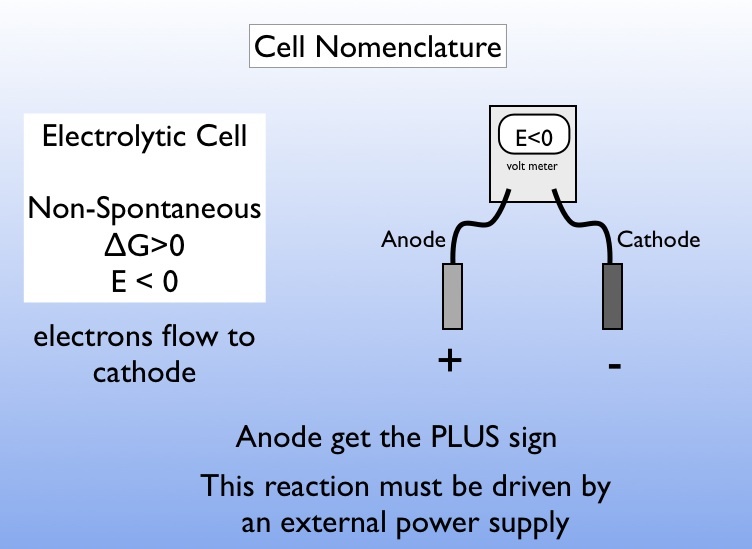

The reaction is non-spontaneous in ...
A Galvanic/ Voltaic Cell
A Electrolytic Cell
Both Galvanic and Electrolytic cells
Electrical energy is converted to Chemical energy in ...
A Galvanic/ Voltaic Cell
A Electrolytic Cell
Both Galvanic/Voltaic and Electrolytic cells
The reaction is spontaneous in ...
A Galvanic Cell
A Electrolytic Cell
Both Galvanic and Electrolytic cells
A salt bridge is used in...
A Galvanic Cell
A Electrolytic Cell
Both Galvanic and Electrolytic cells

Which combination would electroplate an object with copper?
A
B
C
D

In the electrolysis of aqueous potassium nitrate, KNO3, using inert electrodes, 0.1 mol of a gas was formed at the cathode (negative electrode).
Which is correct?
A
B
C
D
Zn(s) + Ag2O(s) + H2O(l) → 2Ag(s)+ Zn(OH)2(s)
This cell delivered 1.50 V. The half-equation for the silver half-cell is:
Ag2O(s)+ H2O(l)+ 2e-→ 2Ag(s)+ 2OH-(aq); E0 = 0.34 V
The standard redox potential for the zinc half-cell must be:

For this cell, the

Which of the following deductions about this cell is correct?
What happens to oxygen molecules in a hydrogen-oxygen fuel cell?
They react with electrons to form oxide ions, O2-
They react with hydrogen ions to form hydroxide ions, OH-
They react with hydrogen ions and electrons to form water

The E0 value for all electrolysis reactions is
positive
neutral
negative
If a half cell has a high reduction potential it prefers to be
oxidised
reduced

What half cell would prefer to be reduced the most?
F2 l F-
Co3+ l Co2+
Au3+ l Au
Cl2 l Cl-
What half cell would prefer to be oxidised the most?
F2 l F-
Co3+ l Co2+
Au3+ l Au
Cl2 l Cl-
What prefers to be oxidised more Cl2 or F2?
F2
Cl2
they prefer to be oxidised the same
both want to be reduced
What ions are present in an electrolyte of CuCl2? (You can select more than one)
Cu
Cu2+
Cl2
Cl-
Has Mg lost or gained electrons in this half equation and has Mg been oxidised or reduced
Mg --> Mg2+ + 2e
Lost, oxidised
Lost, reduced
Gained, oxidised
Gained, reduced
In the following half equation what is reduced?
Cu2+ + 2e --> Cu
Cu
Cu2+
In the following half equation what is oxidised?
2 I- --> I2 + 2e
I-
I2


How many bonds can a carbon form?
2
3
4
5
Which of these is considered as saturated organic compound?
ethene
octane
2-decene
1-heptyne
Saturated hydrocarbon is an organic compound formed only by carbon and hydrogen linked by single bond. Which of these formulas represents a saturated hydrocarbon?
C2H2
C4H10
C5H10
C6H6
The structural formula of 2-butene is _________.
CH3 – CH = C = CH2
CH3 – C - C - CH2
CH3 = CH - CH2 - CH3
CH3 - CH = CH - CH3
Which of these is the chemical structure of 1-hexanone?


What is the major organic product obtained from the following reaction?
1-bromo-2-methylcyclobutane
1-bromo-1-methylcyclobutane
2-bromo-1-methylcyclobutane
2-bromo-2-methylcyclobutane
Which compound will have the highest boiling point?
Methane
Ethane
Propane
Butane
Why does butane have a higher boiling point than methane?
Higher molecular mass leading to slower molecular movement
Entangling of carbon chains requiring more energy to separate
Higher dispersion forces to overcome due to more electrons
More hydrogen bonding to overcome due to more hydrogen atoms
Which compound will have the highest boiling point?
butan-1-ol
butanal
butane
butanoic acid
Why does butanoic acid have a higher boiling point than butanal?
Increased carbon chain length
Higher dispersion forces between molecules
Hydrogen bonding between molecules
Faster molecular motion due to streamlined shape
Identify the compounds that are miscible in water.
Ethane
Ethanol
Ethanal
Ethanoic acid
Methyl ethanoate
What products are obtained when CH4(g) burns completely in an excess of oxygen?
A. CO2
B. CO2 and H2O
C. Hydrogen gas
D. Explosion
A hydrocarbon molecule is saturated if the molecule contains ___________.
A. Single covalent bonds, only
B. A triple covalent bond
C. A double covalent bond, only
D. Explosion
Which of the following is formed when an alcohol is dehydrated?
A. Aldehyde
B. Ketone
C. Alkene
D. Amine
The reaction of water with alkene to produce an alcohol is a/an ______ reaction.
A. Addition
B. Condensation
C. Combustion
D. Saponification
The organic starting materials for the preparation of an ester could be_________
A. a ketone and alcohol
B. water and oxygen
C. an acid and alcohol
D. alkane and aldehyde
Hydrolysis (saponification) of a fat would yield_____________.
A. water and alkene
B. ketone and aldehyde
C. ethanol and acid
D. glycerol and soap
Isomerism that arises out of the difference in spatial arrangement of atoms or groups about the doubly bonded carbon atoms are called?
Structural Isomerism
Stereoisomerism
Geometrical Isomerism
Optical Isomerism
Which among the following does not exhibit geometric isomerism?
1-hexene
2-hexene
3-hexene
4-hexene
Which of the following molecules exhibit geometrical isomerism?
CH2=CHCH3
C6H5CH=CHC6H5
(CH3)2C=CHCH3
CH3CH2N=OH


What would be the classification of a monosaccharide made up of 5 carbons?
Triose
Tetrose
Pentose
Hexose

What type of sugar is this? (Check all that apply)
Aldose
Ketose
Triose
Tetrose
Pentose

What type of sugar is this? (Check all that apply)
Aldose
Ketose
Triose
Tetrose
Pentose
What type of bond is formed between two monosaccharides?
Ester bond
Glycosidic bond
Peptide bond
Double bond
Which carbohydrate is made up of two glucose molecules?
Lactose
Maltose
Sucrose
Galactose
Which monosaccharides are found in lactose?
Glucose and galactose
Fructose and galactose
Maltose and galactose
Sucrose and galactose
Which monosaccharides are found in lactose?
Glucose and galactose
Fructose and galactose
Maltose and galactose
Sucrose and galactose
Which monosaccharides are found in sucrose?
Glucose and maltose
Glucose and galactose
Fructose and galactose
Glucose and fructose
Which carbohydrate do we store in our liver and serves as an energy reserve?
Starch
Glycogen
Glucose
Cellulose
All proteins contain the
Same 20 amino acids
Different amino acids
300 Amino acids occurring in nature
Only a few amino acids
Denaturation of proteins results in
Disruption of primary structure
Breakdown of peptide bonds
Destruction of hydrogen bonds
Irreversible changes in the molecule
Proteins are polymers of ______.
amino acids
disulfide bridges
glucose
peptide bonds
A bond between amino acids is called a(n) _____ bond.
acid
hydrogen
ionic
peptide
Disulfide bridges in proteins help hold them together.
TRUE
FALSE
The linear arrangement of amino acids
Primary
Secondary
Tertiary
Quaternary
What is the monomer of proteins?
amino acids
polypeptide
nucleotides
monosaccharides
The structure of proteins can be changed by environmental factors such as temperature or pH.
TRUE
FALSE
Saturated fats are __________ at room temperature.
liquid
solid
Under basic conditions, lipid molecule hydrolysis produces
Glycerol + Water
Glycerol + Fatty acids
Glycerol + Fatty acid salts
Water + Fatty acids

Which molecule is represented in this image?
Fatty acid
Wax
Glycerol
Phosphate group
What does it mean for a fatty acid to be saturated?
It contains only double bonds
It contains only single bonds
It contains at least one double bond
It contains at least one triple bond
What does it mean for a fatty acid to be unsaturated?
It contains only double bonds
It contains only single bonds
It contains at least one double bond
It contains at least one triple bond
Unsaturated fats are less tightly packed than saturated fats and therefore have a lower melting point.
True
False

What type of molecule is shown above?
A polyunsaturated fatty acid
A monounsaturated fatty acid
A saturated fatty acid
A triglyceride

What type of molecule is shown above?
A polyunsaturated fatty acid
A monounsaturated fatty acid
A saturated fatty acid
A triglyceride
What type of bond joins glycerol to fatty acid molecules?
Peptide bond
Glycosidic bond
Ester bond
Double bond
Which reactants are needed to form soap?
A wax and a phospholipid
A triglyceride and a strong base
A steroid and glycerol
A phosphate group and a fatty acid
Which technique would be most appropriate to indicate the three-dimensional structure of a molecule?
X-ray crystallography
mass spectroscopy
chromatography
infrared spectroscopy
In X-ray crystallography the crystals are usually produced by:
rapidly cooling supersaturated solutions.
slowly cooling unsaturated solutions.
rapidly cooling unsaturated solutions.
slowly cooling supersaturated solutions.

A sample is analysed using mass spectroscopy and the following results are obtained. The base peak for this sample has an m/z value of:
98
83
55
29
The fingerprint region in an infrared spectrum is the most useful region because:
it contains all the troughs
it is the same for all molecules with the same functional group
each molecule will produce a different pattern in this region due to complex bending.
it contains all the peaks for the molecule.

A sample of a hydrocarbon is analysed using a mass spectrometer and the following mass spectrum is obtained. Given that the compound is known to be an alkane, it is most likely to be:
propane.
butane.
pentane.
Methyl propane

A sample of ethanol is analysed using mass spectroscopy. From the data in the mass spectrum what is the fragment producing the base peak?
CH3CH2OH+
CH3CH2+
CH2OH+
OH+
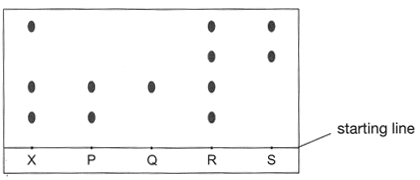
The diagram below shows a chromatogram obtained when a sample X was analysed together with four other known dyes P, Q, R and S. Dye Q was known to cause cancer. Which of the following dye(s) is/are safe for use?
P only
S only
P and S
P and X
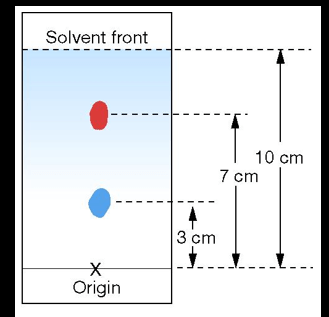
Which technique separates charged particles using electric field?
Hydrolysis
Electrophoresis
Protein synthesis
Protein denaturing
Proteins can be visualized directly in gels by
staining them with the dye
using electron microscope only
measuring their molecular weight
none of these
In isoelectric focusing, proteins are separated on the basis of their
relative content of positively charged residue only
relative content of negatively charged residue only
size
relative content of positively and negatively charged residue

A student performed a gel electrophoresis experiment. The results are represented in the diagram
below. Compared to the fragments at the top of the gel, the fragments at the lower end are
larger, and move slower
larger, and move faster
smaller, and move faster
smaller, and move slower

Consider the production of 2-chloro-2-methylpropane in the following reaction:
(CH3)3COH + HCl --> (CH3)3CCl + H2O
What is the atom economy for the above reaction?
(Relative atomic masses: H = 1.0, C = 12.0, O = 16.0, Cl = 35.5)
50.0%
67.0%
83.7%
95.0%
Which of the following types of reaction has the greatest value of atom economy?
Substitution
Addition
Elimination
Condensation
Which of the following are sources of biomass to replace natural gas as the feedstock of many industrial processes?
(1) Seaweed from large-scale farming
(2) Waste paper from schools and offices
(3) Methane gas from landfill sites
(1) and (2) only
(1) and (3) only
(2) and (3) only
(1), (2) and (3)
24 grams of CH4 was added to the above reaction. Calculate the theoretical yield of CO2.
When reacting Na with Cl2, we calculated that the theoretical yield should be 13 grams. Our actual yield was 12.5 grams. What is the percent yield?
90.4%
104%
96.15%
1.04%
The reaction of 25.0 g benzene, C6H6, with excess HNO3 resulted in 21.4 g C6H5NO2. What is the percentage yield?
C6H6 + HNO3 → C6H5NO2 + H2O
100%
27.39%
54.29%
85.62%

