
 Worksheets
Revision Redox aftermidterm M5
Total questions: 192
Worksheet time: 4hrs 55mins
Which formula describes correctly potassium iodide?
PI
PI2
KI
KI2

A
B
C
D
What is Oxidation?
A reduction reaction where a metal loses oxygen
A redox reaction where a metal loses oxygen
A reduction reaction where a metal gains oxygen
A redox reaction where a metal gains oxygen

Which factors increase the rate of a reaction?
increasing temperature
increasing concentration
increasing total surface area
All of these
Which reaction does not show a redox reaction?
2KBr + F2 → 2KF + Br2
C2H4 + H2 → C2H6
Na2O + 2HCl → 2NaCl + H2O
H2SO4 + Mg → MgSO4 + H2
Ali has an iron ring. He wants to make the ring more beautiful and durable to give his friends as a present. What is the best way to do it?
Ali mempunyai sebentuk cincin besi. Dia ingin menjadikan cincin itu lebih cantik dan tahan lama untuk dihadiahkan kepada rakannya. Apakah langkah yang paling baik dilakukan?
Dip the ring in acid
Mencelup cincin dalam acid
Wash the ring with detergent
Mencuci cincin dengan detegen
Plate the ring with silver
Menyadur cincin dengan argentum
Brush the ring with glossy material
Memberus cincin dengan bahan pengilat
Sodium hydroxide reacts with Sulfuric Acid to make what?
Sulfuric Hydroxide
Sodium Sulfate
Sodium Hydroxide
Sulfuric Sodium
What is characteristic to ionic compounds?
Low melting and boiling points
High melting and boiling points
Softness
Electrical conductivity in solid state

In the reactions
Sn+2 + 2Fe+3 → Sn+4 + 2Fe+2
the oxidizing agent is
Sn+4
Sn+2
Fe+3
Fe+2
Choose all the statements which are correct for an oxidising agent.
HINT: (More than one answer)
removes hydrogen
gains oxygen
is reduced at the end of the reaction
accepts electrons
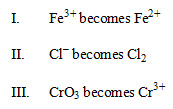
Which are examples of reduction?
I and II
I and III
II and III
I, II and III
Substance that oxidizes another substance by accepting its electrons.
reducing agent
oxidation number
combustion
oxidizing agent
Defined as the loss of electrons.
oxidation
reduction
redox
OIL RIG
In a redox reaction, the oxidizing agent
gains electrons and is oxidized
loses electrons and is oxidized
loses electrons and is reduced
gains electrons and is reduced
Cr2O72-?
What is the oxidation state of Cl in ClO- ?
0
+1
-1
+2
What is the oxidation state of H in H2?
+2
+1
0
None of the above
What is the oxidation state of Pb in PbO ?
+2
+4
0
-2
C in CO32-?
-4
+2
0
+4
S in HSO4- ?
+5
-6
+6
+2
H in NaH ?
+1
0
-1
None of the above
How many valence electrons do elements in Group 15 have?
15
5
4
How many electrons are required to fill the outer shell for elements in Group 15
15
3
5
How many valence electrons do elements in Group 13 have?
13
5
3
How many valence electrons do elements in Group 1 have?
7
10
1
How many valence electrons are required to fill the outer shell for elements in Group 17?
17
1
7
How many valence electrons do most elements in Group 18 have?
18
8
2
What is the charge, or oxidation number, for elements in Group 17?
+ 1
-7
-1
What is the charge, or oxidation number, for elements in Group 2?
-2
+2
-3
What is the charge, or oxidation number, for elements in Group 13?
+ 3
-5
+13
What is the charge, or oxidation number, for elements in Group 14?
14
+4/-4
-16
Cr2O72-?
S in HSO4- ?
+5
-6
+6
+2
Calcium has an oxidation number of +1 only. ( True/False )
True
False
In the following compound, KMnO4, the oxidation number for manganese is 7+. ( True/False )
True
False
The oxidation number of a free element is zero. ( True/False )
True
False
Choose the oxidation number of N in NO.
-1
+1
-2
+2
What are the two ions of iron?
Fe2+, Fe3+
Fe+, Fe2+
Fe2+, Fe4+
What are the two ions of copper?
Cu2+, Cu3+
Cu+, Cu2+
Cu2+, `Cu4+
What are the two ions of lead?
Pb2+, Pb3+
Pb+, Pb2+
Pb2+, Pb4+
Choose the oxidation number for the element zinc
one
two
zero
three
Choose the oxidation number for the element zinc
one
two
zero
three
What are the oxidation states of nitrogen in the compounds NO, NO2, N2O3, N2O4 and N2O5 respectively?
+1, +2, +3, +4, +5
+2, +4, +3, +8, +5
+2, +4, +3, +4, +5
+2, +2, +6, +4, +5
+1, +4, +3, +8, +5
Choose the oxidation number of H in HCl.
+1
-1
+2
-2
Identify the oxidation number of iodine in IO3-
+5
+2
+6
+7
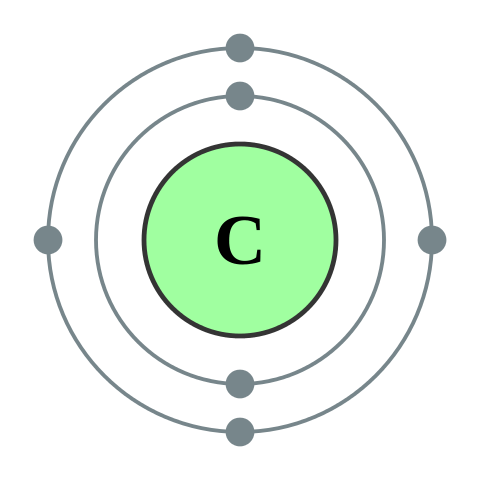
How many valence electrons does carbon have?
4
5
6
7
USE THE PERIODIC TABLE
How many valence electrons does Phosphorus have?
31
5
15
4


This could be the dot diagram of
Mg
Cl
C
O
How many valence electrons does Germanium (Ge) have?
32
4
14
2
How many valence electrons does Selenium (Se) have?
6
16
79
34
Which of the following is a correct electron dot structure?


Which of the following is the correct electron dot structure for nitrogen?








I
H
S
O
2Ca(s) + O2(g) --> 2CaO(s), calcium is __________
which element, if any, is oxidized?
4Fe + 3O2 --> 2Fe2O3
2CaO--> 2Ca + O2
During the process of reduction, _________________
protons are lost.
protons are gained.
electrons are lost.
electrons are gained
neutrons are lost.
The change of I‾ to I2 is ________________
oxidation
reduction
neutralization
Decomposition
Combustion
What is the oxidation number of Nitrogen in HNO3
-7
-5
+5
+7
+2
Find the oxidation number of S in S2O4 2-
+3
+6
-6
-3
-4
Determine the oxidation number of the selected element in each ion/ compound.
a) N in N2O4
b) Cr in CrO4 2-
c) I in IO3-
+8, -6, +5
+2, +8, +6
+4, +6, +5
-4, -6, -5
-4, -8, -6
Identify the species reduced in the following reaction.
Fe(s) + 2 Ag+(aq) → Fe2+(aq) + 2 Ag(s)
Fe
Ag
none of these
None of the above
The below reaction is an example of _________reaction.
F2 → 2 F- + 2 e-
Oxidation
Reduction
Neutralization
decomposition
combustion
What is the oxidation number of: Br2?
-1
+1
-2
0
What is the oxidation number of Sr+2?
-2
0
+2
+1

Which of the following would be considered oxidized in the following reaction:
2 Li + ZnCl2→ 2 LiCl + Zn
Li
Zn
Cl
None of the elements were oxidized
Combustion and single-replacement reactions are __________ redox reactions.
always
never
sometimes
mostly
_____________ synthesis and decomposition reactions involve the transfer of electrons.
All
Most
No
Some
Defined as the loss of electrons.
oxidation
reduction
redox
OIL RIG
Cl2 + 2e- --> 2Cl - is an example of:
a chemical reaction
redox
oxidation
reduction
These keep track of the movement of electrons.
(+) and (-) signs
oxidation numbers
coefficients
subscripts
Substance that oxidizes another substance by accepting its electrons.
reducing agent
oxidation number
combustion
oxidizing agent
What is a half-reaction of this equation, Na + Cl --> NaCl ?
Cl + e- --> Cl-
Cl - e- --> Cl-
Na --> Na + e-
Na° + Cl°--> Na+1Cl-1
What is the reducing agent here: N2 + 3H2 --> 2NH3
N2
H2
NH3
2NH3
Which one of the following conversions is an example of reduction?
Copper (II) oxide to copper (II) sulfate
Copper (II) oxide to copper
Hydrochloric acid to chlorine
Lead (II) nitrate to lead (II) chloride
The ionic equation shows the reaction between zinc (Zn) and hydrochloric acid.
Zn + 2H+ -> Zn2+ + H2
What change takes place in the zinc?
It gains electrons
Its oxidation state increases
It is reduced
It gains hydrogen
When a gas changes iron (III) oxide to iron (II) oxide, it shows that the gas is
a reducing agent
an oxidizing agent
a combustible gas
a diffusible gas
Choose all the statements which are correct for an oxidising agent.
removes hydrogen
gains oxygen
is reduced at the end of the reaction
accepts electrons
In the reaction, Fe2O3(s) + 3CO(g) → 2Fe(l) + 3CO2(g)
carbon monoxide is reduced
carbon monoxide is the oxidising agent
iron(III) oxide is oxidised
iron(III) oxide is the oxidising agent
Name the oxidising agent in the following reaction:
nitrogen + hydrogen -> ammonia
nitrogen
hydrogen
ammonia
State the reducing agent in this reaction.
Cu + 4HNO3 -> Cu(NO3)2 + 2H2O + 2NO2
Cu
HNO3
Cu(NO3)2
NO2
Which one below is redox reaction?
CaCO3+2HCl⟶CaCl2+CO2+H2O
CaO+H2O⟶Ca(OH)2
SO2+2H2S⟶3S+2H2O
NaCl+AgNO3⟶AgCl+NaNO3
Cl2 + 2e- --> 2Cl - is an example of:
a chemical reaction
redox
oxidation
reduction
A decrease in oxidation number.
concentrated
reduction
oxidation
dilute
An increase in oxidation number.
more acidic
reduction
less basic
oxidation
What is a half-reaction of this equation, Na + Cl --> NaCl ?
Cl + e- --> Cl-
Cl - e- --> Cl-
Na --> Na + e-
Na° + Cl°--> Na+1Cl-1
Mg → Mg2+ + 2e–
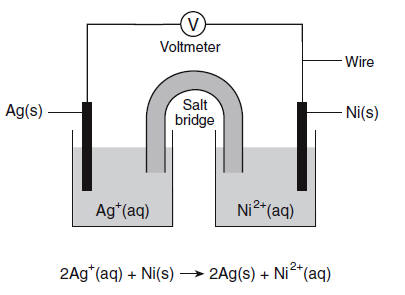
2Al(s) + 6H+(aq) −−−> 2Al3+ (aq) + 3H2(g)
2Al(s) + 6H+(aq) −−−> 2Al3+ (aq) + 3H2(g)
What is a correct half reaction for the following reaction:
3 Ca + N2 ----> Ca3N2
Ca + 3 e- ----> Ca+3
Ca ----> Ca+2 + 2 e-
Ca + 2 e- ----> Ca+2
Ca+2 + 2 e- ----> Ca
What is a correct half reaction for the following reaction:
2 Al + N2 ----> 2 AlN
Al + 3 e- ----> Al+3
N ----> N+2 + 2 e-
Al+3 + 3 e- ----> Al
N + 3 e- ----> N-3
What is oxidation?
A reaction involving oxygen
A reaction involving non-metals
The process of losing the electron is called Oxidation
An Oxidizing agent is the one that losing the electron
The process of receiving the electron is called Reduction
Cu + O2 ---> 2 CuO
Na + Cl ----> NaCl
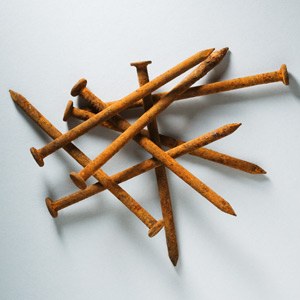
Name the two general classifications of corrosion.
Direct chemical attack and Electrochemical attack.
Fretting corrosion and Galvanic attack.
Rusting is a _____________ process.
Mechanical
Chemical
Physical
Rusting is a special term, given to the corrosion metal is... .
Au
Pt
Fe
Ag
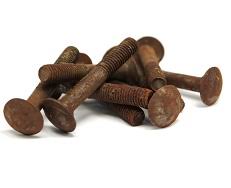
What two things cause Iron to Rust ?
Air and Oxygen
Oxygen and Water
Water and Carbon dioxide
Carbon dioxide and Air
What is the chemical name given to Rust ?
Iron dioxide
Steel oxide
Iron oxide
Carbon dioxide
Rusting can be prevented by
Alloying
Painting
Covering with other fast reactive metal
All of above
two types of Noble metals
gold and platinum
iron and copper
stainless steel and aluminum
tin and brass
Hydrocarbon fuel + oxygen ----> ___+____
(Select 2)
CO2
O2
H2O
C2H4

What conditions are required for rusting?
water only
oxygen only
water and oxygen
Combustion is a
Natural process
Chemical process
Physical process
None of these processes

What is the chemical nature of rust?
iron (II) oxide
hydrated iron (II) oxide
iron (III) oxide
hydrated iron(III) oxide
The following metals would protect iron by electrons flowing to the iron is ... .
Silver
Gold
Copper
Magnesium
For explaining dry corrosion of iron metal, which one of the following is necessary?
Chlorine
Hydrogen
Oxygen
sulphur
Which of the following is an example of corrosion?
Rusting of iron
Tarnishing of silver
Both
None
Corrosion is an example of
Oxidation
Erosion
Electrolysis
Reduction
Which of the following is / are examples of sacrificial protection against rusting?
Iron object coated with tin
Underground iron pipes connected to magnesium bars
Iron railings coated with paint
Which of the following is / are examples of sacrificial protection against rusting?
(1) Iron object coated with tin
(2) Underground iron pipes connected to magnesium bars
(3) Iron railings coated with paint
(1) only
(2) only
(1) and (3) only
(2) and (3) only
Corrosion of metals is fairly high in one of the following mediums.
Acidic
Alkaline
Neutral
Nonaqueous
Metals do not exist in nature in the form of ___________.
Nitrates
Sulphates
Carbonates
Oxides
Due to corrosion, useful properties of metals such as malleability, ductility and electrical conductivity are lost.
Yes
No
Steel is ... than iron
stronger
weaker

Steel which doesn't rust is called...
stainless steel
rust-free steel
All alloys are mixtures.
True
False
Rusting can be prevented by?
Removing paint
Adding water
keeping air (oxygen) away
All of the above
A use of pure iron is ...
There are very few uses
Car bodies
Construction
Cutlery
What do metals conduct well?
heat
electricity
circulation
music

All metal elements melt at the same boiling point.
True
False

What can act as an insulator, preventing the movement, of electricity?
glass
wood
rubber
copper

