
 Worksheets
Periodic Table Practice
Total questions: 192
Worksheet time: 4hrs 50mins
Which scientist edited the Periodic Table and arranged elements in increased atomic number?
Rutherford
Dalton
Mendeleev
Moseley
Which scientist created the Periodic Table and arranged elements in increasing atomic mass?
Rutherford
Thomson
Mendeleev
Moseley
Elements in the same group or family have _____________.
the same number of valence electrons and different properties.
the same number of valence electrons and similar properties
different number of valence electrons and similar properties.
different number of valence electrons and different properties.
Which class of elements are malleable, ductile, shiny when clean and polished, good conductors of heat and electricity, and reacts with acids to form hydrogen gas?
metals
nonmetals
metalloids
ions
What is the name of Group 1 elements?
Alkali Metals
Alkaline Earth Metals
Transition Metals
Halogens
What is the name of the elements that are unreactive and have a full octet?
Halogens
Noble Gases
Alkali Metals
Transition Metals
What is an atom or bonded group of atoms that has a positive or negative charge?
ion
atom
metal
nonmetal
What is the term of an atom that will lose electron(s) and have a positive change?
cation
anion
electronegativity
ionic radius
The Halogen group has an oxidation number of -1. Why?
The Halogen group will gain one electron, therefore have an oxidation number of -1.
The Halogen group will lose one electron, therefore have an oxidation number of -1.
The Halogen group will lose seven electrons, therefore have an oxidation number of -1.
What is the trend for atomic radius (radii)?
It increases left to right on the Periodic Table and decreases down a group.
It decreases left to right on the Periodic Table and increases down a group.
It increases left to right on the Periodic Table and increases down a group.
It decreases right to left on the Periodic Table and decreases down a group.
Which element has the smallest atomic radius?
magnesium
chlorine
bromine
argon
What is the trend for ionization energy?
Across a period (left to right) it increases and down a group it decreases.
Across a period (left to right) it decreases and down a group it increases.
Across a period (left to right) it decreases and down a group it decreases.
Across a period (left to right) it increases and down a group it increases.
What is ionization energy?
The energy required to remove an electron from a neutral atom of an element.
The energy change that occurs when an electron is acquired by a neutral atom.
The measure of the ability of an atom in a chemical compound to attract electrons from another atom in the compound.
How close an atom is to its neighboring atom.
Which element has the highest ionization energy?
oxygen
sulfur
silicon
potassium
What is the ability of an atom in a chemical compound to attract electrons from another atom in the compound?
ionization energy
electronegativity
atomic radius
electron affinity
Which element has the largest electronegativity?
barium
oxygen
iron
lithium

Mendeleev was the first person to arrange the elements into a table. How did he arrange the rows?
Which of the following will have similar properties?
O, S, Se
O, F, Ne
N, Ne, Na
H, K, P
Moseley arranged what we know as the "modern periodic table". How did he arrange it?
atomic mass
atomic number
valence electrons
number of isotopes


How many periods are on the periodic table?
5
6
7
8
Elements in the same group have : (2 correct answers)
Similar chemical properties
Similar names
Same number of outer (valence) electrons)
The same number of protons
Name this group: These metals contain familiar metals such as gold, iron, and copper.


Find an element with similar chemical properties to Barium (Ba).
Ca an Ra, because they are in the same group and have similar chemical properties.
Cs and La, b/c they are in the same period number.
Ca and Y, b/c they are 90 degree angle and have similiar properties.

The blue elements (left side) are called
The yellow elements (right side) are called

What do the periods (rows) represent?
an additional energy level
an additional proton
an additional group
an additional electron
Put the groups of the periodic table in order from group 1A to group 8A (18).
alkali metals
alkaline earth metals
halogens
noble gases
Match the following elements to the group they belong to.
sodium
alkali metal
calcium
alkaline earth metal
chlorine
halogen
argon
noble gas
lithium
2 energy levels
helium
1 energy level
aluminum
3 energy levels
bromine
4 energy levels
strontium
5 energy levels
Mendeleev & Moseley both organized the columns (groups) by...
mass
number
symbol
properties
Element symbols have _____ capital letter(s).
1
2
3
4
Compound formulas have ____ capital letter(s).
1
2
3
more than 1
What is the name of group number 1?
halogens
noble gases
alkali metals
alkaline earth metals
What is the name of group number 2?
transition metals
halogens
metaloids
alkaline earth metals
where are the metaloids found
far left, vertical
stair step/diagonal
far right horizontal
at the bottom
What group number are the halogens found?
18 (8A)
1
2
17 (7A)
Periodic law states that the elements are arranged according to their atomic ________ so that elements with similar chemical properties are in the same ________ and properties repeat periodically.
numbers, rows
masses, rows
masses, column
numbers, column
A grouping of elements based on similar chemical properties, arranged by columns in the periodic table; also known as a group
family
period
row
isotope
A row on the Periodic Table of Elements
family
period
row
isotope
Metals (select all that apply)
are found on the right side of the periodic table.
are found on the left side of the periodic table.
are good conductors of heat and electricity.
are brittle.
are malleable and ductile.
Nonmetals (select all that apply)
are found on the right side of the periodic table.
are found on the left side of the periodic table.
are good conductors of heat and electricity.
are brittle.
can be solid, liquids, or gases at room temperature.

Which element is found in group 2, period 6?
Oxygen (O)
Barium (Ba)
Selenium (Se)
Carbon (C)
Which halogen is found in period 4?
Krypton (Kr)
Xenon (Xe)
Bromine (Br)
Iodine (I)
Which element has similar chemical properties as sodium but has 7 energy levels?
Francium (Fr)
Cesium (Cs)
Rubidium (Rb)
Potassium (K)
Elements that have the same number of energy levels are said to be in the same ______.
group
period
family
classification
What is the name of group number 1?
halogens
noble gases
alkali metals
alkaline earth metals
What is the name of group number 2?
transition metals
halogens
metaloids
alkaline earth metals
where are the metaloids found
far left, vertical
stair step/diagonal
far right horizontal
at the bottom
What group number are the halogens found?
18 (8A)
1
2
17 (7A)
Periodic law states that the elements are arranged according to their atomic ________ so that elements with similar chemical properties are in the same ________ and properties repeat periodically.
numbers, rows
masses, rows
masses, column
numbers, column
A grouping of elements based on similar chemical properties, arranged by columns in the periodic table; also known as a group
family
period
row
isotope
A row on the Periodic Table of Elements
family
period
row
isotope
Metals (select all that apply)
are found on the right side of the periodic table.
are found on the left side of the periodic table.
are good conductors of heat and electricity.
are brittle.
are malleable and ductile.
Nonmetals (select all that apply)
are found on the right side of the periodic table.
are found on the left side of the periodic table.
are good conductors of heat and electricity.
are brittle.
can be solid, liquids, or gases at room temperature.
Which element is found in group 2, period 6?
Oxygen (O)
Barium (Ba)
Selenium (Se)
Carbon (C)
Which halogen is found in period 4?
Krypton (Kr)
Xenon (Xe)
Bromine (Br)
Iodine (I)
Which element has similar chemical properties as sodium but has 7 energy levels?
Francium (Fr)
Cesium (Cs)
Rubidium (Rb)
Potassium (K)
Elements that have the same number of energy levels are said to be in the same ______.
group
period
family
classification


I am usually a good conductor and shiny/lustrous
Metal
Metalloid
Non-metal
I am usually a gas, and at the very right side of the periodic table of elements
Metal
Metalloid
Non-metal
I am Chlorine many electrons to I need to be complete?
8
7
1
0
Potassium has 1 valence electron, would it rather gain 7 electrons or lose its one valence electron to complete its energy level?
lose 1 electron
gain 1 electron
lose 7 electrons
gain 7 electrons
Lewis Dot Structure shows us the..
Energy Levels of electrons
Valence electrons
number of protons
total number of electrons
Match the following term to its description
ion
different number of electrons
isotope
different number of neutrons
different element
different number of protons
Name of Elements in found in group 2
alkali metals
alkali earth metals
transition metals
noble gases
halogens
________ created the first periodic table.
Moseley
Mendeleev
Newton
Dewey
Ionization energy is needed to ___________ valence electrons
remove
add
create
destroy
On the current periodic table, elements are arranged by ------
increasing atomic mass
increasing atomic number
decreasing atomic mass
decreasing atomic number
Name of Elements in found in group 17
alkali metals
alkali earth metals
transition metals
noble gases
halogens
Which element has the highest electronegativity and most ionization energy?
F
Fe
Fr
Fl
Name of Elements in found in the d block
inner transition metals
alkali earth metals
transition metals
noble gases
halogens
Which element has the largest atomic size?
F
Fe
Fr
Fl
Location of protons and neutrons in atom
nucleus
electron cloud
both of these
neither of these
Which element does not belong in Group 1?
Li
Fr
H
K
Na
Match the following term to its description
atomic mass
sum of protons + neutrons
atomic number
# of protons only
proton
has a positive charge
electron
has a negative charge
neutron
has neutral (no) charge
On the first periodic table, elements were arranged by ------
increasing atomic mass
increasing atomic number
decreasing atomic mass
decreasing atomic number
N or C?
Cl or Al?
N or C?
H or F?
The element with the lowest electronegativity in Period 3 is -
Na
Cl
Ar
Mg

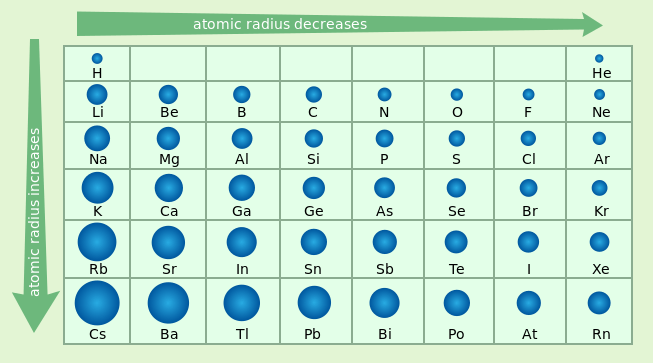


F, N, B


carbon, aluminum, oxygen, phosphorus.
Not sure? check out page 151 in your textbook
Of the halogens, which has the smallest radius?
F
Br
He
At
Which of the following will have a lower ionization energy than Scandium (Sc)?
Helium (He)
Titanium (Ti)
Calcium (Ca)
Magnesium (Mg)
Which of the following will have a higher electronegativity than arsenic (As)?
Carbon (C)
Neon (Ne)
Antimony (Sb)
Germanium (Ge)

Which of the following halogens has the greatest electronegativity?
Chlorine (Cl)
Bromine (Br)
Iodine (I)
Astatine (At)

Which group of elements has the lowest ionization energies?
Alkali Metals (Group 1)
Alkaline Earth Metals (Group 2)
Halogens (Group 17)
Noble Gases (Group 18)

What is the amount of energy required to remove an electron from an atom?
atomic energy
ionization energy
ionic energy
electron energy

What is one-half the distance between the nuclei of identical atoms that are bonded together?
atomic radius
atomic diameter
atomic width
atomic length

What is a measure of the tendency of an atom to attract a bonding pair of electrons when the atom is in a compound?
ionization energy
electropositivity
electronegativity
electron energy

What is a positively-charged ion which forms when an atom loses electrons?
atom
ion
cation
anion

What is a negatively-charged ion which forms when an atom gains electrons?
cation
anion
electron
ion

What is a vertical (up and down) column in the periodic table?
group or family
period
periodic law
octet rule

