
 Worksheets
j
Total questions: 51
Worksheet time: 32mins
What are the laws of refraction? Choose all that apply.
the incident ray, reflected ray, and, refracted ray at the point of incidence all lie in the same plane
The incident ray, refracted ray, and, the normal at the point of incidence all lie in the same plane
The ratio of the sine of the angle 'i' to the sine of angle 'r' is a constant for any given pair of media
the ratio of the cosine of angle 'i' to the cosine of angle 'r' is a constant for any given pair of media
When light gets refracted form a denser to a rarer medium, the speed of light:
Decreases
Increases
remains the same
comes to a stop
When light gets refracted from a rarer to a denser medium the speed of light:
Remains the same
Increases
Decreases
Stops
What happens to the frequency of light moving from one medium to another?
No change
Decreases
Increases
B or C depending on the refractive index of the medium
The wavelength of light on passing from one medium to another:
Denser to rarer- increases; rarer to denser- decreases
Denser to rarer- decreases; rarer to denser- increases
Denser to rarer- no changer; rarer to denser- decreases
Denser to rarer- increases; rarer to denser- no change
Under what conditions does a light ray pass undeviated during refraction? Choose all that apply.
When the angle of incidence at the boundary of the two media is equal to zero
When the refractive indices of the given media are the same
When the angle of incidence is equal to the critical angle
When the refractive index of medium one is less than medium two
The speed of light in air and its refractive index is:
3*10^8 m/s, 9.02
3*10^8 m/s, 8.81
3*10^8 m/s, 1.0003
3*10^7 m/s, 2.23
The speed of light in vacuum and its refractive index is:
3*10^8 m/s, 1
3*10^8 m/s, 66
3*10^8 m/s, 2.9
3*10^4 m/s, 1
The speed of light in water and its refractive index is:
2.25*10^8 m/s, 1.6
2.25*10^8 m/s, 16
2.29*10^8 m/s, 166
2.25*10^8 m/s, 1.33
The speed of light in glass and its refractive index is:
2*10^8 m/s, 3
2*10^8 m/s, 8.9
2*10^8 m/s, 1.5
2*10^16 m/s, 1.5
The speed of light in diamond and its refractive index:
1.25*10^8 m/s, 2.41
1.25*10^8 m/s, 3.24
1.25*10^8 m/s, 7.1
1.25*10^9 m/s, 4.1
What is lateral displacement?
When the emergent ray's angle of emergence is equal to the angle of incidence but is parallel to it, not on the same line
When the incident ray gets displaced and comes out of the block at an angle of emergence = 90°
When the incident ray gets displaced in the block and traces its path back, but parallel to the original ray
Which one of the following is a factor that DOES NOT affect the angle of deviation in a prism?
Wavelength of light
Angle of incidence
The refractive index of the prism
Speed of light
s
Which of these is the correct formula for refractive index?
real depth/ aparent depth
apparent depth / real depth
shift/ real depth
apparent depth. shift
The refractive index of glass with respect to air is 1.5. What is the refractive index of air with respect to glass?
8/9
2/3
1/2
3/2
What is the relationship between the angle of incidence and the angle of refraction for a given pair of media?
n1 sin θ1 = n2 sin θ2
c/V= μ
V/f= λ
real depth/ apparent depth= μ
A coin placed at the bottom of a beaker appears to be raised by 4cm. I the refractive index of water is 4/3, find the depth of the water in the beaker.
21cm
32cm
16cm
12cm
A postage stamp appears to be raised by 7mm when placed under a rectangular glass block of refractive index 3/2. Find the thickness of the glass block.
21mm
17mm
16mm
19mm
The velocity of light in a diamond is 121000 kms/s. What is its refractive index? ( take the speed of light= 3* 10^8 m/s
2.48
3.31
1.96
2.24
What are partial reflection and refraction?
when light strikes a medium obliquely, part of the light goes back in the same medium, and the other travels in a straight line in a different direction through the new medium
when light strikes a medium normally, part of the light goes back in the same medium, and the other travels in a straight line in a different direction through the new medium
when light strikes a medium obliquely, all of the light gets refracted
when light strikes a medium obliquely, all of the light gets reflected
The velocity of light in a diamond is 121000 kms/s. What is its refractive index? ( take the speed of light= 3* 10^8 m/s
2.48
3.31
1.96
2.24
What are partial reflection and refraction?
when light strikes a medium obliquely, part of the light goes back in the same medium, and the other travels in a straight line in a different direction through the new medium
when light strikes a medium normally, part of the light goes back in the same medium, and the other travels in a straight line in a different direction through the new medium
when light strikes a medium obliquely, all of the light gets refracted
when light strikes a medium obliquely, all of the light gets reflected

"Light ray's always travel between two points in a path which needs the shortest possible time to cover" : This is_______
Fermi principle
Fermat's principle

When a thick glass slab is placed over some printed letters, the letters appear __________ when viewed through the glass slab.
Raised
Lowered

The process of changing speed at the interface when light travels from one medium to another resulting in a change in the direction of light is called __________
Refraction
Reflection

During refraction change in direction of light is due to change in the __________of light in the medium
Speed
Frequency

Lights travels in vacuum with a speed nearly equal to ___________(denoted by letter 'c')
3 ×10 8 m/s
343.2 m/s

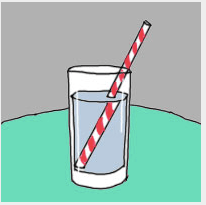
Why does the straw appear to be bent?
light is reflected
light is absorbed
light is turned
light is refracted
What do we call a material that light can travel through?
air
water
medium
pathway
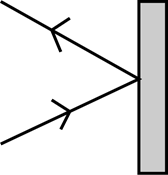
In the illustration, the light ray striking the object is-
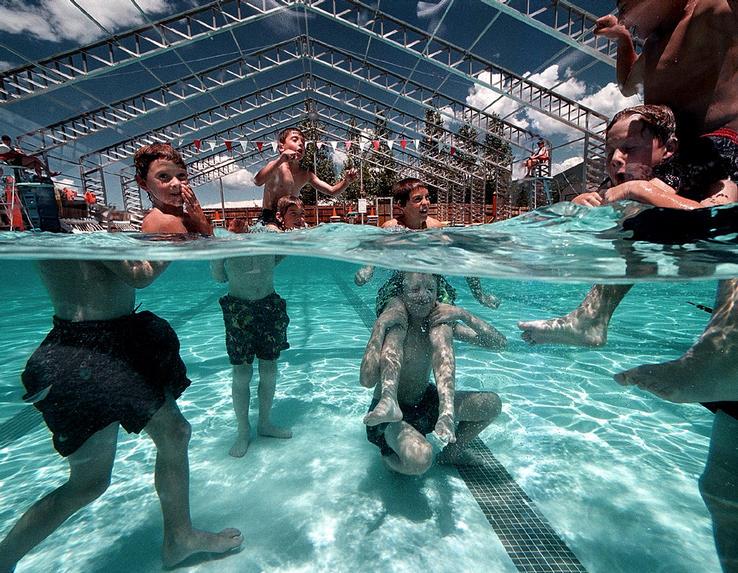
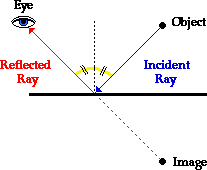
What is the angle of reflection equal to?
The angle of refraction
The angle of incidence
The angle of absorption
The angle of light
flint glass n=1.70
barium glass n=1.60
crown glass n=1.523
water n=1.33
diamond n=2.45
flint glass n=1.70
barium glass n=1.60
crown glass n=1.523
water n=1.33
diamond n=2.45


diamond n=2.45
flint glass n=1.70
barium glass n=1.60
crown glass n=1.523

