
 Worksheets
Earth History Review
Total questions: 50
Worksheet time: 40mins
Which of these is not related to the geologic time scale?
Eon
Era
Period
Century
Which of these is the longest time?
Eon
Era
Period
Epoch
How old is the Earth?
4.6 Billion Years Old
4.6 Million Years Old
1 Billion Years Old
2020 Years Old
Which type of fossil is used to date other fossils and rocks?
Cast
Preserved
Carbonized
Index
Which statement is an example of absolute age?
this fossil is the same age as that fossil
that fossil is 65,000 years old
Layer A is the oldest
my son is older than my daughter
What are fossilized organisms that lived only during a very specific time period and are found on multiple continents that are used to help date other fossils.
trilobites
trace fossils
index fossils
transitional fossils

Which fossil in the layers above would make the best index fossil?
D
A
B
C
Which is the correct order of era's from oldest to youngest.
Pre-Cambrian, Paleozoic, Mesozoic, Cenozoic
Cenozoic, Pre-Cambrian, Mesozoic, Cenozoic
Pre-Cambrian, Mesozoic, Cenozoic, Paleozoic
Paleozoic, Pre-Cambrian, Cenozoic, Mesozoic

Scientists know the Nautilus lived between 56 and 200 million years ago. What could you predict about the age of the snail based on this information.
The "snail" also lived between 56 and 200 million years
The "snail" could have lived about 50 million years ago
The "snail" could have lived about 150 million years ago.
The "snail" is older than the "Nautilus"

What is the correct order of events from oldest to most recent?
B,C,D,A,E
A,B,D,C,E
C,D,B,E,A
B,D,A,E,C


In this rock layer diagram there is a fault at E and an intrusion at D. Which occurred first? How do you know?

Look at the diagram, what layer did animal E first show up in?
Layers #4
Layers #5
Layers #6
Layers #8

Which statement best describes the Law of Superposition?
Each sedimentary layer of rock represents 1,000 years of Earth's age, much like the rings of a tree
In undisturbed layers of sedimentary rock, the lowest layers contain the older rocks
In undisturbed layers of sedimentary rocks, the upper rock layers are older than the lower rock layers
Rocks that form near volcanoes are older than the surrounding rock.
How do scientists know that some mountains were once at the bottom of an ocean?
Freshwater rivers flow to the ocean
Saltwater fish are found in some mountain streams
Dinosaur bones have been discovered in the mountains
Marine fossils have been found on the peaks of some mountains

Look at the fossils trapped in each strata. During its time, which fossil lived for the longest time? there is an error in this formation, but it doesn't affect your answer.


This red hot rock is a lava flow that originated deep underground and has reached Earth's surface. As it cools, it will harden to form what type of rock?
metamorphic
igneous
sedimentary

What type of rock is formed deep underground from Earth's heat and pressure?
igneous rock
sedimentary rock
metamorphic rock

method of determining the age based on measuring radioactive elements
radioactive dating
relative dating
teenage dating
no dating

Ice core
A long cylinder of ice obtained from drilling through ice caps used to study past climates and atmospheres
broken ice chips that are best used to cool grape soda
atoms that don't move and remain electrons when exposed to nuclear physical changes
a lot of reading. Did you read this one too? Good, cause the answer is all about climates and atmosphere

A technique used to determine the actual age of a fossil
relative dating
absolute dating or radioactive dating
rock layers
index fossils


A scientist finds Trophite fossils. According to the chart above, in what era and period were these rock layers deposited?
Cenozoic Era; Tertiary Period
Mesozoic Era; Triassic Period
Paleozoic Era; Permian Period
Paleozoic Era; Mississippian Period

Scientists have identified four sedimentary rock layers from an archaeological dig as shown above. Which is most likely the oldest sedimentary rock layer?
Layer R
Layer S
Layer T
Layer U

A geologist uncovered a fossil while digging in the side of a hill. He hypothesized that it was MOST likely from the end of the Paleozoic era or the beginning of the Mesozoic era. How old would the fossil have to be dated in order to support his hypothesis?
100 million years old
225 million years old
400 million years old
550 million years old

The figure below shows a wall of the Grand Canyon. The most recent rocks of the Grand Canyon formed during which geologic period?
Permian
Devonian
Cambrian
Precambrian

What is the best scenario from the fossils in the rock layers?
Fossil C came after Fossil A
Fossil B came before Fossil D
Fossil D came before Fossils C,B, and A
Fossil A is the oldest

Place the layers and the fault in order from OLDEST to YOUNGEST.
D, Q, A, Z, L, Fault
Fault, D,Q, A, Z, L
L, Z, A, Fault, Q, D
D, Q, Fault, A, Z, L

What type of event usually marks the end of an Era
A Mass Extinction
A Quinceanera
An earthquake
A Volcanic Eruption
Scientists know the Nautilus lived between 56 and 200 million years ago. What could you predict about the age of the snail based on this information.
The "snail" also lived between 56 and 200 million years
The "snail" could have lived about 50 million years ago
The "snail" could have lived about 150 million years ago.
The "snail" is older than the "Nautilus"

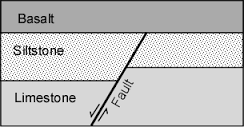

The diagram below represents a stack of rock layers. These layers have not changed position since they formed. If the age of layer 4 is 400 million years and the age of layer 1 is 500 million years, then the age of Layer 2 is
younger than 400 million years.
400 million years.
older than 500 million years.
between 400 million and 500 million years.

Four fossils were discovered in sedimentary rock layers as shown in the table. Which of the following best describes the age of the shell relative to the age of the fish, and the age of the bone?
The shell is older than the fish, and younger than the bone.
The shell is older than the fish, and the same age as the bone.
The shell is younger than the fish, and the same age as the bone.
The shell is the same age as the fish, and younger than the bone.
A geologist uncovered a fossil while digging in the side of a hill. He hypothesized that it was MOST likely from the end of the Paleozoic era or the beginning of the Mesozoic era. How old would the fossil have to be dated in order to support his hypothesis?
100 million years old
225 million years old
400 million years old
550 million years old

This type of fossil provides evidence of the activities of ancient organisms; examples include marks left by footprints or tails
mold
carbon film
trace
cast
Which best describes intrusions in rock layers?
fossil rock
sedimentary rock
metamorphic rock
igneous rock
How do ice cores indicate volcanic eruptions on Earth?
The cores show evidence of repeated melting and freezing
The cores show evidence of being frozen at cooler temperatures
The cores contain evidence of gases and ash
The cores contain evidence of dead animals and vegetation
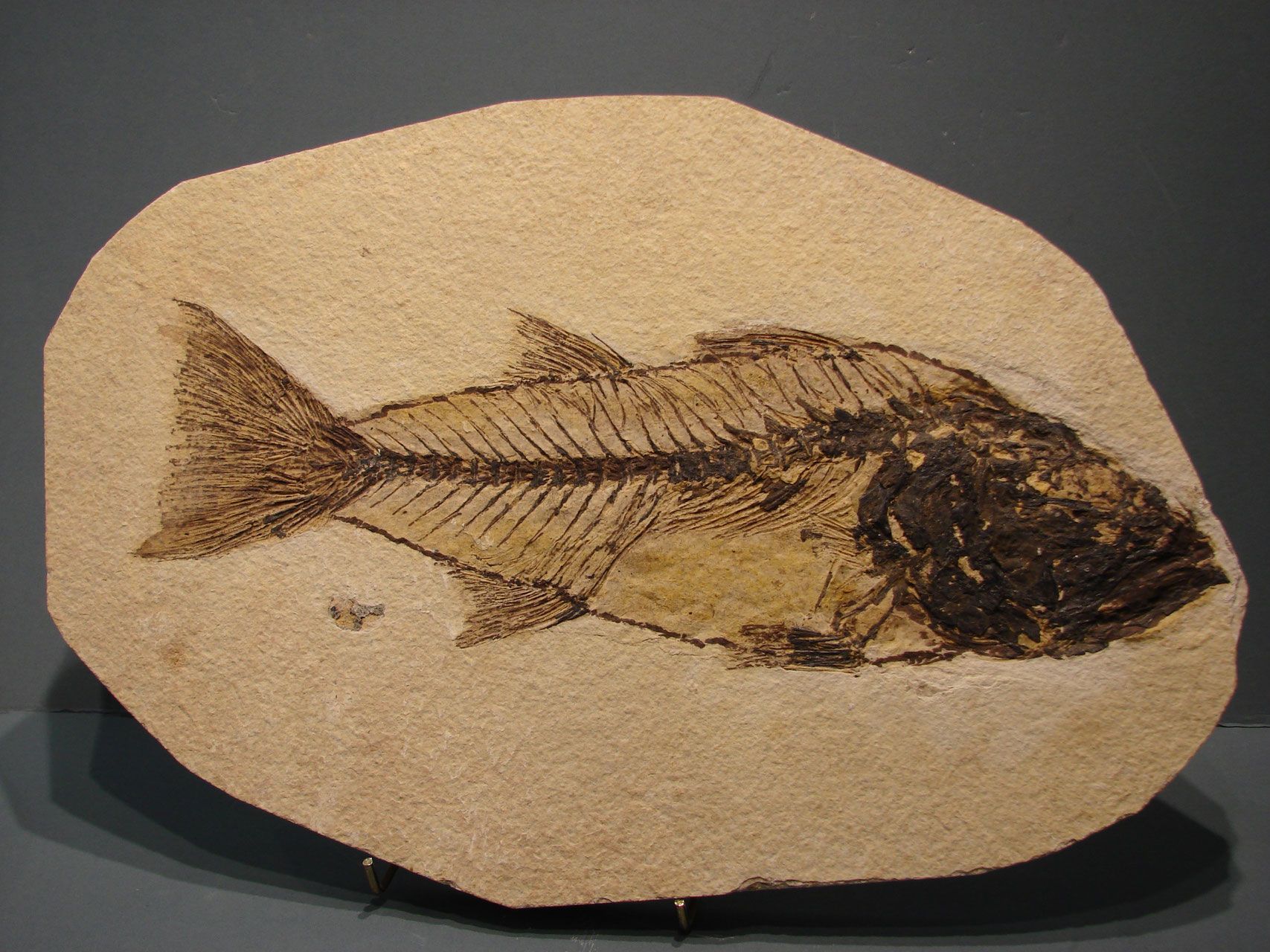
If a scientist found a fish fossil in the desert, what can they infer?
An animal ate the fish.
The water covered the area long ago.
Today's fish looks the same
The fish is endangered.

The diagram below shows two sections of rock layers found several miles apart.
Based upon the information in the diagram, which conclusion can best be made?
The rock layers contained fossils identical to each other.
Rock layers are laid down from the youngest to the oldest.
Rock layers containing similar fossils were formed at the same time.

