
NEW
Font size
 Worksheets
Continental Drift & Plate Tectonics
Total questions: 36
Worksheet time: 39mins

The block diagram represents the formation of an island arc near a plate boundary.
An island arc is located near the boundary between which two tectonic plates?
Antarctic Plate and Indian–Australian Plate
Philippine Plate and Eurasian Plate
African Plate and North American Plate
Scotia Plate and South American Plate
Which statement best supports the theory that all the continents were once a single landmass?
Rocks at ocean ridges are older than those adjacent of the sea floor.
Rock and fossil correlation can be made where the continents appear to fit together.
Marine fossils can be found at high elevations above sea level on all continents.
Great thicknesses of shallow-water sediments are found at interior locations on some continents.
The primary cause of convection currents in the Earth's mantle is believed to be the
differences in densities of Earth materials
subsidence of the crust
occurrence of earthquakes
rotation of the Earth
Which geological feature is composed of the youngest crustal bedrock?
Peru-Chili Trench
Mid-Atlantic Ridge
Adirondack Mountains
San Andreas Fault

Samples of ocean floor bedrock were collected at points A, B, C and D. Which sequence shows the correct order of the age of the bedrock from oldest to youngest?
D>C>B>A
A>D>B>C
C>B>D>A
A>B>D>C
What formed the Hawaiian Islands?
Mantle Hot Spot
Trench
Subduction
Mid-Ocean Ridge
The Hawaiian Islands were formed as a result of
lava flowing over Earth’s surface where two tectonic plates move apart
an oceanic plate moving over a mantle hot spot
two oceanic plates colliding to form an island arc
tectonic plates sliding past each other

Which world map shows the locations where most earthquakes and volcanoes occur on Earth?


Earth’s internal heat is the primary source of energy that
warms the lower troposphere
melts glacial ice at lower altitudes
moves the lithospheric plates
pollutes deep groundwater with radioactivity

The cross section represents a pattern of magnetic field reversals preserved in the igneous bedrock of the oceanic crust east of the Mid-Atlantic ridge.
Which cross section best represents the magnetic field pattern west of the Mid-Atlantic ridge?


Which two features are commonly found at divergent plate boundaries?
mid-ocean ridges and rift valleys
wide valleys and deltas
ocean trenches and subduction zones
hot spots and island arcs
When a continental crustal plate collides with an oceanic crustal plate, the continental crust is forced to move over the oceanic crust. What is the primary reason that the continental crust stays on top of the oceanic crust?
Continental crust is less dense
Continental crust deforms less easily
Continental crust melts at higher temperatures.
Continental crust contains more mafic minerals.
According to tectonic plate maps, New York State is presently located
at a convergent plate boundary
above a mantle hot spot
above a mid-ocean ridge
near the center of a large plate

The map below shows California and a section of the San Andreas Fault.
What is the primary geologic process occurring along the San Andreas Fault?
transform movement
spreading movement
subduction
convergence

Base your answer to the question on the cross section and on your knowledge of Earth science. The cross section represents the distance and age of ocean-floor bedrock found on both sides of the Mid-Atlantic Ridge.


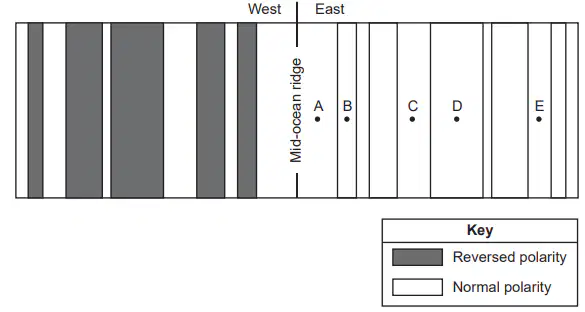
The diagram represents magnetic patterns of normal and reversed polarity of ocean crust on the west side of a mid-ocean ridge. Letters A, B, C, D, and E represent locations on the seafloor on the east side of the mid-ocean ridge.
Which two locations on the east side of the mid-ocean ridge represent areas of reversed magnetic polarity?
A and B
B and D
C and D
E and A
The Mariana Trench is Earth’s deepest oceanic trench. This trench formed as the Pacific Plate was
overriding the Philippine Plate
overriding the Eurasian Plate
subducting under the Philippine Plate
subducting under the Eurasian Plate
Compared to the thickness and density of the continental crust, the relative thickness and density of Earth’s oceanic crust are
thinner and less dense
thinner and more dense
thicker and less dense
thicker and more dense
Compared to the thickness and density of the continental crust, the relative thickness and density of Earth’s oceanic crust are
thinner and less dense
thinner and more dense
thicker and less dense
thicker and more dense

Base your answer to the question on the cross section, which shows the major surface features of Earth along 25° S latitude between 75° W and 15° E longitude. Points A, B, and C represent locations on Earth’s crust.
Bedrock samples were taken at the mid-ocean ridge and points B and C. Which grid below properly shows the relative age of the bedrock samples between these locations?


Which concept states that most sediments are deposited in layers that are flat and parallel to Earth’s surface?
principle of superposition
cross-cutting relationship
dynamic equilibrium
original horizontality

