
NEW
Font size
S
M
L
XL
 Worksheets
Periodic Trends and Bonding
Total questions: 36
Worksheet time: 27mins
Name
Class
Date
1.
As you move down the periodic table atoms get bigger. This is because ____________.
a)
The atoms have more mass.
b)
The atoms have more protons.
c)
The atoms have more energy levels
d)
The atoms have more neutrons
2.
As you move across the periodic table atoms tend to get smaller because, ______________.
a)
the atoms have more mass.
b)
the atoms have less mass
c)
the atoms have more protons.
d)
the atoms have less electrons.
3.
Electronegativity is...
a)
the ability of an atom to attract/ accept electrons
b)
the ability of an atom to lose electrons
c)
the energy required to remove an electron from a specific atom
d)
how easy it is to make friends.
4.
Ionization energy is...
a)
the energy required to add an electron to a specific atom
b)
how much energy it takes to remove an electron from an atom
c)
the energy required to shield the outer electrons from the nucleus
d)
a measure of the ability of an atom to attract electrons
5.
Metals have the largest -
a)
atomic radius and electronegativity
b)
electronegativity and ionization energy
c)
atomic radius only
d)
ionization energy and atomic radius
6.
Which statement correctly and completely identifies a trend?
a)
Atomic radius decreases across a period and increases down a group.
b)
Electronegativity decreases across a period and decreases down a group.
c)
Ionization energy increases across a period and increases down a group.
d)
Ionic radius increases across a period and increases down a group.
7.
A negatively charged subatomic particle that exists in various energy levels outside the nucleus of an atom
a)
neutron
b)
electron
c)
proton
d)
subatomic particle
8.
The chart scientists use to organize and classify all the known elements
a)
elements chart
b)
the chart
c)
Periodic Table of the Elements
d)
Period table
9.
The tendency of an atom to attract electrons and acquire a negative charge
a)
electronegativity
b)
charge
c)
bonding ability
d)
electron configuration
10.
Vertical columns of elements (families) on the periodic table with similar properties
a)
groups
b)
periods
c)
quadrants
d)
rows
11.

What is an ion?
a)
A Charged Atom
b)
A Large Atom
c)
A Small Atom
d)
A Cute Atom
12.

Why are ions formed?
a)
To make our lives difficult
b)
Because atoms want 8 valence electrons
c)
Because atoms have the same number of protons and electrons
d)
Because atoms gained neutrons
13.

An atom becomes _________ when it gains electrons.
a)
Positive
b)
Negative
c)
Neutral
d)
Invinsible
14.
Group 17 always has ions with a charge of
a)
+1
b)
+2
c)
-1
d)
-2
15.
What charge will an Oxygen ion have?
a)
+1
b)
-1
c)
+2
d)
-2
16.
If an element has 3 valence electrons, what charge will likely form on its ion ?
a)
+3
b)
+5
c)
-3
d)
-5
17.

Elements on the LEFT side of the periodic table will most likely form:
a)
Positive ions
b)
Negative ions
c)
Neutral Ions
d)
None of these
18.

Cations are...
a)
Positive
b)
Negative
c)
Neutral
d)
Purring
19.

Anions are...
a)
Positive
b)
Negative
c)
Neutral
d)
Crying
20.

An atom becomes _______ when it loses electrons.
a)
Positive
b)
Negative
c)
Neutral
d)
Invinsible
21.

The positive ions tend to _____________ electrons.
a)
lose
b)
gain
22.
The negative ions tend to _____________ electrons.
a)
lose
b)
gain
23.
Why do all bonds form?
a)
so the number of protons equals the number of electrons
b)
so an atom can become unstable
c)
to fill the outermost energy level
24.
Ionic bonds are between...
a)
Metal and Non-metal
b)
Non-metal and Non-metal
c)
Metal and Metal
25.
How are ionic bonds formed?
a)
Transfer of electrons
b)
Sharing of electrons
26.
Why do elements bond?
a)
To be friends
b)
To create a new element
c)
To become stable
27.
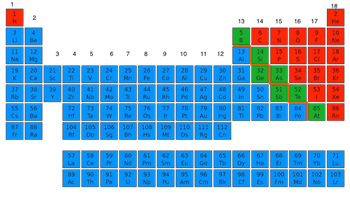
Where are the nonmetals located on the periodic table?
a)
Blue
b)
Red
c)
Green
28.
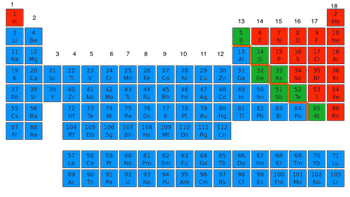
Where are metals located on the periodic table?
a)
Blue
b)
Green
c)
Red
29.

What type of elements form cations?
a)
metals
b)
nonmetals
c)
metalloids?
30.
Is hydrogen considered a metal or a non-metal?
a)
A metal
b)
Nonmetal
c)
Metalloid
31.

Is this ionic bond drawn correctly?
a)
Yes
b)
No
32.
How do covalent bonds form?
a)
Donating & receiving valence e- between atoms.
b)
Opposite slight charges attract each other between compounds.
c)
Scientists are still not sure how they form.
d)
Sharing valence e- between atoms.
33.

What two types of atoms make a covalent bond?
a)
2 Nonmetals
b)
1 Nonmetal and 1 Metal
c)
2 Metals
d)
2 Noble Gases
34.
What do we call a covalent bond where electrons are shared UNEVENLY or UNEQUALLY?
a)
Ionic
b)
Polar Covalent
c)
Nonpolar Covalent
d)
Van der Waals Force
35.
A metallic bond is a bond between ________.
a)
nonmetals
b)
metals
c)
transition metals
d)
metalloids
36.
Which of the following is NOT a property of metals?
a)
Hard
b)
Can conduct electricity
c)
Very brittle (breaks easily)
d)
Malleable (can bend without breaking)
Reset

