
 Worksheets
Unit 3/4 Review
Total questions: 80
Worksheet time: 2hrs 31mins
The------ particle determines the identity of what element you have'
electron
proton
neutron
valence shell
WhIch sub atomic particle vary between isotopes of an element?
protons, electrons, and atomic mass
protons, electrons, and atomic number
neutrons and electrons
neutrons only
What are valence electrons?
electrons on the first orbital always
nucleus
the outermost shell
the number of electrons present in the outermost orbital
If an atom has 15 electrons, 14 protons and 14 neutrons, the it is:
a cation
an anion
a neutral atom
more information is needed
If Ca losses two electrons, it becomes:
Ca2
Ca+
Ca2+
Ca2-
If an atom has 13 protons, 12 electrons and its atomic mass is 27, how many neutrons are there?
14
15
13
12

How many protons does this isotope of titanium have?
22
26
48
70
An element has three isotopes. Given the abundances and relative masses, calculate the average atomic mass and determine (from the periodic table) which element it is.
Abundances | Relative masses
0.005% | 234.04 amu
0.720% | 235.04 amu
99.275% | 238.05 amu
Uranium (#92, Atomic Mass: 238.03 amu)
Fluorine (#9, Atomic Mass: 19.00 amu)
Mercury (#89, Atomic Mass: 200.59 amu)
Polonium (#84 209 amu)


It has no effect on the state or mass of the nucleus.
alpha
beta
gamma
positron
What is the net effect of beta decay during the nuclear reaction of elements?
changes neutron to a proton
changes proton to a neutron
it has no changes at all
increases the mass of the product formed by 4
It has no effect on the state or mass of the nucleus.
alpha
beta
gamma
positron
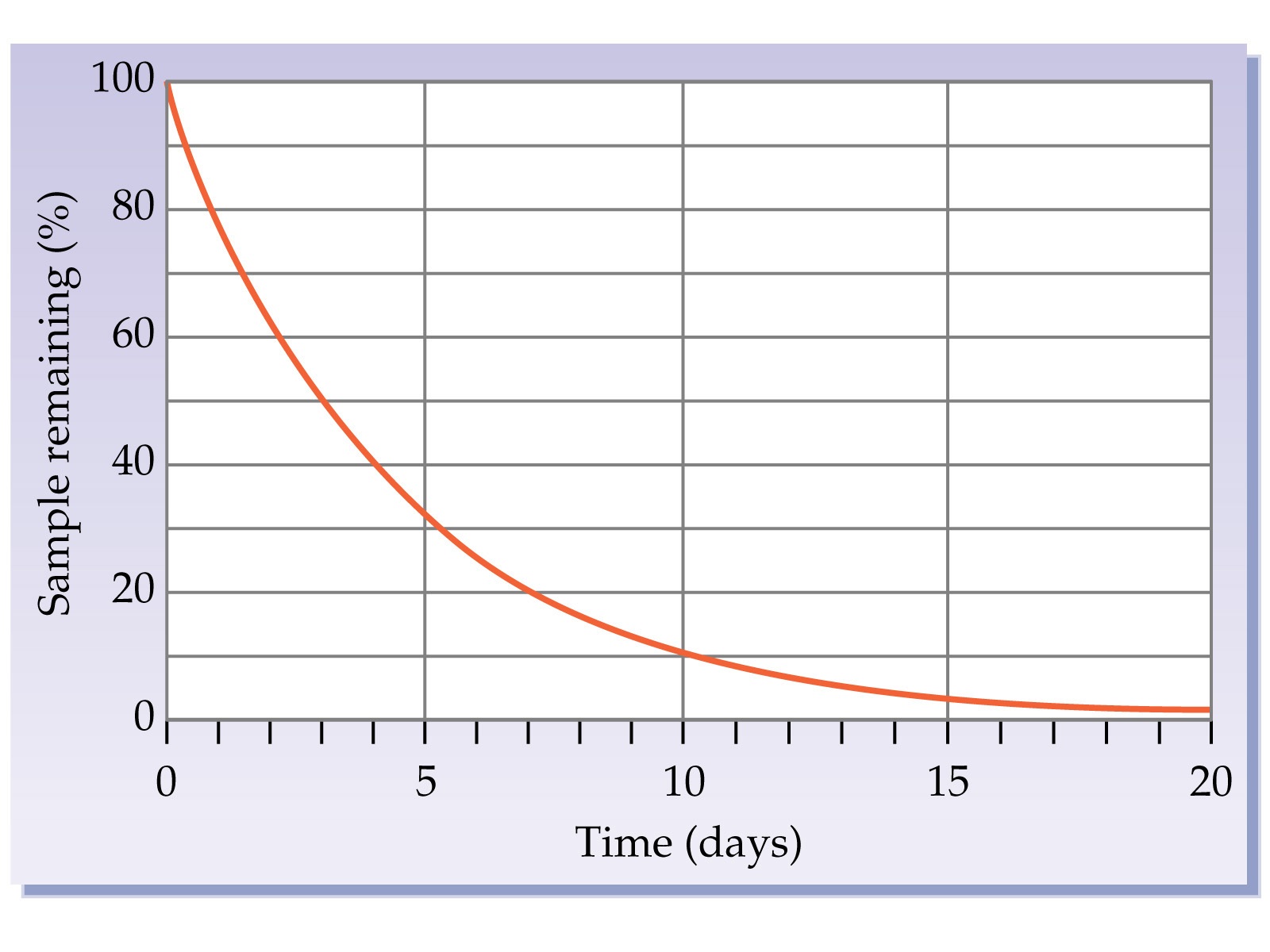
What is the Half Life of this isotope?
3 days
5 days
8 days
10 days
The half-life of Zn-71 is 2.4 minutes. If one had 100.0 g at the beginning, how many grams would be left after 2.4 minutes has elapsed?
100.0g
50.0g
12.5g
8.5g
The half-life of Zn-71 is 2.4 minutes. If one had 100.0 g at the beginning, how many grams would be left after 4.8 minutes has elapsed?
100.0g
25.0g
12.5g
8.5g
The half-life of Zn-71 is 2.4 minutes. If one had 100.0 g at the beginning, how many grams would be left after 7.2 minutes has elapsed?
100.0g
25.0g
12.5g
8.5g

What is the half life of californium?
1 year
2.8 years
3 years
5 years


14
4
3
28
The elements in this group all have 5 valance electrons.
Group 5
Group 15
Group 3
Group 18
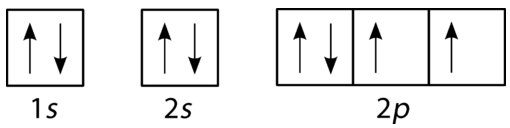


Which area on the periodic table represents the electrons in the "d" sublevel?
representative elements
columns 3-8
rare earth elements
transition elements


Which color has the highest frequency?
red
orange
green
blue
What is the frequency of a photon that has a wavelength of 850 m?
3.53 x 10⁵ Hz
3.5 x 10⁵ Hz
3.5 x 10⁵ J
2.8 x 10⁻⁶ Hz

The element with the lowest electronegativity in Period 3 is -
Na
Cl
Ar
Mg

If a potassium atom lost one electron, what would be the symbol for that ion?


Put these in increasing order of increasing electronegativity:
F, N, B
B < N < F
B < F < N
N < F < B
F < N < B
Ra, Be, Ca, Rb, H

Of this pair, Se2- has the larger radius?
True
False

Which outline of elements are known as the transition metals?
A
B
C
D
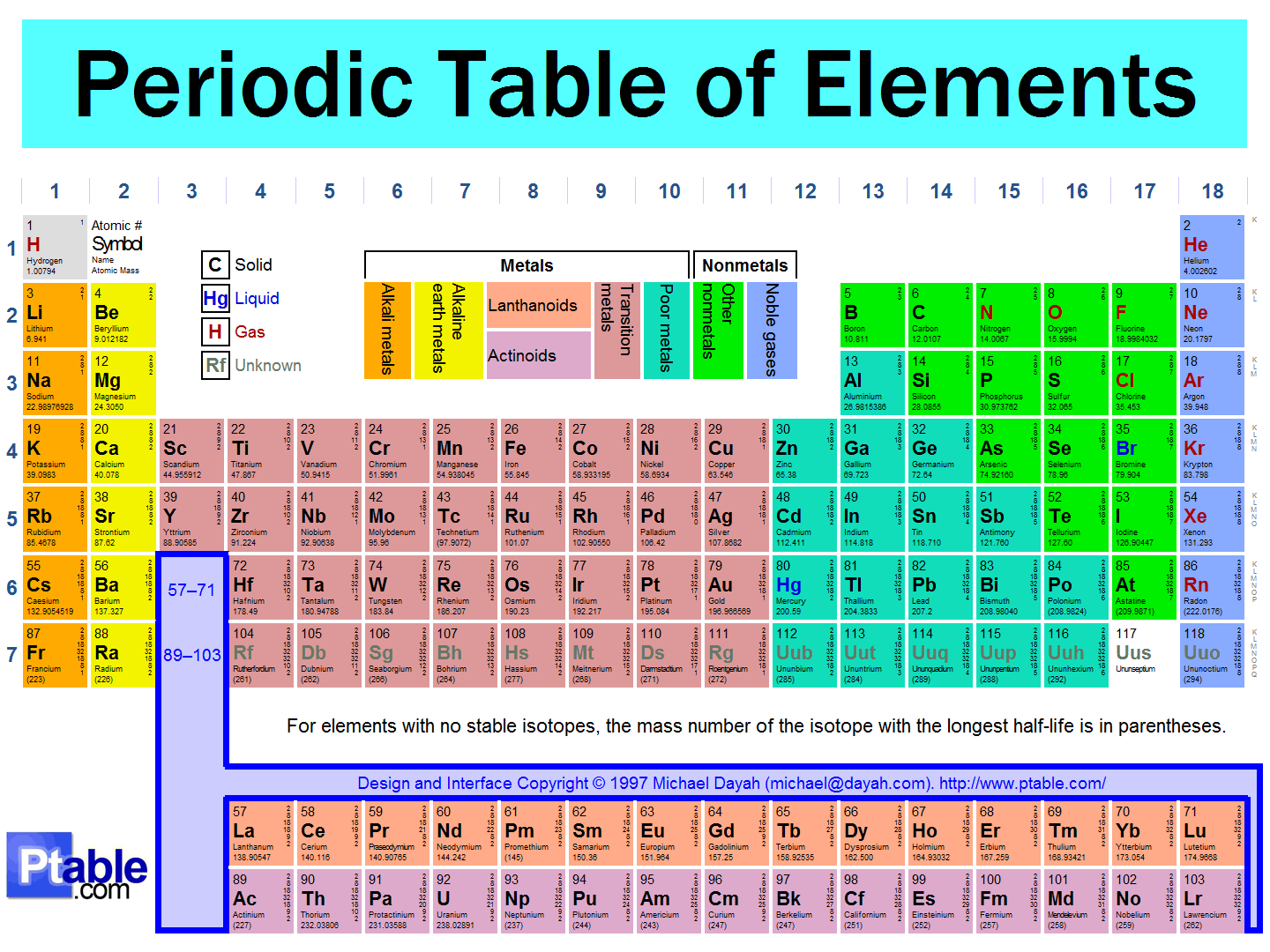
What do the vertical columns on the periodic table tell us?
The number of orbitals
The number of valence electrons (electrons on the outer most shell)

How many orbitals does Nickel have?
3
4
5
10

Who discovered the nucleus?
Rutherford
Bohr
Thomson
Dalton

Who discovered the electrons?
Rutherford
Bohr
Thomson
Dalton
How many valence electrons and energy levels does (Pb) lead have?
4 valence electrons and 6 energy levels (orbitals)
6 valence electrons and 4 energy levels (orbitals)
5 valence electrons and 5 energy levels (orbitals)
5 valence electrons and 10 energy levels (orbitals)

What is the name of group number 2?
transition metals
halogens
metaloids
alkaline earth metals
Metals (select all that apply)
are found on the right side of the periodic table.
are found on the left side of the periodic table.
are good conductors of heat and electricity.
are brittle.
are malleable and ductile.
Nonmetals (select all that apply)
are found on the right side of the periodic table.
are found on the left side of the periodic table.
are good conductors of heat and electricity.
are brittle.
can be solid, liquids, or gases at room temperature.

