wayground logo

Free Printable Worksheets

NEW

Font size

S
M
L
XL
Worksheets

Biology Checkpoint Review

Total questions: 50

Worksheet time: 50mins

Name
Class
Date
1.
The diagram shows a container divided into two compartments by a membrane permeable to water but not to starch. Two solutions containing different concentrations of dissolved starch were placed on each side of the membrane. Which of the following describes what will happen to the water level during the process of osmosis?  
a)
The water level of both sides of the membrane will decrease 
b)
The water level on the right side of the membrane will increase 
c)
The water level on the left side of the membrane will increase
d)
The water level on both sides of the membrane will stay the same 
2.
An animal cell placed in a sugar solution is shown in the diagram. Which statement best describes how osmosis will affect this animal cell?  
a)
Water will move out of the cell and the cell will shrink
b)
Water will move into the cell and the cell will expand 
c)
Sugar will move out of the cell and the cell will expand 
d)
Sugar will move into the cell and the cell will expand
3.
In order to make hydrochloric acid, which is required in human digestion, ATP is used to move hydrogen ions from the blood to the stomach lining. This is an example of ___.   
a)
Active Transport
b)
Passive Transport
c)
Osmotic Potential 
d)
Facilitated Diffusion
4.
In active transport, carrier proteins ___.  
a)
Move substances across the cell membrane without the use of ATP.
b)
Move from low concentration to high concentration by diffusion
c)
Move small molecules through the cell membrane by osmosis 
d)
Move substances from a low concentration to high concentration through the use of energy.
5.
The diagrams show the stages of mitosis in random order.  What sequence correctly shows the stages of mitosis?             
a)
3-1-2-4
b)
1-3-4-2
c)
4-2-3-1
d)
2-1-4-3
6.
A daughter cell that resulted from a mitotic division has 24 chromosomes.  How many chromosomes did the parent cell have?   
a)
6
b)
12
c)
24
d)
48
7.
A bone cell of a goat contains 60 chromosomes.  How many chromosomes will be in each daughter cell after mitosis? 
a)
15
b)
30
c)
60
d)
120
8.
What must occur during the cell cycle to ensure proper division of the chromosomes?  
a)
The cell must grow in size
b)
The mitochondria must divide 
c)
The DNA of the cell must replicate
d)
The cell membrane must dissolve
9.
The main purpose of DNA replication is to ___.  
a)
Capture sunlight
b)
Store energy in the bonds of a glucose molecule
c)
Synthesize proteins 
d)
Copy genetic information 
10.
The figures below show four processes involving DNA and RNA.  Use these figures to answer the next question. 
Which figure shows the process of replication?
a)
figure 1
b)
figure 2
c)
figure 3
d)
figure 4
11.
.  Which statement best describes the primary function of DNA replication?   
a)
To ensure daughter cells have a complete copy of the DNA
b)
To prevent mutations from occurring in cells 
c)
To provide genetic variation within specific organisms
d)
to allow prokaryotic cells to undergo meiosis
12.
An energy pyramid is shown in the diagram.  Which organism in the pyramid receives the least amount of energy?
a)
fox
b)
bird
c)
grasshopper
d)
grass
13.
An energy pyramid is shown.  Which statement best describes the flow of energy in the pyramid?
a)
10% of the energy is gained as it moves from the grasshopper to the grass. 
b)
10% of the energy is transferred as it moves from the toad to the snake.
c)
90% of the energy is gained as it moves from the snake to the toad.
d)
90% of the energy is lost as it moves from the grasshopper to the toad
14.
An energy pyramid is shown.  As energy moves through the pyramid, the amount of available energy ___.
a)
Increases as the size of the organisms increase 
b)
Doubles as it moves up each trophic level. 
c)
Remains the same as it is transferred to the next trophic level. 
d)
Decreases because it is used by the organism and released as heat 
15.
Which statement is not supported by the information in the diagram?
a)
Through photosynthesis the plant creates food, which is essential to the fox.
b)
CO2 released by the plant and O2 released by the fox are waste products. 
c)
Gases produced by the plant and fox form the ozone layer.
d)
The fox uses the O2 from the plant, and the plant uses the CO2 from the fox.
16.
The red-billed ox pecker obtains a steady food supply by constantly picking ticks off the bodies of large animals such as giraffe, zebra, and rhinoceros.  This helps the animals get rid of parasites.  This relationship is best described as ___.
a)
Commensalism
b)
Parasitism
c)
Mutualism
d)
Predation
17.
Mistletoe can grow on oak trees and extract water and nutrients at the oak tree’s expense.  This relationship is best described as ___.
a)
Commensalism
b)
Parasitism
c)
Mutualism
d)
Predation
18.
Organisms that make up the first level of a food chain and produce their own food are classified as ___.
a)
predators
b)
autotrophs
c)
heterotrophs
d)
decomposers
19.
The process shown represents___________.
a)
Photosynthesis of glucose
b)
Replication of DNA
c)
Transcription of a gene
d)
Translation of a protein
20.
The process represented in the diagram is ______________.
a)
Recombination
b)
replication of DNA
c)
transcription of a gene
d)
translation of a protein
21.
Which sequence of nucleotides represents the gene for this trait?
a)
ACT AAG
b)
TCU TTG
c)
GAA UCU
d)
UCC TGA
22.
This section of mRNA AAG UUU CCA AGU GUU UAA would code for what sequence of amino acids?
a)
Lys-Phe-Pro-Ser-Val
b)
Ser-Lys- Gly-Ser- Gle-Ile
c)
Lys-Lys-Gly-Asp-Cys-Try
d)
Lys-Phe-Pro-Ser
23.
Which of these best describes the correct sequence in the expression of a trait? 
a)
trait --> gene--> enzyme
b)
gene--> protein --> trait
c)
gene --> trait --> DNA
d)
protein --> gene --> trait
24.
Some microorganisms, such as yeast, produce energy in oxygen-free environments through the process of  
a)
Mitosis
b)
Photosynthesis 
c)
Aerobic respiration
d)
Anaerobic respiration
25.
The diagram shows the relationship between photosynthesis and respiration. What are the products of photosynthesis?   
a)
Energy and oxygen 
b)
Glucose and oxygen 
c)
Carbon dioxide and water 
d)
Glucose and carbon dioxide
26.
 Photosynthesis is the process by which 
a)
The potential energy of glucose is transferred to ATP molecules 
b)
Glucose is gradually broken down to form lactic acid or alcohol 
c)
Two glucose molecules combine to form maltose and water 
d)
Light energy is converted into the chemical energy of glucose 
27.
The diagram shows an investigation performed over a period of 6 hours.  The gas bubbles produced in this investigation most likely contained molecules of  ___.
a)
Oxygen 
b)
Sulfur dioxide
c)
Uric acid
d)
Ammonia
28.
Clostridium botulinum bacteria grow well in low-oxygen environments, including improperly canned foods.  It causes food poisoning.  Which of these processes does Clostridium botulinum use to produce energy when in these low-oxygen environments?
a)
Aerobic respiration
b)
Anaerobic respiration 
c)
Photosynthesis 
d)
Chemosynthesis
29.

In gel electrophoresis a DNA sample from an unknown donor is placed in a small well at one end of a special gel-coated plate. Samples from known donors are placed in other wells on the plate. An electric current is passed through the plate, causing the DNA fragments to separate. The size and location of the separated fragments can be compared for similarities. The more similar the locations and sizes of the fragments, the more closely the donors of the samples are related. The diagram shows four samples being compared with an unknown sample.


The donor of which sample is most closely related to the donor of the unknown sample?

a)

Sample 1

b)

Sample 2

c)

Sample 3

d)

Sample 4

30.

The results shown in the picture were obtained using a technique known as gel electrophoresis. This technique separates mixtures of DNA. In the picture nine different samples of DNA are compared.


Gel electrophoresis can be used to —

a)

determine the differences in ages of a set of people

b)

identify how closely two individuals are related

c)

determine how effective certain medications are

d)

D identify different blood types

31.

If we were to look inside a normal male bone cell, how many total chromosomes would we find?

a)

1

b)

2

c)

23

d)

46

32.

When an area of a chromatid is exchanged with the matching area on a chromatid of its homologous chromosome, _____ occurs.

a)

crossing over

b)

mutagenesis

c)

hybridization

d)

fertilization

33.
Human eggs and sperm are _____, and each has ____ chromosomes.
a)
diploid, 23
b)
diploid, 46
c)
haploid, 23
d)
haploid, 46
34.
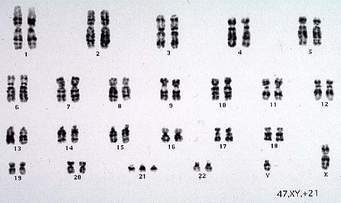
Based on the Karyotype shown, at which chromosome pair can we identify a genetic disorder? 
a)
Chromosome pair 5
b)
sex chromosomes
c)
Chromosome pair 21
d)
There are no chromosomal disorders
35.
If a gene is found only on the X chromosome and not the Y chromosome, it is said to be what?
a)
sex-linked trait
b)
polygenic trait
c)
codominant trait
d)
incomplete dominance trait
36.

What will most likely be the result if all of the mitochondria are removed from a plant cell?

a)

It will be unable to carry out respiration.

b)

It will lose water through osmosis.

c)

It will break down the ribosomes in the cell.

d)

It will be unable to photosynthesize

37.

During strenuous exercise, body temperature increases. The body responds to the increase in temperature by sweating, which helps to reduce the body temperature. Which is demonstrated in this situation?

a)

excretion

b)

metabolism

c)

homeostasis

d)

synthesis

38.

Why is meiosis important for sexual reproduction?

a)

It allows the zygote formed from fertilization to have triple the chromosome number of the organism.

b)

It allows gametes to have twice the original number of chromosomes of the organism

c)

It allows gametes to have half the original number of chromosomes of the organism.

d)

It allows the zygote formed from fertilization to have half the original number of chromosomes of the organism.

39.

Which process produces the most variation within a species?

a)

asexual reproduction

b)

sexual reproduction

c)

mitosis

d)

cloning

40.

The use of pesticides on crops has been a common farming practice for decades. What has been the greatest effect of natural selection through the use of pesticides on certain insect populations?

a)

Natural selection has been altered because the insects and their predators are killed.

b)

The rate of selection is increased because the pesticides do not kill the insects that are naturally resistant to it.

c)

The rate of selection has decreased because the pesticides kill only young insects.

d)

The pesticides have altered natural selection by causing the insect DNA to spontaneously mutate.

41.

What type of organic molecules are enzymes?

a)

carbohydrates

b)

lipids

c)

nucleic acids

d)

proteins

42.

What are the subunits of DNA and their function?

a)

nucleotides that store information

b)

monosaccharides that provide quick energy for the cell

c)

lipids that store energy and provide insulation

d)

proteins that provide the building blocks for the structural components of organisms

43.

How does the amount of energy resulting from fermentation compare with that of aerobic respiration?

a)

Aerobic respiration results in less energy

b)

Aerobic respiration results in more energy

c)

Each process results in equal amounts of energy

d)

Each process results in variable amounts of energy

44.

This diagram shows a plant cell. Which structure is found in a plant cell but is absent in an animal cell?

a)

1

b)

2

c)

3

d)

4

45.

The inheritance of short wings in Drosophila fruit flies is an x-linked, recessive trait. Which would most likely result if a short-winged female mates with a long-winged male?

a)

All offspring will be short-winged.

b)

All females will be long-winged, and all males will be short-winged.

c)

All females will be short-winged, and all males will be long-winged.

d)

Half of the males and females will be short-winged, and half will be long-winged.

46.

A hospital wants to identify the parents of a baby. Based on the DNA fingerprints, which couple is most likely the parents of the baby?

a)

Couple W

b)

Couple Z

c)

Couple Y

d)

Couple X

47.

Which would most likely produce a mutation that is passed on to offspring?

a)

radiation changing the DNA sequence in skin cells

b)

a gamete with an extra chromosome forming

c)

tobacco smoke altering the genes in lung cells

d)

exposure to chemicals altering nerve cell function

48.

A large population of cockroaches was sprayed with an insecticide. A few of the cockroaches survived and produced a population of cockroaches that was resistant to this spray. What can best be inferred from this example?

a)

A species will adapt no matter what the environment.

b)

The environment has no effect on the survival of an organism.

c)

Insecticides cause mutations that are passed on to the next generation.

d)

Individuals with favorable variations survive and reproduce.

49.

Which most directly controls the rate at which food is broken down to release energy?

a)

enzymes

b)

hormones

c)

nucleic acids

d)

vitamins

50.

How are sexual reproduction and asexual reproduction different?

a)

Sexual reproduction produces offspring identical to the parents, but asexual reproduction produces offspring with traits from both parents.

b)

Asexual reproduction produces offspring identical to the parents, but sexual reproduction produces offspring with traits from both parents

c)

Sexual reproduction only occurs in multicellular organisms, but asexual reproduction only occurs in unicellular organisms.

d)

Asexual reproduction only occurs in multicellular organisms, but sexual reproduction only occurs in unicellular organisms.