wayground logo

Free Printable Worksheets

NEW

Font size

S
M
L
XL
Worksheets

Weather In The Atmosphere

Total questions: 45

Worksheet time: 48mins

Name
Class
Date
1.

A mixture of gases that surrounds the Earth like a blanket.

a)

atmosphere

b)

troposphere

c)

ozone

d)

nitrogen

2.

Gas in the atmosphere that protects the Earth from the Sun's rays

a)

atmosphere

b)

troposphere

c)

ozone

d)

nitrogen

3.
Earth's current atmosphere is _?_.
a)
78% nitrogen, 21% oxygen, 0.9% argon and 0.037% carbon dioxide
b)
78% oxygen, 21%nitrogen, 0.9% argon, 0.037% carbon dioxide
c)
78% nitrogen, 21% argon, 1% oxygen
d)
78% oxygen, 21% nitrogen, 1% carbon dioxide
4.

The air we breathe is mostly made of

a)

nitrogen

b)

oxygen

5.

The highest layer of the atmosphere is

a)

troposhphere

b)

mesosphere

c)

stratosphere

d)

exosphere

6.

Weather happens in the

a)

troposhphere

b)

mesosphere

c)

stratosphere

d)

exosphere

7.

As you get farther away from the Earth, the layers of the atmosphere get

a)

colder

b)

warmer

8.

The amount of water vapor in the air

a)

condensation

b)

Precipitation

c)

Saturated

d)

Humidity

9.

What process in the water cycle is driven directly by the Sun's energy?

a)

Precipitation

b)

Condensation

c)

Evaporation

d)

Transpiration

10.

Clouds are formed as a result of which process in the water cycle

a)

evaporation

b)

condensation

c)

precipitation

11.
What is a front?
a)
A place where air masses meet
b)
the front part of a storm
c)
An area of very high wind
d)
an area that has fair weather
12.
rapidly moving cold air  mass runs into a warm air mass the cold air slides under the warm air. This is called a  .....
a)
cold front
b)
warm front
c)
stationary front
13.
What type of storm front is this? 
a)
warm front
b)
cold front
c)
stationary front
d)
occluded front
14.
What type of storm front is this?
a)
warm front
b)
cold front
c)
stationary front
d)
occluded front
15.
What characteristics are used to classify air masses?
a)
temperature and humidity
b)
pressure and temperature
c)
latitude and longitude
d)
wind speed and location 
16.
Where would you find a tropical maritime air mass?
a)
over the ocean, near the equator
b)
over the ocean, near the poles
c)
over a continent, near the equator
d)
over a continent, near the poles
17.
When a warm air mass and a cold air mass meet, but they push at each other and neither one can move, it is called a/an - 
a)
warm front
b)
cold front
c)
occluded front
d)
stationary front
18.
What type of storm front is this?
a)
warm front
b)
cold front
c)
stationary front
d)
occluded front
19.
Occluded fronts include
a)
2 cold air masses and 1 warm
b)
2 warm air masses and 1 cold
20.

What type of air mass is associated with cold and humid air?

a)

Maritime polar

b)

Continental polar

c)

Maritime tropic

d)

Continental tropic

21.

What type of air would a continental tropic air mass bring?

a)

warm and humid

b)

warm and dry

c)

cold and dry

d)

cold and humid

22.

Carry Instruments for collecting Weather data high into the atmosphere where human observation is not feasible.

a)

Weather Satellite

b)

Weather Balloon

c)

Weather Map

23.

Are lines joining places on the map that have the same air pressure.

a)

Isotherms

b)

Isobars

24.

Are lines joining places that have the same temperature.

a)

Isotherms

b)

Isobars

25.
This weather instrument is a...
a)
anemometer
b)
barometer
c)
wind vane
d)
thermometer
26.
This weather instrument is a...
a)
thermometer
b)
anemometer
c)
rain gauge
d)
barometer
27.
This weather instrument is a...
a)
anemometer
b)
Christmas ornament
c)
wind vane
d)
barometer
28.
This weather instrument is an...
a)
wind vane
b)
anemometer
c)
barometer
d)
thermometer
29.
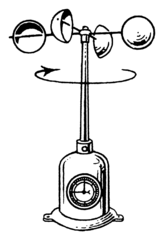
What instrument measures wind speed?
a)
thermometer 
b)
wind vane
c)
barometer
d)
anemometer 
30.
What instrument measures air pressure?
a)
barometer
b)
hydrometer 
c)
rain gauge
d)
anemometer 
31.

How is a warm front shown on a weather map?

a)
b)
32.
Which instrument measures humidity?
a)
sling psychrometer
b)
thermometer
c)
anemometer
d)
wind vane
33.

Scientists who study weather and try to predict it are called?

a)

astronomers

b)

climatologists

c)

meteorologists

d)

weatherologists

34.

A cloud cover symbol that is 3/4 black and 1/4 white represents...

a)

20-30% cloud cover.

b)

50-60% cloud cover.

c)

70-80% cloud cover.

d)

90-100% cloud cover.

35.

A ________________ is an intense storm with strong winds, heavy rain, lightning, and thunder.

a)

tornado

b)

hurricane

c)

thunderstorm

36.

A _________ can from when a rapidly spinning column of low pressure air, called a funnel cloud touches the ground.

a)

thunderstorm

b)

hurricane

c)

tornado

37.

A _____________ is a large, rotating low-pressure system that forms over the warm waters of oceans near the equator.

a)

tornado

b)

hurricane

c)

thunderstorm

d)

flooding

38.

What makes weather?

a)

tornados

b)

wind

c)

hurricane

d)

sun

39.

What causes wind?

a)

air pressure that is the same

b)

the sun

c)

unequal heating of the earth

d)

storms

40.

An overflowing of water in a normally dry area

a)

Storm Surge

b)

Flood

c)

Thunderstorm

d)

Hurricane

41.

A long period with little or no rainfall

a)

Flood

b)

Storm

c)

Drought

d)

Hurricane

42.
Where are blizzards most common?
a)
Upper Midwest and the Great Plains
b)
Hawaii
c)
Gulf Coast
d)
Carolina Coast
43.

What will happen if the relative humidity is 100 percent, and the temperature begins falling?

a)

It will start to rain

b)

The air will be sticky and uncomfortable

c)

The temperature will rise

d)

The barometric pressure will rise

44.
What type of front brings cool, cold weather to an area?
a)
cold front
b)
warm front
c)
stationary front
d)
occluded front
45.
What type of front brings warm and humid weather to an area?
a)
cold front
b)
warm front
c)
stationary front
d)
occluded front