wayground logo

Free Printable Worksheets

NEW

Font size

S
M
L
XL
Worksheets

Electrons, Periodicity and Bonding

Total questions: 55

Worksheet time: 1hrs 25mins

Name
Class
Date
1.
The second energy level can hold up to how many electrons?
a)
2
b)
8
c)
10
d)
12
2.
Electron cloud is based on
a)
Quantum Mechanics
b)
Gold Foil Experiment
c)
Matter is made up of small particles called atoms
d)
Nuclear Theory
3.

Rows on the periodic table are called...

a)

groups

b)

periods

c)

families

d)

shells

4.

How many valence electrons does a nitrogen atom have?

a)

3

b)

7

c)

5

d)

1

5.

Ionic Bonding involves:

a)

The transfer of protons

b)

The transfer of neutrons

c)

The transfer of electrons

d)

None Of the above

6.

What is a valence electron?

a)

an electron that is found in the outermost shell of an atom.

b)

an electron found in the innermost shell of an atom.

c)

an electron found in the middle shell.

7.

What is the number of valence electrons for Neon and the other Noble Gases?

a)

5

b)

6

c)

7

d)

8

8.

Bonds that form between two metals are called ______________ bonds.

a)

ionic

b)

covalent

c)

metallic

d)

pervasive

9.
How many valence electrons in this structure?
a)
6
b)
5
c)
4
d)
7
10.
What elements generally make a covalent bond?
a)
metal and nonmetal
b)
2 nonmetals
c)
metal
d)
none of the above
11.
How many electrons does Si contain? (click to see image)
a)
14
b)
28
c)
2
d)
4
12.

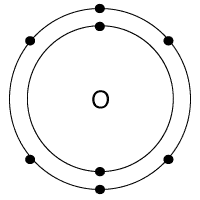
Which is the correct Lewis Structure for oxygen?

a)
b)
c)
d)
13.

CaCl2 is an example of what type of bond?

a)

Covalent

b)

Metallic

c)

Ionic

14.
What are the electrons in the outer most level called?
a)
Outer level electrons
b)
Protons
c)
Neutrons
d)
Valence Electrons
15.
How many more electrons are needed to fill an outermost energy level of a Carbon atom?
a)
its already full, 0 needed
b)
2
c)
4
d)
carbon is a nonmetal, it has no electrons
16.
Which of the following compounds is formed by ionic bonding?
a)
HF
b)
PCl5
c)
MgCl2
d)
CH4
17.
In chemical compounds, covalent bonds form when
a)
the electronegativity difference between two atoms is very large.
b)
electrons are completely transferred between two metals.
c)
pairs of electrons are shared between two nonmetal atoms.
d)
two nonmetal atoms are attracted to each other by opposite charges.
18.
Predict the bond that will form between Be and F.
a)
Ionic
b)
Covalent
19.
Predict the bond that will form between Se and Cl
a)
Ionic
b)
Covalent
20.
An atom becomes _________ when it gains electrons.
a)
Positive
b)
Negative
c)
Neutral
d)
Invinsible
21.

When an atom loses an electron, it becomes a

a)

positive ion

b)

negative ion

c)

neutral ion

d)

neutral atom

22.

Look at the periodic table. Which list of elements forms a group on the periodic table?

a)

Li, Be, B, C, N, O, F, and Ne

b)

He, Ne, Ar, Kr, Xe, and Rn

c)

B, Si, As, Te, and At

d)

Sc, Ti, V, Cr, Mn, Fe, Co, Cu, Ni, and Zd

23.

Which is NOT a property of metals?

a)

brittleness

b)

conductivity

c)

ductility

d)

luster

24.

What are two properties that make a metal a good choice to use as wire in electronics?

a)

conductivity, malleability

b)

ductility, conductivity

c)

luster, malleability

d)

malleability, high density

25.

Where are most metals on the periodic table?

a)

on the left side only

b)

on the right side only

c)

in the middle only

d)

on the left side and in the middle

26.
As you move down a group, atomic radius increases because - 
a)
you add more and more neutrons
b)
you add more and more protons
c)
you add more and more shells (energy levels)
d)
you add more atomic mass
27.
The atom with the largest atomic radius in Group 18 is - 
a)
Ar
b)
He
c)
Kr
d)
Rn
28.
As you move across the periodic table from left to right, the atomic radius decreases.  This is because - 
a)
the number of protons increases, so attraction to electrons increases
b)
the number of energy levels increases
c)
the number of electrons increases
d)
the atomic mass increases
29.
The atom with the largest atomic radius in Period 4 (row 4) is - 
a)
K
b)
Kr
c)
Fe
d)
Fe
30.
Francium (Fr) has the lowest ionization energy in Group 1 because - 
a)
it has the smallest number of valence electrons
b)
it has the greatest atomic mass
c)
it has the greatest number of protons, so it attracts its electrons the strongest
d)
its 1 valence electron is very far from the nucleus, so little energy is needed to remove it
31.
The element with the smallest ionization energy in Period 6 is - 
a)
Rn
b)
Cs
c)
Os
d)
Tm
32.
As you move across the periodic table atoms tend to get smaller because, ______________.
a)
the atoms have more mass.
b)
the atoms have less mass
c)
the atoms have more protons.
d)
the atoms have less electrons.
33.
The energy required to remove electrons is the definition of: 
a)
Electronegativity
b)
Atomic Number
c)
Atomic Radius
d)
Ionization
34.
What atom matches this electron configuration?
1s2s2p3s2
a)
Neon
b)
Magnesium
c)
Aluminum
d)
Potassium
35.
Which is the electron configuration for an oxygen atom?
a)
1s22s22p63s23p64s2
b)
1s22s22p4
c)
1s22s22p6
d)
1s22s22p63s23p6
36.
How many d orbitals are there in a given sublevel?
a)
1
b)
3
c)
5
d)
7
37.
What is this element? 
1s22s22p63s23p6
4s23d104p6
a)
Argon
b)
Krypton
c)
Selenium
d)
Bromide
38.
What atom matches this electron configuration?
[Xe] 6s2 4f14 5d9
a)
Mercury
b)
Gold
c)
Platinum
d)
Thallium
39.
What is the shorthand electron configuration for Sulfur atom?
a)
[Ar] 3p4
b)
[He] 3s23p4
c)
[Ne] 3s23p4
d)
[Na] 3s23p3
40.
What element has the valence shell configuration
3s2 3p2
a)
Al
b)
B
c)
Si
d)
Ga
41.
Which element is pictured?
a)
neon
b)
fluorine
c)
magnesium
d)
argon
42.
Identify the element in Period 5 that has 1 valence electron?
a)
Rb
b)
Nb
c)
Ag
d)
Sb
43.
What is the name of this element?
a)
Helium
b)
Hydrogen
c)
Argon
d)
Silver
44.
What group does this element belong to?
a)
Group 1: Alkali metals
b)
Group 18: Noble Gases
c)
Group 2: Alkaline-Earth Metals
d)
Group 17: Halogens
45.

How many valence electrons?

a)

2

b)

3

c)

4

d)

5

46.

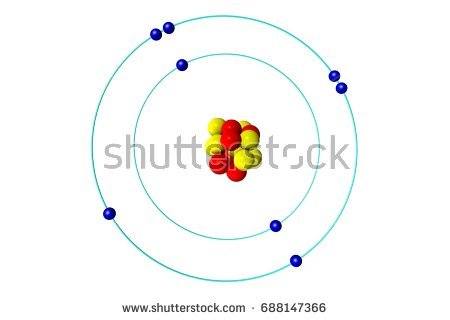
Which Bohr model represents Neon?

a)
b)
c)
d)
47.
An electron occupies the lowest energy orbital that can receive it.
a)
Hund’s rule
b)
Pauli exclusion principle
c)
Bohr model of the atom
d)
Aufbau principle
48.
All orbitals of equal energy are occupied by one electron before any single orbital is occupied by a second electron.
a)
Aufbau principle
b)
Pauli exclusion principle
c)
Hund’s rule
d)
Core Notation
49.
No two electrons in the same atom can have the same four quantum numbers.
a)
Aufbau principle
b)
Pauli exclusion principle
c)
Hund’s rule
d)
Noble gas notation
50.
What is incorrect about this orbital diagram?
a)
Both arrows in the 2p box should be pointing up
b)
There is nothing incorrect with this diagram
c)
In the 2p box there should only be 1 electron in the first 2p box and one in the 2nd 2p box
d)
All the arrows should be pointing up.
51.

Identify the rule that is being violated

a)

Aufbau's Principle

b)

Hund's Rule

c)

Pauli's Exclusion Principle

d)

Heisenberg uncertainty principle

52.

Which is the electron configuration of Ar (Argon)

a)

1s2 2s2 2p6 3s2 3p6

b)

1s2 2s2 2p6 3s2 3p0

c)

1s2 2s2 3s2 4s2 4p6

d)

3s2 4f14 4s2

53.

What is the shape of a p orbital?

a)

sphere

b)

it's just too complex to think about it

c)

dumbbell

d)

I don't know this stuff.

54.

In 1s2, the 1 means

a)

there is 1 electron

b)

the electrons are in the 1st energy level

c)

the shape is circular

d)

there is a -1 charge

55.

In 1s2, the 2 means

a)

there are 2 electrons in this level

b)

it is the 2nd energy level

c)

there is a +2 charge

d)

there is a -2 charge