Wayground logo

Free Printable Worksheets

Font size

S
M
L
XL
Worksheets

Atomic Structure & Nuclear Decay

Total questions: 58

Worksheet time: 2hrs 18mins

Name
Class
Date
1.

The atomic number identifies the number of __________.

a)

electrons

b)

atoms

c)

protons

d)

neutrons

2.

Subatomic particles that have a negative charge

a)

electrons

b)

protons

c)

quarks

d)

neutrons

3.

How many protons does sulfur have?

a)

32

b)

16

c)

48

d)

12

4.

How many electrons does sulfur have

a)

16

b)

32

c)

48

d)

12

5.

Subatomic particle that has a positive charge

a)

electron

b)

poitron

c)

neutron

d)

proton

6.

In what part of an atom can the protons and neutrons be found?

a)

nucleus

b)

neutrine

c)

electron cloud

d)

proton cloud

7.

Which parts of the atom move around the nucleus?

a)

electrons

b)

protons

c)

electrode particles

d)

neutrons

8.

What mass does a neutron have?

a)

1 amu

b)

0 amu

c)

-1 amu

d)

+2 amu

9.
Complete the missing label on the diagram.
a)
Neutron
b)
Centre
c)
Nucleus
d)
Sub atomic particle
10.
In order for an atom to be neutral what has to be true?
a)
The atom has more protons than neutrons
b)
The atom has more neutrons than protons
c)
The atom has the same number of protons and neutrons
d)
The atom has the same number of protons and electrons
11.

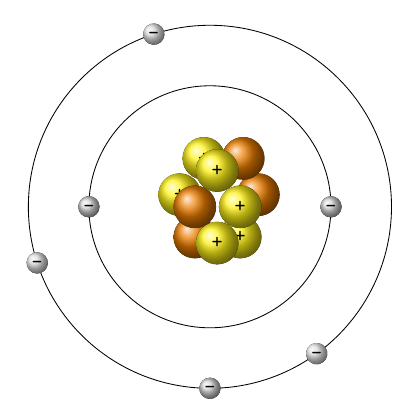
How many electrons does this atom have?

a)

2

b)

4

c)

6

d)

10

12.
Where is most of the mass in an atom located?
a)
in the nucleus
b)
in the protons
c)
in the neutrons
d)
in the electrons
13.

What is the mass number?

a)

the number of protons in the nucleus

b)

the number of protons and neutrons in the nucleus

c)

the number of neutrons in the nucleus

d)

the number of protons and electrons in the atom
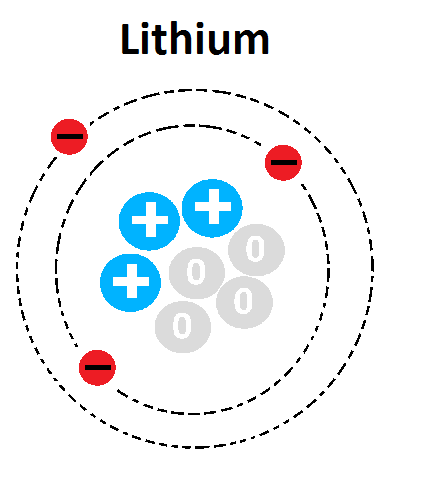
14.

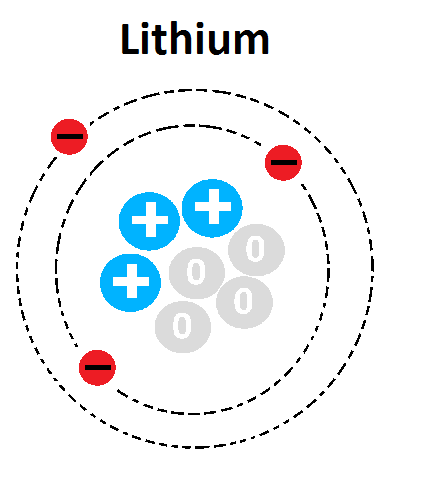
What is the atomic number of this atom?

a)

1

b)

3

c)

4

d)

7

15.

What is the mass number of this atom?

a)

1

b)

3

c)

4

d)

7

16.
How is the number of neutrons in the nucleus of an atom calculated?
a)
Add the number of e- and p+ together
b)
Subtract the number of e- from p+
c)
Subtract the number of p+ from the mass number
d)
Add the mass number to the number of e-
17.
If an atom has 12 positively charged subatomic particles, which of the following must it also have to be considered a neutral atom?
a)
12 neutrons
b)
12 electrons
c)
12 protons
d)
24 protons and neutrons
18.

An atom has 10 protons, 15 neutrons and 10 electrons what is its mass number.

a)

20

b)

10

c)

35

d)

25

19.
An element with a mass number of 11 and an atomic number of 5 has how many neutrons?
a)
11
b)
5
c)
6
d)
16
20.

Which of the following determines the identity of an element?

a)

number of protons

b)

atomic mass

c)

number of neutrons

d)

number of shells

21.
How many neutrons would Fe-56 have?
a)
56
b)
26
c)
30
d)
33
22.
If an atom of nickel has a charge of +3, how many electrons does the atom have?
a)
28
b)
25
c)
26
d)
31
23.
If an atom of oxygen has a charge of -2, how many electrons does the atom have?
a)
18
b)
6
c)
8
d)
10
24.
How many neutrons would V-49 have?
a)
26
b)
49
c)
23
d)
50.94
25.

Atoms of the same element which have a different number of neutrons are called _________________.

a)

ions

b)

isotopes

c)

quarks

d)

molecules

26.
An atom becomes _________ when it gains electrons.
a)
Positive
b)
Negative
c)
Neutral
d)
Invinsible
27.
An atom becomes _______ when it loses electrons.
a)
Positive
b)
Negative
c)
Neutral
d)
Invinsible
28.
You see an model of an atom with 5 protons and 4 electrons. What kind of atom is this? 
a)
positive ion 
b)
negative ion 
c)
neutral ion 
d)
strange ion
29.

If an atom gains 3 electrons, what charge will it have as an ion?

a)

+3

b)

-3

c)

+5

d)

-5

30.

If an atom loses 2 valence electrons, what charge will it have as an ion?

a)

+2

b)

-2

c)

0

d)

+8

31.

A chloride ion has 17 protons and 18 electrons. What is its charge?

a)

+

b)

-1

c)

neutral

d)

+17

32.

An iron ion is found to have 23 electrons. What is its charge?

a)

+3

b)

-3

c)

+2

d)

30

33.

Which of the following would represent an isotope of a particle with 5 protons, 6 neutrons, and 5 electrons?

a)

5 protons, 6 neutrons, 2 electrons

b)

5 protons, 5 neutrons, 5 electrons

c)

6 protons, 5 neutrons, 5 electrons

d)

5 protons, 6 neutrons, 6 electrons

34.

What is the difference between hydrogen-1 and hydrogen-2?

a)

Hydrogen-1 has no neutrons.

b)

Hydrogen-2 has 2 neutrons.

c)

Hydrogen-1 has a +1 charge.

d)

Hydrogen-1 has 1 neutron.

35.

Which of the following is not a way that ions can form?

a)

gaining electrons

b)

gaining protons

c)

losing electrons

d)

All of the above are ways that ions can form.

36.

Describe the structure of an alpha particle.

a)

a fast-moving electron

b)

2 protons and 2 neutrons

c)

a slow-moving neutron

d)

a hydrogen nucleus

37.

What is the relative charge of an alpha particle?

a)

-1

b)

0

c)

1

d)

2

38.

In alpha decay, the mass number...

a)

increases by 2

b)

decreases by 2

c)

increases by 4

d)

decreases by 4

39.

In alpha decay, the atomic number...

a)

increases by 2

b)

decreases by 2

c)

increases by 4

d)

decreases by 4

40.

The mass number of Neptunium (Np) is (a)   .

41.

The atomic number of Neptunium (Np) is (a)   .

42.

A neutron changes into a proton and an electron releasing this type of particle.

a)

alpha decay

b)

beta decay

c)

gamma decay

d)

all of the above

e)

alpha & beta decay

43.

How is the alpha particle written in a nuclear equation?

a)

42He

b)

24He

c)

0-1e

d)

00γ

44.
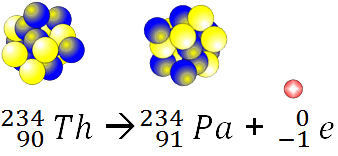
Which type of nuclear radiation is being emitted here?
a)
Alpha
b)
beta
c)
gamma 
d)
none
45.
Solve this equation for alpha decay.
85209At = ___ + 24He
a)
83205Bi
b)
86209Rn
c)
81207Tl
d)
85208At
46.
Solve this equation for beta decay.
614C = ___ + -10e
a)
410Be
b)
714N
c)
210He
d)
613C
47.

During beta-particle emission, a neutron splits into a____________________.

a)

proton and electron

b)

neutron and electron

c)

neutron and proton

48.
Uranium-238  decays into  Thorium-234  by emitting .........
a)
an alpha particle
b)
a beta particle
c)
gamma rays
d)
visible light
49.
The process of nuclear change in an atom of radioactive material is called... 
a)
nuclear decay
b)
nuclear mass
c)
isotopes
d)
radon
50.
Radioactive materials have unstable...
a)
electrons
b)
protons
c)
nuclei
d)
neutrons
51.
In a correctly written symbol what would be located in the "A" position?
a)
number of neutrons
b)
atomic number
c)
number of electrons 
d)
mass number
52.

In a correctly written symbol what would be located in the "Z" position?

a)

number of neutrons

b)

atomic number

c)

number of electrons

d)

mass number

53.

The particle emitted in beta-minus decay is a(n) (a)   .

54.

The atomic number of Actinium (Ac) is (a)   .

55.
If we start off with element 24X50 after an alpha decay we get another element Y that looks like
a)
22Y50
b)
22Y46
c)
20Y48
d)
26Y54
56.

In beta decay the mass number

a)

increases by 1

b)

decreases by 1.

c)

stays the same.

d)

is unpredicatble.

57.

In beta decay, the atomic number

a)

increases by 1.

b)

decreases by 1.

c)

stays the same.

d)

is unpredictable.

58.
If we start off with element 24X50 after an beta decay we get another element Y that looks like
a)
23Y50
b)
22Y46
c)
25Y50
d)
24Y50