

wayground logo

Free Printable Worksheets

NEW

Font size

S
M
L
XL
Worksheets

Unit 4 Test Review

Total questions: 44

Worksheet time: 1hrs 25mins
Name
Class
Date
1.
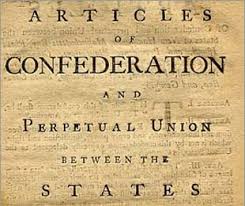
Under the Articles of Confederation, which government had the MOST power?
a)
Legislative branch
b)
the president
c)
the state governments
d)
national government
2.
Which of the following is an example of a weakness in the Articles of Confederation?
a)
Congress couldn't collect taxes
b)
Weak national government
c)
Provided no common currency/money for all 13 states
d)
All of the  above
3.

Many veterans (soldiers who fought in the Revolution) were angry because...

a)

They weren't allowed to keep their weapons

b)

They weren't given much credit for their win

c)

They did not believe the war ended fairly

d)

They didn't get paid for their service

4.

What did Shays' rebellion reveal about the Articles of Confederation?

a)

That it was too similar to the British system

b)

That it was too weak to succeed

c)

That it was strong and resilient

d)

That it was a successful model of government

5.
The three branches of government are ________________
a)
Executive, Legislative, and Judicial
b)
Legislative, Judicial, and National
c)
Executive, Principle, and Judicial
d)
Judicial, National, and Legislative
6.
Which branch of government has two houses?
a)
Executive
b)
Legislative
c)
Judicial
d)
National
7.
Which part of the legislative branch has representation based on population?
a)
Senate
b)
Judicial
c)
House of 
Representatives
d)
House of Congress
8.
Which part of the legislative branch has the same number of representatives for each state?
a)
House of Representatives
b)
Judicial
c)
Executive
d)
Senate
9.
The _______________ was the solution to the disagreement about how many representatives each state would have. 
a)
Great Compromise
b)
Three-fifths Compromise
c)
Great Dispute
d)
Big Agreement
10.
How were slaves counted as part of the population when deciding the number of representatives for a state?
a)
All slaves were counted.
b)
Three-fifths of the number of slaves was added to the population.
c)
Slaves were not counted at all.
d)
Slaves were allowed to vote and be elected to represent each state.
11.
What document replaced the Articles of Confederation and established a new national government? 
a)
The Declaration of Independence 
b)
The Constitution 
c)
The Magna Carta 
d)
The English Bill of Rights 
12.
Who was happy with the Virginia plan?
a)
Small States
b)
Large States
13.
Which Plan was favored by small states?
a)
New Jersey Plan
b)
Virginia Plan
14.
Before the U.S. Constitution was ratified, the United States was governed by which document?
a)
Magna Carta
b)
Articles of Confederation
c)
Mayflower Compact
d)
Declaration of Independence
15.
The Constitution contains no Bill of Rights to protect individual liberties like freedom of speech, trial by jury, and the right against searches and seizures.
a)
Federalist
b)
Anti-Federalist
16.

Amendment 3 is best described as:

a)

Freedom to petition the government

b)

sharing powers between the federal and state governments

c)

Keeping soldiers from living in your home

d)

Due Process and protection under the law

17.
Free Speech is found in which Amendment?
a)
First Amendment
b)
Second Amendment
c)
Third Amendment
d)
Fourth Amendment
18.

Which amendment protects your rights to be searched and have things taken from you with a warrant?

a)

Amendment Three

b)

Amendment Four

c)

Amendment Five

d)

Amendment Seven

19.

The right to a speedy trial and an attorney is from which amendment?

a)

Fourth Amendment

b)

Fifth Amendment

c)

Sixth Amendment

d)

Seventh Amendment

20.

Which was the group of people that supported the ratification of the new Constitution after the Constitutional Convention?

a)

Federalists

b)

Anti-Federalists

c)

Republicans

d)

Democrats

21.

Which was the group of people that were against the ratification of the new Constitution after the Constitutional Convention?

a)

Federalists

b)

Anti-Federalists

c)

Republicans

d)

Democrats

22.

Which group favored a much stronger central government?

a)

Federalists

b)

Anti-Federalists

23.

Which group favored a much weaker central government?

a)

Federalists

b)

Anti-Federalists

24.

Which of the following terms is used to describe the approval of the new Constitution?

a)

Objection

b)

Ratification

c)

Federalization

d)

Deliberation

25.

Patrick Henry and Thomas Jefferson were part of this political party

a)

Federalists

b)

Anti-federalists

26.
The Constitution contains no Bill of Rights to protect individual liberties like freedom of speech, trial by jury, and the right against searches and seizues.
a)
Federalists
b)
Anti-Federalists
27.

What important charter was signed in 1215 in English by King John resulting in the establishment of the principle of limited government?

a)

Magna Carta

b)

Code of Hammurabi

c)

Twelve Tables

d)

Declaration of Independence

28.
Why do we have 3 branches of government instead of 1 branch?
a)
to mix things up
b)
we like odd numbers
c)
to limit power
d)
that is what they had in England
29.
What type of government votes for officials to serve the will of the people?
a)
Federal Government
b)
Monarchy
c)
Dictatorship
d)
Representative Government
30.
A system in which each branch of government limits the power of the other branch
a)
totalitarianism
b)
checks and balances
c)
unlimited government
d)
absolutism
31.
We the people
a)
Republicanism
b)
Popular Sovereignty
c)
Federalism
d)
Separation of powers
32.
No official government is above the law
a)
Checks and balances
b)
Federalism
c)
Limited Government
d)
Separation of Powers
33.
Divides power between central and local governments
a)
Checks and Balances
b)
Judicial Review
c)
Limited Government
d)
Federalism
34.
includes the three branches of government
a)
Judicial Review
b)
Republicanism
c)
Limited Government
d)
Separation of powers
35.
The Power of the president to VETO a bill is an example of: 
a)
Separation of Power
b)
Checks and Balances 
c)
Republicanism 
d)
Popular Sovereignty 
36.
Power is equal between federal and state government; this is an example of:
a)
Checks and Balances
b)
Separation of Power
c)
Federalism 
d)
Republicanism 
37.
Why did the framers of the Constitution place strict limits o the power of the government?
a)
They were afraid that the states would get too much power.
b)
They wanted to perserve the idea of self-government
c)
They wanted to protect individual rights.
d)
They did not trust the people to govern themselves
38.
These are personal liberties (freedoms) and privileges guaranteed to every citizen
a)
Individual Rights
b)
Separation of Powers
c)
Limited Government
39.
This is the idea that everyone, citizens and powerful leaders alike, must obey the law
a)
Limited Government
b)
Republicanism
c)
Individual Rights
d)
Federalism
40.
This idea calls for the people to exercise or delegate their power by electing or VOTING for their political representation
a)
Republicanism
b)
Separation of Powers
c)
Individual Rights
d)
Checks and Balances
41.
The principle of government that states federal and state governments must share powers
a)
Federalism
b)
Republicanism
c)
Checks & Balances
d)
Separation of powers
42.
which statement describes republicanism as defined in the US constitution?
a)
the president is elected through the electoral college
b)
citizens choose their representatives
c)
a Supreme Court rules if laws are constitutional
d)
a 2 party political system was created
43.
the Federalist papers refers to the need for
a)
a government limited by a constitution
b)
a federal system of government
c)
an independent military separate from the government
d)
a national education system
44.
the president can appoint federal judges, the supreme court can declare a law unconstitutional, and congress over riding a presidential veto of a law are all examples of 
a)
the 3 branches of the US government
b)
the idea of separation of powers
c)
the principle of checks and balances
d)
the system of federalism
