Wayground logo

Free Printable Worksheets

Font size

S
M
L
XL
Worksheets

ASM midterm

Total questions: 75

Worksheet time: 6hrs 15mins

Name
Class
Date
1.
A Compound that is being dissolved is called a
a)
Solution
b)
Solute
c)
Solvent
d)
Suspension
2.
Why can water have no net charge but have slight charges in different parts of the molecule?
a)
The oxygen end is slightly negative and the hydrogen end is slightly positive
b)
The hydrogen end is slightly negative and the oxygen end is slightly positive
c)
The hydrogen and oxygen ends change in polarity
d)
Because it is hydrophobic
3.
Attractions between water molecules are called
a)
Covalent bonds
b)
Ionic bonds
c)
Polar bonds
d)
Hydrogen bonds
4.
Water is a universal solvent because it...
a)
It can be found anywhere
b)
It freezes when it gets cold
c)
floats when frozen
d)
Dissolves most substances
5.
Which types of compounds dissolve easily in water?
a)
Polar and Nonpolar
b)
Polar and Ionic
c)
Nonpolar and Ionic
d)
Covalent and Nonpolar
6.
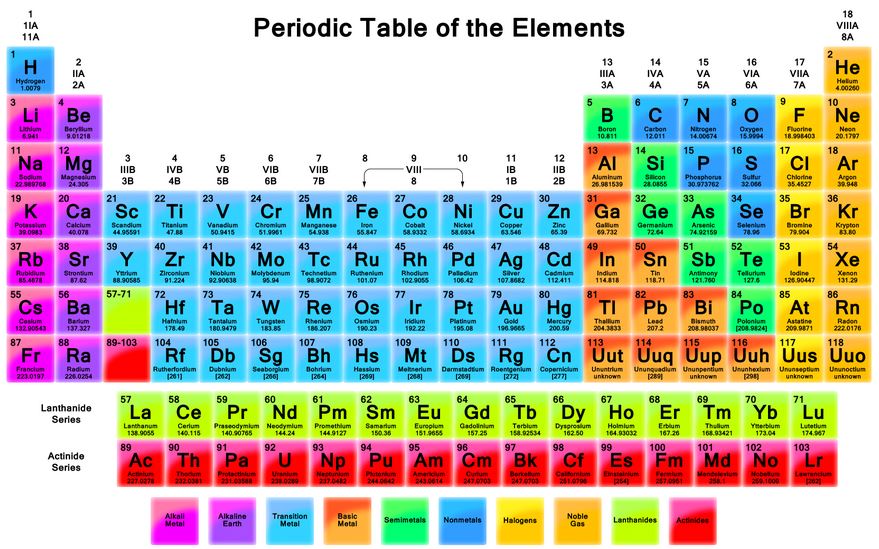
Elements on the LEFT side of the periodic table will most likely form:
a)
Positive ions
b)
Negative ions
c)
Neutral Ions
d)
None of these
7.
An ionic bond forms when atoms ___________ electrons.
a)
gain
b)
share
c)
increase
d)
transfer
8.
Which type of bond has a transfer of an electron from on atom to another?
a)
Polar Covalent 
b)
Non Polar Covalent
c)
Ionic
d)
Metallic
9.
If an atom loses two electrons what charge will it have?
a)
+ 2
b)
 - 2
c)
+1
d)
-1
10.
How are covalent bonds explained?
a)
When one atom takes the other atom's electron
b)
When the atom shares an electron with an another atom
c)
When the two nucleus merge
d)
When the neutrons leave the nucleus
11.
The number of _____ is most important in determining how an atoms will bond. 
a)
Neutrons
b)
Protons
c)
Valence Electrons
d)
Electron sin the innermost shell
12.

In sea-floor spreading, molten material rises from the mantle and erupts

a)

along the edges of all the continents.

b)

along mid-ocean ridges.

c)

in deep-ocean trenches.

d)

at the north and south poles.

13.

The process by which the ocean floor sinks beneath a deep-ocean trench and back into the mantle is known as _______

a)

convection.

b)

continental drift.

c)

subduction.

d)

conduction.

14.

Most geologists think that the movement of Earth’s plates is caused by _______

a)

convection.

b)

continental drift.

c)

subduction.

d)

conduction.

15.

The geological theory of _______ states that pieces of Earth’s lithosphere are in constant, slow motion.

a)

subduction

b)

plate tectonics

c)

deep-ocean trenches

d)

sea-floor spreading

16.

The place where two plates come together is known as a _______

a)

transform boundary.

b)

divergent boundary.

c)

convergent boundary.

d)

rift valley.

17.

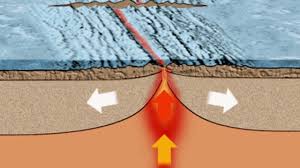
Below is a picture of sea-floor spreading. How are the ocean crusts moving?

a)

Converging

b)

Diverging

c)

Sliding

d)

No movement

18.

The San Andreas Fault in California is known as an active earthquake area. What type of

boundary is it?

a)

Converging

b)

Diverging

c)

Transform

d)

Sea Floor Spreading

19.
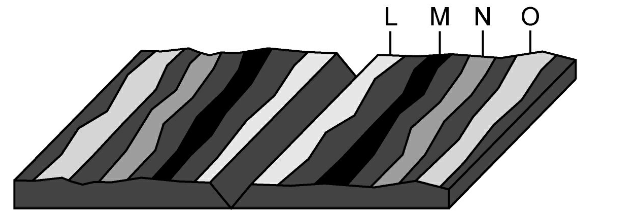
Where would the oldest rock be found?
a)
L
b)
M
c)
N
d)
O
20.
How is it possible for new crust to be formed without increasing the surface area of the Earth?
a)
Crust is destroyed at the same time it is created
b)
New crust is underwater where it sinks
c)
New crust breaks more easily than old crust
21.
A plate boundary at which two plate move parallel to each other in opposite directions
a)
convergent plate boundary
b)
divergent plate boundary
c)
transform plate boundary
d)
subduction
22.
Wegener’s proposal of a supercontinent was supported by:
a)
earthquake data
b)
seafloor magnetism
c)
rock, fossil, and climate data.
d)
convection currents in the mantle.
23.
A German scientist Alfred Wegener was the first to hypothesize that ...........
a)
Continents were once joined
b)
The sea floor is spreading
c)
Continents are moving
d)
The Earth's magnetic pole flips
24.
Peer scientists reviewing Wegener’s hypothesis of continental drift rejected his notion because
a)
His evidence was too few to make a valid conclusion 
b)
He did not explain how continents move and what moves them
c)
His evidence was not clear in showing  how continents were joined
d)
He lied by including false evidence
25.
Which of these phenomenon is not directly cased by plate tectonics 
a)
Volcanic eruptions
b)
Earthquakes
c)
Tsunamis
d)
Landslides
26.
Which body has the greater effect on Earth's tides?
a)
Sun
b)
Saturn
c)
Moon 
d)
Venus
27.
When the moon is at full moon or new moon, what type of tide will we experience?
a)
rip tide
b)
spring tide
c)
neap tide
d)
breaker tide
28.

Wha type of tide would this arrangement of earth-moon-sun create?

a)

full moon tide

b)

new moon tide

c)

neap tide

d)

spring tide

29.
Which tide is associated with the least difference between high and low water?
a)
spring tides
b)
neap tides
c)
high tides
d)
low tides
30.

The movement of deep, cold, nutrient filled water to the surface of the ocean is..

a)

Ocean Current

b)

Upwelling

c)

Deep Currents

d)

Surface Currents

31.

What affects the density of water?

a)

Salt

b)

Temperature

c)

The seasons of the year

d)

Both A and B

32.
Two types of ocean currents are
a)
local and global
b)
sea and land
c)
surface and deep
d)
warm and cold
33.
Surface currents are mainly caused by
a)
The Coriolis Effect
b)
Cold and Warm Water
c)
Convection
d)
Wind
34.
What causes ocean currents in the Northern Hemisphere to curve to the right?
a)
Earth's orbit around the Sun
b)
Earth's spinning on its axis
c)
Earth's magnetic field
d)
Earth's force of gravity
35.
As you go deeper in the ocean, the water is colder and less salty.
a)
True
b)
False
36.
Warm ocean currents generally come from
a)
The North Pole
b)
The South Pole
c)
The Equator
d)
Both A and B
37.
What process brings the deep cold ocean currents up to the surface?
a)
Conduction
b)
Global Wind Patterns
c)
Convection Currents
d)
Temperature and salinity
38.

The more scientific name of the Global Conveyor Belt is _____.

a)

halinethermal circulation

b)

thermohaline circulation

c)

thermodensity circulation

39.
The large, circular surface-current pattern found in each ocean.
a)
California Current
b)
Surface Current
c)
Gyre
d)
Global Conveyor Belt
40.

During a(n) ____ event, trade winds are much stronger than usual.

a)

El Nino

b)

La Nina

c)

Normal

d)

Partly sunny

41.

Normally, atmospheric upwelling and rain occurs in the:

a)

FAR Western Pacific

b)

Central Pacific

c)

Western Pacific

42.

Both El Nino and La Nina have this in common

a)

Influence birds that migrate over the ocean

b)

Influence rainy / dry weather world wide

c)

The weather at the polar regions

d)

The directions that ships travel in the oceans

43.

The picture represents a(n) ___ event.

a)

El Nino

b)

La Nina

c)

Non-El Nino (normal conditions)

44.

Why do the fisherman of Peru and South America not welcome a strong El Nino?

a)

El Nino poisons the fish

b)

El Nino causes strong winds and currents which move fish westward

c)

El Nino bring cold water to the surface which kills the base of the food chain

d)

El Nino shuts off upwelling and nutrients needed for the marine food chain do not rise to the surface

45.
What is chemosynthesis?
a)
Where bacteria use light energy to make glucose.
b)
Where plants use light energy to make glucose
c)
Where bacteria use chemical reactions to make glucose
46.

Chemosynthesis is the

a)

conversion of carbon into sugars and nutrients by bacteria in dark places. They use hydrogen gas, hydrogen sulfide and methane gas as a source of energy, relies on sunlight.

b)

conversion of carbon into sugars and nutrients by bacteria in dark places. They use hydrogen gas, hydrogen sulfide and methane gas as a source of energy, rather than sunlight.

c)

conversion of carbon into sugars and nutrients by bacteria in dark places. They use hydrogen gas, hydrogen sulfide and methane gas as a source of energy, with little to no sunlight.

d)

conversion of carbon into sugars and nutrients by bacteria in dark places. They use hydrogen gas, hydrogen sulfide and methane gas as a source of energy, with some sunlight.

47.

Photosynthesis is the

a)

conversion of carbon dioxide and water into sugars and oxygen by bacteria- with help of light

b)

conversion of methane gas and water into sugars and oxygen by plants - with help of light

c)

conversion of carbon dioxide and water into sugars and oxygen by plants - with little to no light

d)

conversion of carbon dioxide and water into sugars and oxygen by plants - with help of light

48.

What is a similarity in chemosynthesis and photosynthesis

a)

they both produce carbon dioxide

b)

they both use light

c)

the both are used by plants

d)

they both produce energy and sugar

49.

This process will most likely occur in aphotic region of the ocean (near hydrothermal vents).

a)

Photosynthesis by way of algae and zooplankton

b)

Cellular Regeneration by way of smaller autotrophic organisms

c)

Chemosynthesis by way of small microbes

d)

Bacterial Fission by way of bacteria

50.

Which of the following correctly describes the relationship between photosynthetic algae and coral reefs?


Corals contain photosynthetic algae, called zooxanthellae, that live in their tissues. The coral provides the algae with a protected environment and compounds they need for photosynthesis. The algae produce oxygen and help the coral to remove wastes.

a)

Commensalism

b)

Mutualism

c)

Competitive

d)

Parasitism

51.

What is the primary purpose of cellular respiration?

a)

to release oxygen from air molecules

b)

To release energy from ATP molecules

c)

To break down glucose and transfer its energy to ATP molecules

d)

To transfer the sun energy into glucose
52.

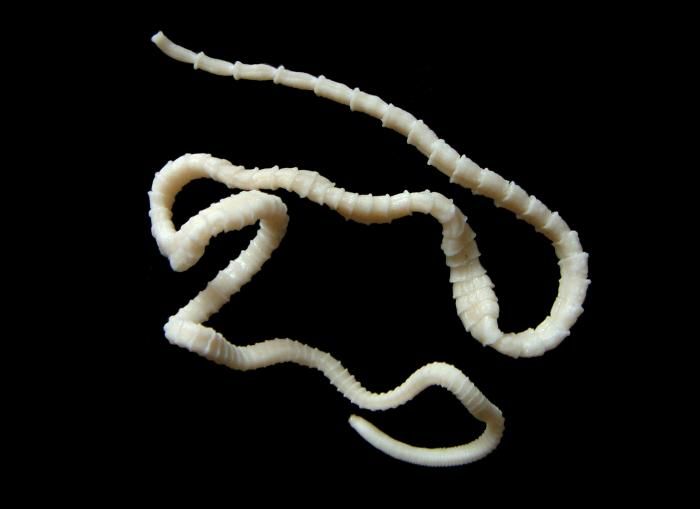
A tapeworm lives in the intestine of a cat absorbing nutrients through its skin. A tapeworm and a cat have this type of relationship.

a)

mutualism

b)

parasitism

c)

commensalism

d)

competition

53.
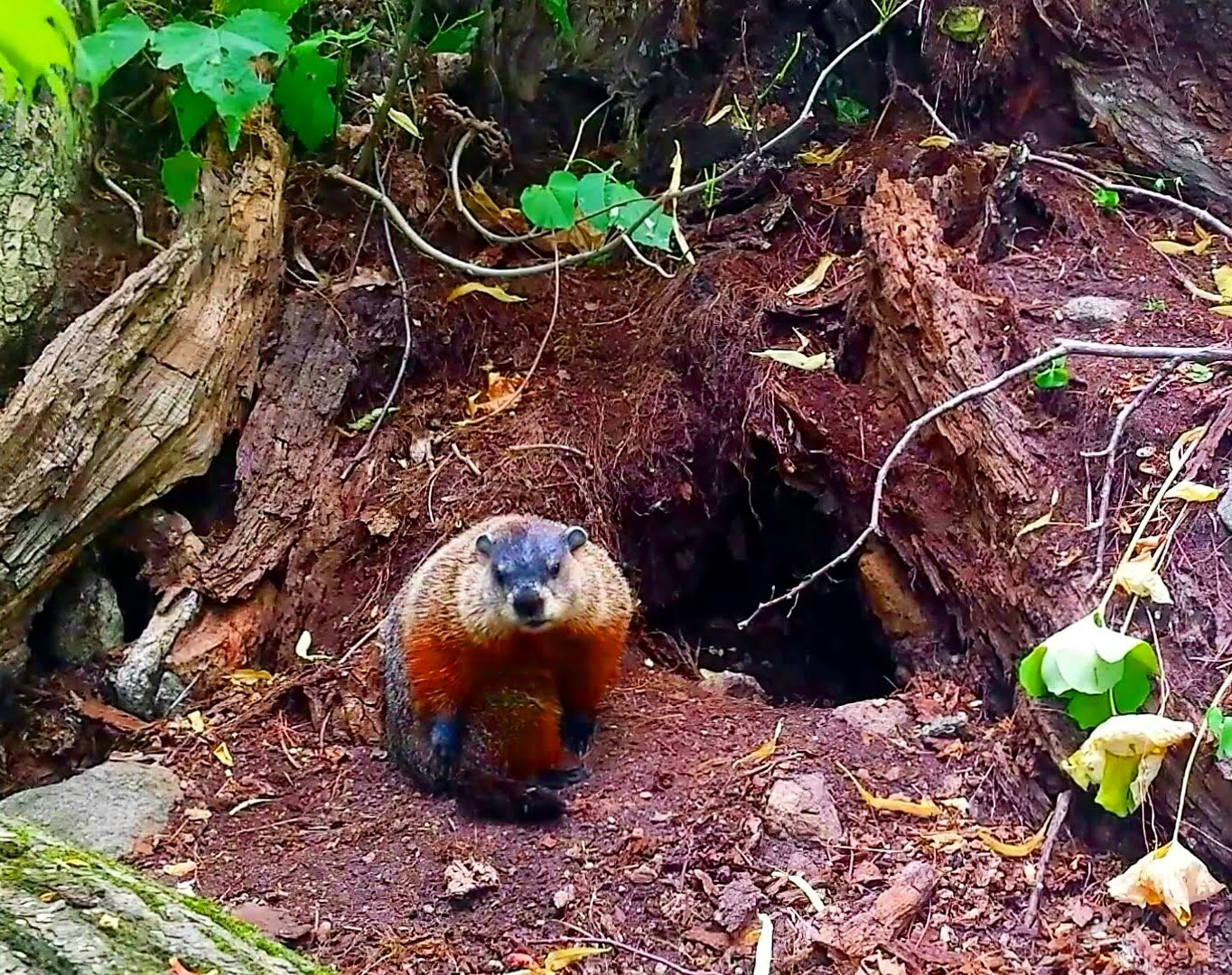
What type of symbiosis?  Skunks often live in burrows that have been dug and abandoned by woodchucks.  
a)
commensalism
b)
mutualism
c)
parasitism
d)
predation
54.
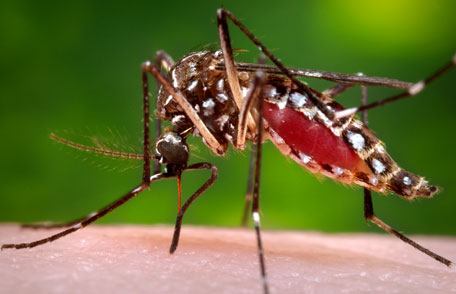
When a mosquito bites you, you are the __________ and the mosquito is the  ____________.
a)
host, hostess
b)
parasite, host
c)
host, parasite
d)
prey, predator
55.

Barnacles create home sites by attaching themselves to whales. As the barnacle is a filter feeder, it also gets access to more water (and more food) due to the relationship. Whale is unaffected.

a)

symbiosis

b)

parasitism

c)

mutualism

d)

commensalism

56.

Remoras attach themselves to a shark’s body. They travel with the shark and feed on the leftover food scraps after the shark has finished its meal, not taking any food from the shark or slowing it down when swimming.

a)

symbiosis

b)

parasitism

c)

mutualism

d)

commensalism

57.
About ___ percent of the planet is covered in ocean
a)
25
b)
50
c)
85
d)
70
58.
To measure primary productivity, you can measure carbon dioxide consumption, total carbohydrates produced or ________________.
a)
dissolved oxygen
b)
total proteins produced
c)
light energy entering system
59.
Would salt water or fresh water be expected to have a greater concentration of dissolved oxygen?
a)
salt water
b)
fresh water
c)
they would be equal
60.
Which environment would have a greater amount of dissolved oxygen, warm water (31degrees C) or cool water (18 degrees C)?
a)
warm
b)
cool
c)
they would be the same
61.

Autotrophs

a)

use photosynthesis.

b)

are at the top of the food chain.

c)

are able to survive without oxygen.

d)

cannot assimilate carbon.

e)

are primary consumers.

62.

The gross primary productivity of an ecosystem is

a)

the biomass of the producers.

b)

the energy capured after accounting for respiration

c)

the total amount of biomass.

d)

the total energy captured by photosynthesis.

e)

the energy available to primary consumers.

63.

Any green plant or any of various microorganisms that can convert light energy or chemical energy into organic matter.

a)

Heterotroph

b)

Primary producer

c)

Marine Snow

d)

Bacteria

64.

An organism that cannot produce its own food, instead taking nutrition from other sources of organic carbon, mainly plant or animal matter.

a)

chemoautotroph

b)

mixotroph

c)

autotroph

d)

heterotroph

65.

An organism which derives its energy from chemicals, and needs to consume other organisms in order to live. (almost always bacteria)

a)

chemoautotroph

b)

mixotroph

c)

autotroph

d)

heterotroph

66.
Increasing temperature can increase enzyme activity to a certain point. Then what happens?
a)
The enzymes have completed all the reactions so stop
b)
The enzymes have been denatured or destroyed
c)
Nothing - the rate continues to increase all the time
67.
If a plant receives more carbon dioxide, what happens to the rate of photosynthesis?
a)
Increases
b)
Decreases
c)
Stays the same
68.
What human activity affects the environment in such a way that algae blooms increase?
a)
agriculture
b)
fertilizer run off increases nutrients in ground water
c)
people contaminating fresh water sources
d)
all of the above
69.
A scientist set up an experiment to see how vinegar affects plant growth. Five seed pots received a small amount of vinegar in the soil and were placed in the sunlight. Another five pots received no vinegar and were placed in the shade. The scientist grew the seedlings for two months. Which explains why her experiment was not set up properly?
a)
More than one variable was changed.
b)
She did not have a control.
c)
She did not grow the plants long enough.
d)
Vinegar should not be used on plants.
70.

Scientific theories...

a)

describe.

b)

explain.

71.

Which of the following words is used to describe a set of measurements that are closely grouped together, but not necessarily close to the actual value.

a)

precise

b)

accurate

72.

These are variables that can potentially distort the relationship between the IV and the DV.

a)

confounding variables

b)

confusing variables

c)

constructing variables

d)

extraneous variables

73.
A(n) ______ is a substance with a pH less than 7
a)
Acid
b)
Alkaline
c)
Base
d)
Buffer
74.

An acid

a)

is a substance that releases H+ ions when dissolved in water

b)

is a substance that does not release any ions when dissolved in water

c)

is a substance that releases OH- when dissolved in water

d)

releases an equal amount of OH- and H+ ions when dissolved in water

75.

What is a square called that we use to sample populations?

a)

grid

b)

quadrat

c)

cube

d)

quarter