
 Worksheets
ALG II - Graphs of QUADRATICS (Vertex, Standard &Factored) form
Total questions: 68
Worksheet time: 2hrs 37mins
In what form is the quadratic:
y=(x+3)(x−3) written?
standard form
vertex form
factored form
Given the quadratic:
Find the x-intercepts.
0 and 3
3 and -3
0 and -9
only 3
Given the quadratic:
Find the x-intercepts.
2 and 6
-3 and -6
-2 and 6
-6 and -2
Given the quadratic:
Find the value of x = 2(p+q)
(a)
Find the axis of symmetry of the quadratic below:
leave no spaces in your answer and include x=
remember x = 2a−b
(a)
What is the vertex of the quadratic:
y=−4(x+3)2−3
(3,-3)
(-4,-3)
(3,3)
(-3,-3)
In what form is the quadratic:
y=−4(x+3)2−6 written ?
standard form
vertex form
factored form
Will the quadratic below have a maximum or minimum?
y=−4(x+3)2
maximum
minimum
Which of the following quadratics are in vertex form?
Check all that apply.
y=−(x+5)2−2
y=(x+1)2−2
y=(x+7)(x−9)
y=4x2+2x−9
y=21(x−4)(x+2)
Which of the following quadratics are in factored form?
Check all that apply.
y=−(x+5)2−2
y=(x+6)(x−9)
y=4x2+2x−9
y=31(x−4)(x+2)
What is the y-intercept of the quadratic below?
6
1/3
-6
-1/3
What is the y-intercept?
f(x) = -2x2 + 4x - 6
6
-6
1
-1

Identify the vertex
(-1, -9)
(0, -8)
(-4, 0)
(0, 0)
Does the graph of
y = 2(x + 5)2 + 2
have a minimum or a maximum?
Minimum
Maximum
What is the formula to find the axis of symmetry?
x = 2−b
y = 2a−b
x = 2a−b
x = 2ab
Given: y = 2(x - 5)2 + 6, type the vertex as an ordered pair.
(a)

Which quadratic equation models the parabola shown?
y = (x-2)(x-5)
y = (x+2)(x+5)
y = -(x+2)(x+5)
y = -(x-2)(x-5)

What are the x-intercepts of the quadratic?
2 and 4
-2 and -5
2 and 5
-2 and -4

Which quadratic equation models the parabola shown?
y = (x-2)(x+5)
y = (x+2)(x+5)
y = -(x-2)(x-5)
y = -(x+2)(x+5)
What is the name of this form:
y = a(x - h)2 + k
vertex form
standard form
factored form
A parabola has a vertex at (-3, 2).
Where is the axis of symmetry?
y = -3
x = 3
x = -3
y = 2

Maximum or Minimum
Maximum
Minimum

What is the equation of the axis of symmetry?
y = 3
x = 3
x = -3
(3,-1)
Which function has a maximum at (2, 0)?


What is the vertex?
(-3, 0)
(3, 0)
(0, 18)
(18, 0)

Name the x-intercept(s)
0
2 and 4
4 and 0
(2, 4)

What is the y-intercept of the quadratic function?
2
4
-2
0

What is the equation for the axis of symmetry for the quadratic function shown?
y = -3
x = -3
x = 5
y = 5
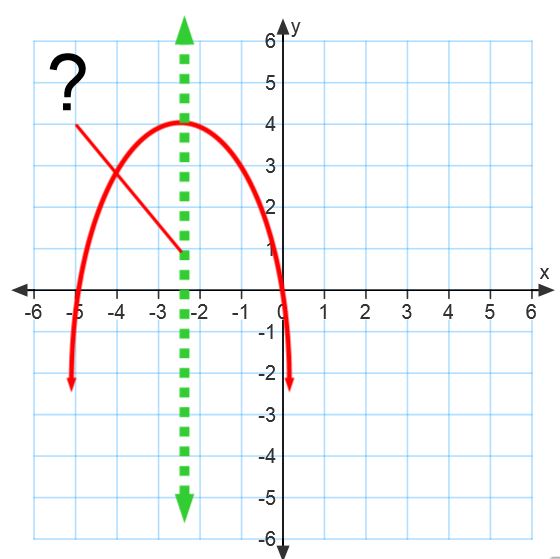
What is the green dashed line called?
x-intercepts
parabola
axis of symmetry
the vertex
Does the parabola open UP or DOWN?
y=−4(x+3)2
UP
DOWN

What are the green dots called?
y-intercepts
maximum
minimum
x-intercepts
Which of the following quadratics are WIDER than the standard quadratic ?
Check all that apply.
y=−(x+5)2−2
y=43(x+1)2
y=(x+6)(x−9)
y=4x2+2x−9
y=31(x−4)(x+2)
Which of the following quadratics have a REGULAR WIDTH? (look at the 'a' value)
Check all that apply.
y=−(x+5)2−2
y=43(x+1)2
y=(x+6)(x−9)
y=4x2+2x−9
y=31(x−4)(x+2)
Find the axis of symmetry for
f(x) = x2 - 8x + 15. Remember to calculate -b/2a
x = -4
x = 4
y = 4
y = -4
What is the axis of symmetry for
f(x) = 4(x - 2)2 + 3

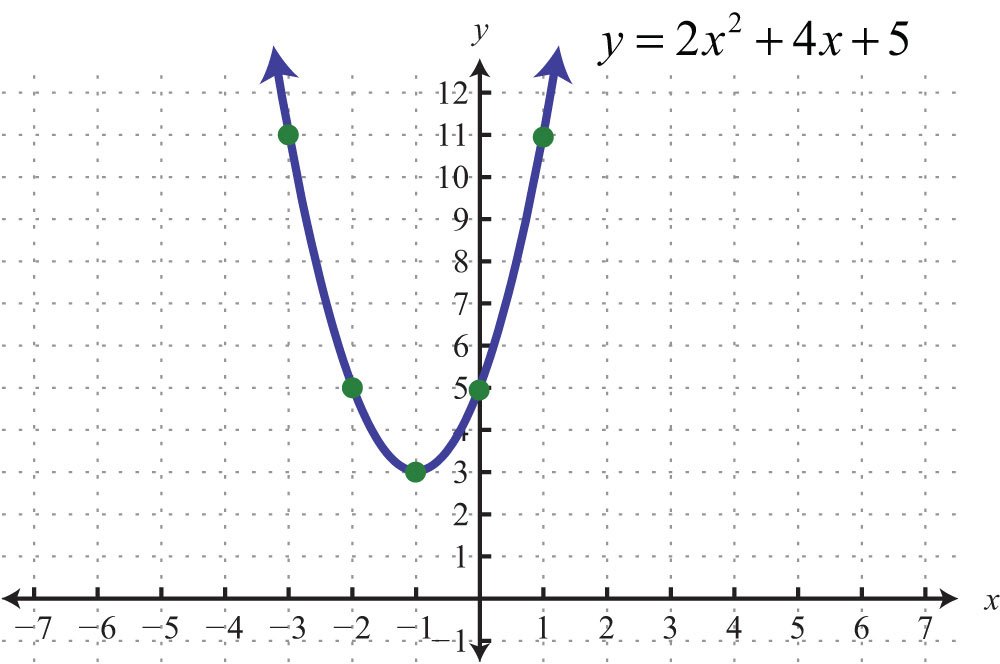
What is the y-intercept of this parabola?
(−1, 3)
(5, 0)
(−2, 5)
(0, 5)

What is the range of this quadratic?
[3, inf)
(-inf, 3]
(-inf, inf)
(-inf, 2]

The best form of a quadratic to find the Y-intercept.
Factored Form
Vertex Form
Standard Form
The best form of a quadratic to find the vertex.
Factored Form
Vertex Form
Standard Form
The best form of a quadratic to find the X-intercepts.
Factored Form
Vertex Form
Standard Form
What is the y-intercept of this parabola?
(−1, 3)
(5, 0)
There isn't one
(0, 5)
What is the axis of symmetry of the quadratic below: Remember -b/2a
y=3x2−6x+8
Leave NO spaces in your answer.
(a)
What is the vertex of the function
y = −4(x +7)2 − 8 ?
(a)
Given: y = 1/2(x + 4)2 - 5,
Find the axis of symmetry.
y = 4
x = -4
x = 4
x = -5
Given: y = 1/2(x + 4)2 - 5,
The graphed parabola will be:
Wider
More narrow
Regular width
Find the y intercept: (remember to ignore the x's and multiply)
y=−2(x−1)(x+3)
What is the value of c?
answer should be ONE number with no spaces
(a)
What is the vertex of the quadratic:
y=−4(x+3)2
(0,-3)
(-4,-3)
(-4,3)
(-3,0)

Match the following.
Standard Form
f(x)=ax2+bx+c
Vertex Form
f(x)=a(x−h)2+k
Intercept Form
f(x)=a(x−p)(x−q)
f(x)=(x−3)(x−1)
Which form would you use if you want to find the x-intercepts?
f(x)=x2−4x+3
Which form would you use if you want to find the y-intercept?
f(x)=(x−2)2−1
Which form would you use if you want to find the vertex?
Match the following

y=(x−6)2+8

y=−(x+8)(x−6)

y=x2−6x+8

y=(x−6)(x+8)
f(x) = -2(x - 4)2 - 3
What is the standard form of a quadratic?
y = ax2 + bx + c
y = a(x - h)2 + k
y = mx + b
y = (x - h)(x - k)
What is the vertex form a quadratic?
y = ax2 + bx + c
y = a(x - h)2 + k
y = mx + b
y = (x - h)(x - k)
Given zeros of x = 3 and x = -1, what would the factored forms be?
y=(x - 3)(x - 1)
y=(x + 3)(x -1)
y=(x - 3)(x + 1)
Not enough information
Which equation matches the x-intercepts x=5,-7 ?
y=(x+5)(x-7)
y=(x-5)(x+7)
y=(x+5)(x+7)
y=(x-5)(x-7)

What is the axis of symmetry for this parabola?
x = 2
x = - 8
x = -1
y = -1
Which direction does the following equation open? y=−3(x+3)(x−2)
Down, because the 'a' value is positive.
Up, because the 'a' value is negative.
Down, because the 'a' value is negative.
Up, because the 'a' value is positive.

