
 Worksheets
Matter 1
Total questions: 73
Worksheet time: 57mins
Matter is anything that has:
energy
volume
mass and volume
style
How would you find the mass of an object?
Measure its dimensions with a ruler, and then multiply length x width x height
Water displacement
use a balance/scale
use a timer
How would you find the volume of an irregular shaped object?
use a ruler to measure its dimensions
water displacement
use a balance/scale
use a timer
How could you determine if a gold colored coin is made of gold?
You wouldn't be able to figure it out.
If it looks like gold, it's gold.
You could test the properties of the gold coin, like density and compare those to the properties of gold.
You would guess.
What is the density of a liquid if its volume is 100 mL and its mass is 50 g?
2.0 g/mL
175 g/mL
0.5 g/mL
6000 g/mL
True or False: The density of a specific type of material is an intensive property
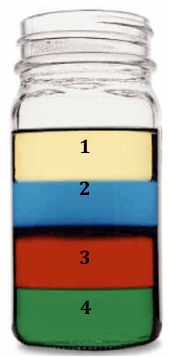
Put the layered liquids in order from most dense to least dense:
A rock has a mass of 14 g and a volume of 2 cm3. What is the density of the rock?
What type of mixture is chocolate chip ice cream?
Homogeneous
Heterogeneous
Which of the following are pure substances?
Carbon dioxide (CO2)
Chocolate Milk
Salt water
Nitrogen (N2)
Magnesium
Which of the following are mixtures?
Sodium bicarbonate (NaHCO3)
Steel (alloy of Fe + C)
Salt water (NaCl + H2O)
Gold (Au)
Beach Sand
Which of the following are compounds?
Ammonia (NH3)
Lemonade
Sugar (C12H22O11)
Blood
Jewelry Gold (gold and platinum)
Which of the following is an element?
Lead
Iron rust
(Iron oxide)
Aluminum
Silver sulfate
Which of the following is/are evidence of a chemical change?
Change of color (unintended)
Change of shape
Change of size
Change of odor
What is the best evidence that a chemical change has occurred?
Change of color
Production of Bubbles
Change of state/phase
a new substance is made
Which of the following is/are just physical changes?
Change of size
Reaction with acid
Change of state of matter
Change of how something smells
Which of the following are examples of intensive properties?
Conductivity
Mass
Length
Density
Volume
Which of the following are examples of chemical properties?
Conductivity
Flammability
Reactivity
Malleability
Which of the following are examples of chemical changes?
Burning paper
Cutting paper
Iron rusting
Wrinkling paper
Which of the following are physical changes?
Cutting your hair
Fruit rotting
Water boiling
Dropping an alka-seltzer in water
Which of the following are extensive properties?
Mass
Volume
Density
Temperature
Which of the following is NOT an example of matter?
Sunglasses
Beach Towel
Sunlight
Water
The smallest unit of an element that retains the properties of that element is called a(n)
Element
Compound
Atom
Molecule
Solids, liquids, and gases are three phases of matter that
Have mass
Take up space
Are made up of atoms
All of the above
Which of the following is NOT a pure substance?
Element
Compound
Homogeneous Mixture
Molecule
Which property of a substance is not affected by a physical change?
Reactivity
Size
Position
Shape
The different substances in a mixture
keep most of their physical properties
cannot be separated
combine chemically
Which of the following causes a chemical change?
Moving
Melting
Burning
Shattering
Unlike a mixture, a pure substance has
Atoms
Molecules
A specific size
A fixed composition
Which of the following is an example of a chemical change?
Ice melting
Iron rusting
Pounding gold into a thin foils sheet
A puddle evaporating
Which of the following is a homogeneous mixture?
Diamond
Sugar Water Solution
Hydrochloric Acid
(HCl)
Iron
Which of the following is a heterogeneous mixture?
Ammonia
A dog
Bronze
Carbon dioxide
Which of the following is an example of a compound?
Titanium
Solid CO2
(dry ice)
Radium
Helium
How does filtration work?
The stickiest dyes travel up the shortest distance.
Holes in the paper only allow the smaller particles through.
The lower boiling point liquid travels furthest.
Magnetic particles cling to the paper.
Which of the following are all pure substances?
Salt, sugar, milkshake
Gold, air and chocolate
Aluminium, Iron, carbon dioxide
Tap water, sea water, cocoa powder
Which statement is False
Compounds can be separated by chemical methods.
Heterogeneous mixtures are made of more than one substance.
Compounds are not mixtures.
Elements can be separated by chemical means
Melting point is
an extensive property
The time it takes for something to melt
The temperature at which a solid substances melts
The temperature at which the vapor pressure of a liquid is equal to the pressure of the atmosphere on the liquid.

If an object floats in water, it means the object is ________ than the water.
more dense
more massive
less massive
None of the above

Which best represent a compound?
F and E and H
A and D and I
G and D
B and I and G
__________ assume the shape of a closed container
Liquids
Gases
Solids
Which best represent an Element
F and E and H
A and E and I
G and D
B and I and G
a mixture that looks the same throughout
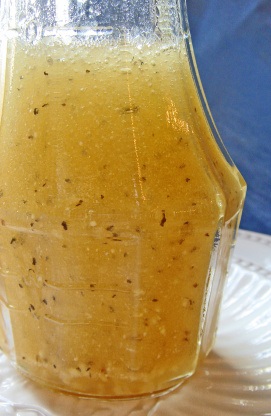


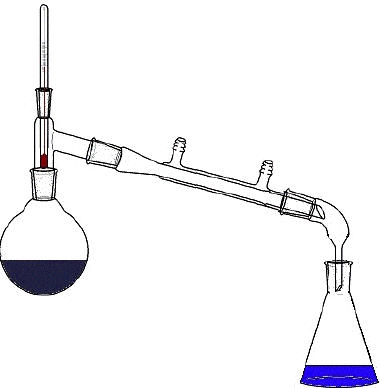
James wants to seperate the salt from the water in his glass of salt water. What seperation method should James use?
Magnets
Evaporation
Filter
Using his hands


Which best represent a mixture?
F and E and H
A and D and I
G and B and C
B and I and G
If something looks homogeneous, what might it be?
Element
Compound
Homogeneous Mixture
Heterogeneous Mixture
Which is two or more elements chemically combined in a fixed ratio?
Element
Compound
Homogeneous Mixture
Heterogeneous Mixture
True or False: Chemical changes can not be reversed
True
False
Which is not a method that can be used to separate a substance from a mixture without altering the identity substances?
Filterring
Distillation using Boiling Point
Magnetic Separation
Reactivity with acid
Which contains particles that are arranged in a crystalline structure and only have vibrational KE?
H2O(l)
Fe(s)
He(g)
NaCl(aq)
Which would have a defined volume and shape?
H2O(l)
Fe(s)
He(g)
NaCl(aq)
Which is a mixture?
H2O(l)
Fe(s)
He(g)
NaCl(aq)
Which has translational, rotational and vibrational KE, and has a defined volume?
H2O(l)
Fe(s)
He(g)
NaCl(aq)
Which of the following would have the largest distance between the particles if they are all the same substance?
Solid
Liquid
Gas
A sample of pure water from Venezuela as compared to a sample of water from the USA will be
Exactly the same chemically
Different given the amount of dissolved substances in each
Similar but the composition of Hydrogen to Oxygen will not be exactly the same
Which is not a compound?
N2
MgO
C6H12O6
NaCl
Which is a single substance?
Air
Salt water
Ammonia
Steel
Two different samples are heated and both decompose into substances with different properties. One of the original samples is soluble in water and the other is not. Both look homogeneous. What can you conclude?
Both are elements but they are not the same
Both are the same compound
Both are compounds but they are not the same
Both are mixtures but they are not the same
What type of property is electrical conductivity?
physical and intensive
physical and extensive
chemical and intensive
chemical and extensive
What type of property is reactivity to acid?
physical and intensive
physical and extensive
chemical and intensive
chemical and extensive
What type of property is mass?
physical and intensive
physical and extensive
chemical and intensive
chemical and extensive
You perform paper chromatography using water on two different black inks. One stays put and the other separates into yellow , red and blue dyes. The blue travels furthest then red then yellow. Which is true?
Both dyes are soluble in water
The blue dye molecules are the smallest
The yellow dye molecules are the smallest
Chapnick is the smallest

