wayground logo

Free Printable Worksheets

Font size

S
M
L
XL
Worksheets

Fall Check-point

Total questions: 76

Worksheet time: 3hrs 21mins

Name
Class
Date
1.
What kind of acceleration is shown here?
a)
positive
b)
negative
c)
none
d)
varies
2.
What kind of acceleration is shown here?
a)
positive
b)
negative
c)
none
d)
varies
3.
What kind of acceleration is shown here?
a)
none
b)
positive
c)
negative
d)
varies
4.
What is the velocity?
a)
not moving
b)
increasing
c)
positive
d)
negative
5.
What is the velocity?
a)
positive
b)
negative
c)
decreasing
d)
increasing
6.
What is the velocity?
a)
positive
b)
negative
c)
decreasing
d)
increasing
7.
What is the velocity?
a)
0 m/s
b)
positive m/s
c)
negative m/s
d)
decreasing
8.
Is the speed constant or non-constant?
a)
constant
b)
non-constant
9.
Is the speed constant or non-constant?
a)
constant
b)
non-constant
10.
Is the speed constant or non-constant?
a)
constant
b)
non-constant
11.
Which section of the graph shows decreasing velocity?
a)
CD
b)
DE
c)
EF
d)
GH
12.
Which section of the graph shows increasing velocity?
a)
AB
b)
BC
c)
DE
d)
EF
13.
Which section of the graph shows deceleration?
a)
AB
b)
BC
c)
EF
d)
GH
14.
In which of the following graphs (click the image) are both runners moving at the same speed (note that graph c is the bottom right graph, and graph d is the bottom left graph)? 
a)
Graph A
b)
Graph B
c)
Graph C
d)
Graph D
15.
The picture of the position vs. time graph shows an object that is...
a)
accelerating/speeding up
b)
moving at a constant speed 
c)
not moving 
d)
accelerating/slowing down. 
16.
Acceleration is defined as the CHANGE in 
a)
time it takes for one place to move to another place. 
b)
velocity of an object.
c)
distance divided by the time interval 
d)
velocity divided by the time interval 
17.
Why does a car accelerate as it round a corner at a constant speed?
a)
Its direction changes
b)
It doesn't
c)
It slows down
d)
Its speeds up  
18.
Determine the motion of the car.
a)
at rest 
b)
moving at constant speed
c)
speeding up
d)
slowing down
19.
Determine the motion of the car.
a)
at rest 
b)
constant velocity 
c)
speeding up
d)
slowing down
20.
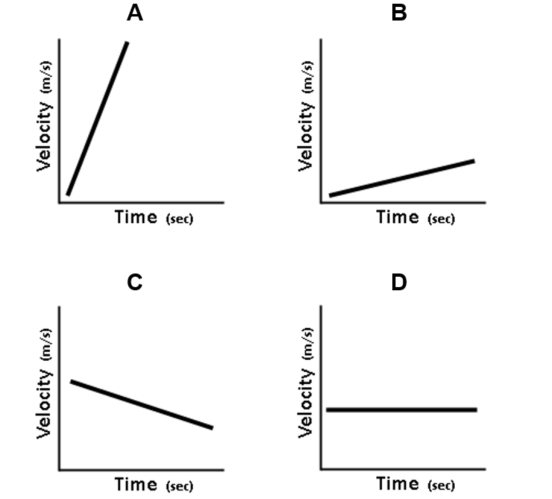
Which graph shows the object standing still?
a)
A
b)
B
c)
C
d)
D
21.
Which graph demonstrates the greatest positive speed?
a)
A
b)
B
c)
C
d)
D
22.
Which graph represents zero acceleration (constant velocity)?
a)
A
b)
B
c)
C
d)
D
23.
Which graph represents the greatest acceleration?
a)
A
b)
B
c)
C
d)
D
24.
What law is best described by inertia?
a)
1st
b)
2nd
c)
3rd
d)
law of conservation of mass
25.
a)
1st
b)
2nd
c)
3rd
d)
law of motion
26.
Equal and Opposite
a)
1st
b)
2nd
c)
3rd
d)
speed 
27.
What Unit do we Measure Force in? 
a)
Newtons
b)
Joules
c)
Force
d)
Kilograms
28.
With unbalanced forces, the object will move in the direction that the _______ force is being applied.
a)
larger 
b)
smaller 
c)
equal 
d)
less
29.
What is Newton's First Law
a)
F=ma
b)
Every action has an equal and opposite reaction
c)
An object at rest stays at rest, an object in motion stays in motion. 
d)
Friction 
30.
A person is pushed forward into their seatbelt when a car stops
a)
1st
b)
 2nd
c)
2 and 3
d)
3rd 
31.
Which type of force(s) will cause a change in an object's motion?
a)
gravity
b)
zero net force
c)
balanced forces
d)
unbalanced forces
32.
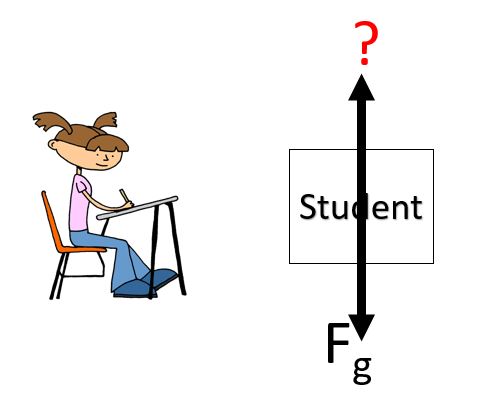
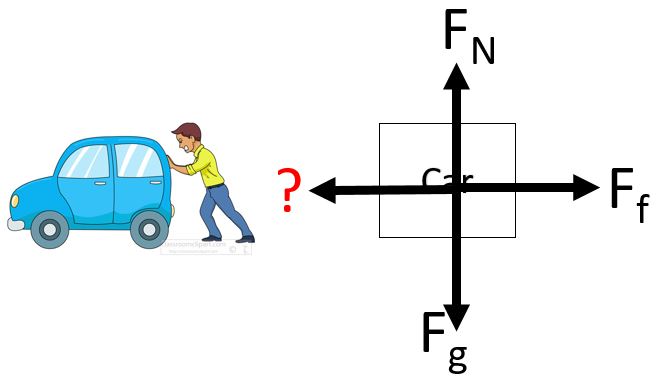
Name the missing force....
a)
weight force
b)
normal force
c)
frictional force
d)
tension force
33.
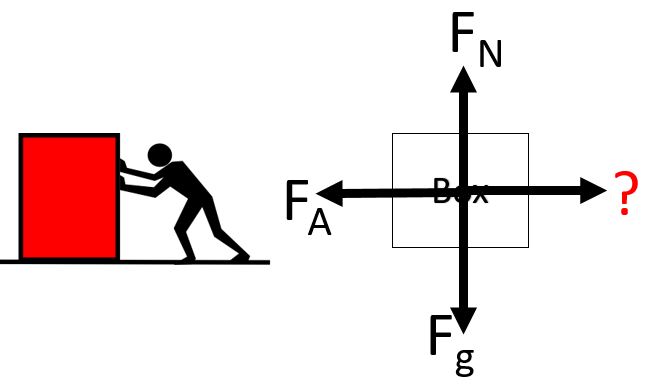
Name the missing force...
a)
frictional force
b)
weight force
c)
thrust
d)
buoyant force
34.
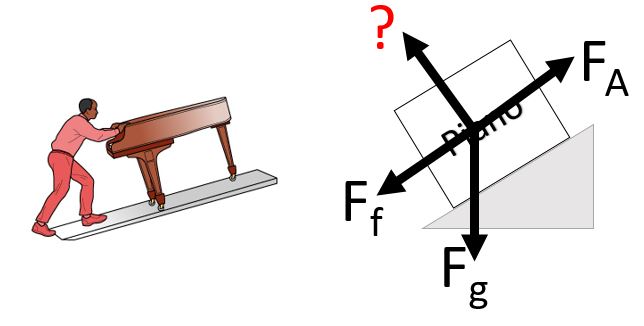
Name the missing force...
a)
normal force
b)
applied force
c)
frictional force
d)
tension force
35.
Name the missing force...
a)
applied force
b)
weight force
c)
tension force
d)
drag
36.

Whenever an object is moving, there is always this force opposing the motion:

a)

inertia

b)

momentum

c)

friction

d)

applied force

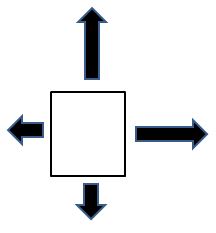
37.

This object would be moving (pick all that are correct):

a)

up

b)

down

c)

left

d)

right

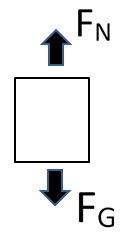
38.

Which of the following is true about this free-body diagram?

a)

the forces are are balanced

b)

the object is free-falling

c)

the object is moving upward

d)

the forces are unbalanced

39.
A box is moving to the left up a ramp. Which way is the force of friction pointing?
a)
down the ramp to the right
b)
up the ramp to the left
c)
there is no friction
d)
straight up
40.
A type of friction that occurs when air pushes against a moving object causing it to decelerate.
a)
surface area
b)
air resistance
c)
velocity
d)
gravity 
41.
Is this a scalar quantity or a vector quantity?
A deer running 15 meters per second due west
a)
Scalar
b)
Vector
42.
Which of the following units best represents an acceleration?
a)
50 m
b)
50 s
c)
50 m/s
d)
50 m/s/s
43.
The law of universal gravitation is credited to whom? 
a)
Einstein 
b)
Galileo
c)
Darwin
d)
Newton 
44.
Two factors effecting the magnitude of force of gravity between 2 objects are...
a)
weight and mass 
b)
distance and weight 
c)
mass and matter 
d)
mass and distance 
45.
As distance between objects increases the pull of gravity...
a)
increases 
b)
decreases 
c)
Stays the same 
46.
The amount of matter in an object.
a)
force 
b)
mass
c)
weight 
d)
pressure 
47.
A person would weigh less on the moon than on the Earth because...
a)
the moon has less mass, and therefore less gravity
b)
the moon has more mass, and therefore less gravity
c)
the moon has less mass, and therefore more gravity
d)
the moon has more mass, and therefor more gravity
48.
The purpose of crumble zones on a car is to
a)
decrease time of impact.
b)
increase force of impact.
c)
increase the time of impact.
d)
decrease the impulse during impact.
49.
The difference between a car hitting a wall vs. a car hitting a hay stack is
a)
the Impulse on the car hitting the wall is greater
b)
the change in momentum of the car hitting the wall is greater
c)
the force on the car hitting the hay stack is greater
d)
the collision time of the car hitting the hay stack is greater
50.
The impulse-momentum theorem states that
a)
the impulse on an object is equal to the change in momentum it causes 
b)
the force on a moving object is equal to the magnitude of the impulse.
c)
the impulse on an object is greater than the change in momentum it causes 
d)
the impulse on an object is less than the change in momentum it causes
51.
can a bullet have the same momentum a truck?
a)
yes
b)
no
52.

The momentum of an object depends upon the object's ___________&_____________.

a)

size and shape

b)

mass and speed

c)

mass and veloctiy

d)

mass and energy

53.

Determine the momentum of 1,000-kg car moving northward at 20 m/s.

a)

20,000 N

b)

20,000 Joules

c)

20,000 Kg * m/s

d)

20,000 kg * m/s north

54.

When the speed of an object is doubled, its momentum...

a)

remains unchanged in accord with the conservation of momentum.

b)

doubles.

c)

quadruples.

d)

decreases.

55.
The total momentum before a collision is _________ the total momentum after a collision.
a)
equal to 
b)
less than 
c)
more than
d)
It depends on the type of collision
56.

Collisions where objects BOUNCE apart.

a)

inelastic collisions

b)

elastic collisions

c)

explosions

d)

none of these

57.

Two Pool Balls collide and then go separate directions.

a)

inelastic collision

b)

elastic collision

c)

explosion

d)

none of these

58.

Collision where objects collide, and stick together.

a)

inelastic collision

b)

elastic collision

c)

explosion

d)

none of these

59.

A ball thrown straight up takes 8 total seconds to complete its journey all the way up and down. 1 second into its journey and 7 seconds into its journey the magnitude of its velocity will be ______________ and its direction _______________.

a)

opposite, the same

b)

the same, opposite

c)

the same, the same

d)

opposite, opposite

60.

The fact that an apple and a watermelon, dropped simultaneously from the same height, would hit the ground at the same time indicates that

a)

you don't like apples or watermelons.

b)

greater masses have greater acceleration.

c)

lesser masses have greater acceleration.

d)

acceleration is independent of mass.

61.

The initial horizontal velocity of a projectile is ____ its final horizontal velocity.

a)

less than

b)

equal to

c)

greater than

62.

What is true about the vertical velocity of a projectile launched horizontally?

a)

It is initially at its maximum value.

b)

It increases due to gravity as it falls.

c)

It remains constant throughout its trajectory.

d)

It decreases as it falls due to gravity.

63.

Which hits the ground first if they start at the same height: a dropped ball or a ball launched with a

horizontal velocity?

a)

the launched ball

b)

the dropped ball

c)

they both hit at the same time

64.

What is the velocity of an object launched straight up at its highest point?

a)

zero

b)

equal to its vx

c)

½ its maximum value

d)

equal to gravity

65.

The path followed by a projectile is also known as its

a)

trajectory

b)

range

c)

height

d)

vertical displacement

66.

Once a projectile is launched, what is the only force that affects its motion?

a)

mass

b)

friction

c)

inertia

d)

gravity

67.

Which of the following statements about the horizontal and vertical components of projectile motion is true?

a)

Changes in the horizontal component occur only when the vertical component changes.

b)

Both the horizontal and vertical components are always constant.

c)

The vertical component changes while the horizontal component stays the same.

d)

The horizontal and vertical components are dependent of each other.

68.
What is the horizontal acceleration of a projectile?
a)
0 m/s2
b)
9.8 m/s2
69.
What is the vertical acceleration of a projectile?(neglect air resistance) 
a)
0 m/s2
b)
9.8 m/s2
70.

In a projectile motion we always have...

a)

1 component (x)

b)

3 components (x,y, and z)

c)

2 components (x and y)

d)

0 components

71.
Energy due to motion is ____________ energy. 
a)
Potential 
b)
Energy
c)
Kinetic
d)
Friction
72.
The faster an object moves, the ________ kinetic energy it has. 
a)
more
b)
less
c)
none of the above
d)
all of the above 
73.
__________ is stored energy. 
a)
Potential
b)
Kinetic
c)
None of the above 
d)
All of the above 
74.
Gravitational potential energy depends on the ________ and ________ of the object. 
a)
Height and mass
b)
Friction and movement
c)
Mass and Movement
d)
Height and Friction 
75.
What kind of energy is in a rock at the edge of a cliff?
a)
Potential
b)
Kinetic
76.
What kind of energy is in a moving skateboard?
a)
Potential
b)
Kinetic