wayground logo

Free Printable Worksheets

Font size

S
M
L
XL
Worksheets

Unit 2- Forces Review

Total questions: 83

Worksheet time: 2hrs 48mins

Name
Class
Date
1.
What is the formula for force?
a)
F=M/A
b)
F=A/M
c)
F=M*A
d)
F=M*F
2.
45 m/s2 is the... 
a)
Mass
b)
Force 
c)
Acceleration
d)
weight
3.
If a force of 26 N is exerted on two balls, one with a mass of 0.52 kg and the other with a mass of 0.78 kg, which ball will have the greater acceleration?  (F=ma)
a)
The one with a mass of .78 kg will have the greatest acceleration.
b)
The one with a mass of .52 kg will have the greatest acceleration.
c)
They will both accelerate at the same rate.
4.
A 20 kg bike accelerates at 10 m/s2.  what was the force?
a)
25 Newtons
b)
20 Newtons
c)
200 Newtons
d)
10 Newtons
5.
Unit of mass
a)
m/s 2
b)
m/s
c)
newtons
d)
kg
6.

A student pushes a box to right with a force of 10N while a young boy pushes the box to the left with a force of 8N. What is the net force on the box? 

a)
18N left
b)
18N right
c)
2N right
d)
2N left
7.
If net force acting on object is 0, then the force is considered to be..
a)
Balanced
b)
Unbalanced
c)
Equal in Direction
d)
Distance/Time
8.
A cat sitting on couch, a pencil on desk and a car at rest are all example of..
a)
Balanced Force
b)
Unbalanced Force
9.
A car speeding up, a dog slowing down and person turning around the block are examples of..
a)
Balanced Forces
b)
Unbalanced Forces
10.
What is Newton's First Law known as? The Law of
a)
Friction
b)
Mass
c)
Inertia
d)
Gravity
11.
Which type of force(s) will cause a change in an object's motion?
a)
gravity
b)
zero net force
c)
balanced forces
d)
unbalanced forces
12.
What is Newton's First Law
a)
F=ma
b)
Every action has an equal and opposite reaction
c)
An object at rest stays at rest, an object in motion stays in motion. 
d)
Friction 
13.
This equation goes with which law?
a)
Newton's first law of motion
b)
Newton's second law of motion
c)
Newton's third law of motion
d)
None of these
14.
Which of Newton's laws is illustrated when a magician pulls a tablecloth out from under the dishes without disturbing them?
a)
first
b)
second
c)
third 
d)
fourth
15.
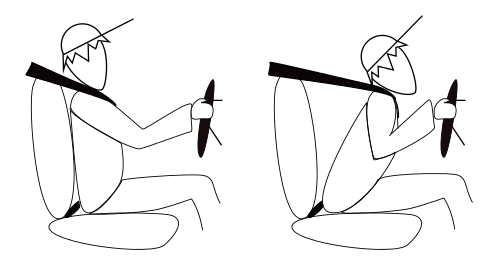
A person is pushed forward into their seat belt when a car stops.  Which law is this?
a)
1st
b)
 2nd
c)
2 and 3
d)
3rd 
16.
A bike accelerates at 10 m/s2 when a force of 50N is applied.  What is the mass of the bike and its rider?
a)
25 kg
b)
200 kg
c)
20 kg
d)
5 kg
17.
Which of Newton's Laws is illustrated with a large mass and a small mass accelerating?
a)
1st Law, the Law of Inertia.
b)
2nd Law, the Law of Acceleration
c)
3rd Law, the Law of Action Reaction
d)
The Law of Conservation of Mass
18.

When a heavy football player and a light one run into each other with the same acceleration, who exerts more force?

a)
The heavy one
b)
The light one
c)
They are equal
d)
There is no such thing as force 
19.
What is Newton's First Law of Motion?
a)
F = m x a
b)
Every action has an equal an opposite reaction
c)
An object at rests stays, an object in motion stays in motion
d)
Friction
20.
What pulls a ball back to earth?
a)
Gas
b)
Friction
c)
Gravity
d)
Molecules
21.
Which law best describes a satellite orbiting the earth?
a)
Law of Inertia
b)
Law of Mass and Acceleration
c)
Law of Action Reaction
22.
A _______ is a push or pull.
a)
Newton
b)
Acceleration
c)
Momentum
d)
Force
23.
What is Newton's Second Law of Motion?
a)
F = m x a
b)
Action/Reaction
c)
Object in motion will stay in motion, object at rest will stay at rest
d)
Velocity
24.
Which force produces a change in motion?
a)
Unbalanced force
b)
Balanced force
c)
Gravitational force
d)
Frictional force
25.
What is the standard unit force is measured in?
a)
Newton
b)
Gram
c)
Pound
d)
Meter
26.
According to Newton's Second Law, if you increase the force applied to an object:
a)
It accelerates more
b)
It doesn't move
c)
You get more inertia
d)
It decelerates
27.
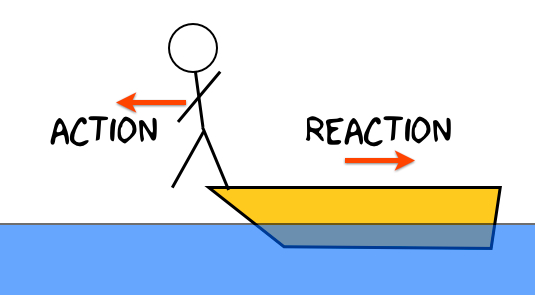
What Newton's law does this picture represent?
a)
Newton's 2nd law
b)
Newton's 1st law
c)
Newton's 3rd law
d)
Newton's 5th law
28.
1000 kg is the -----
a)
Force
b)
Mass
c)
Acceleration
d)
Weight
29.
20 N is the ----
a)
Mass
b)
Force
c)
Acceleration
d)
Weight
30.
45 meters per second squared is the--
a)
Acceleration
b)
Mass
c)
Weight
d)
Force
31.
If an object is stationary (not moving) the forces acting upon it are---
a)
Balanced
b)
Unbalanced
c)
Weak
d)
Hulk Smash?
32.
Forces always act in equal and opposite pairs.
a)
Newton's 1st Law
b)
Newton's 2nd Law
c)
Newton's 3rd Law
d)
Newton's 4th Law
33.

An object at rest will _____ if no outside forces are applied.

a)
Stay at rest
b)
Decrease mass
c)
Increase velocity
34.
Newton's Law of Inertia describes the motion of-
a)
Objects at rest only
b)
Objects in motion only
c)
Objects at rest and objects that are in motion
d)
Objects without a mass and resist being set into motion
35.
Which law best explains how objects accelerate when a force is applied?
a)
Newton's Law of Inertia
b)
Newton's Law of F=ma
c)

Newton's Law of Action and Reaction

d)
Newton's Law of Chemistry
36.
Which law best explains why the coin sitting on top of the ring falls directly into the jar below because it wants to remain at rest?
a)
Newton's Law of Inertia
b)
Newton's Law of F=ma
c)

Newton's Law of Action and Reaction

d)
Newton's Law of Science
37.
Which one of Newton’s Laws of Motion best explains why the dishes do not move when the table cloth is removed?
a)
Newton's Law of Inertia
b)
Newton's Law of F=ma
c)

Newton's Law of Action and Reaction

d)
Newton's Law of Biology
38.
Which law best explains why people remain in motion when a car crashes, if they are not wearing a seat belt?
a)
Newton's Law of Inertia
b)
Newton's Law of F=ma
c)

Newton's Law of Action and Reaction

d)
Newton's Law of Biology
39.
Which law best explains why more force must be applied to the bowling ball to make it accelerate at the same rate as the tennis ball. 
a)
Newton's Law of Inertia
b)
Newton's Law of F=ma
c)

Newton's Law of Action and Reaction

d)
Newton's Law of Biology
40.
Calculate the acceleration of the tire in the diagram.
a)
5.3 m/s2
b)
0.2 m/s2
c)
12.0 m/s2
d)
9.8 m/s2
41.
A man hits a 0.2 kg golf ball causing it to accelerate at rate of 20 m/s2. Calculate the force used on the golf ball.
a)
4 N
b)
100 N
c)
0.01 N
d)
20.2 N
42.
A force of 560 N is needed to produce an acceleration of 20 m/s2. What is the mass of the accelerated body?
a)
28 kg
b)
11200 kg
c)
0.04 kg
d)
580 kg
43.
If you double the mass of an object with the same force apply on it, the acceleration will
a)
double
b)
cut in half
c)
the same
d)
zero
44.
What kind(s) of objects have inertia?
a)
all objects with mass
b)
only objects at rest
c)
only objects in motion
d)
only objects whose motion is being changed
45.
Which one needs a greater net force to move, a kilogram of feathers or a kilogram of iron? 
a)
feathers 
b)
iron
c)
same
d)
depends on their friction
46.
After a cannonball is fired into frictionless space, the amount of force needed to keep it going equals
a)
twice the force with which it was fired
b)
the same amount of force with which it was fired
c)
1/2 the force with which it was fired
d)
zero, since no force is required to keep it moving. 
47.
The acceleration produced by a net force on an object is
a)
inversely proportional to the mass of the object.
b)
directly proportional to the magnitude of the net force.
c)
in the same direction as the net force.
d)
 all of the above
48.

A 10-kg brick and a 1-kg book are dropped in a vacuum. The Fg (weight) on the 10-kg brick is

a)

10 times as much as the force on the 1-kg book

b)

zero.

c)

the same as the force on the 1-kg book.

d)

none of the above

49.
A book weighs 4 N. When held at rest in your hands, the net force on the book is
 
a)
0 N.
b)
 0.4 N.
c)
 4 N.
d)
 39 N.
50.
A 20 kg bike accelerates at 10 m/s2.  what was the net force
a)
25 Newtons
b)
20 Newtons
c)
200 Newtons
d)
10 Newtons
51.
The tendency of an object to stay in motion or at rest is called 
a)
velocity
b)
acceleration
c)
speed
d)
inertia
52.
What is the difference between mass and weight?
a)
mass is how much matter is in an object, and weight is the gravitational pull on that object
b)
mass and weight are the same
c)
weight affects how much mass is in an object
d)
weight is determined by how many atoms make up an object
53.
What is the net force?
a)
5000 N right
b)
4000 N right
c)
40 N left
d)
4000 N left
54.
Which of the following shows the direction of the friction force?
a)
A
b)
B
c)
C
d)
D
55.
Which force produces a change in motion?
a)
unbalanced force
b)
balanced force
c)
gravitational force
d)
frictional force
56.
What is the standard unit force is measured in?
a)
Newtons
b)
pounds
c)
grams
d)
meters
57.
What is Newton's First Law known as? The Law of
a)
Friction
b)
Mass
c)
Inertia
d)
Gravity
58.
What is the formula for force?
a)
F=M/A
b)
F=MA
c)
F=AX
d)
what is force?
59.
According to Newton's second law, if you increase the force applied to an object :
a)
it accelerates more
b)
it doesn't move
c)
you get more inertia
d)
it decelerates
60.
What law of motion does this picture represent?
a)
Newtons 1st law
b)
Newtons 4th law 
c)
Newtons 3rd law 
d)
Newtons 2nd law
61.
What is Newtons 2nd law of motion?
a)
Pancakes 
b)
Force= Mass multiplied by acceleration
c)
For every action there is a equal and opposite  re-action.
d)
Law of gravity 
62.
What Newtons law does this picture represent
a)
Newtons 2nd law 
b)
Law of gravity 
c)
Newtons 1st law
d)
Newtons 5th law
63.
Newton's first law of motion states that __________.
a)
when a force is applied on an object, there is an equal force applied by the object in the opposite direction
b)
hen a force acts on an object, its acceleration is in the same direction as the force
c)
an object will remain at rest or keep moving with a constant velocity unless a force acts on it
d)
cceleration is calculated by dividing the force exerted on an object by the mass of the object
64.
What type of force?
a)
Magnetic
b)
Gravitational
c)
Applied
d)
Normal
65.
What type of force is holding this balloon to the wall?
a)
Applied
b)
Gravitational
c)
Magnetic
d)
Electrical
66.
What force holds the planets in motion around the sun?
a)
Magnetic
b)
Electrical
c)
Gravitational
d)
Air Resistance
67.
What force ultimately slows the roller coaster to a stop?
a)
Applied
b)
Normal
c)
Friction
d)
Magnetic
68.
Rina’s mother asked her to help move some items from the hall closet to the garage. One item she wanted to move was a large box of old school books. Rina tried to lift the box, but could not pick it up. What force was Rina NOT able to overcome? 
a)
frictional force
frictional forcefrictional force
b)
gravitational force
c)
electrical force
d)
magnetic force 
magnetic force
69.

Which of these free-body diagrams is the correct one for this object? (the key)

a)
b)
c)
d)
e)
70.

Which of these free-body diagrams is the correct one for this object? (the figure skater)

a)
b)
c)
d)
e)
71.

Which of these free-body diagrams is the correct one for this object? (person sitting in the chair, assuming their back is not resting on the back of the chair)

a)
b)
c)
d)
e)
72.

Which of these free-body diagrams is the correct one for this object? (the box, assuming it is being pushed to the right)

a)
b)
c)
d)
e)
73.

Which of the following is possible for an object with balanced forces acting on it? (Choose all that apply)

a)

at rest

b)

moving at constant speed

c)

changing direction

d)

slowing down

74.

Which of the following is possible for an object with unbalanced forces acting on it? (choose all that apply)

a)

Moving to the right with a constant speed of 3 m/s

b)

Moving to the left with rightward acceleration

c)

changing direction

d)

at rest

75.

Whenever an object is moving, there is always this force opposing the motion:

a)

inertia

b)

momentum

c)

friction

d)

applied force

76.

Which diagram best shows person pushing a couch (accelerating) across the floor?

a)
b)
c)
d)
77.

The force that keeps objects on top of surfaces instead of letting them sink into the surface is known as:

a)

normal

b)

abnormal

c)

static

d)

inertia

78.

The hockey puck is moving at a constant velocity across the ice. What forces does the puck experience at this moment?

a)

None

b)

Gravity

c)

Gravity and Normal

d)

Gravity, Normal, and Friction

e)

Gravity, Normal, Friction, and Applied

79.
What is a normal force?
a)
It always opposes gravity.
The same as a frictional force.
b)
It is equivalent to the weight of an object.
c)
It acts perpendicular to a contact surface.
d)
It is equivalent to inertia.
80.

Ted is trying to move a fridge through his house, he gets stuck on a carpet and even though he is pushing the fridge, it is not moving. What force is acting against him?

a)

applied

b)

static friction

c)

kinetic friction

d)

normal

81.

A downward-moving skydiver who has just opened the parachute is slowing down.

a)
b)
c)
d)
82.
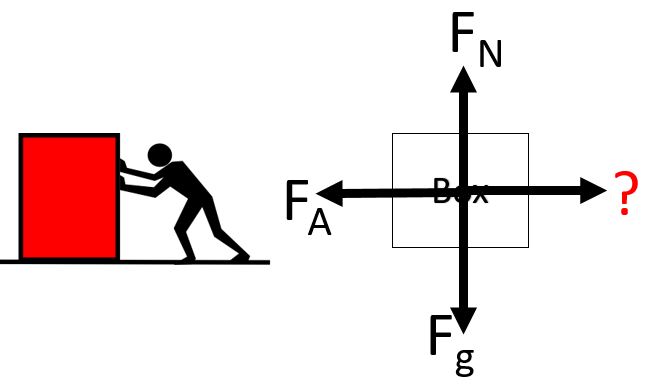
Name the missing force...
a)
frictional force
b)
weight force
c)
thrust
d)
buoyant force
83.
A type of friction that occurs when air pushes against a moving object causing it to decelerate.
a)
surface area
b)
air resistance
c)
velocity
d)
gravity