wayground logo

Free Printable Worksheets

Font size

S
M
L
XL
Worksheets

CHEMISTRY -END OF TERM 1 EXAMS (Grade 9)

Total questions: 201

Worksheet time: 4hrs 45mins

Name
Class
Date
1.

The charge of an ion is -3. This means the atom must have:

a)

Gained 3 protons

b)

Lost 3 protons

c)

Gained 3 electrons

d)

Lost 3 electrons

2.

If an ion is positively charged, it is referred to as a:

a)

Anion

b)

Cation

3.

Fill-in-the-blank: Elements in the same ____________ have similar chemical properties.

a)

group

b)

row

c)

period

4.

A sulfur atom has 16 protons and 16 neutrons. What is its atomic mass?

a)

16

b)

24

c)

32

d)

48

5.

Standard atomic notation includes:

a)

Element symbol

b)

Atomic mass

c)

Atomic number

d)

All of the above

6.

The periodic table has how many groups and periods

a)

19 groups and 8 period

b)

18 groups and 7 periods

c)

8 periods and 18 groups

d)

9 periods and 18 groups

7.

Which of the following is a compound

a)

Ne

b)

Ca

c)

Cl

d)

Ca2CO3

8.

Pepsi is an example of a __________ mixture

a)

homogeneous

b)

heterogeneous

9.

Elements in the same ____________ share the same physical and chemical properties

a)

Group

b)

Period

10.

According to the periodic table, Oxygen is in group _____ and period _____

a)

6A; 2

b)

2; 6A

c)

5; 8A

d)

7A; 2

11.

The amount of space an object takes up.

a)

Volume

b)

Density

c)

Mixture

d)

Mass

12.
Name the elements in
NaHCO3
a)
sodium, hydrogen, carbon, oxygen
b)
sulfur, hydrogen, cobolt
c)
sodium, hydrogen, cobolt
d)
sulfur, hydrogen, carbon trioxide
13.
What is the chemical name of NO2?
a)
Nitrogen dioxide 
b)
Dinitrogen dioxide
c)
Dinitrogen oxide 
d)
Dioxide nitrogen
14.
The measurement 0.0265 g, rounded off to two significant figures, would be
a)
0.026 g. 
b)
0.027 g.
c)
0.03 g.
d)
0.030 g.
15.
In division and multiplication, the answer should have the same number of significant figures as the
a)
number in the calculation with the fewest significant figures.
b)
number in the calculation with the most significant figures.
c)
average number of significant figures in the calculation.
d)
total number of significant figures in the calculation.
16.
What is the element name of the atom pictured? 
a)
Fluorine
b)
Neon
c)
Argon
d)
Potassium
17.
An element with a mass number of 11 and an atomic number of 5 has how many neutrons?
a)
11
b)
5
c)
6
d)
16
18.
Calculate the molar mass of Mg(OH)2.
a)
33.2 g/mol
b)
41.3 g/mol
c)
86.9 g/mol
d)
58.3 g/mol
19.
The properties of an element can be predicted from...
a)
color
b)
location on Periodic Table
c)
educated guess
d)
atomic number
20.
What section is the least reactive? 
a)
yellow
b)
red
c)
dark blue
d)
orange
21.
Anions are _______ that form ____________ ions and __________ electrons.
a)
nonmetals, positive, lose
b)
nonmetals, negative, gain
c)
metals, positive, gain
d)
metals, positive, lose
22.
What is the charge does a sodium ion have?
a)
+2
b)
+1
c)
-1
d)
-2
23.
Which is most likely to form a negative ion?
a)
an element from group 17
b)
a metal
c)
an element from group 1
d)
an element with atoms that have eight valence electrons
24.
Which is most likely to form a negative ion?
a)
an element from group 17
b)
a metal
c)
an element from group 1
d)
an element with atoms that have eight valence electrons
25.

A __________ is a subatomic particle with a negative charge.

a)

proton

b)

neutron

c)

electron

d)

nucleus

26.

Group 17 is known as

a)

Semi-metal

b)

Halogen

c)

Transition metal

d)

Gas

27.

Rows on the periodic table are called ___________.

a)

Periods

b)

Sentences

c)

Fences

28.

What block is represented by the colour red?

a)

p-block

b)

d-block

c)

s-block

d)

f-block

29.
A chemical bond resulting from the electrostatic attraction between positive and negative ions is called a(n)
a)
covalent bond.
b)
ionic bond.
c)
charged bond.
d)
dipole bond.
30.

Valence electrons are found

a)

in the innermost energy level of an atom

b)

in the middle energy levels of an atom

c)

in the outermost energy levels of an atom

31.
SiCl4
a)
silicon tetrachloride
b)
silicon quadchloride
c)
monosilicon tetrachloride
d)
silicon chloride
32.
What is the correct name for NO?
a)
Mononitrogen Monoxide
b)
Nitrogen Monoxide
c)
Mononitrogen Dioxide
d)
Nitrogen Oxide
33.
What element do all acids contain?
a)
H
b)
O
c)
C
d)
He
34.

Always add the word "________" to the end when naming acids

a)

base

b)

hydro

c)

acid

d)

Baumstark

35.

An atom has the atomic number of 14.

How many valence electrons this atom has?

a)

8

b)

3

c)

4

d)

6

36.
The chemical formula for sulfuric acid is H2SO
How many atoms are present?
a)
3
b)
6
c)
7
d)
10
37.
What is the relative formula mass of NaOH?
a)
20
b)
39
c)
40
d)
45
38.

Find Atomic Mass: What is the mass of one mole of Lithium (Li)?

a)

6.9 grams

b)

14.0 grams

c)

22.9 grams

d)

56.9 grams

39.

Find Molecular Mass: Calculate the mass of one mole of CO2 (carbon dioxide).

a)

18.0 grams

b)

44.0 grams

c)

14.0 grams

d)

180.0 grams

40.

Calculate the molecular mass of Na3PO4.

a)

164 amu

b)

133 amu

c)

257 amu

d)

170 amu

41.

Calculate the molecular mass of Zn(C2H3O2)2.

a)

185 amu

b)

180 amu

c)

183 amu

d)

179 amu

42.

Calculate the mass of 3SO2.

a)

64 amu

b)

128 amu

c)

192 amu

d)

200 amu

43.

Calculate the mass of 2Cl2F2.

a)

108 amu

b)

89 amu

c)

111 amu

d)

216 amu

44.

Rosie calculated the mass of Mg(OH)2. by adding 24 amu, 16 amu, and 1 amu together.


What would you tell Rosie?

a)

Rosie forgot about the coefficient.

b)

Rosie forgot an element.

c)

Rosie is correct!!

d)

Rosie ignored the subscript outside the parentheses.

45.
What is the mass number?
a)
the number of protons
b)
the number of protons and neutrons
c)
the number of neutrons
d)
the number of protons and electrons
46.
The relative atomic mass is the average mass of an atom compared to 
a)
the mass of a carbon-12 atom.
b)
1/12 the mass of a carbon-12 atom
c)
the mass of a hydrogen atom
d)
1/12 the mass of a hydrogen atom
47.
What is the relative molecular mass of fluorine gas, F2?
a)
19
b)
38
c)
9
d)
18
48.

Calculate the relative formula mass of

copper (ii) chloride, CuCl2


[Relative atomic mass:

O = 16 ; Al = 27 ; S = 32 ; Cl = 35.5 ; Cu = 64 ]

(a)  

49.
What is the relative formula mass of NaOH?
a)
20
b)
39
c)
40
d)
45
50.

Calculate the relative formula mass of

aluminium sulphate, Al2(SO4)3


[Relative atomic mass:

O = 16 ; Al = 27 ; S = 32 ; Cl = 35.5 ; Cu = 64 ]

(a)  

51.

The atomic mass of an element is the ___.

a)

average of the mass number and the atomic number for the element

b)

weighted average of the masses of the isotopes of the element

c)

total mass of the isotopes of the element

d)

total number of subatomic particles in the nucleus

52.

What is the scientific notation for 1,079,000,000,000,000 (Hint, count the number of zeros)

a)

1,079x1012

b)

1.0x10¹⁵

c)

1.079x10¹⁹

d)

1.079x10¹⁵

53.

How many zinc(II) atoms are in 65.4 grams of zinc (Zn). (Hint: Look at the periodic table for the Molecular Weight of Zinc. Remember that Grams = MW x Moles)

a)

10

b)

4,277.2

c)

6.02x10²³

d)

130.8

54.

Which is the smallest number show below?

a)

1x10⁻³

b)

0.001

c)

0.0003

d)

1x10⁻⁶

55.

What is the scientific notation for 1,188,000,000,000 ?

a)

1,188x105

b)

1.857x10¹⁵

c)

1.888x10⁻¹²

d)

1.188x10¹²

56.

How many protons are there in 6.0 g of nitrogen gas?


Avogadro constant, L = 6.022 × 10²³ mol–1

a)

1.3 × 10²³

b)

9.0 × 10²³

c)

1.8 × 1024

d)

3.6 × 1024

57.
The number 6.02 x 10²³ is called...
a)
Obama's number
b)
Bohr's number
c)
Trump's number
d)
Avogadro's number
58.
How many atoms of iodine are in a mole of iodine?
a)
53
b)
63.55g
c)
126.9
d)
6.02 x 10²³
59.
We use the periodic table to calculate...
a)
mass
b)
molar mass
c)
moles
60.
What is the molar mass of C2H4O2?
a)
40g
b)
50g
c)
60g
d)
68g
61.
How do we get mass from moles?
a)
multiply by avogadro's number
b)
multiply by molar mass
c)
divide by avogadro's number
d)
divide by molar mass
62.
What would be the mass of 1.5mol H2O
a)
20
b)
27
c)
32
d)
40
63.
What is the mass of 0.75 moles of (NH4)3PO4?
a)
101.75 g
b)
121.75 g
c)
111.75 g
d)
131.75 g
64.

How many molecules would be in 8.4 moles of Octane (C8H18)?

a)

5.77 x 10²³

b)

5.04 x 1024

c)

5.77 x 1026

d)

5.04 x 10²³

65.
Which has more molecules?
a)
1 mole H2O
b)
1 mole Al(OH)3
c)
1 mole NaCl
d)
There are all the same
66.
How many molecules are in 32.4 grams of phosphorous pentoxide?
a)
1.76 x 10²³ molecules
b)
0.29 moles
c)
1.76 x 10²² molecules
d)
0.29 molecules
67.
What is the mole used for? 
a)
To measure the amount of grams in a substance
b)
To measure the amount of atoms or molecules in a substance
c)
To measure the amount of energy in a substance
d)
To measure the amount of bonding in a substance 
68.

What is Avogadro's Number?

a)

6.02 x 10²³

b)

- 6.02 1023

c)

6.02 x 10⁻²³

d)

6,020,000,000,000

69.
Avogadro's number of representative particles is equal to one_____.
a)
kilogram
b)
gram
c)
kelvin
d)
mole
70.
Where do you look to calculate the molar mass?
a)
avogadros number
b)
periodic table 
71.

How many moles are in 4.5x1024 Silver atoms?

a)

0.747 particles

b)

0.747 mol

c)

2.71x1047 mol

d)

2.71x1047 particles

72.
How many moles of carbon atoms are there in 5g of carbon?
a)
60 mol
b)
17 mol
c)
0.42 mol
d)
7 mol
73.
How many molecules are present in 25 g of NaBr?
a)
102.96 molecules
b)
0.24 molecules
c)
1.45x10²³ molecules
d)
2.34 x 10²⁰molecules
74.

Name the ionic compound, LiCl

a)

lithium chlorine

b)

lithium chloride

c)

lithium chlorate

d)

lithium monochloride

75.

Name the ionic compound, CaCO3

a)

calcium carbide

b)

calcium carbon trioxide

c)

calcium carbon oxide

d)

calcium carbonate

76.

Name the ionic compound, FeBr3

a)

Iron (II) bromide

b)

Iron (III) bromide

77.
K20 - name?
a)
potassium dioxide
b)
potassium oxide
c)
potassium oxygen
d)
dipotassium dioxide
78.

What is the formula for diphosphorus pentoxide?

a)

P2O5

b)

PO5

c)

P5O2

d)

Po2O5

79.

What is the name for SiCl4?

a)

silicon tetrachloride

b)

silicon quadchloride

c)

monosilicon tetrachloride

d)

silicon chloride

80.

What is the chemical formula of sulfur hexabromide?

a)

SBr₆

b)

S₆Br

c)

S(VI)Br

d)

SBr4

81.
When metals bond with non-metals they form what type of bonds
a)
covalent
b)
ionic
c)
cooperative
d)
lewis
82.
What is krypton?
a)
element
b)
compound
c)
mixture
83.
Can be found on the periodic table
a)
Element
b)
Compound
c)
MIxture
84.

Name the ionic compound, CaCO3

a)

calcium carbide

b)

calcium carbon trioxide

c)

calcium carbon oxide

d)

calcium carbonate

85.

Name the ionic compound, FeBr3

a)

Iron (II) bromide

b)

Iron (III) bromide

86.

Name the molecular compound CO

a)

carbon monoxide

b)

monocarbon monoxide

c)

carbide

d)

oxygen carbide

87.
H2SO- name?
a)
hydrogen sulfide
b)
hydrosulfuric acid
c)
hydrogen sulfide
d)
sulfuric acid
88.
Where are the non-metals located on the periodic table?
a)
All over
b)
On the left side of the "staircase"
c)
On the right side of the "staircase"
89.

Name the following compound:

CO2

a)

monocarbon dioxide

b)

carbon oxide

c)

carbon dioxide

d)

oxygen carbonide

90.
What is the proper name for CaCl2?
a)
Calcium dichloride
b)
Monocalcium dichloride
c)
Calcium chloride
d)
Calcium chlorine
91.

What is the correct formula of phosphorus trichloride?

a)

P2Cl3

b)

P3Cl3

c)

PCl3

d)

PCl5

92.

What is the correct molecular formula for sodium nitrate?

a)

NaNO2

b)

Na3N

c)

Na3NO

d)

NaNO3

93.

What is the correct molecular formula for barium hydroxide?

a)

Ba(OH)2

b)

Ba2OH

c)

BaOH

d)

Ba2OH

94.
Name this compound:
Cs2S
a)
cesium sulfide
b)
cesium sulfate
c)
cesium II sulfate
d)
cesium II sulfide
95.

What is the name for AlBr3?

a)

aluminum bromide

b)

aluminum tribromide

c)

aluminum bromine

d)

monoaluminum tribromide

96.
Name this compound.
MgF2
a)
magnesium fluoride
b)
manganese Phosphide
c)
magnesium(III) fluoride
d)
magnesium fluoride(II)
97.
Name this formula: 
Al2O3
a)
Aluminum Oxide
b)
Aluminum Oxygen
c)
Antimony Oxide
d)
Aluminum (VII) Oxide
98.
Name the compound Na2O
a)
Sodium Oxide
b)
Sodium Dioxide
c)
Sodium Oxygen
d)
Natride Oxide
99.
find the formula zinc sulfate
a)
ZnSO3
b)
ZnSO4
c)
ZnS
d)
Zn(SO4)2
100.
find the formula zinc sulfate
a)
ZnSO3
b)
ZnSO4
c)
ZnS
d)
Zn(SO4)2
101.

What is the correct name for the compound with the formula (NH4)3PO4

a)

Ammonium Pyrophosphite

b)

Ammonium Phoporylate

c)

Ammonium Phosphite

d)

Ammonium Phosphate

102.

What is the correct formula for Calcium Phosphate?

a)

Ca3(PO4)2

b)

Ca3(PO4)

c)

Ca2(PO4)

d)

Ca2(PO4)2

103.

The correct name for the compound with the formula PbSO3 is

a)

Lead (II) Sulfite

b)

Lead (III) Sulfite

c)

Lead Sulfite

d)

Lead Sulfate

104.

What is the correct name for the compound with the formula NH4NO3

a)

ammonium nitrite

b)

ammonium nitrate

c)

ammonium nitride

105.

What is the name for the compound with the formula NH4Cl

a)

ammonium chloride

b)

ammonium hypochlorite

c)

ammonium hypochlorate

d)

ammonium chlorate

106.

What is the correct formula for a mercury II sulfate

a)

Hg(SO4)3

b)

Hg(SO4)4

c)

Hg(SO4)2

d)

HgSO4

107.

What is the correct formula for aluminum nitrate

a)

Al2(NO3)3

b)

Al(NO3)3

c)

Al(NO3)2

d)

Al2(NO3)4

108.

What is the correct name for the compound with the formula Pb(NO3)2

a)

Lead (I) Nitrate

b)

Lead Nitrite

c)

Lead (II) Nitrate

d)

Lead Nitrate

109.

What is the correct formula for iron III phosphate

a)

Fe3P4

b)

Fe(PO4)

c)

Fe2(PO4)2

d)

Fe6(PO4)3

110.

What is the name of Al2O3

a)

aluminum oxide

b)

dialuminum trioxide

c)

aluminum III oxide

111.

What is the name of the compound P4S10

a)

phosphorous sulfide

b)

tetraphosphide decasulfate

c)

phosphorous decasulfate

d)

tetraphosphorous decasulfide

112.

Hydrogen peroxide represents which formula?

a)

HO

b)

HO2

c)

H2O2

113.

What formula represents dinitrogen trioxide?

a)

N3O2

b)

NO2

c)

N2O3

114.
What is the formula for Hydrosulfuric Acid?
a)
H2(SO3)
b)
H2S
c)
H2(SO2)
d)
H2(SO4)
115.
Name the acid: H3PO3
a)
hydrophosphoric acid
b)
phosphorous acid
c)
phosphoric acid
d)
phosphoric hydroxide
116.
Name HF
a)
hydrofluoric acid
b)
Hypofluoric acid
c)
hydrogen fluorine acid
d)
fluoric acid
117.
What is the formula for nitric acid?
a)
HNO2
b)
HNO3
c)
HNO4
d)
H2NO3
118.
What is the formula for perchloric acid?
a)
H3ClO3
b)
H3ClO4
c)
HClO3
d)
HClO4
119.
chlorous acid
a)
HClO3
b)
HClO2
c)
HClO
d)
HCl
120.

The correct name for this acid H2SO3 is

a)

Hydrosulfiric acid

b)

Sulfurous acid

c)

Sulfiric acid

d)

Sulfate acid

121.

Binary acids start with "____________"

a)

acid

b)

nitric

c)

hydraulic

d)

hydro

122.

When naming oxyacids, change "-ite" to:

a)

-ate

b)

-ic

c)

-ous

d)

-ite

123.

When naming binary acids, the ending always changes to:

a)

-ate

b)

-ite

c)

-ic

d)

-ous

124.

When naming oxyacids, change "-ate" to:

a)

-ate

b)

-ic

c)

-ous

d)

-ite

125.

The "Polyatomic Ion" chart is needed to name:

a)

binary acids

b)

oxyacids

c)

jack acids

d)

all acids

126.
Write the formula for copper (I) phosphide?
a)
Cu3P
b)
CuP
c)
Cu1P
d)
CuP3
127.

NaBr

a)

Bromide sodide

b)

Sodium bromide

c)

Sodium bromate

d)

Sodium bromite

128.

SiCl4

a)

silicon tetrachloride

b)

silicon quadchloride

c)

monosilicon tetrachloride

d)

silicon chloric acid

129.

Name this compound:

Li2SO3

a)

Lithium sulfate

b)

Lithium sulfite

c)

Lithium sulfide

d)

Lithium (I) suflite

130.
"Everything is composed of atoms" was stated by:
a)
Democritis
b)
Dalton
c)
Moseley
d)
Einstein
131.
John Dalton stated:
a)
elements are made of atoms
b)
atoms of a given element are identical
c)
atoms cannot be subdivided, created, nor destroyed
d)
all of the above
132.
The scientist responsible for "discovering" the nucleus is:
a)
Bohr
b)
Rutherford
c)
Schroedinger
d)
Einstein
133.
The nucleus of an atom can be described as:
a)
spacious and negatively charged
b)
dense and positively charged
c)
spacious and positively charged
d)
dense and negatively charged
134.
Electrons are not factored into atomic mass because:
a)
They are so small their mass is negligible
b)
They're not in the nucleus
c)
They're too big
d)
They move so quickly their mass is zero
135.
How did Rutherford discover the proton?
a)
Cathode tube ray experiment
b)
Gold Foil Experiment
c)
Planetary Model
d)
Plum Pudding Model
136.
True or False: The majority of an atom is made up of empty space
a)
True
b)
False
137.
The word "atom" comes from a Greek word that means
a)
Invisible
b)
Indivisible
c)
Undivided
138.
Electrons can be found in
a)
The protons
b)
The nucleus
c)
Electron Clouds
139.
What scientist first developed 4 rules for atomic theory, and helped kick start modern chemistry?
a)
J.J. Thomson
b)
Ernest Rutherford
c)
John Dalton
d)
Democritus
140.
The positive particles of an atom are 
a)
Electrons 
b)
Positrons 
c)
Neutrons 
d)
Protons 
141.
The central region of an atom where its neutrons and protons are is its 
a)
Nucleus 
b)
Electron Cloud
c)
Core 
d)
Center 
142.
James Chadwick discovered the ________.
a)
proton
b)
neutron
c)
electron
d)
nucleus
143.
In the modern periodic table elements are arranged by:
a)
atomic mass
b)
atomic number
c)
valence electrons
d)
number of isotopes
144.

Which element is a metalloid?

a)

H

b)

Re

c)

Ne

d)

B

145.

In Mendeleev's periodic table, elements in each column had similar

a)

atomic masses.

b)

properties.

c)

atomic numbers.

d)

symbols.

146.

Mendeleev left gaps in his periodic table because

a)

the table was too small.

b)

protons belonged there.

c)

the table was too full.

d)

no known elements fit there.

147.

How was Mendeleev's periodic table arranged?

a)

by increasing atomic mass

b)

by decreasing atomic mass

c)

by increasing atomic number

d)

by decreasing atomic number

148.

Which group is very stable due to the fact that they have a full outermost energy level?

a)

alkali metals

b)

halogens

c)

alkaline-earth metals

d)

noble gases

149.

From this element key of Nitrogen, determine the atomic mass of nitrogen

a)

7

b)

7.01

c)

14.01

d)

21.01

150.

Look at the periodic table. Which list of elements forms a group on the periodic table?

a)

Li, Be, B, C, N, O, F, and Ne

b)

He, Ne, Ar, Kr, Xe, and Rn

c)

B, Si, As, Te, and At

d)

Sc, Ti, V, Cr, Mn, Fe, Co, Cu, Ni, and Zd

151.

Where are most metals on the periodic table?

a)

on the left side only

b)

on the right side only

c)

in the middle only

d)

on the left side and in the middle

152.

Iodine is a nonmetal. What is one property of iodine?

a)

conductivity

b)

dull appearance

c)

malleability

d)

ductility

153.

Which arrow shows the direction of the groups on the

Periodic Table?

a)
b)
c)
154.

The atomic number is the same as

the---

a)

atomic mass

b)

group number

c)

number of protons

d)

period number

155.

Rows in the Periodic Table are called

a)

Periods

b)

Groups/Families

c)

Cousins

d)

Metals

156.

The history of the Atomic Theory involves many changes from its early form. Theories change because

a)

people decide to no longer agree with them.

b)

all theories must be changed after a certain time.

c)

new evidence is found that allows the theory to be changed.

d)

when scientists die, their theories are always changed.

157.
What was Dmitri Mendeleev's greatest contribution to the history of the periodic table?
a)
He arranged all of the known elements by their atomic number
b)
He realised that there was a pattern of reactivity which repeated every 8 elements
c)
He predicted the existence (and properties) of new elements
d)
He identified the "law of triads" which became the groups
158.
Who arranged the first periodic table.
a)
Mosely
b)
Einstein
c)
Mendeleev
d)
Bohr
159.
Why did scientists need/want to organize the elements?
a)
Scientists like things organized
b)
make it easier to understand the elements
c)
have one list of the known elements.
d)
none of the above
160.
What property did Menedleev use to organize his first periodic table?
a)
atomic number
b)
atomic mass
c)
alphabetical order
d)
chemical properties
161.
Moseley discovered that the ________ was the most fundamental property needed for organization.                                                 
a)
atomic mass
b)
mass number
c)
atomic number
d)
number of protons
162.
A ___________ is an arrangement of elements in columns
a)
columns
b)
rows
c)
periodic table
d)
electron shell
163.

I am a British scientist who came up with today's periodic table of elements that is based on ATOMIC NUMBER. Who am i?

a)

Henry G.J Mosely

b)

J.J Thomson

c)

Erwin Schrodinger

d)

John Dalton

164.

The "Law of Octaves" was the brainchild of

a)

Glenn Seaborg

b)

Lothar Meyer

c)

Johann Dobereiner

d)

John Newlands

165.

The "Law of Octaves" stated that

a)

The properties of the elements repeated every eighth element when arranged by their atomic mass

b)

Elements could be classified in groups of three based on their mass and properties

c)

The properties of the elements repeated of a regular basis when arranged by their atomic number

d)

doubling the frequency of a tone raises its pitch by an octave

166.

The first usable modern periodic table was developed by

a)

Dmitri Mendeleev

b)

Glenn Seaborg

c)

John Newlands

d)

Johan Dobereiner

167.

Which of the following was NOT a reason that Mendeleev was given credit for the first periodic table rather than Lothar Meyer?

a)

Mendeleev published first

b)

Meyer didn't leave spaces for undiscovered elements

c)

Mendeleev corrected the mass of many elements

d)

Mendeleev classified anomalous elements by their properties rather than their mass

168.

Why was Henry Moseley responsible for solving the mystery of the anomalous elements on the periodic table?

a)

He corrected the mass of those elements

b)

He corrected the properties of those elements

c)

He discovered the electron

d)

He discovered atomic number

169.

Which scientist's model is shown?

a)

Dalton

b)

Schrodinger

c)

Chadwick

d)

Bohr

170.
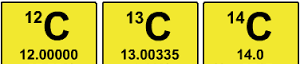
What do these isotopes of carbon all have in common?
a)
neutrons & mass number
b)
atomic number and neutrons
c)
atomic number and electrons
d)
protons, atomic number, and mass number
171.
How many neutrons in C-14?
a)
6
b)
7
c)
14
d)
8
172.
Isotopes are atoms of the same element with different #’s of __________ & therefore different __________.
a)
n0 ;  atomic #’s
b)
p+ ; atomic #’s
c)
e- ; atomic masses
d)
n0 ; atomic masses
173.
If X is the symbol for an element, which of the following two symbols represent    isotopes of the same element?     I. 7735X  II. 7733X  III. 8137X  IV. 8135 X
a)
I and II
b)
III and IV
c)
I and IV
d)
I and III
174.
Four isotopes of lead include lead-204, lead-206, lead-207, and lead-208.  The average atomic mass of lead is 207.2.  Which isotope of lead is likely to be the most abundant.
a)
204
b)
206
c)
207
d)
208
175.

Bromine-80 has how many neutrons?

a)

41

b)

42

c)

44

d)

45

176.

An atom that has gained or lost electrons in an attempt to become stable/bond with another atom.

a)

Normal/Neutral Atom

b)

Ion

c)

Isotope

177.

If an atom has 4 protons and 2 electrons it has a charge of ____.

a)

0

b)

-2

c)

+2

d)

+1

178.

If an atom has a charge of -2 and an atomic number of 16 it should have _______ electrons.

a)

14

b)

16

c)

18

d)

20

179.

What is the name of the pictured isotope?

a)

Chlorine-18

b)

Chlorine-17

c)

Chlorine-35

180.

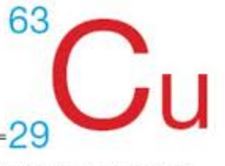
What is the name of the pictured isotope?

a)

Copper-29

b)

Copper-63

c)

Copper-34

181.
How many neutrons does the isotope of lithium have?
a)
8
b)
3
c)
4
d)
5
182.
How many electrons does a Copper atom have?
a)
63
b)
29
c)
92
d)
34
183.
Write 'True' or 'False'
The mean is always one of the numbers in the data
a)
TRUE
b)
FALSE
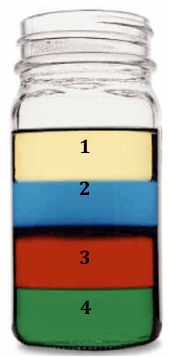
184.
Put the liquids in order from most dense to least dense?
a)
4, 3, 2, 1
b)
1, 2, 3, 4
c)
3, 4, 2, 1, 
d)
4, 3, 1, 2
185.
What is the formula for density?
a)
density = mass x volume
b)
density = mass / volume
c)
density = mass + volume
d)
density = mass - volume
186.
Frank has an eraser. It has a mass of 4g, and a volume of 2cm3. What is its density?
a)
8 g/cm3
b)
2 g/cm3
c)
1/2 g/cm3
d)
24 g/cm3
187.

Why do objects sink or float in H2O?

a)

Because their densities are higher or lower than compared to water

b)

Because their densities are using gravity to pull down

c)

Because their densities are heavier or lighter

d)

Because their mass and volumes are equal

188.
What is the volume of Object X?
a)
10.0 cm3
b)
15.0 cm3
c)
20.0 cm3
d)
25.0 cm3
189.
Calculate the density of the cube. (Hint: calculate the volume of the cube using V= Bh)
a)
0.33 g/cm3
b)
0.4 g/cm3
c)
0.6 g/cm3
d)
0.5 g/cm3
190.

What is the volume of 150 grams of lead if it has a density of 11.3 g/cm3?

a)

13.3 g

b)

13.3 cm3

c)

.075 g

d)

1695 cm3

191.
Which box has a higher density?  
a)
Box A
b)
Box B
c)
cannot be determined
d)
they are the same
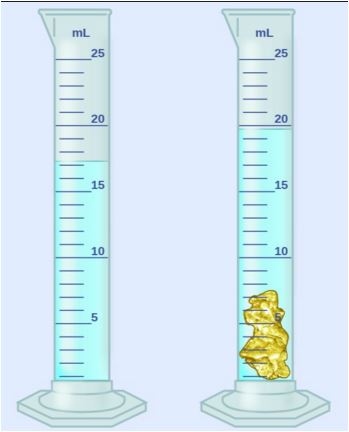
192.
An irregularly shaped piece of gold was lowered into a graduated cylinder holding a volume of water equal to 17 ml. The height of the water rose to 20 ml. If the mass of the gold was 27 g, what was its density?
a)
9 g/mL
b)
10.5 g/mL
c)
6.5 g/mL
d)
8 g/mL
193.

What is the chemical name of MgCl2?

a)

Magnesium Chloride 2

b)

Magnesium Chloride

c)

Magnesium (II) Chloride

d)

Magnesium Dichloride

194.

If your cation is a transition metal, it should have a _________________.

a)

Roman numeral

b)

Subscript

c)

Polyatomic Ion

d)

Prefix

195.

What is the chemical name of CsI?

a)

Cesium Monoiodide

b)

Carbon Sulfide Iodide

c)

Cesium Iodide

d)

Carbon Silicate

196.

How many electrons are there in the cation Aluminum?

a)

10

b)

13

c)

16

d)

3

197.

The formula of copper(II) oxide is

a)

CuO

b)

Cu2O

c)

CuO2

198.

The formula of iron(III) oxide is

a)

FeO

b)

FeO2

c)

Fe2O

d)

Fe2O3

199.

The formula of ammonium ion is

a)

NH3

b)

NH3+

c)

NH4

d)

NH4+

200.

The name of KHCO3 is

a)

potassium carbonate

b)

potassium hydrogencarbonate

201.

The formula of sodium sulphate is

a)

NaSO4

b)

Na2SO4

c)

Na(SO4)2

d)

Na2(SO4)3