
 Worksheets
Biology: Chapter 7 question bank
Total questions: 100
Worksheet time: 8hrs 20mins

• homozygous for alleles that produce black fur and
• homozygous for alleles of an epistatic gene that prevents fur coloration.
What color fur will the mouse have?

A female is born with attached earlobes, which is a recessive phenotype. Which of the following genotypes could her parents have?
RR and RR
Rr and rr
Rr and RR
RR and rr

The Punnett square in Figure 7.1 shows a cross between two parents who have the genotype Ss for a genetic disorder caused by a recessive allele. Which of the following will be a carrier of the genetic disorder?
Ss parent
Ss offspring
SS offspring
ss offspring

Refer to Figure 7.3. If individual III-2 marries a person with the same genotype as individual I-1, what is the chance that one of their children will be afflicted with hemophilia?
0%
25%
50%
75%

What type of inheritance pattern does the trait represented by the shaded symbols in Figure 7.3 illustrate?
incomplete dominance
multiple alleles
codominance
sex-linked

For the trait being followed in the pedigree, individuals II-1 and II-4 in Figure 7.3 can be classified as ___________.
homozygous dominant
mutants
homozygous recessive
carriers

What is the relationship between individual I-1 and individual III-2 as Figure 7.3?
grandfather-granddaughter
grandmother-grandson
great aunt-nephew
mother-son

What phenotype is depicted in Figure 7.4?
O
AB
A
B

Which type of heredity does the pedigree in Figure 7.5 demonstrate?
autosomal recessive
autosomal dominant
X-linked recessive
X-linked dominant
If a female fruit fly heterozygous for red eyes (XRXr) crossed with a white-eyed male (XrY), what percent of their offspring would have white eyes?
0%
25%
50%
75%
A phenotype that results from a dominant allele must have at least _________ dominant allele(s) present in the parent(s).
one
two
three
four
A man heterozygous for blood type A marries a woman heterozygous for blood type B. The chance that their first child will have type O blood is ___________.
0%
25%
50%
75%
A person who has a disorder caused by a recessive allele is
considered a carrier of the disorder
homozygous for the recessive allele
unable to pass the allele to offspring
certain to have offspring with the disorder
Someone who is heterozygous for a recessive allele that causes a disorder
is not a carrier of the disorder
will not have the disorder
cannot have offspring with the disorder
will get the disorder late in life
Two parents have the genotype Gg for a genetic disorder caused by a dominant allele. What is the chance that any of their children will inherit the disorder?
25%
50%
75%
100%
The wide range of eye color indicates that eye color is
sex-linked
recessive
polygenic
epistatic
For an XX female to express a recessive sex-linked trait, she must have
a Y chromosome
an inactivated allele
two recessive alleles
two dominant alleles
One parent is homozygous for a recessive allele and one parent is heterozygous for a recessive allele in an autosomal dominant genetic disorder. What is the chance that a child of those two parents will have the disorder?
25%
50%
75%
100%
Human height occurs in a continuous range because it is affected by the interaction of several genes, making it a(n)
autosomal trait
sex-linked trait
polygenic trait
codominant trait
Suppose a mouse is homozygous for alleles that produce black fur and homozygous for alleles of an epistatic gene that prevents fur coloration. What color fur will the mouse have?
all white
mostly black
entirely gray
black and white
A female is born with attached earlobes, which is a recessive phenotype. Which of the following genotypes could her parents have?
RR and RR
Rr and RR
Rr and rr
RR and rr
Suppose a person is homozygous recessive for a recessive genetic disorder. This genotype means that the person
is a carrier for the disorder
has the genetic disorder
cannot pass on the gene
is healthy and is not a carrier
Suppose a person is a carrier for a genetic disorder. Which of the following phrases about this person is true?
does not have the disorder but can pass it on
will develop the disorder only late in life
cannot pass the disorder to sons, just daughters
the allele is not passed on due to Y chromosome activation
If more males than females in a family have a recessive sex-linked disorder, what can you infer about patterns of inheritance in that family?
the males would pass on the disorder to sons
all females would be carriers of the disorder
females would not develop the disorder
only females would be carriers of the disorder
Sex-linked disorders appear more often in males because the Y chromosome
does not carry sex-linked genes
affects phenotype strongly
has genes only for sex determination
is smaller than the X chromosome
Which of the following tools is used to match up chromosome pairs using chemical stains?
pedigree chart
karyotype
meiosis map
linkage map
organism whose genome contains a gene for a certain trait or disease that is not expressed in the organism's phenotype
carrier
karyotype
X chromosome inactivation
gene that is located on a sex chromosome
autosomal gene
sex-linked gene
incomplete dominance
codominance
is a process that occurs in female mammals in which one of the X chromosomes is randomly turned off in each cell
codominance
complete dominance
X chromosome inactivation
karyotype
heterozygous phenotype that is a blend of the two homozygous phenotypes
complete dominance
incomplete dominance
codominance
pedigree
heterozygous genotype that equally expresses the traits from both alleles
complete dominance
sex-liked gene
polygenic traits
codominance
trait that is produced by two or more genes
linkage map
polygenic trait
multiple alleles
codominance
diagram that shows the relative locations of genes on a chromosome
karyotype
linkage map
pedigree
genome
chart of the phenotypes and genotypes in a family that is used to determine whether an individual is a carrier of a recessive allele
pedigree
linkage map
genome
X chromosome inactivation
image of all of the chromosomes in a cell
karyotype
pedigree
linkage map
Punnett square
A person who has a disorder caused by a recessive allele is
considered a carrier of the disorder
homozygous for the recessive allele
unable to pass the allele to offspring.
certain to have offspring with the disorder.
Gene expression is influenced by many factors. Which of the following is a factor in gene expression?
Karyotype
Phenotype
Environment
Phenotype
A couple is trying to determine the likelihood of their offspring inheriting hemophilia. The mother is a carrier for the disorder and the father has the disorder. What chance will their offspring have of being a hemophiliac
0%
25%
50%
100%
Which of these genotypes would a child that has a recessive disorder have?
SS
Ss
ss
For an XX female to express a recessive sex-linked trait, she must have
a Y chromosome
two dominant alleles
two recessive alleles
two inactive alleles
Thomas Morgan’s research with fruit flies determined that
alleles always assort independently.
chromosomes are inherited as a group.
genes never assort independently.
traits sometimes are inherited as a group.
Thomas Morgan’s research with fruit flies determined that
alleles always assort independently.
chromosomes are inherited as a group.
genes never assort independently.
traits sometimes are inherited as a group.
Two genes cross over 6% of the time. This percentage means that the genes are
inactivated in 6 out of 100 offspring.
incompletely dominant in 6 out of 100 offspring
not inherited together in 6 out of 100 offspring.
on sex chromosomes in 6 out of 100 offspring.
What is the main reason that sex-linked disorders are most often observed in males?
. The X chromosome only has genes for genetic disorders.
The Y chromosome cannot have genes that cause genetic disorders.
The Y chromosome cannot mask alleles on the X chromosome.
The X chromosome has genes only for sex determination.
Which of the following tools is used to match up chromosome pairs using chemical stains?
pedigree chart
karyotype
meiosis map
linkage map
Mendel's Second Law. Allele pairs separate independently of each other during gamete formation (meiosis). Meaning, different traits appear to be inherited separately.
Law of Segregation
Law of Independent Assortment
A heterozygous phenotype is somewhere between the two homozygous phenotypes. Neither allele is completely dominant or completely recessive
Incomplete Dominance
Codominant
Dominant
Recessive
Polygenic Traits
Trait that is expressed due to 2 or more genes working together.
Genes that are located on the sex chromosomes.
Mendel's first law. Organisms inherit 2 copies of each gene, one from each parent. Organisms donate only one copy of each gene in their gametes. Thus, the 2 copies of each gene segregate, or separate, during gamete formation (meiosis).
A.K.A. Cross breed. Result of mixing, through sexual reproduction, two animals or plants of different breeds
Codominance
Traits produced by two or more genes
A heterozygous phenotype is somewhere between the two homozygous phenotypes. Neither allele is completely dominant or completely recessive
Both alleles of a gene are expressed completely - neither allele is dominant or recessive.
A.K.A. Cross breed. Result of mixing, through sexual reproduction, two animals or plants of different breeds
A.K.A. Cross breed. Result of mixing, through sexual reproduction, two animals or plants of different breeds
Hybrid
Nicholas
Quentin
Hunter
Sex-Linked Genes
Genes that are located on the sex chromosomes.
Mendel's first law. Organisms inherit 2 copies of each gene, one from each parent. Organisms donate only one copy of each gene in their gametes. Thus, the 2 copies of each gene segregate, or separate, during gamete formation (meiosis).
Trait that is expressed due to 2 or more genes working together.
Both alleles of a gene are expressed completely - neither allele is dominant or recessive.
The true-breeding (homozygous) parent individuals from which F1 hybrid offspring are derived in studies of inheritance
P generation
F1 generation
F2 generation
F3 generation
F1 generation
The first filial, hybrid (heterozygous) offspring arising from a parental (P generation) cross.
The offspring resulting from interbreeding (or self-pollination) of the hybrid FF1 generation.
The true-breeding (homozygous) parent individuals from which F1 hybrid offspring are derived in studies of inheritance
Allele
Any of the alternative versions of a gene that may produce distinguishable phenotypic effects.
An allele that is fully expressed in the phenotype of a heterozygote. Only need 1 copy of dominant allele to show dominant trait.
An allele whose phenotypic effect is not observed in a heterozygote - it is "masked" or hidden.
The genetic makeup, or set of alleles, of an organism. (Ex: PP, Pp or pp)
An allele that is fully expressed in the phenotype of a heterozygote. Only need 1 copy of dominant allele to show dominant trait.
Allele
Dominant Allele
Recessive Allele
Genotype
An allele whose phenotypic effect is not observed in a heterozygote - it is "masked" or hidden.
Recessive Allele
Dominant Allele
Recessive Allele
Allele
The genetic makeup, or set of alleles, of an organism. (Ex: PP, Pp or pp)
Genotype
Phenotype
Genetics
Allele
Phenotype
The EXPRESSED/observable physical and physiological traits of an organism, which are determined by its genetic makeup.
A diagram used in the study of inheritance to show the predicted genotypic results of random fertilization in genetic crosses between individuals of known genotype.
The genetic makeup, or set of alleles, of an organism. (Ex: PP, Pp or pp)
An allele that is fully expressed in the phenotype of a heterozygote. Only need 1 copy of dominant allele to show dominant trait
Punnett Square
A diagram used in the study of inheritance to show the predicted genotypic results of random fertilization in genetic crosses between individuals of known genotype.
The EXPRESSED/observable physical and physiological traits of an organism, which are determined by its genetic makeup.
Having two identical alleles for a given gene; dominant (RR) or recessive (rr)
Having two different alleles for a given gene (Rr)
Having two identical alleles for a given gene; dominant (RR) or recessive (rr)
Homozygous
Heterozygous
Homozygous Recessive
Homozygous Dominant
Having two different alleles for a given gene (Rr)
Homozygous Dominant
Heterozygous
Homozygous Recessive
Allelic Combination
A genetic tool that looks at the history of a genetic disorder in a family.
Punnett Square
Genealogy
Pedigree Chart
Family Tree
Karyotype
A display of the chromosome pairs of a cell arranged by size and shape.
Epistasis
Homozygous
Heterozygous
A type of gene interaction in which one gene alters the phenotypic effects of another gene that is independently inherited; ex: baldness in blonde/red hair
Epistasis
Genetics
Sex-Linked Trait
Recessive
Scientific study of heredity
Genetics
Central Dogma of Biology
Pedigree
Punnett Square
According to the Law of Dominance, a ____________ allele will always express itself over a _____________ allele
Dominant, Recessive
Recessive, Dominant
Heterozygous, Homozygous
Homozygous, Heterozygous
A person who does not show symptoms but can pass on the disease is known as a _________________.
Carrier
Homozygous
Heterozygous
Disease
Diseases which effect only males or predominantly males are found on which chromosome?
Pair 1
Pair 5
Pair 21
X chromosome
Y chromosome
Why are sex linked traits more common in males?
They don't have the same immunity as females
They only have 1 X chromosome
They need 2 effected copies for expression
1 X chromosome is inactivated
Heterozygous phenotype is between the two homozygous phenotypes.
X Inactivation
Incomplete dominance
Codominance
Both traits are expressed equally.
X Inactivation
Incomplete dominance
Codominance


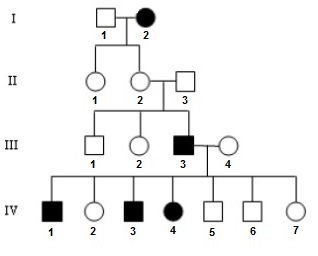


In this pedigree, which gender can be carriers of colorblindness and not have it?
Just males
Just females
Both genders

Which genes will have the greatest chance of being separated during crossing over?
B and C
A and B
C and D
D and A

