
 Worksheets
Matter & Energy
Total questions: 68
Worksheet time: 34mins
In an endothermic reaction, energy is _________.
absorbed
released
Solid --> liquid --> gas, is what type of change?
endothermic
exothermic
gas --> liquid --> solid; is what type of change?
endothermic
exothermic

Ice cubes in your glass of soda melt. The ice is undergoing what type of change?
endothermic
exothermic

Your family uses candles to see when the electricity goes out. The wax candle is undergoing what type of change?
exothermic
endothermic

A sunflower makes food during photosynthesis. The production of glucose/food is what type of change?
exothermic
endothermic

You freeze juice to make ice pops. The juice is undergoing what type of change?
exothermic
endothermic

A school bus burns gasoline to create energy for motion while delivering students to school. The gasoline is undergoing what type of change?
exothermic
endothermic
A reaction occurs in a test tube you are holding; it started out at about room temperature but then it starts to feel cold to you. What type of change is occurring in the test tube?
endothermic
exothermic
A reaction that has a negative ΔH value.
endo
exo
When this type of reaction occurs, the surrounding temperature goes up if the energy goes to KE.
endothermic
exothermic
The condensation of water is what type of process?
endothermic
exothermic
You must add heat to this type of reaction in order for it to occur.
endothermic
exothermic
Sublimation of a solid, is what type of process?
endothermic
exothermic

_____________ is the tool used to measure temperature.
A thermometer
A scale
A ruler
none of the above

The prefix "exo" means
"in"
"out"
"up"
"down"

The prefix "endo" means
"in"
"out"
"up"
"down"
A high specific heat means...
It heats up more quickly with added energy than something with a low specific heat
It requires more energy to change its temperature than something with a low specific heat


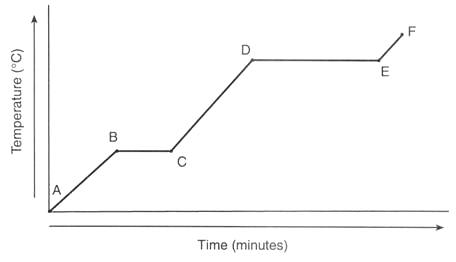
What is happening between D and E?
Melting
Boiling
Condensing
Freezing
Sublimation
What is happening between B and C?
Melting
Boiling
Condensing
Freezing
Sublimation
What is happening between A and B?
The KE is increasing
The PE is increasing
The KE is decreasing
The PE is decreasing

What does section B show?
Melting
Boiling
Condensing
Freezing
None of these options

Which will heat up faster?
copper
granite
iron
basalt

Which will heat up slower?
water
lead
granite
iron
Which of the following best explains why the sand at the beach is hotter than the water?
Sand has a higher specific heat than water.
Sand has a lower specific heat than water.
There is more water than sand at the beach.
There is more sand than water at the beach.
5. What is it called when a gas turns directly into a solid?
Freezing
Deposition
The phase change from liquid water to gaseous water only at the surface of the liquid is called...
boiling
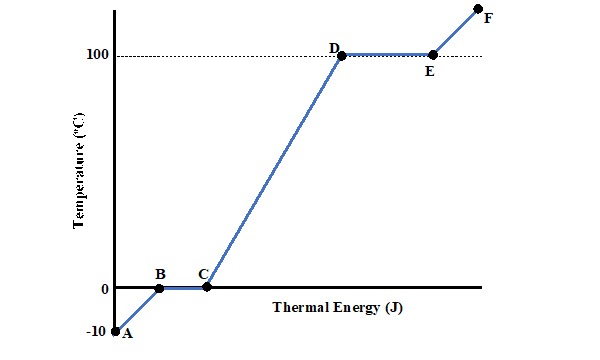
Between which two points is a liquid heating up?
A ----> B
B ----> C
C ----> D
D ----> E
E ----> F

100o C
60o C
20o C
-60o C

The graph shows a cooling curve for an unknown substance. What is happening during segment BC?

In which of the following segments is the kinetic energy remaining constant?
D-E
E-F
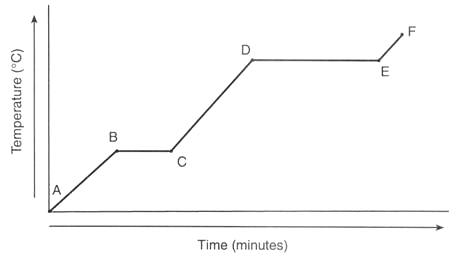
What is happening to the particles in the substance between points A and B?
Melting
Freezing
Speeding Up
Slowing Down

Where on the graph are phase changes taking place?
1
2
3
4
5
When a liquid is boiling which is false
The surroundings are being cooled
The liquid is a constant temperature
The potential energy of the system is increasing
The kinetic energy of the sytem is increasingf
True or False: Boiling is a process that cools its surroundings
True
False
True or False: Energy is neither added nor removed during a phase change
True
False
True or False: During a phase change of any kind the temperature is constant until the change is complete
True
False
True or False: A boiling substance may feel hot or cold to you depending on the temperature that it boils at
True
False
True or False: If a substance absorbs energy and the energy increases just the KE of the molecules it will get warmer (higher temperature)
True
False
True or False: If a substance absorbs energy and the energy increases just the PE of the molecules it will get warmer (higher temperature)
True
False
A low specific heat means...
It heats up more quickly with added energy than something with a high specific heat
It requires more energy to change temperature than something with a high specific heat
What is happening between D and E?
the KE is increasing
The PE is increasing
The KE is decreasing
The PE is decreasing
The energy is constant in the system
What is happening during section D?
The KE is increasing
The PE is increasing
The KE is decreasing
The PE is decrfeasing
The energy of the system is not changing
A substance's heating curve is shown in the graph. Can you tell its freezing point from this graph?
No, it is impossible
Yes, it is 60o C
Yes, it is 20o C
Yes, it is -60o C
Yes, it is -100o C
At which of the following temperatures will the KE of the molecules be zero?
0oC
0 Kelvin
-273oC
-100oC
Which temperature is the same as 100oC?
373 K
173 K
-173 K
-373 K
Which temperature is the same as 273 K?
273oC
173oC
100oC
0oC
True/False; The Kelvin scale has no negative values
True
False
A temperature of 37oC is closest to the temperature of
this room
your body
outside on a cold day
the sun
A temperature of 4oC is closest to the temperature of
this room
your body
the inside of a refrigerator
the inside of your freezer
A temperature of 22oC is closest to the temperature of
this room
your body
the inside of a refrigerator
the inside of your freezer
If 100 gram of water rises in temperature by 20 degrees Celsius; how many Joules of heat energy were added to it?
Impossible to tell
2,000 J
4,200 J
8,400 J
How many Joules of heat energy are released when 50. grams of water are cooled from 70. to 60. degrees celsius?
impossible to tell
42 J
210 J
2100 J
4200 J
If the temperature of a substance changes by 10 degrees celsius, how by how many degrees Kelvin would it change by?
10
263
273
283
Which sample of water has particles with the highest average KE?
10 mL of water at 25oC
100 mL of water at 35oC
200 mL of water at 35oC
5 mL of water at 65oC
Which temperature is equivalent to 120 K?
-153oC
-120oC
293oC
393oC
In an endothermic reaction the ∆H is
positive
negative
zero
If the ∆H of a reaction is negative, which is true
the products have more energy than the reactants
the reactants have more energy than the products
the products and reactants have the same amount of energy

