wayground logo

Free Printable Worksheets

Font size

S
M
L
XL
Worksheets

A&P Unit 4: Skeletal System Review I

Total questions: 60

Worksheet time: 3600secs

Name
Class
Date
1.
Where is Red Bone Marrow found?
a)
Compact Bone
b)
Periosteum
c)
Spongy Bone
d)
Cavity
2.
What is the hard layer of bone?
a)
Spongy Bone
b)
Compact Bone
c)
Salty Bone
d)
Periosteum
3.
What part of bone creates Red Blood Cells?
a)
Red Bone Marrow
b)
Yellow Bone Marrow
c)
Cavity
d)
Compact Bone
4.
What is the term for a bone broken completely and piercing the skin?
a)
Closed Fracture
b)
Open Fracture
c)
Hairline Fracture
d)
Communited Fracture
5.

Which of the following structures is found in your axial skeleton?

a)

phalanges

b)

humerus

c)

patella

d)

vertebrae

6.

Which of the following is an example of a sesamoid bone?

a)

phalanges

b)

humerus

c)

patella

d)

vertebrae

7.

What is the name given to the long, middle section of a long bone?

a)

diaphysis

b)

epiphyses

c)

epiphyseal plate

d)

periosteum

8.

The tough layer of connective tissue surrounding the bone and allowing for attachment to tendons and ligaments is called

a)

diaphysis

b)

epiphyses

c)

epiphyseal plate

d)

periosteum

9.

What structure does "A" represent?

a)

central Haversian canal

b)

osteon

c)

osteocyte

d)

canaliculi

10.

What structure does "B" represent?

a)

central Haversian canal

b)

osteon

c)

osteocyte

d)

canaliculi

11.

What structure does "C" represent?

a)

central Haversian canal

b)

osteon

c)

osteocyte

d)

canaliculi

12.

What structure does "D" represent?

a)

central Haversian canal

b)

osteon

c)

osteocyte

d)

canaliculi

13.

The "little beams" that make up spongy bone are called

a)

concentric lamellae

b)

interstitial lamellae

c)

trabeculae

d)

osteons

14.

When a bone is broken, a large mass of blood forms that is called a(n)

a)

osteocyte

b)

hematoma

c)

osteoclast

d)

callus

15.
The adult skeletal system is composed of how many bones?
a)
216
b)
371
c)
206
d)
199
16.

Consists of bones of the upper and lower limbs and the bones that anchor the limbs to the axial skeleton

a)

axial skeleton

b)

thoracic vertebrae

c)

appendicular skeleton

d)

carpals

17.

A bone, like the femur or humerus, is classified as a(n):

a)

ossified bone

b)

intramembranous bone

c)

compact bone

d)

long bone

18.

Articular cartilage is found:

a)

at the ends of bones

b)

between sutures

c)

surrounding long bones

d)

at the growth plate

19.
What are the three jobs of your bones?
a)
movement, structure, joints
b)
movement, structure, protection
c)
structure, digestion and breathing
d)
movement, digestion and breathing
20.

The axial skeleton is

a)

the head and trunk

b)

the limbs

c)

the whole skeleton

d)

just the head

21.

Hematopoeisis is

a)

bone formation

b)

bone break down

c)

blood cell production

d)

tissue production

22.

Epiphyseal plate is also known as the

a)

epiphyseal line

b)

growth plate

c)

kid bone plate

23.

Cartilage on the ends of the bone is the

a)

hyaline cartilage

b)

articular cartilage

c)

soft cartilage

24.

The bone cells that maintain bone tissue are

a)

osteocytes

b)

osteon

c)

osteoclasts

d)

osteoblasts

25.
attaches bone to bone
a)
tendon
b)
ligament 
c)
cartilage
d)
bone
26.
_________ is a function of the skeletal system that is completed by joints, ligaments, and tendons.
a)
Protection
b)
Storage
c)
Synthesis
d)
Movement
27.
What are functions of the skelton?
a)
protection
b)
Make blood cells
c)
movement
d)
all of them
28.
Where are blood cells made? 
a)
Yellow marrow 
b)
Red marrow
c)
Spongy Bone 
d)
Periosteum
29.
Calcium, fat, and other nutrients are ______ in the _______ marrow of long bones.
a)
synthesized/yellow
b)
synthesized/red
c)
stored/yellow
d)
stored/red
30.
One function of the skeletal system is _______ especially in regards to the vital organs, such as the brain, heart, and lungs.
a)
Protection
b)
Storage
c)
Synthesis
d)
Movement
31.

Which is not a function of the skeletal system?

a)

shape and support

b)

movement

c)

protection

d)

gas exchange

32.

What is a joint?

a)

The place where 2 or more bones meet.

b)

A thin membrane that covers the surface of bone.

c)

A band of tissue that hold bones together.

d)

Connective tissue

33.

What is the function of marrow?

a)

To make protein

b)

To make red blood cells and store fat.

c)

reduce friction

d)

to hold bones together

34.

A tough band of tissue that holds bones together at the joint are called a __________________________.

a)

tendon

b)

cartilage

c)

periosteum

d)

ligament

35.

Bones are living things.

a)

True

b)

False

36.

Which system is responsible for creating red blood cells?

a)

skeletal

b)

muscular

c)

respiratory

d)

nervous

37.

Which of the following is NOT a function of the skeletal system?

a)

Helps your body move

b)

Send oxygen to the body

c)

Protect your organs

d)

Give your body shape and structure

38.

The skeletal system works with the ______________ to help your body move.

a)

digestive system

b)

circulatory system

c)

respiratory system

d)

muscular system

39.
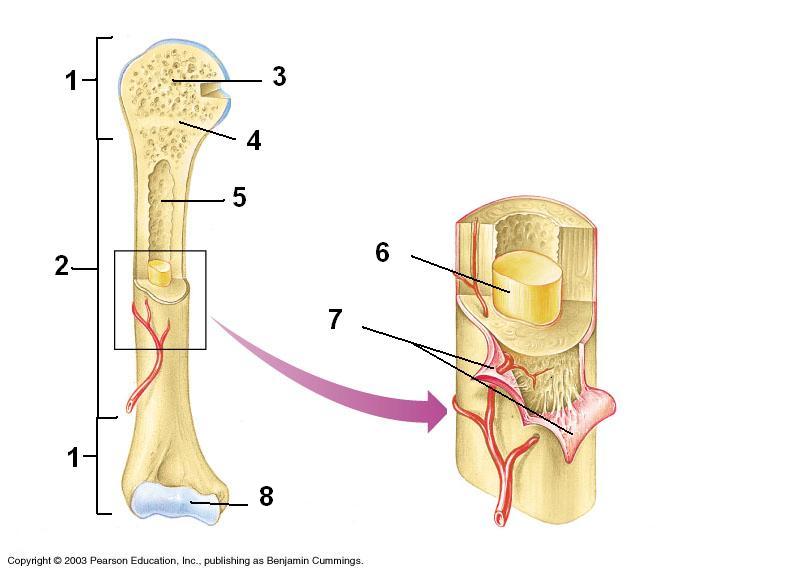
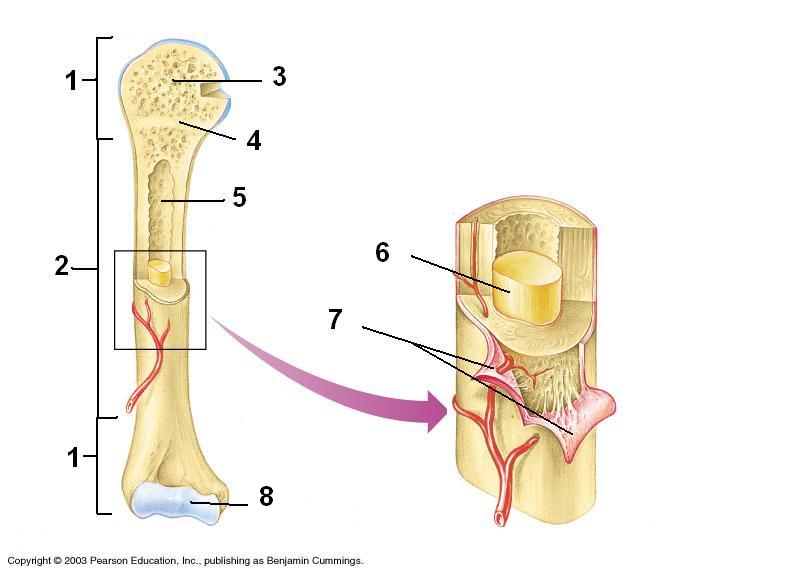
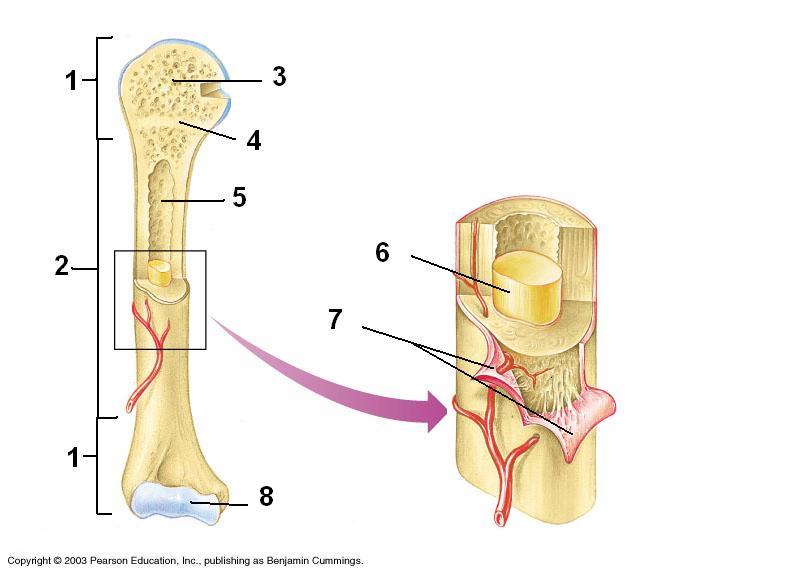
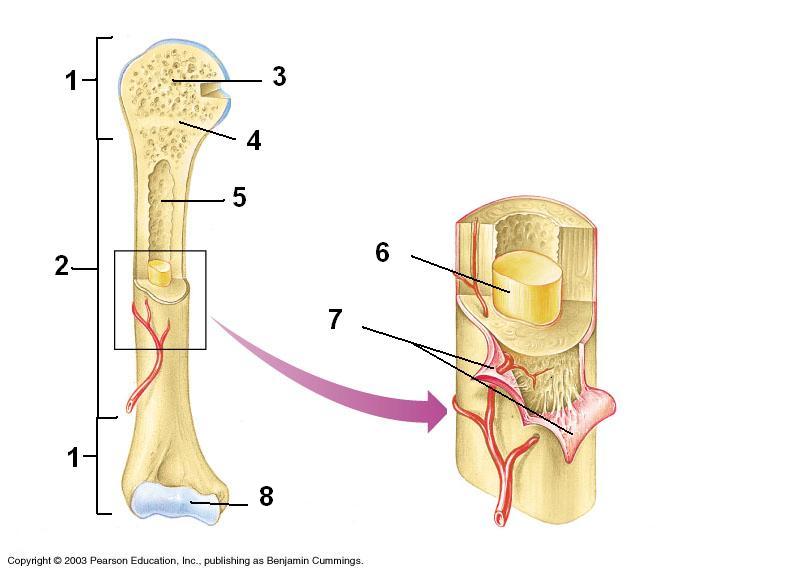
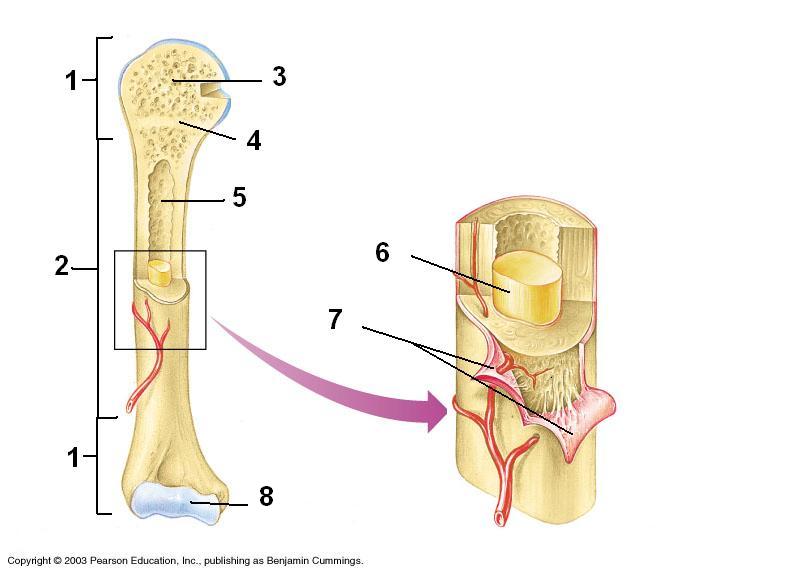
Structure #2 is the 
a)
medullary cavity
b)
periosteum
c)
epiphysis
d)
diaphysis
40.
The shiny white substance at #8 is the 
a)
articular cartilage
b)
periosteum
c)
yellow marrow
d)
diaphysis
41.
Structure #5 is the 
a)
medullary cavity
b)
periosteum
c)
epiphysis
d)
diaphysis
42.
Structure #7 is the 
a)
medullary cavity
b)
periosteum
c)
epiphysis
d)
diaphysis
43.
In adults, the substance at #6 would be 
a)
red marrow
b)
yellow marrow
c)
spongy bone
d)
clotted blood
44.
The epiphysis is 
a)
The shaft of a bone
b)
a bone cell
c)
the end of a long bone
d)
the covering of a bone
45.
Periosteum
a)
the membrane lining the bone cavity
b)
the tough membrane covering the shaft of the bone
c)
the shiny, articulating cartilage on the ends of a bone
d)
the blood vessels inside a bone
46.
Spongy bone would primarily be found where in a bone?
a)
diaphysis
b)
epiphysis
c)
periosteum
d)
endosteum
47.
Structure #1 is the 
a)
osteon
b)
lamellae
c)
lacunae
d)
periosteum
48.
Structure #3 is a/n
a)
osteon
b)
perforating (Volkmann's) canals
c)
Central (Haversian) canals
d)
canaliculi
49.
Structure #4 is a/n
a)
osteon
b)
osteocyte
c)
lacuna
d)
osteoblast
50.
Structures #5, which are situated within structures #8, are 
a)
osteons
b)
lamellae
c)
lacunae
d)
osteocytes
51.
Structures #6 are  
a)
osteons
b)
lamellae
c)
lacunae
d)
canaliculi
52.
Structures #8, the cavities surrounding structures #5, are the
a)
osteons
b)
lamellae
c)
lacunae
d)
osteocytes
53.

What can be found in the central canal of the haversian canal system?

a)

osteocytes

b)

lamella

c)

blood vessels and nerves

d)

red blood cells

54.
Bone forming cells are called...
a)
osteoblasts
b)
osteocytes
c)
osteoclasts
d)
osteons
55.

What is the fourth stage of bone growth and repair?

a)

Bony callus formation

b)

Hematoma Formation

c)

Bone Remodeling

d)

Bone Generation

56.

What is the third stage of bone growth and repair?

a)

Bone Remodeling

b)

Bone Generation

c)

Hematoma Formation

d)

Bony Callus Formation

57.

What is the first stage of bone growth and repair?

a)

Bone Generation

b)

Bone Remodeling

c)

Bony Callus Formation

d)

Hematoma Formation

58.
Osteo means?
a)
Bone
b)
Bone tissue
c)
skin
d)
tissue
59.

Appositional growth is growth in _________.

a)

length

b)

mass

c)

width

d)

weight

60.

Longitudinal growth stops when ____________ plates ossify.

a)

Endosteal

b)

Epiphyseal

c)

Articular

d)

Calcitonic