
 Worksheets
Standard 4 (up to Immigration)
Total questions: 60
Worksheet time: 30mins
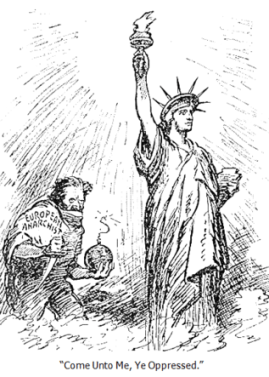
What kind of fears are reflected in the political cartoon?
communist fears of the free market
fears of international terrorism
fears of presidential scandals
nativist fears of immigrants
The idea that business should be free from government regulation best represents which system?
Social Darwinism
capitalism
laissez-faire
socialism
Why do some historians label John D Rockefeller and other big businessmen of the Gilded Age as "Robber Barons"?
They mimicked the lifestyles of medieval lords.
Many owned large estates in the western part of the country.
Some stole large sums of money from the federal treasury.
They were ruthless competitors who cheated and exploited workers.
How did the ideas of Social Darwinism impact the economic culture of the United States in the late 1800s and early 1900s?
It justified the growth of large businesses at the expense of smaller businesses.
It promoted the use of government programs to improve the situation for poor citizens.
It led to the formation of labor unions as a way to improve working conditions.
It led to support for a private school system to give wealthy children the best education.
What was a result of the Homestead Act and the Continental Railroad?
The decline of the Plains Indians
The completion of the Erie Canal
More immigrants settling in the North.
Crowded Cites.

Attitude the government had toward big business during the late 1800s. "hands off"
Laissez Faire
Monopoly
Social Darwinism
Trust

Used the Bessemer Process to make steel more efficiently and less expensive.
Rockefeller
Carnegie
Bryan
Morgan
Promoted settlement in the West and had a huge impact on the coal and steel industry.
Transcontinental Railroad
National Road
Erie Canal
I-90
Andrew Carnegie's attempt to own every necessary to produce steel and manufacture steel.
Horizontal Integration
Bimetallism
Vertical Integration
Trust Integration
The Gospel of Wealth said Rich people had
would set quotas
a duty to help the poor
bimetallism
more money than Rockefeller
How did government policies such as the Homestead Act lead to further expansion of the American West? (4.1)
They created policies for the organization and development of new states
It provided free or cheap land to settlers willing to utilize western land
It prioritized industrial leaders to build factories and manufacturing centers in the west
The government offered tax cuts and other legal benefits to companies and workers who moved west
Which of the following most impacted the growth of railroads in the second half of the nineteenth century? (4.2)
The Dawes Severalty Act
Government land subsidies to railroad companies
The leadership of captains of industry who used private money to fund the railroad
Increased tariffs and trade regulations that funneled money to railroad companies
Why did the U.S. government generally support open immigration policies in the late 1800s? (4.2)
Most immigrants came seeking refuge from war-torn European countries
Industry leaders needed continued access to a large, cheap labor force
Immigrants allowed for the population of smaller western states to grow
The government needed the increased tax revenue to pay off the national debt
An economic system characterized by private ownership of property and the use of that property to make a profit is called (4.3)
Capitalism
Communism
Socialism
Republicanism
Large corporations that emerge to dominate one industry are known as (4.3)
Institutions
Board of Trustees
Monopolies
Cartels
The primary difference between vertical and horizontal integration methods of business is (4.3)
Vertical integration deals with domestic products while horizontal deals with foreign products
Horizontal integration can only be used for agricultural products
Vertical integration monopolizes the levels of production while horizontal integration monopolizes competition
Horizontal integration was viewed as illegal by the U.S. government while vertical integration was upheld in the Supreme Court
How did newly developed technologies affect daily lives for farmers in the late nineteenth century? (4.4)
Farmers were untouched by mechanical advancement
Farming became more mechanized and demanded technological investment from farmers
Most farms were converted into industrial centers specializing in mechanically farmed crops
Farmers struggled to compete with factory made products
The idea that economic preference should be given to born Americans over immigrants is referred to as (4.4)
Social Darwinism
Nativism
Laissez Faire
Muckraking
Who would most likely support William Jennings Bryan in the election of 1896?
a government official in Georgia
a farmer in Kansas who supported bimetalism
a merchant in New York
an industrial worker in Pennsylvania
Which best explains the popularity of bimetallism for Midwest farmers?
They believed it would lead to an inflation of the United States currency.
They believed it would increase the value of the United States dollar.
They hoped it would increase the silver mining business in Colorado.
They felt it would prevent President Cleveland's re-election.
Which of the following was a negative effect of mechanized farming during the late 1800s?
More difficult farming techniques
Enabled farmers to produce products more efficiently
Overproduction, which led to falling farming prices
Underproduction, which led to inflation
Read the statement below:
“Since transportation is a public necessity, the government should own and operate the railroads in the public interest.”
Which third party held beliefs most similar to those expressed by the quote?
Know-Nothing
Greenback
Populist
Bull Moose

The "Cross of Gold" speech, which is depicted in the cartoon above, was a Populist initiative promoting what?
Hard money, based on the gold standard
Deflation, in order to raise farm prices
Bimetallism, which based money on gold and silver
Muckraking, to expose the corruption of big business

Which idea of the late 1800s is MOST closely associated with the cartoon above?
Regulated Capitalism
Social Darwinism
Gospel of Wealth
Graduated income taxes
Why did farmers want the coinage of silver(bimetallism)?
to have more money in circulation to pay their bills
to get rid of the gold standard
so they could not use paper money
to have more credit available to buy more land
What name was given to former slaves, who migrated to the western plains, looking to escape the violent white backlash in the South, following Reconstruction?
Homesteaders
Exodusters
Settlers
Pioneers
How did the Populist Party view the concept of laissez-faire economics?
They supported laissez-faire economics because it promoted competition
They supported laissez-faire economics because it reinforced the gold standard.
They opposed laissez-faire economics because they wanted more government regulations
They opposed laissez-faire economics because farmers benefitted most from a free economy
Which of the following were results of industrialization in the United States?
Growing difference in wealth
Exploitation of workers
Attempts to close the Western frontier
Development of Tenement Housing
Why did the new immigrants of the late 1800s experience more discrimination than those of the early 1800s?
Most of them came from the Anglo-Saxon regions of Northern and Western Europe
They spoke unfamiliar languages, brought new cultural traditions, and lacked valuable labor skills
Most of them settled in rural areas, taking agricultural jobs away from American citizens
They easily adjusted to life in America and quickly took control of local political parties

The passage above BEST represents the struggles of which of the following groups
Rural sharecroppers in former Confederate states
Women living in the West who were subject to voting laws
Immigrants who lived in urban ethnic neighborhoods
Factory workers who were not allowed to join unions
“Long ago it was said that "one half of the world does not know how the other half lives." That was true then. It did not know because it did not care. The half that was on top cared little for the struggles, and less for the fate of those who were underneath, so long as it was able to hold them there and keep its own seat.
- Jacob Riis, How The Other Half Lives
Which group of people is the above quote and image MOST LIKELY referring to?
African American sharecroppers
Immigrants living in urban tenements
Chinese and Irish railroad workers living in tent villages
Populist protestors camped outside the White House
The Battle of Wounded Knee, the passage of the Dawes Act, and the completion of the Transcontinental Railroad are most closely associated with which of the following?
Creation of western cities
The downfall of Native American culture
The growth of agriculture development in the west
The increased amount of land given to settlers
Why did reformers of the early 1900s frequently attack political machines?
The machines denied voting rights to the poor
The machines accepted bribes in return for favors
The machines wasted money on military spending
The machines discriminated against migrant workers
During the Gilded Age why were Farmers having a hard time earning a living?
Railroads overcharged them
Too many farms unionized
Agricultural prices were rising
Agricultural output was declining
Which of the following BEST contributed to the 1912 Election of Woodrow Wilson
Wilson promised to raise tariffs and lower anti-trust laws
His party was openly opposed to a federal income tax.
The Republican and Democratic parties joined forces against the Free Soilers
The Republican vote had been split between Progressive and Conservative Party members
What was the MAIN reason the Chinese Exclusion Act was supported
The US wanted to retaliate against Chinese attacks
Leaders wanted to stop Chinese Religious influence
Political and economic leaders wanted to reduce competition from Chinese laborers
West coast leaders wanted to stop opium smuggling
True or False: The Indian Citizenship act ended the Reservation System for Native Americans.
True
False
The one thing Booker T Washington and WEB Dubois agreed on:
Education
Unions
Immediate respect
Vocational training
Which of the following is the best definition of the Convict Lease System?
State governments rented out prisoners to private companies
Federal prisons paid felons to build infrastructure projects
State government leaders leased out prison property to private companies
Convicted murderers were sent to uninhabited islands along the Atlantic Coast
Why were the Pullman railcar strike and Homestead steel strike unsuccessful?
They showed the Government only supported Business Owners
Most workers refused to take part
The court ruled the strikes were illegal
Factory owners hired children to replace them
A women's rights activist would most likely support:
Ratification of the 19th amendment
Repeal of the 18th amendment
Laissez-faire economics
Poll taxes
Which of the following would MOST likely be used as a strikebreaker?
Unskilled laborers
Native Americans
Muckrakers
Political Machines
A union leader would most likely support
Collective Bargaining
Child labor
Lockouts
Laissez faire economics
What is a political by-product of Ellis Island as immigrants arrived?
Nativist groups, such as the KKK, infused hostility within the Democratic Party
Immigrants were welcomed by political machines in return for their votes
Theodore Roosevelt was easily elected President due to his support of muckrakers
Nativism strongly impacted pro-immigration policies

What was another reason Congress passed this act in 1862?
To promote settlement in the west
To protect industry in the Northeast
To improve transportation in the South
To transport manufactured goods to the east

Which statement best completes the list above?
Congress passed tariffs on imported beef
Most of the cowboys on cattle drives were European immigrants
The cattle industry was nationalized under the Department of Agriculture
The railroad and meatpacking industries ended the need for cattle drives
What was the purpose of the Federal Reserve Act of 1913?
To limit private investment
To promote financial stability after the panic of 1907
To reduce competition among states
To support stock speculation
Nativism, economic problems on the West Coast, and controversy over lower wages all led to the passage of:
The Chinese Exclusion Act
Sherman Anti-Trust Act
Voting Rights Act
Homestead Act
Which of the following best describes the "New Immigrants" of the late 19th and early 20th Centuries
Northern and Western Europeans
Southern and Eastern Europeans
Mediterraneans from Europe, Africa, and Asia
Asians and Latin Americans

Which statement about Teddy Roosevelt is best supported by the picture
Conservationism was a major goal for him
President Roosevelt hunted big-game
Preservation of Native American land and rights was a major goal for him
He supported reclamation of land for agricultural use
What was the primary purpose of the Interstate Commerce Act, the Sherman Antitrust Act, and the Clayton Antitrust Act?
To eliminate unfair business practices
To reduce imports from foreign nations
To reduce the power of labor unions
To increase the power of local governments
True or False: Muckrakers were journalists who helped corrupt politicians and businesses.
True
False
What was a MAJOR goal of the Progressive Movement?
To stimulate the economy through tax returns
To support government control of factor production
To encourage immigration from Southern and Eastern Europe
To correct the economic and social abuses of industrial society
What was the purpose of poll taxes and literacy tests on African Americans?
To prevent them from voting
To limit their access to public facilities
To block their educational opportunities
To deny them economic advancement
Which of the following were PRIMARY goals of President Theodore Roosevelt's trust-busting policies?
Save the nation's banks and raise interest rates
Encourage competition in business and protect consumers
End the ability of unions to organize and use strikes to stop industrial production
Give the government power over American industry and set price controls
i. Direct election of senators
ii. Federal income tax
iii. National women's suffrage
iv. Prohibition of alcohol
Which heading should go in the blank to BEST complete the partial outline above
Steps to promote civil rights
Local and state laws
Progressive Era Amendments
Changes from the Reconstruction Er

