Worksheets
Unit 6- Aqueous Systems
Total questions: 113
Worksheet time: 3hrs 38mins
The process of dissolving a substance in solution
solvotion
salvation
solvation
salvution
What does "like dissolves like" mean?
polar solvents dissolve in polar solutes
polar solutes dissolve in polar solvents
non-polar solvents dissolve in polar solutes
non-polar solutes dissolve in polar solvents
Gases are more soluble at ______temps and _____pressures
high, low
low , high
high, high
low, low
Molarity concentration is abbreviated as _________
MM.
m.
Mol.
M.
How many mols of HCl are in 3 liters of 2.0M HCl solution?
2.0
1.5
6.0
0.66

How do you know when you have a saturated solution?
You don't see anymore material in the solution. It has dissolved.
The material dissolves and no more will dissolve because you see it collect at the bottom.
The solution is bubbling and cloudy.
The solution is clear and there is nothing at the bottom.
You are given a small beaker of solution at room temp. You add a bit of solute to the solution and it dissolves. The solution was:
saturated
unsaturated
concentrated
warm
In a sample of seawater, the solvent is:
water
sea
salt
air

Which of the following is the strongest base?
oven cleaner - 13.5
lemon juice - 2.5
soap - 10
blood - 7.4
Which of the following is the strongest acid?
oven cleaner - 13.5
lemon juice - 2.5
soap - 10
blood - 7.4
Solutions that have more OH– ions than H+ ions are
acids
bases
enzymes
neutral
Solutions that have more H+ ions than OH- ions are
acids
bases
enzymes
neutral
A scientist runs tests on an unknown substance. He finds that it is extremely corrosive. It produces H+ ions in solution. And, it has a pH of 1. What type of substance has he identified?
weak acid
strong acid
weak base
strong base
A substance is found to have the following characteristics:
Very bitter taste
Feels slippery to the touch
Produces OH- ions when dissolved in water
In what category would the substance be classified?
acid
base
enzyme
fatty acid
What type of solution is formed when the H+ ions equal the OH- ions?
acidic
basic or alkaline
neutral
enzymatic
Which of the following are properties of acids?
They conduct electricity when dissolved in water
They taste sour
They react with metals to produce hydrogen gas
All of the answer choices are correct
Which of the following would be classified as an acid?
NaCl
Ca(OH)2
H2CO3
BaBr2
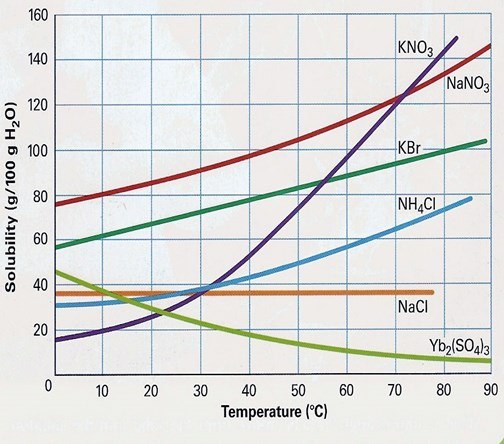
At 30'C, which substance has the lowest solubility?
KNO3
KBr
NaCl
Yb2(SO4)3
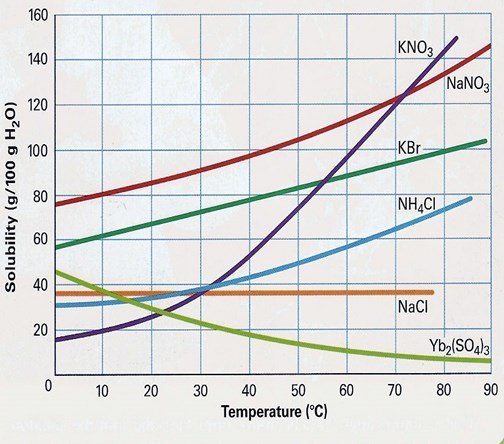
At which temperature do KBr and KNO3 have the same solubility?
60
55
50
Never
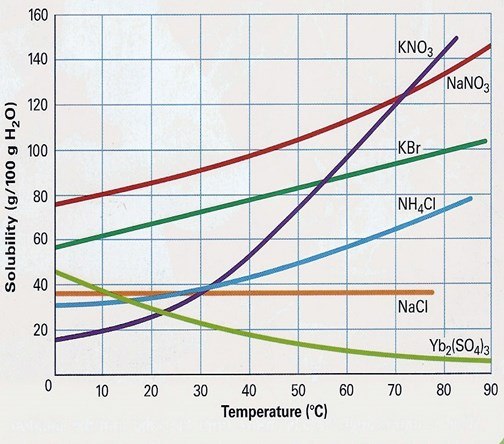
At 80'C, KBr's solubility is:
100
90
80
0
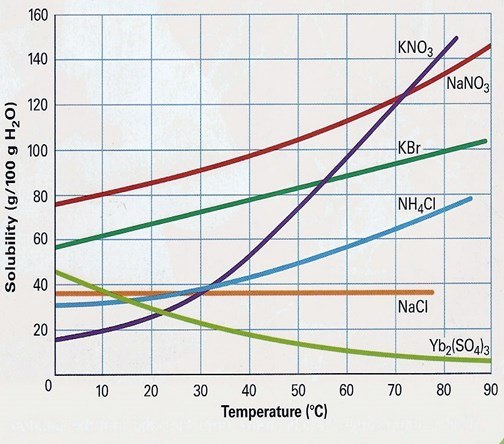
At 10'C, NaNO3's solubility is 80 g/100 g of H2O. Based on this information, what would the solubility be in 50 g of H2O.
40
80
160
16
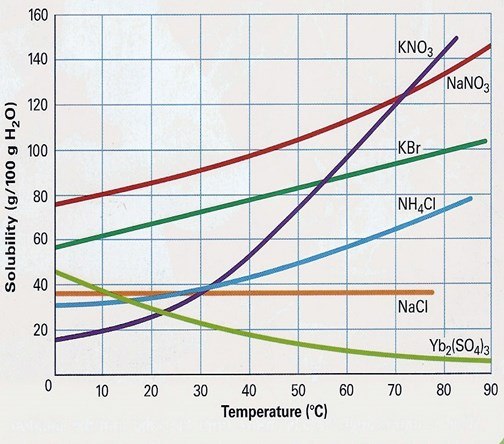
Identify if the following solution would be saturated, unsaturated, or supersaturated: 103 g KBr at 70'C.
Unsaturated
Saturated
Supersaturated
How could you change a saturated solution to an unsaturated solution?
Add solvent
Add solute
Identify a method to decrease the dissolving rate of a solution:
decrease the temperature
add KE
stir the solution
increase the temperature

Which substance is least soluble at 0 ºC?
KI
KNO3
KClO3
Ce2(SO4)3

When 40 grams of NaCl is dissolved in 100 grams of water at 90 ºC, the solution can be correctly described as:
supersaturated
saturated
unsaturated

Which would NOT increase the rate at which a sugar cube dissolves?
Reducing the amount of solvent
Crushing the sugar cube
Stirring the solution
Heating the solvent

Three 10 g samples of sugar are represented below.
Sample A dissolves in water more slowly than sample B.
Sample B dissolves more slowly than sample C.
Which of the following best explains why sample A dissolves more slowly than the other two?
It has the most volume.
It has the smallest surface area.
It has the largest number of sugar molecules.
It has the fewest bonds between sugar modules.
A technican prepared a solution by heating 100 mL of distilled water while adding KCl crystals until no more KCl would dissolve. She then capped the clear solution and set it aside on the lab counter. After several hours she noticed the solution had become cloudly and some solid had settled to the bottom of the flask. Which statement best describes what happened?
As the solution cooled, evaporation of water increased the KCl concentration beyond its solubility.
Water molecules, trapped with the KCl crystals, were released after heating.
At lower temperatures the solubility of KCl decreased so some of the solute comes out of solution.
At increased temperatures the solubility of KCl increased and remained too high after cooling.
What is the molarity of a 0.5L sample of a solution that contains 60.0 g of sodium hydroxide (NaOH)
0.8 M
1.5M
3.0M
6.0M
A student is preparing solutions for a laboratory experiment by dissolving solid solutes in liquid solvents. Which action will increase the rate of solubility
lowering the temperature of the solvent
stirring the solute in the solution
increasing the pressure on the solution
increasing the particle size of the solute
What is the molality of a solution in which 3.0 moles of NaCl is dissolved in 1.5 Kg of water?
2.0 M
0.22 m
135 m
2.0m
Which equation is used to find molarity?
Moles solute/L solution
Moles solute/kg solution
Moles solute/kg solvent
Grams solute/L solution
What is the percent by mass of a solution made by dissolving 20.0 g of NaCl into 180.0 g of water?
10.0 %
11.1 %
80.0 %
20.0 %
What mass of water should be added to 22.0 g of KCl to make 5.50% by mass solution?
400 g
40 g
0.25 g
25 g
How many grams of NaNO3 are needed to prepare 100 g of 15.0 % by mass NaNO3 solution? (MM = 85 g/mol)
15 g
1275 g
12.75 g
150 g
What is the molarity of 0.068 mol of NaCl in 3.8 L of solution?
0.018 M
0.0011 M
1.052 M
0.062 M
How many grams of solute are dissolved in 0.125 L of 5.00 M NaCl (MM = 58.45)?
0.625 g NaCl
625 g NaCl
36.5 g NaCl
0.04 mol NaCl
Calculate the mass percent of solution, if there is 100 g of sugar and 400 g of water
30
25
20
15
For a solution, pH + pOH =
7
14
1.0 x 10⁻¹⁴
-log (1.0 x 10 -14)
If the pH of a solution is 4.0, what is the pOH?
4.0
10.0
1.0 x 10 -4
cannot be determined from the information
The pH of a solution is 8.43. What is the [H3O+]concentration?
3.7 x 10 -9
1.0 x 10-8.43
2.7 x 10⁻⁶
1.0 x 10⁻¹⁴
If the [H3O+] of a solution is 1 x 10⁻³ M, the pH is
11
-3
3
1
If the pH of a solution is 8 the [H3O+] is
1.0 x 10⁶ M
8.0 x 101 M
1.0 x 10⁸ M
1.0 x 10⁻⁸ M
If the [OH-] of a solution is 2.7 x 10⁻⁴ M, the pOH of the solution is
10.44
1.00
3.57
-4.43
If the [H3O+] of a solution is 9.3 x 10⁻³ M, the pOH of the solution will be
2.03
1.02
11.97
12.98
If a solution has a pOH of 3.7 the [OH-] of the solution is
5.0 x 10⁻¹¹
2.0 x 10⁻⁴
10.3
14
Find the pH of a solution with [OH-] = 8.41 x 10⁻⁴.
3.08
10.92
9.88
11.23
What is the pOH of a solution with [H+] = 1.24 x 10 -2?
1.91
1.61
12.09
12.39
What is the pH of a solution that has a [H+] of 2.5 x 10⁻⁵?
4.60
2.5
5.0
7
What is the [H+] if the pH is 4.0?
1.0 x 10⁻¹⁰ M
1.0 x 10⁻¹⁴ M
1.0 x 10⁻⁴ M
1.0 x 10⁻⁷ M
What is the pOH of a solution where the [OH-] is 7.3 x 10⁻² M?
-1.14
1.14
2.01
11.99
What is the [OH-] if the [H+] is 1.0 x 10⁻³M?
1.0 x 10⁻³ M
1.0 x 10⁻¹⁴ M
6.02 x 10⁻²³ M
1.0 x 10⁻¹¹ M
What is the [OH-] if the pH is 4.9?
4.9 x 10⁻¹⁰ M
1.0 x 10⁻⁴ M
1.25 x 10⁻⁵ M
7.94 x 10⁻¹⁰ M
A solution of KOH is 2.5 x 10⁻⁵ M. What is the [H+] concentration? (Hint: Find pOH, then pH, then [H+].)
4.60
9.40
3.98 x 10⁻¹⁰
1.0 x 10-4.60
The pH of a solution is 8.43. What is the hydrogen ion H+ concentration?
3.7 x 10⁻⁹ M
2.7 x 10⁻⁶ M
1.0 x 10-8.43 M
1.0 x 10⁻¹⁴
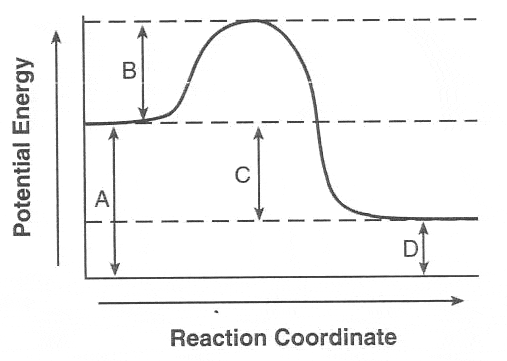
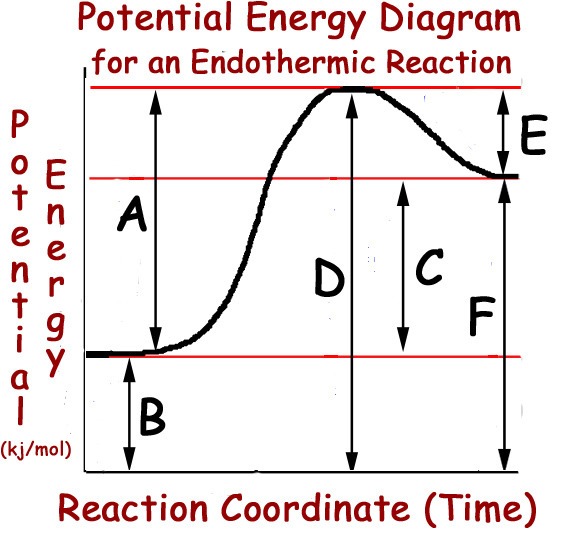
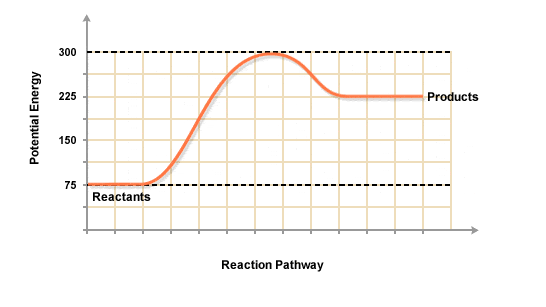
What type of reaction is this?
Endothermic
Exothermic
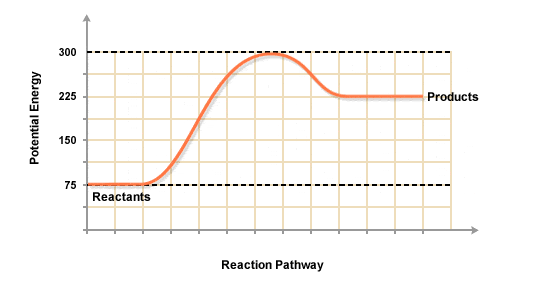
What is the energy of the activated complex?
75 kJ
225 kJ
300 kJ
50 kJ
In a chemical reaction, how quickly or slowly reactants turn
into products is called the
Catalyst
Reaction Rate
Concentration
Temperature
What is the name given to a catalyst in the human body?
Biology
Catalyst
Chemical
Enzyme
If the reactant particles collide with less energy than the activation energy, the particles will be rebound, and no reaction will occur.
True
False
The collisions which bring about a chemical reaction are called:
Consistent collisions
Normal collisions
Effective collisions
More collisions correspond to a:
Faster reaction rate
Slower reaction rate
Constant reaction rate
Catalysts permit reactions to proceed along a ___________energy path.
lower
higher
magnetic
psycho's
Smaller particle size allows for a _________ surface area to be exposed for the reaction.
larger
smaller
rectangular
spherical
Increasing the ____ causes the particles (atoms
or molecules) of the reactants to move more quickly so that
they collide with each other more frequently and with more
energy.
Catalyst
Surface Area
Temperature
Concentration
________ is the measure of how much area of an
object is exposed.
Surface Area
Catalyst
Temperature
Concentration
Grains of sugar have a greater _______ than a solid cube of
sugar of the same mass, and therefore will dissolve quicker in water.
Surface Area
Catalyst
Temperature
Concentratrion
Pick the TWO (2) options that will INCREASE the rate of a reaction.
Reducing Heat
Adding Catalyst
Adding Heat
Removing Catalyst
Which of the following will lower the rate
of reaction?
adding an enzyme to the reaction
decreasing the temperature from 40°C to
10°C
breaking a chunk of calcium up into
smaller pieces
increasing the amount of solute
dissolved in a solution