
 Worksheets
Solutions & Solubility
Total questions: 115
Worksheet time: 3hrs 42mins
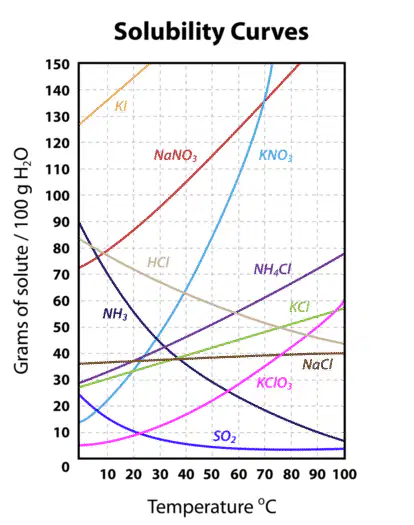
A solution of 30g of NH4Cl at 30oC would be
saturated
supersaturated
unsaturated
A solution of 70g of HCl at 25oC would be
saturated
supersaturated
unsaturated
A solution of 140 g of NaNO3 at 15oC would be
saturated
supersaturated
unsaturated
A solution of 8 g of SO2 at 60oC would be
saturated
supersaturated
unsaturated
A solution of 70 g of NH3 at 10oC would be
saturated
supersaturated
unsaturated
A solution of 90 g of KNO3 at 60oC would be
saturated
supersaturated
unsaturated
Which salt is least soluble at 60oC?
KI
NaNO3
SO2
KCl
Which salt is most soluble at 10oC?
KI
NaNO3
SO2
KCl
Which salt shows the least change in solubility from 0 to 100⁰C ?
NaCl
KNO3
SO2
HCl
How many grams of NaNO₃ could be dissolved in 100g of water at 45⁰C ?
110 g
80 g
72 g
140 g
How many grams of KClO₃ could be dissolved in 100 g of water at 45⁰C?
20 g
60 g
80 g
40 g
How many grams of KI could be dissolved in 100 g of water at 10⁰C ?
75 g
122 g
5 g
135 g
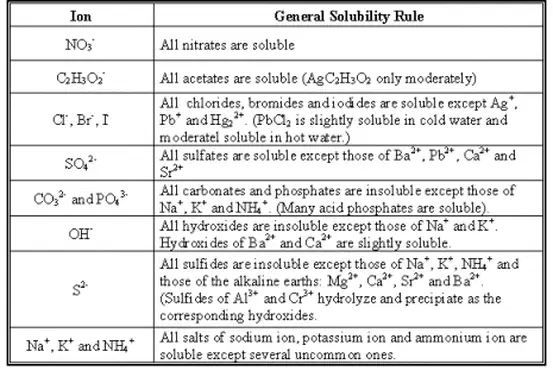
Fe(OH)3
soluble
insoluble
AgCl
soluble
insoluble
AgCl
soluble
insoluble
MgSO4
soluble
insoluble
NaCl
soluble
insoluble
CaCO3
soluble
insoluble
A homogenous mixture is called a...
solute
solvent
solution
soluble
The part of the solution that is being dissolved is called the
solvation
solvent
solute
mixture
Reducing the concentration of a solution
experimenting
solvation
molarity
diluting
amount of solute per unit of volume
concentration
dissolving
molarity
acidic
A concentration defined as the number of moles of solute per liter of solution is called...
molality
molarity
percent by mass
dilution
The part of a solution that does the dissolving is called the...
solvation
solvent
solute
mixture
The ability to dissolve is called...
solvation
solution
solubility
dilution
A(n) ___ solution is one in which the solute is dissolved in water.
aqueous
homogeneous
hetergeneous
concentrated
Which of these will not affect the rate of solvation?
increasing the surface area (smaller pieces)
heating
stirring
adding more solute
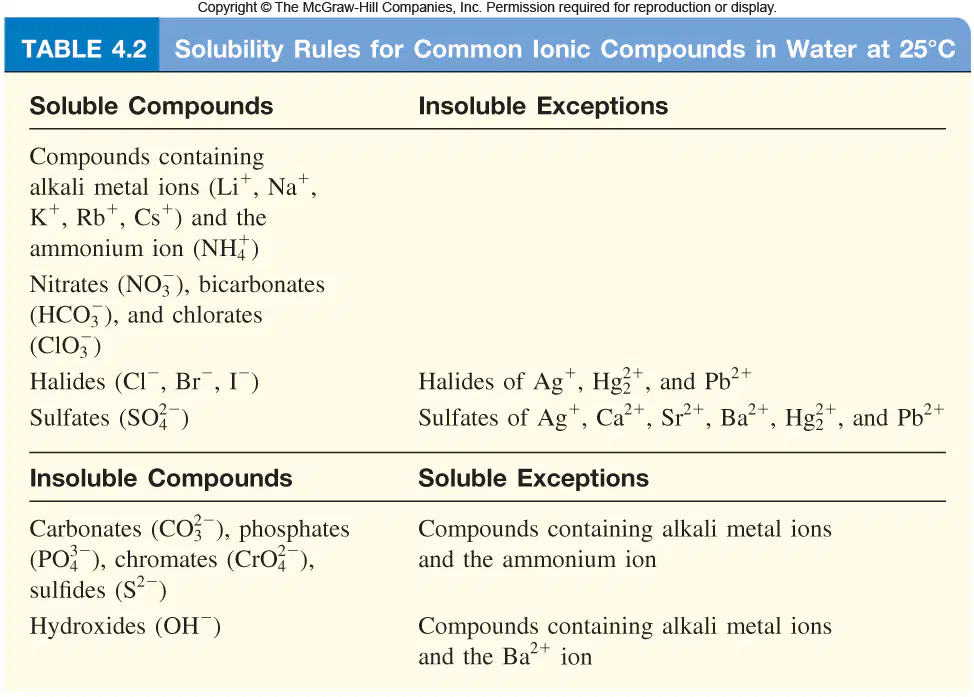
According to the solubility rules, magnesium chromate (MgCrO₄) is...
soluble
insoluble
According to the solubility rules, is potassium nitrate (KNO₃) soluble?
yes
no
All (a) are soluble.

How much KNO3 solute is saturated at 40 degrees?
75
55
65
85
How much C12H22O11 solute is saturated at 40 degrees?
240
220
230
250
How much Ce2(SO4)3 solute is saturated at 80 degrees?
20
15
30
2
How much NaBr solute is saturated at 70 degrees?
110
120
130
140

At what temperature can you fully dissolve 140g of NaNO3?
62
73
81
You cannot determine this
At what temperature can you fully dissolve 60g of KNO3?
27
30
37
You cannot determine this
At what temperature can you fully dissolve 120g of NaBr?
70
20
100
You cannot determine this
What type of a solution is 60g NaNO3 at 40ºC in 100g H2O?
Saturated
Unsaturated
Supersaturated
What type of a solution is 100g KNO3 at 40ºC in 100g H2O?
Saturated
Unsaturated
Supersaturated
What type of a solution is 260g sugar at 50ºC in 100g H2O?
Saturated
Unsaturated
Supersaturated
What type of a solution is 25g NaCl at 70ºC in 100g H2O?
Saturated
Unsaturated
Supersaturated
What type of a solution is 55g KCl at 70ºC in 100g H2O?
Saturated
Unsaturated
Supersaturated

Using the provided solubility graph, place the following substances in the proper type of solution formed in 100 g of water.
50 g of KCl at 90°C
50 g of KCl at 60°C
48 g KNO3 at 60°C
80 g KNO3 at 48°C
65 g KNO3 at 70°C
25 g of NaCl at 0°C
10 g SO2 at 60°C
130 g of KI at 0°C
70 g of NH4Cl at 88°C
60 g of HCl at 45°C

At approximately what temperature can 115 g of NaNO3 be dissolved in 100 g of water to create a saturated solution?
(a) °C
How much KCl can be dissolved in 100 g of water at 75°C to form a saturated solution?
(a) g
What temperature do I have to heat 100 grams of water in order to dissolve 120 grams of NaNO3? (Give the answer to the ones place.)
(a) °C

At what temperature can equal masses of KCl and HCl be dissolved in 100 grams of water? (Give the answer to the ones place.)
(a) °C
A solution occurs when the (a) is (b) in a (c) .
solute
dissolved
solvent
solution
salt
filtered
Concentration is
the amount of solute in the solvent
the amount of solvent in the solute
density
particle size
Which solution is more concentrated?
Solution 1:
500 mL of water
100 g of salt
Solution 2:
500 mL of water
90 g of salt
Solution 1
Solution 2
They have the same concentration
I have no idea
In order to dilute a solution, you need to
add more of the solid
add more water
find the mass
find the volume
What volume, in milliliters, of 10.0 M NaOH is needed to prepare 300 mL of 2.00 M NaOH by dilution?
0.067 mL
60.0 mL
100 mL
125 mL
If I have 340 mL of a 0.5 M NaBr solution, what will the concentration be if I add 560 mL more water to it?
.188 M
3.78 M
.389 M
1.76 M
Find the molarity of 186.55 g of sucrose, C12H22O11 in 250 mL of water.
2.18 M
0.746 M
1.18 M
0.545 M
As you remove solvent (evaporate the water) from the solution, the concentration (M) will...
increase
decrease
stay the same
What is a homogeneous mixture of two or more substances?
solute
solvation
solution
solvent
What is the molarity of a solution that has 0.080 moles of calcium chloride dissolved in 850 mL of solution?
9.4 M
0.94 M
94 M
0.094 M
What is the molarity of a solution that has 1.50 moles of lead nitrate dissolved in 0.500 L of solution?
3.00 M
0.003 M
0.300 M
0.0300 M
What is the molarity of a solution that has 16.0 g of potassium sulfide (K2S - molar mass 110 g/mol) dissolved in 0.650L of solution?
24.6 M
0.346 M
2.23 M
0.223 M
If I add water to 100 mL of a 1.5 M NaOH solution until the final volume is 150 mL, what will the molarity of the diluted solution be?
1 M
2.25 M
0.6 M
1.50 M

Using the solubility curve pictured, determine whether 50 g of potassium chloride in 100g of water will be saturated, unsaturated, or supersaturated at 50°C.
saturated
unsaturated
supersaturated
20 g of calcium chloride per 100 g of water at 90°C will be...
saturated
unsaturated
supersaturated
What is the maximum amount of cesium (III) sulfate that can be dissolved at 30°C?
10 g
4 g
35 g
95 g
Molarity is the measure of the (a) of a solution.
The two pieces of information needed to calculate molarity are the (a) of the solute and the (b) of solution.
The two parts of a solution are the ___ and the ___.
(Select all that apply)
solvent
solution
solute
solvation
What does it mean for a solution to become supersaturated?
This is when a solvent has dissolved a solute, but the limit of how much can be dissolved has not been reached yet.
This is when a solvent has no solute in it.
This is when a solvent has more solute dissolved in it than under normal conditions.
This is when a solvent has the maximum amount of solute dissolved in it.
A student attended an event at a traditional tea room that offered sugar cubes instead of sugar packets. She added two sugar cubes to a cup of hot tea. After she finished drinking the tea, she was surprised to see two small chunks of undissolved sugar at the bottom of her cup. All the sugar dissolves in tea of the same temperature when added from a packet. Which of the following BEST explains why sugar remains undissolved from cubes but not from packets?
The temperature of the tea with cubes was lower than the one with packets.
Unlike the packet, the cube is compacted so not all sugar molecule surface areas contact the tea.
Adding a cube decreases the likelihood of stirring the tea, where as adding a packet reminds people to stir.
Unlike the tea cup with cubes, tea with packets is served in a bigger cup that allows for more tea.
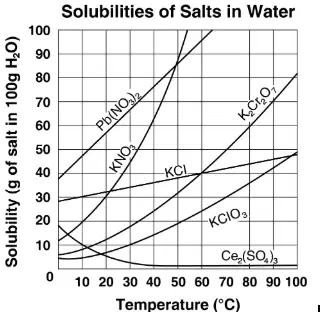
Which term correctly describes a solution containing 50 g KCl/100g H2O at 60°C?
subsaturated
saturated
supersaturated
unsaturated
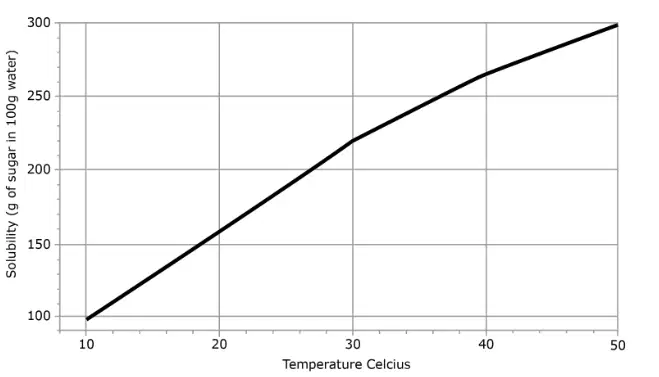
The following graph represents the amount of sugar that dissolves in 100 g of water at different temperatures. Which of these is the best prediction of the greatest amount of sugar that will dissolve in 300 g of 30 °C water?
70 g
220 g
660 g
1320 g
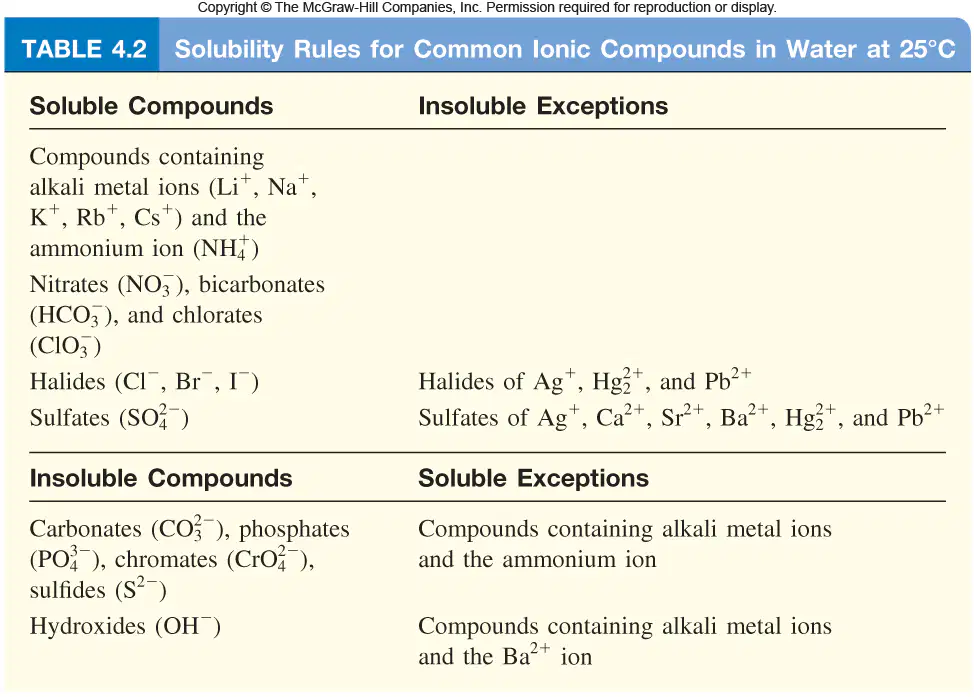
Use solubility rules to determine the missing states of matter in the equation below.
(NH4)2Cr2O7 (aq) + Ca(OH)2 (aq) --> 2 NH4OH ( ? ) + CaCr2O7 ( ? )
Which product is insoluble?
(NH4)2Cr2O7
Ca(OH)2
NH4OH
CaCr2O7
Based on general solubility rules, which compound will form a precipitate if it is the product of a double replacement reaction?
ammonium sulfide ((NH4)2S)
potassium phosphate (K3PO4)
lead (II) nitrate
(Pb(NO3)2)
tin (II) carbonate
(SnCO3)
Which unit listed below is used to measure solution concentration in chemistry?
electronegativity
molarity
solubility
viscosity
What is the molarity of 5.60 mol of sodium carbonate in 1500 ml of solution?
Round to one decimal place.
Which equation can be used to calculate the dilution of a solution?
a = bc
c = λν
PV = nRT
M1V1 = M2V2
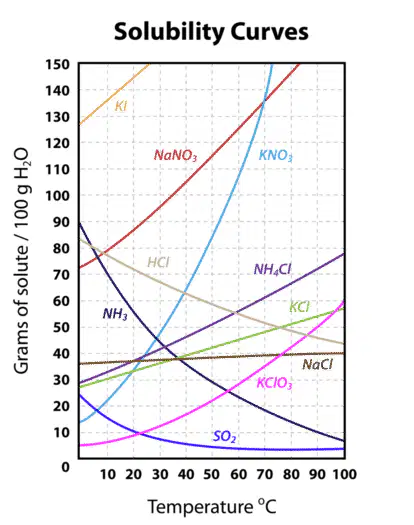
What type of a solution is 150g NaCl at 25ºC in 100g H2O?
Saturated
Unsaturated
Supersaturated
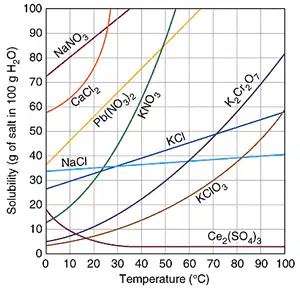
How many grams of CaCl2 could be dissolved in 100g of water at 30⁰C?
74 g
50 g
90 g
100 g
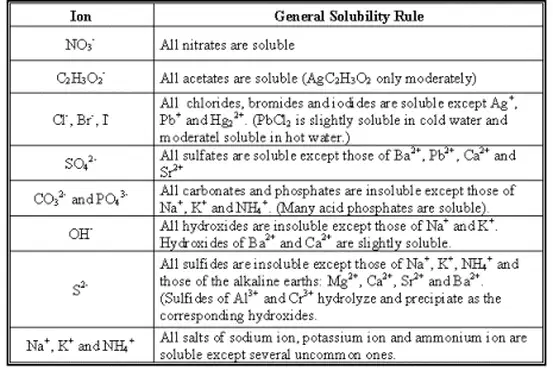
Which of the following compounds is insoluble in water?
CaCO3
NaCl
LiNO3
KBr
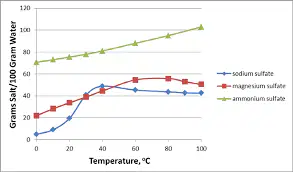
What is the solubility of Na2SO4 at 30oC?
20 g/100 g H2O
30 g/100 g H2O
40 g/100 g H2O
50 g/100 g H2O
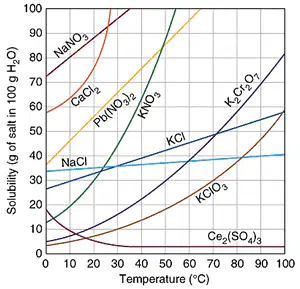
What is the solubility of NaCl in 100 g of water at 25⁰C?
56 g
26 g
36 g
46 g
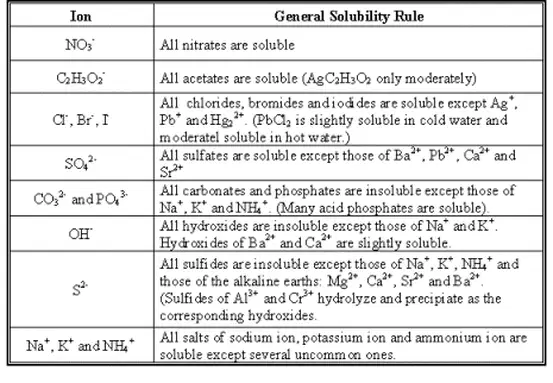
Which of the following compounds is insoluble in water?
NaCl
KCl
AgCl
LiCl
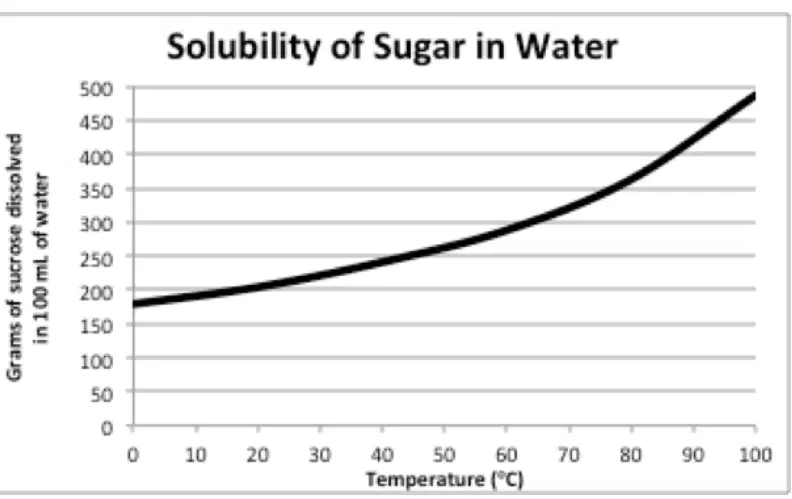
How many grams of sugar can be dissolved in 100 g of water at 20⁰C?
160 g
180 g
220 g
200 g

A scientist makes a solution that contains 44.0 grams of hydrogen chloride gas, HCl(g), in 200. grams of water, H2O(l), at 20.°C. This process is represented by the balanced equation below.
Explain, in terms of the distribution of particles, why the solution is a homogeneous mixture.
The particles in a solution are (a) distributed.
A ____________ is another name for a homogeneous mixture.
solute
solution

A student is preparing solutions for a laboratory experiment by dissolving solid solutes in liquid solvents. Which action will increase the rate of solubility
lowering the temperature of the solvent
increasing the pressure on the solution
stirring the solute in the solution
increasing the particle size of the solute
A student is preparing solutions for a laboratory experiment by dissolving solid solutes in liquid solvents. Which action will increase the rate of solubility
lowering the temperature of the solvent
decreasing the size of the solute particles
stirring the solute in the solution
increasing the particle size of the solute
A student is preparing solutions for a laboratory experiment by dissolving solid solutes in liquid solvents. Which action will increase the rate of solubility
lowering the temperature of the solvent
raising the temperature of the solvent.
increasing the particle size of the solute
You make a Kool Aid drink using Kool Aid powder, sugar, & water & you notice your drink still has to much powder sitting at the bottom. What will happen if you add more water to the drink?
decrease the solubility of your drink
decrease the solubility rate of your drink
increase the solubility rate of your drink
increase the solubility of your drink
The amount of solute that can be dissolved in a specific amount of solvent at a given temperature is its
concentration.
density.
dilution.
solubility.
Raising the temperature of the solvent typically has what effect on the rate of dissolving?
Increases
Decreases
Pauses
No effect
A student is preparing solutions for a laboratory experiment by dissolving solid solutes in liquid solvents. Which action will increase the rate of solubility
lowering the temperature of the solvent
stirring the solute in the solution
increasing the pressure on the solution
increasing the particle size of the solute
How could you change a saturated solution to an unsaturated solution?
Add solvent
Add solute
A solution that has water as the solvent is called a(n).....
Aqueous Solution
Water-Based Solution
Organic Solution
Dilute Solution
A solution that is able to dissolve additional solute is best described as
supersaturated.
concentrated.
saturated
unsaturated.
A ____________ solution contains more than the maximum amount of solute a solvent can theoretically hold. Crystals can be grown from these solutions.
unsaturated
supersaturated
saturated
take a cup of water, add sugar, and stir. if the resulting solution contains sugar crystals that do not dissolve, the solution is said to be
non of these
a homogenous soultion
an unsaturated solution
a saturated solution
When a crystal of solute is added to a clear aqueous solution, the solution becomes solid and look like snow. The solution is
Saturated
Unsaturated
Supersaturated
Solvated
The amount of solute that can be dissolved in a specific amount of solvent at a given temperature is its
concentration.
density.
dilution.
solubility.
As you put in more solute in the solution, the concentration of the solution will...
increase
decrease
stay the same
Michael is making lemonade. As he adds more sugar to the lemonade, the concentration of the sugar in the lemonade will...
increase
decrease
stay the same
molarity
molarity
The term molar, which describes a solution's concentration, is written as?
M
mol
g
g/L
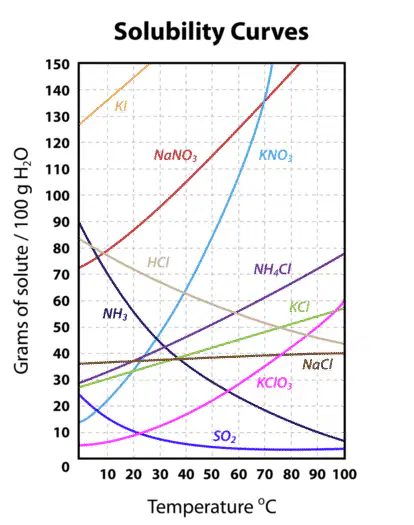
Which of the following compounds is most soluble in water at 20oC?
CaCO3
AgCl
KI
NaNO3
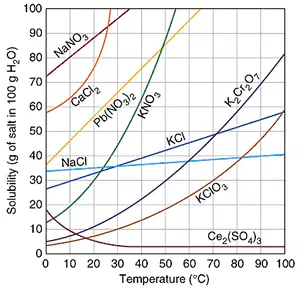
How many grams of NaNO3 can be dissolved in 100 g of water at 30oC?
80 g
100 g
95 g
70 g

