
 Worksheets
CU12: Forces Between Particles
Total questions: 116
Worksheet time: 2hrs 42mins
Which is the correct Lewis dot diagram for Magnesium?


Which is the correct Lewis Dot Diagram for Boron?


What is the purpose of Lewis Dot Diagrams?
To visually represent the positions of all an atom's electrons.
To visually represent an atom's valence electrons & quickly determine what needs to happen for it to be electron satisfied (happy).
To visually represent the atomic mass of an element's atom.
To visually represent the number of total electrons in an element's atom.
Which of these Lewis Dot Diagrams is INCORRECT for Neon?


If an atom's charge becomes +2, what does that mean about the atom?
The atom gained 2 electrons.
The atom lost 2 electrons.
The atom is bonded to another atom in a covalent bond.
The atom has 2 protons.
Which type of bond is formed when metals bond with non-metals?
metallic
If an atom gain electrons, it...
becomes overall positively charged.
becomes overall negatively charged.
stays neutral.
becomes neutral.
Metals tend to...
gain electrons.
lose electrons.
ALL of the following are characteristics of ionic bonds EXCEPT:
They have low melting points.
They conduct electricity when dissolved in water.
They are solids at room temperature.
They are formed between metal atoms and a nonmetal atoms.
What does the prefix "di" mean?
What does the prefix "tetra" mean?

Which is the correct chemical/empirical formula for the molecule in the diagram?
Which is the correct name for PCl3?
Diphosphorous trichloride
Phosphorous Dichloride
Phosphorus Trichlorine
Phosphorous Trichloride

Which is the correct Lewis Dot diagram for Argon?
a
b
c
d

Both Helium and Krypton are noble gases. Are the Lewis Dot diagrams correct?
Yes, both have correct diagrams.
No, both do NOT have correct diagrams.
The diagram for He is correct, but for Kr it is NOT correct.
The diagram for He is NOT correct, but it is correct for Kr.
Which is the correct chemical/empirical formula for the compound called "sulfur dichloride"?
2SCl
SCl
SCl2
S2Cl
Which is the correct chemical/empirical formula for the compound called "boron trifluoride"?
BF3
B3F
BF
3BF
What is the correct name for the compound N2Br4 ?
Nitrogen tetrabromide
Dinitrogen tetrabromide
Dinitride tetrabromide
Dinitrogen tetrabromine
What is the correct name for the compound ClF ?
chlorine fluoride
chlorine fluorine
monochlorine monofluoride
chlorine monofluoride
Valence electrons are the...
outermost electrons in an atom's electron cloud.
total electrons in an atom's electron cloud.
When you draw a Lewis Dot diagram, how many unpaired valence electrons does chlorine (Cl) have?
1
5
6
7
Ionic bonds form between...
Losers & Gainers
Gainers & Gainers
Losers & Losers
Why do elements form bonds?
To make more atoms.
To create a new element.
To become electron satisfied.
A covalent bond forms when atoms ___________ electrons.
gain
share
increase
transfer

What type of bond forms between Be & F?
no bond forms
covalent bond
ionic bond
metallic bond

What 2 types of atoms make a covalent bond?
2 metals
2 noble gases
2 nonmetals
1 metal & 1 nonmetal
Atoms in covalent compounds...
contain a sea of electrons that move from atom to atom.
overlap their electron clouds and share electrons.
are attracted to each other like magnets after transferring electrons.
Which type of atoms will form positive ions?
metals
nonmetals
noble gases
Which of these bond types allows electrons to move freely among the atoms?
metallic
polar covalent
ionic
nonpolar covalent

Lewis dot diagrams for sodium (Na) and chlorine (Cl) are shown in the attached diagram. Which of the following best describes what will happen with these two elements when forming a bond?
Sodium and chlorine will share their valence electrons
Sodium gains seven electrons and chlorine will gain one electron
Sodium will lose one electron and chlorine will gain one electron
Sodium will gain seven electrons and chlorine will lose one electron

Lewis dot diagrams are shown for lithium (Li) and chlorine (Cl) in the attached photo. If these atoms form a bond, what will happen to their electrons?
Lithium will gain one electron and chlorine will lose one electron.
Lithium will lose one electron and chlorine will gain one electron.
Lithium will gain seven electrons and chlorine will lose one electron.
Instead of transferring their electrons, lithium and chlorine will share their electrons so that both atoms may obtain a full valence shell.

In the diagram attached, the electrons are not attached to a specific nucleus, but are able to freely move and flow throughout the mass. What kind of bonding is this a representation of?
Covalent
Ionic
Metallic
Hydrogen
What occurs when potassium reacts with chlorine to form potassium chloride?
Electrons are shared and the bonding is ionic.
Electrons are shared and the bonding is covalent.
Electrons are transferred and the bonding is ionic.
Electrons are transferred and the bonding is covalent.
Which of the following occurs in an ionic bond?
Two ions share protons.
Two ions share electrons.
Similarly charged ions attract.
Oppositely charged ions attract.
How many electrons can fit into the first shell (closest to the nucleus)?
2
8
6
10
The molecule that forms between Potassium and Nitrogen requires how many atoms of each element?
1 potassium, 1 nitrogen
1 potassium, 3 nitrogen
3 potassium, 1 nitrogen
2 potassium, 3 nitrogen
The molecule that forms between Calcium and Fluorine requires how many atoms of each element?
1 calcium, 1 fluorine
1 calcium, 2 fluorine
2 calcium, 1 fluorine
2 calcium, 3 fluorine
Covalent bonds form between...
Losers & Gainers
Gainers & Gainers
Losers & Losers
Metallic bonds form between...
Losers & Gainers
Gainers & Gainers
Losers & Losers
How do "Loser" atoms end up with a full valence shell?
They steal electrons to fill up their outer shell.
They give away electrons to reveal their full shell underneath.
They share their electrons with other atoms.
How do "Gainer" atoms get a full valence shell?
They steal or share electrons to fill up their outer shell.
They give away electrons to reveal their full shell underneath.
They already have a full valence shell.
H, He, Li, & Be only need ____ valence electrons to have a full valence shell.
4
Atoms in ionic compounds...
contain a sea of electrons that move from atom to atom.
overlap their electron clouds and share electrons.
are attracted to each other like magnets after transferring electrons.
Atoms in compounds held together by metallic bonds...
contain a sea of electrons that move from atom to atom.
overlap their electron clouds and share electrons.
are attracted to each other like magnets after transferring electrons.
Which type of atoms will form negative ions?
losers
gainers
noble gases
Water (H2O) is held together by...
Polar covalent bonds.
Nonpolar covalent bonds.
ionic bonds.
Are the individual atoms more stable and well-behaved when they are bonded together to form a molecule or before they are bonded together?
Individually
When two nonmetals do not share electrons evenly, the resulting bond will be...
nonpolar covalent.
polar covalent.
ionic.
metallic.
Since covalent compounds do not have free electrons, they are...
good conductors of electricity.
poor conductors of electricity.
used for wires to carry electricity.
Most covalent compounds are do NOT exist in which state of matter?

Why do the ice cubes float on liquid water?
When water molecules form a solid, they are not as close together as they are in the liquid state.
When water molecules form a solid, they are closer together compared to the liquid state.
When water molecules form a solid, they take up the same amount of room as they did in the liquid state.
The weaker the forces are holding a substance together, the _____________ the melting point.
higher
lower
Intramolecular forces are...
the forces between atoms, holding them together.
the forces holding an atom's nucleus together.

Which atoms bond together to form a water molecule?

Why do we say that water is a polar molecule?
Because all water is from the North Pole.
The Oxygen side of the molecule is slightly negative, and the Hydrogen part is slightly positive.
Polarity refers to the same charges that repel.
The electrons are positive and the protons are negative.
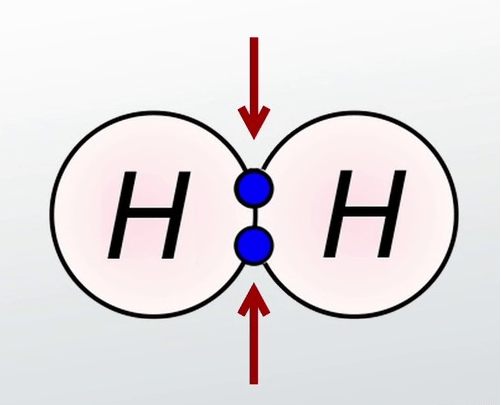
Metallic
Diatomic molecules happen when two of the same kind of atom bond with each other (i.e. Oxygen with Oxygen). What type of bond should they form?
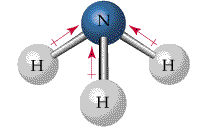
This molecule contains N and H atoms. It is NOT symmetrical, so it is held together by...
polar covalent bonds.
nonpolar covalent bonds.
ionic bonds.
metallic bonds.
When two atoms of the same nonmetal element bond together, they form a(n)
ionic bond.
nonpolar covalent bond.
polar covalent bond.
James Bond.
Which of the following pairs of elements is most likely to form an ionic bond? (You should refer to a Periodic table.)
sulfur and oxygen
sulfur and fluorine
sodium and sulfur
oxygen and fluorine
Polar covalent molecules have...
no charges.
slight positive and negative charges on opposite ends of the molecules.
completely positive and negative charges on the opposite ends of the molecules.
Why is it difficult to wash oil from your hands with plain water?
Both substances are polar. Like polarities repel.
Both substances are nonpolar. Like polarities repel.
Water is nonpolar, and oil is polar, so they will not combine.
Water is polar, and oil is nonpolar, so they will not combine.
___________ bonds happen when electrons are shared EVENLY between the two bonded atoms.
Polar Covalent
Nonpolar Covalent
Ionic
Metallic
A polar bond happens between...
two non metals of the same strength.
two non metals, one is stronger than the other.
two metals.

CH4 is a nonpolar molecule because...
It is NOT symmetrical
It is symmetrical
How many Aluminum atoms are in Al2O3?
3
5
2
1
Polar Covalent and Nonpolar Covalent
Polar Covalent and Ionic
Nonpolar Covalent and Ionic
metallic
Oil is too dense to mix with water.
Water can only mix with molecules that have positive and negative ends.
Water can only mix with non-polar molecules.
The electrons in a polar covalent molecule are shared...
evenly.
unevenly.
Electrons are not shared.
The electrons in a nonpolar covalent molecule are shared...
evenly.
unevenly.
Electrons are not shared
The electrons in an ionic molecule are shared...
evenly.
unevenly.
Electrons are not shared.
Molecules that contain whole number charges on atoms (+1,-3, etc.) must be...
Polar Covalent
Nonpolar Covalent
Ionic
Polar Covalent or Ionic
A diatomic molecule like O2 is always _____ because electrons are shared _____
nonpolar; unequally
polar; equally
nonpolar; equally
polar; unequally
The melting point and boiling point for polar covalent bonds would be _______.
high
low
How would the melting point and boiling point for nonpolar covalent bond?
High
Low
Do substances held together by polar covalent bonds dissolve in water?
yes
no
Do substances held together with nonpolar covalent bonds dissolve in water?
yes
no
When two gainers share electrons unevenly, the resulting bond will be...
nonpolar.
polar.
ionic.
metallic.
Compared to ionic compounds, covalent compounds generally have...
good conductivity.
greater densities.
more chemical bonds.
a low melting point.
To attain the same electron configuration of a noble gas.
To increase their mass.
It's a nice thing to do.
In the compound N2O, what does the subscript 2 indicate?
There are 2 sodium atoms for each atom of oxygen
There are 2 nitrogen atoms for each atom of oxygen
There are 2 oxygen atoms for each atom of nitrogen
Nitrogen atoms are twice a large as oxygen
Carbon has four electrons in its valence shell. How many more electrons does carbon need to have a full valence shell?
Due to its polarity, water doesn't mix with ____________ substances like _____________.
polar; oil
polar; salts
Non-polar; oil
Non-polar; salts
How many atoms of hydrogen are in a sugar molecule with the formula C6H12O6
12
6
24
18
Water forms round drops because...
water molecules are attracted to each other.
water molecules repel each other.
water is wet.

A water strider can skate along the top of a pond because...
water molecules repel each other.
water molecules are attracted to each other.
water is really dense.
water striders are afraid of water and avoid it
Sulfur Tetrafluoride
Tetrasulfide Fluoride
dinitrogen pentoxide
chlorine trifluoride
A(n) _____________ is an atom that has an electric charge.

The following properties are all characteristics of ionic compounds EXCEPT
high melting and boiling points
soft
crystal lattice structure
conduct electricity when dissolved in water
malleable (bendy)

True or false? Ionic compounds have high melting points.
true
false

True or false? Ionic compounds conduct electricity when they are in their solid state.
true
false
Which is a property shared by most covalent bonds?
high boiling point
high melting point
low melting point
nonpolar bonds
Magnesium bromide is an ionic compound with the chemical formula MgBr2 What does the "2" tell you?
There are 2 molecules.
There are 2 Magnesium atoms.
There are 2 Bromine atoms.
Which of the following is a property of ionic compounds?
Low melting points
Are brittle crystals
Contain no charged particles
Low boiling points
A metallic bond is formed when many metal atoms ___________.
share their pool of valence electrons
share covalent bonds between atoms
share ionic bonds between atoms
exchange neutrons
Why do metallic compounds conduct electricity as solids?
Valence electrons are mobile, allowing electricity to flow through the metal.
Protons are mobile, allowing electricity to flow through the metal.
Which of the following is NOT a property of metals?
Can conduct electricity
Very brittle (breaks easily)
Malleable (can bend without breaking)
What do electrons do in a metallic bond?
They stay on the metal atom.
They are transferred from atom to atom.
They form a covalent bond with another atom.
They float around freely.
At room temperature, most metals are in the ____________ state of matter.
plasma
Molecules held together with ionic bonds are always...
polar.
nonpolar.
Geckos can climb really smooth surfaces because...
Their feet are sticky.
They excrete a goo, like a snail.
They have "hooks" on their legs they use to grasp the crevices in a surface.
They put the atoms of their feet really close to the atoms of the climbing surface, using the attraction between their atoms and the surface's atoms to "stick".

