wayground logo

Free Printable Worksheets

Font size

S
M
L
XL
Worksheets

SCH3U Unit 1 Review

Total questions: 112

Worksheet time: 2hrs 24mins

Name
Class
Date
1.
What is atomic number?
a)
Number of protons in an atoms 
b)
Number of neutrons in an atom
c)
Mass of an atom
d)
Charge on an atom
2.
Which subatomic particles are found in the nucleus of an atom?
a)
Protons and Electrons
b)
Protons and Neutrons
c)
Neutrons and Electrons
d)
Protons, Neutrons and Electrons
3.
The total number of protons and neutrons in an atom is called the...
a)
Atomic number
b)
Proton number
c)
Mass number
d)
Weight number
4.
Atoms of the same element must always have the same number of _________
a)
electrons
b)
neutrons
c)
isotopes
d)
protons
5.

The mass number of an element that has 18 protons, 18 electrons, and 19 neutrons is _____.

a)

12.5

b)

13

c)

25

d)

37

6.

Who was the first contributor to the atomic theory?

a)

John Dalton

b)

Ernest Rutherford

c)

JJ Thompson

d)

Democritus

e)

Neils Bohr

7.

What is the correct order of scientists in order of their work related to the atomic theory from earliest to most recent?

a)

Neils Bohr, Ernest Rutherford, JJ Thomson, John Dalton, & Democritus

b)

JJ Thomson, John Dalton, Neils Bohr, Ernest Rutherford, & Democritus

c)

Democritus, John Dalton, JJ Thomson, Ernest Rutherford, and Neils Bohr

d)

John Dalton, Neils Bohr, JJ Thomson, Democritus, & Ernest Rutherford

8.

What is Neils Bohr's contribution to the atomic theory?

a)

Created the atomic theory

b)

Created a model of the atom with electrons moving around the nucleus in a fixed orbits

c)

Discovered that the proton had a positive charge

d)

Believed that atoms of a given element are identical

e)

Discovered the electron

9.
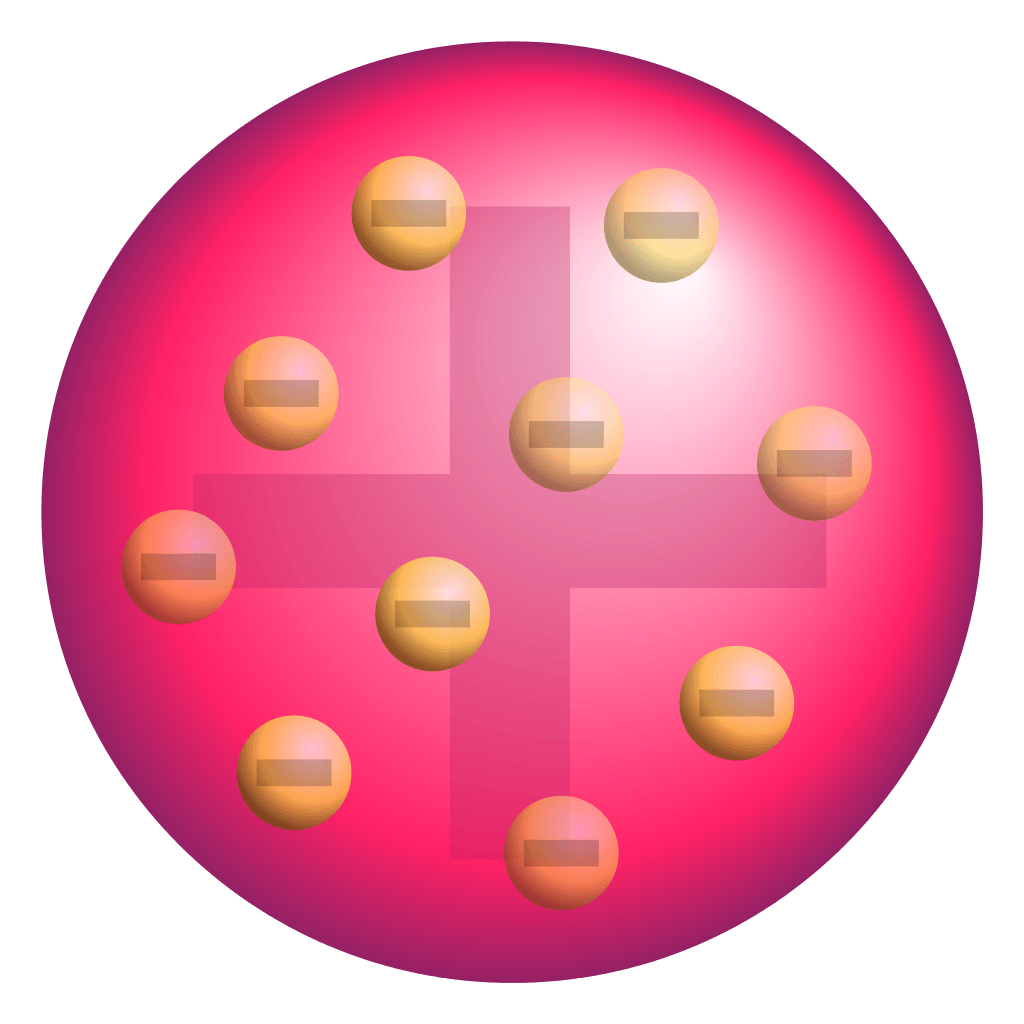
Who came up with this model of an atom?
a)
J.J. Thompson
b)
Ernest Rutherford
c)
Neils Bohr
d)
James Chadwick
10.
Who's model is this?
a)
Thomson
b)
Rutherford
c)
Democritus
d)
Bohr
11.
What is an isotope? 
a)
A charged atom
b)
An atom with different amounts of neutrons
c)
An atom with different amounts of protons
d)
A neutral atom
12.

As you move left to right on a row or period what happens?

a)

Atomic number increases by 1

b)

Electrons decrease

c)

Number of shells decrease

d)

Nothing

13.
Ionization energy is the...
a)
energy needed to remove the outermost electron.
b)
ability of an atom to attract electrons from another atom.
14.
Electronegativity is the...
a)
energy needed to remove the outermost electron.
b)
ability of an atom to attract electrons from another atom.
15.
Which element has the smaller atomic radius: potassium (K) or bromine (Br)?
a)
potassium (K)
b)
bromine (Br)
16.

Nonmetals tend to

a)

gain electrons

b)

lose electrons

17.
If my charge becomes 2+ what does that say about me?
a)
I am stealing 2 electrons
b)
I am losing 2 electrons
c)
I am in period 2
d)
I have an atomic # of 2
18.
When metals bond with non-metals they form what type of bonds
a)
covalent
b)
ionic
c)
cooperative
d)
lewis
19.
How do the following two elements bond together?
Na1+  F1-         
a)
NaF
b)
NaF3
c)
Na3F
d)
Na1F2
20.
Carbon dioxide
a)
C2O2
b)
C20
c)
CO
d)
CO2
21.
Phosphorous trichloride
a)
PCl3
b)
P3Cl
c)
P3Cl3
d)
PCL
22.
Disulfur trioxide
a)
S3O2
b)
SO
c)
S2O3
d)
S2O
23.
What part of an atom is involved in chemical bonding?
a)
protons
b)
neutrons
c)
electrons
d)
nucleus
24.
How many valence electrons does nitrogen have?
a)
3
b)

2

c)
5
d)
1
25.
A covalent bond involves a __________ of electrons.
a)
sharing
b)
borrowing
c)
exchanging
d)
switching
26.

The electrons in a polar covalent molecule are shared...

a)

Evenly

b)

Unevenly

c)

Electrons are not shared

d)

None of the Above

27.

In a polar covalent bond, the electrons gather around...

a)

The atom with the Greatest Electronegativity

b)

The atom with the Lowest Electronegativity

c)

Each atom Equally

d)

None of the Above

28.
Write the formula for copper (I) phosphide?
a)
Cu3P
b)
CuP
c)
Cu1P
d)
CuP3
29.
Name this compound:
Li2SO3
a)
Lithium sulfate
b)
Lithium sulfite
c)
Lithite sulfide
d)
Sulfur lithite
30.
What is the formula for silver nitrate?
a)
Ag3NO
b)
AgNO3
c)
Ag(NO3)2
d)
Ag2NO3
31.
What is the formula for manganese (II) chloride?
a)
MgCl2
b)
MnCl2
c)
Mn2Cl
d)
MnCl
32.
Name this compound: 
NH4F
a)
Ammonia fluoride
b)
Ammonium fluorite
c)
Ammonia fluorate
d)
Ammonium fluoride
33.
Which of the following molecules contains only London dispersion forces?
a)
CF4
b)
HCl
c)
H2O
d)
MgO(aq)
34.
Which of the following molecules has hydrogen bonding?
a)
HCl
b)
HI
c)
HF
d)
HBr
35.

Which of the following compounds has the electrons being transferred?

a)

CF4

b)

N2O3

c)

SeS

d)

Cr2S3

36.

How many valence electrons does Selenium have?

a)

1

b)

2

c)

6

d)

7

37.

Which Metal is Multivalent?

a)

Aluminum

b)

Calcium

c)

Lithium

d)

Cobalt

38.

How many electrons phosphorous gain when participating in a ionic bond?

a)

1

b)

2

c)

3

d)

4

39.

Which element is diatomic

a)

Sodium

b)

Carbon

c)

Bromine

d)

Magnesium

40.

Which element is a halogen?

a)

Sulfur

b)

Nitrogen

c)

Lithium

d)

Iodine

41.
Atomic radius generally increases as we move
a)
 down a group and from right to left across a period
b)
up a group and from right to left across a period
c)
down a group and from left to right across a period
d)
up a group and from left to right across a period
42.
Which one of the following atoms has the largest radius?
a)
Ba
b)
S
c)
F
d)
N
43.

Why does Cl have a smaller radius than Si?

a)

It has more energy levels

b)

It has fewer energy levels

c)

It has a more effective nuclear charge

d)

It has a less effective nuclear charge

44.
As you go down a group, the amount of shielding....
a)
increases
b)
decreases
c)
stays the same
45.
Which of the following elements has the most "shielding" electrons?
a)
Nitrogen
b)
Phosphorus
c)
Arsenic
d)
Bismuth
46.

when atom gain an electron (negative) the size of atom

a)

Increase

b)

Decrease

c)

No change

d)

Small

47.
Which of the following sequences corresponds to a correct trend in ionization energy?
a)
Cl > S > P > Al
b)
Sr > Ca > Mg > Be
c)
Rb > K > Na > Li
d)
Rb > Sr > I > Xe
48.
__________ have the lowest first ionization energies of the groups listed.
a)
Transition elements
b)
 Halogens
c)
Alkaline earth metals
d)
Alkali metals
49.
Sodium is much more apt to exist as a cation than is chlorine. This is because __________
a)
chlorine is a gas and sodium is a solid
b)
chlorine is more metallic than sodium
c)
chlorine has a greater ionization energy than sodium does
d)
chlorine has a greater electron affinity than sodium does
50.
Of the following elements, __________ has the most negative electron affinity.
a)
Be
b)
N
c)
F
d)
Li
51.

Put these in increasing order of electronegativity:

F, N, B (smallest on left; largest on right)

a)

B < N < F

b)

B < F < N

c)

N < F < B

d)

F < N < B

52.

Hydrogen has an electronegativity of 2.20, fluorine an electronegativity of 3.98. What sort of bond do they form?

0-0.4 = nonpolar; 0.41-1.7 = polar covalent; 1.71+ = ionic

a)

mostly ionic

b)

polar covalent

c)

mostly covalent

d)

nonpolar covalent

53.

A diatomic molecule like O2 is always_______ because electrons are shared ________.

a)

pure covalent; equally

b)

polar; equally

c)

nonpolar; unequally

d)

nonpolar; equally

54.
What kind of bond forms between a cation and an anion?
a)
Chemical bond
b)
Ionic bond
c)
Covalent bond
d)
Electron bond
55.
What is the name for an ion with a positive charge?
a)
Anion
b)
Cation
c)
Dogion
d)
Ion
56.
What is the name for an ion with a negative charge?
a)
Anion
b)
Cation
c)
Dogion
d)
Ion
57.
What is the name for sulfur after it gains two electrons?
a)
Sulfur ion
b)
Sulfate
c)
Sulfide
d)
Sulfite
58.
Predict the bond that will form between Be and F.
a)
Ionic
b)
Covalent
59.
Each column in the periodic table is called a 
a)
period
b)
group
c)
cluster
d)
unit
60.
Which of the following will have the highest electronegativity?
a)
Carbon (C)
b)
Neon (Ne)
c)
Antimony (Sb)
d)
Germanium (Ge)
61.
Which of the following will have a lower ionization energy than Scandium (Sc)?
a)
Helium (He)
b)
Titanium (Ti)
c)
Calcium (Ca)
d)
Magnesium (Mg)
62.
Which elements have the most similar chemical properties?
a)
K and Na
b)
K and Ca
c)
K and Cl
d)
K and S
63.
This is the correct dot diagram for sodium (Na)
a)
true
b)
false
64.
This is a correct dot diagram for oxygen (O)
a)
true
b)
false
65.
This is a correct dot diagram for nitrogen (N)
a)
true
b)
false
66.
What explains the very high melting and boiling point of water
a)
Strong dipole-dipole bonds between water molecules
b)
Strong hydrogen bonds between water molecules
c)
Dispersion forces which are present in all molecules
d)
Asymmetrical shape of the polar bonds.
67.
Does H2S have hydrogen bonding?
a)
yes
b)
no
68.
Does CH4 have hydrogen bonding?
a)
yes
b)
no
69.
All molecules have London forces between them, but dipole-dipole and hydrogen bonding are so much stronger that when they are present we can ignore London forces.  Which of these has ONLY London forces?
a)
I2
b)
NH3
c)
OCl2
d)
SH2
70.
Molecular compounds do not conduct electricity because they:
a)
break up into ions
b)
do not break up into ions
c)
do not dissolve in water
d)
have high melting points
71.
Which of the following has a full valence shell?
a)
Oxygen
b)
Neon
c)
Barium
d)
Carbon
72.
Which type of bond has an equal sharing of electrons?
a)
Polar Covalent 
b)
Non Polar Covalent
c)
Ionic
d)
Metallic
73.
Which is the correct lewis dot structure for calcium chloride?
a)
A
b)
B
c)
C
74.
This could be the dot diagram of
a)
Ne
b)
H
c)
C
d)
F
75.

Which of the following best describes an element?

a)

a) A pure substance made up of two or more types of atoms.

b)

b) A pure substance made up of only one type of atom.

c)

c) A compound made up of two or more elements

d)

d) A mixture of different substances.

76.

Which of the following is not a subatomic particle?

a)

a) Proton

b)

b) Electron

c)

c) Neutron

d)

d) Molecule

77.

Which of the following is a characteristic of a chemical change?

a)

a) Change in state

b)

b) Change in color

c)

c) Production of gas

d)

d) All of the above

78.

What is it called if there are three-pairs of electrons being shared?

a)

Triple Bond

b)

Three Single Bonds

c)

Tribond

d)

Double and Single Bond Combo

79.

Which of the following is the best representation of a molecule of fluorine (F2)?

a)

A

b)

B

c)

C

d)

D

80.
How many electrons are shared in a double bond?
a)
2
b)
4
c)
6
d)
8
81.
A pure substance containing only one kind of atom.
a)
element
b)
mixture
c)
compound
82.
Can only be separated by chemical means.
a)
element
b)
mixture
c)
compound
83.
Which of these molecules is nonpolar?
a)
O2
b)
H2O
c)
HBr
d)
NI3
84.
Of these 3 molecules, which has polar covalent bonding?
a)
O2
b)
NaI2
c)
HBr
d)
MgO
85.
Which of these molecules is polar?
a)
H2O
b)
BBr3
c)
I2
d)
MgI2
86.
In the HCl molecule which atom would have a slightly negative charge?
a)
H
b)
Both
c)
Cl
d)
Neither
87.
According to VSEPR theory the shape of BBr3 is____
a)
trigonal planar
b)
tetrahedral
c)
trigonal pryamidal
d)
bent
88.
According to VSEPR theory the shape of H2S is ____
a)
trigonal planar
b)
tetrahedral
c)
trigonal pryamidal
d)
bent
89.
According to VSEPR theory the shape of NH3 is ____
a)
trigonal planar
b)
tetrahedral
c)
trigonal pryamidal
d)
bent
90.
Which of these has the highest boiling point?
a)
PH3
b)
CH4
c)
NaCl
d)
CO2
91.
According to VSEPR theory the shape of SiH4 is ____
a)
trigonal planar
b)
tetrahedral
c)
trigonal pyramidal
d)
bent
92.
Why does H2O have a higher boiling point than H2Se?
a)
It has stronger bonding
b)
it has dipole-dipole forces
c)
it has london dispersion forces
d)
it has hydrogen bonding
93.
The following all contain polar bonds, which one is a polar molecule?
a)
CBr4
b)
PCl3
c)
BCl3
d)
BeCl2
94.

Name the following

Ca3(PO4)2

a)

calcium phosphate

b)

calcium (III) phosphate

c)

tricalcium diphosphate

d)

calcium phosphide

95.

How many total electrons are in the phosphide ion with a -3 charge?

a)

18

b)

15

c)

12

d)

10

96.

If these 2 atoms were to make a diatomic nitrogen molecule, what type of bond would form between them?

a)

single

b)

double

c)

triple

d)

ionic

97.

Which label shows hydrogen bond in between water molecule?

a)

X

b)

Y

c)

Z

98.

CHECK ALL THAT APPLY:

In a Hydrogen bond, which of the following atoms is attracted to hydrogen?

a)

Nitrogen

b)

Carbon

c)

Oxygen

d)

Fluorine

e)

Calcium

99.
What is the name of this Molecule shape
a)
Tetrahedral
b)
Trigonal Pyramidal 
c)
Trigonal bipyramidal
d)
Bent
100.
Which of these forces applies to all molecules
a)
London Dispersion
b)
Dipole dipole
c)
Hydrogen Bonding
d)
Covalent bonding
101.

What property of water allows it to stick to other water molecules?

a)

Polarity

b)

Cohesive property

c)

Surface tension

d)

Hydrogen bonding

102.

Why is water referred to as a universal solvent?

a)

It can dissolve more substances than any other liquid

b)

It can dissolve no substances

c)

It can dissolve fewer substances than other liquids

d)

It is not a solvent

103.

How does the high specific heat capacity of water benefit aquatic ecosystems?

a)

It allows for rapid temperature changes, protecting aquatic life.

b)

It prevents water from boiling at lower temperatures.

c)

It helps regulate the temperature, providing a stable environment.

d)

It increases the solubility of gases in water.

104.

What kind of molecule is water considered to be?

a)

Polar molecule

b)

Square molecule

c)

Triangle molecule

d)

Hexagon molecule

105.

What causes water to have a slightly positive and negative charge?

a)

Its color

b)

Its smell

c)

Its taste

d)

Its polarity

106.

What kind of bonds do water molecules form with each other?

a)

Hydrogen bonds

b)

Oxygen bonds

c)

Carbon bonds

d)

Nitrogen bonds

107.

What is the reason for water's high heat capacity?

a)

Its smell

b)

Its hydrogen bonds

c)

Its taste

d)

Its color

108.

A water molecule is a ________ molecule, which has one oxygen that has a *slight/partial*__________ charge and two hydrogens that have a *slight/partial* ___________ charge.

a)

nonpolar, positive, negative

b)

polar, positive, negative

c)

polar, negative, positive

d)

nonpolar, negative, positive

109.
Large bodies of water, such as lakes and oceans, do not quickly fluctuate in temperature. What is the reason for this phenomenon?
a)
Water is an acid.
b)
Water is a versatile solvent.
c)
Water has a high heat capacity.
d)
 Water acts as a buffer.
110.
Water is often called the "universal solvent" because many substances can be dissolved in water. What property of water allows it to be such a versatile solvent? 
a)
purity
b)
polarity and cohesion
c)
high heat capacity
d)
expansion upon freezing
111.
Water makes up approximately 60% of the human body and plays a vital role in regulating body temperature. Which property of water makes it good at regulating temperature?
a)
Water is a good solvent.
b)
Water exhibits strong cohesion.
c)
. Water has an unusual crystalline structure.
d)
Water has a high capacity for heat.
112.
 Which of the following characteristics of water is not a result of hydrogen bonding?
a)
adhesive strength
b)
capillarity
c)
cohesive strength
d)
All of the above are a result of hydrogen bonding.