wayground logo

Free Printable Worksheets

Font size

S
M
L
XL
Worksheets

Chemistry Packet 1 Review

Total questions: 109

Worksheet time: 4hrs 52mins

Name
Class
Date
1.

In a laboratory, the following should NOT be worn

a)

gloves

b)

open toed shoes

c)

apron

d)

goggles

2.

In the classroom you should stack your bags and books in the aisles.

a)

True

b)

False

3.

If you do not understand a direction or part of a lab procedure, you should

a)

figure it out on your own as you go

b)

ask your teacher

c)

guess

d)

write a pros and cons list

4.
Horseplay or practical jokes in the laboratory are
a)
ok as long as  you're done
b)
always accepted
c)
dangerous and could cause harm and invalidate the experiment
d)
fun
5.
You have been injured in the laboratory (cut, burn, etc.). First you should
a)
apply first aid yourself
b)
tell the science instructor at once
c)
see a doctor after school
d)
visit the school nurse after class
6.
You are heating a piece of glass and now want to pick it up. You should 
a)
pour cold water on it
b)
use tongs
c)
pick up the end that looks cooler
d)
use a rag or paper towels
7.

A student can pick up any broken glass as long as they throw it in the trash.

a)

True

b)

False

8.
Chipped or cracked glassware is okay to use.
a)
True
b)
False
9.

If electrical equipment is damaged,

a)

try to fix it.

b)

report it to the teacher.

c)

use it anyway.

10.
To put out a fire on a person's hair or clothes, use:
a)
the fire blanket.
b)
the wind from running.
c)
the fire extinguisher.
d)
any wet chemical you can find.
11.

Any student can go into the science storage room if they need something.

a)

True

b)

False

12.

When is it OK to eat or drink at the lab tables?

a)

Always

b)

During group work, but not during lab activities

c)

When you have teacher permission

d)

During lab activities

13.

When removing the plug from a socket,

a)

after washing your hands, unplug the cord.

b)

grab the cord and jerk it out of the wall

c)

grasp the plug

14.
Long hair in the laboratory must be 
a)
A. cut short. 
b)
B. held away from the experiment with one hand.
c)
 C. always neatly groomed.
d)
D. tied back or kept entirely out of the way with a hair band, hairpins, or other confining device.
15.
If you wear contact lenses in the school laboratory
a)
take them out before starting the lab
b)
you do not have to wear protective goggles
c)
 advise your science instructor that you wear contact lenses
d)
 keep the information to yourself
16.

After you finish heating glass,

a)

place it on the desk.

b)

rinse the glass to cool it off.

c)

place it on an insulation pad.

17.

If you do not understand how to use a piece of equipment,

a)

try to figure it out.

b)

ask your lab partner and then do it.

c)

ask the instructor.

18.
How many minutes are in a year?
a)
31,536,000 min
b)
525,600min
c)
52,560min
19.
How many inches are in 1 mile?
(Hint:  5280 ft = 1 mi)
a)
66,330 in
b)
63,360 in
c)
63,660 in
d)
63,066 in
20.
How many years are in a 3 months?
a)
Uh Duh! There are no years in a month!
b)
0.75yrs
c)
0.50yrs
d)
0.25yrs
21.
The length of a desk is 3.5 feet. How many centimeters is the length? 
(there are 2.54 cm in an inch)
a)
60 cm
b)
120.23 cm
c)
106.68 cm
d)
117.12 cm
22.
How many dimes equals 14 quarters?
a)
140 dimes
b)
35 dimes
c)
70 dimes
d)
20 dimes
23.
The area of a rectangle is A = bh. Solve the formula for h.
a)
h = A - b
b)
h = b/A
c)
h = Ab
d)
h = A/b
24.
How would you write 564,000,000 in scientific notation?
a)
5.64 x 10⁻⁷
b)
5.64 x 10⁶
c)
5.64 x 10⁸
d)
56.4 x 10⁷
25.
The rule of scientific notation is to write all exponents with a base of ____.
a)
50
b)
5
c)
100
d)
10
26.
When writing a number in scientific notation, the first number must be greater than 1, but less than 10.
a)
False
b)
True
27.
UNDERSTANDING
If the exponent is a positive number...
a)
you will get a large number
b)
you will get a smaller number
28.
UNDERSTANDING
If the exponent is a negative number...
a)
you will get a large number
b)
you will get a small number
29.
When your exponent is negative, you move your decimal....
a)
to the right
b)
to the left
c)
to both sides
d)
nowhere.... the decimal goes nowhere
30.
ANY number raised to a power of 0 will be....
a)
10
b)
itself
c)
1
d)
0
31.
Which of the following is correct scientific notation?
a)
20.35 x 10⁴
b)
.2035 x 104
c)
2035 4
d)
2.035 x10⁴
32.
What is the simplified version of
a)
3.9 x 10⁶
b)
4 x 10²⁰
c)
4 x 10⁶
d)
3.9 x 10²⁰
33.
Multiply:
(9.4 x 10⁶)(3.2 x 10⁵)
a)
30.08 x 10¹¹
b)
3.8 x 101
c)
3.008 x 10¹²
d)
2.9375 x 101
34.
(9.6×103) × (6.7×102)
a)
64.32×10⁵
b)
6.432×10⁶
c)
64.32×10⁶
d)
64.32×10⁵
35.
(9.6×10⁻⁸)÷(2×10-15)
a)
-4.8×10⁷
b)
4.8×10⁷
c)
4.8×10⁻⁷
d)
-4.8×10⁻⁷
36.
Solve:
(6 x 10⁶) / (2 x 10³)
a)
12 x 103
b)
3 x 10⁹
c)
1.2 x 10⁴
d)
3 x 10³
37.
(7.2 x 10⁶)-(3.4x 10⁶)
a)
3.8x10⁶
b)
7.7x10⁶
c)
3.7x 10⁶
d)
3.9x10⁶
38.

(3.5 x 10⁴)+(4.7 x10⁴)

a)

1.5 x 10⁴

b)

6.2 x 10⁴

c)

8.2 x 10⁴

d)

4.5 x 10⁴

39.
Write the answer in scientific notation.
7.3 x 10⁵  +   3.7 x 105  =
a)
11.0 x 10⁵
b)
1.1 x 10¹⁰
c)
1.10 x 10¹¹
d)
1.1 x 10 6
40.
Write the answer in scientific notation.
4.1 x 10⁵ +   5.5 x 106  =

a)
5.91 x 10⁶
b)
9.6 x 10⁵
c)
9.6 x 10¹¹
d)
4.65 x 10⁵
41.
Subtract using scientific notation. 
(2 x 10³) - (1.9 x 10²)
a)
1.81 x 10⁵
b)
1.81 x 10³
c)
1.81 x 10⁶
d)
1.81 x 10⁴
42.
Add using scientific notation.
(5.2 x 10⁷) + (3.01 x 10⁴)
a)
5.20301 x 10¹¹
b)
.520301 x 10⁷
c)
5.20301 x 10⁷
d)
5.20301 x 10⁸
43.
(8.3 x 10⁵) - (1.5 x 10⁴)
a)
8.15 x 10⁵
b)
6.8 x 10⁴
c)
6.8 x 10⁵
d)
8.15 x 10⁴
44.
Flammability is an example of what property?
a)
Chemical property
b)
Physical property
45.
What type of property is the ability to combust?
a)
Physical property
b)
Chemical property
46.
Which is an example of a physical property?
a)
ability to react with acid
b)
 color
c)
flammability
d)
ability to react with oxygen
47.
Which is NOT a physical property?
a)
odor
b)
reacts with bleach
c)
sinks in water
d)
density
48.
Physical properties are
a)
properties that can be observed without changing the identity of the substance
b)
properties that describe how a substance changes into a completely different substance
c)
properties that we can only observe with our eyes
d)
properties that we need special tools to observe
49.
Which of the following is a chemical property of water?
a)
Reacts with pure sodium
b)
Boils at 100 oC
c)
Is liquid at room temperature
d)
Has a density of 1 gm/mL
50.
Alka-Seltzer gives off carbon dioxide when added to water
a)
physical change
b)
chemical change
51.
Which of the following is a sign that a chemical reaction has occurred?
a)
change in shape
b)
melting
c)
formation of a gas
d)
dissolving
52.
What kind of properties can only be observed when a substance changes into a different substance?
a)
physical properties
b)
chemical properties
c)
liquid properties
d)
real properties
53.
What is burning an example of?
a)
physical change
b)
physical property
c)
chemical change
d)
chemical property
54.

Type of mixture that has the SAME COMPOSITION in every part.

a)

Homogenous

b)

Heterogeneous

55.

Type of mixture that DOESN'T HAVE the same composition in every part.

a)

Homogeneous

b)

Heterogeneous

56.
A mixture made of parts that separate upon standing is what type of mixture?
a)
suspension
b)
solution
c)
alloy
d)
colloid
57.
Water can dissolve many things so it is called the .....
a)
wonderful water
b)
cohesion
c)
liquid
d)
universal solvent
58.
What is a precipitate?
a)
an insoluble reactant formed during a chemical reaction
b)
an insoluble product formed during a chemical reaction
c)
a soluble solvent in a saturated solution
d)
a soluble solute in a saturated solution
59.
Define solubility
a)
how much pressure is in an object has
b)
Surface Area per Temperature
c)
how much solute can dissolve in a solvent
d)
it is a made up word
60.
Rey is making soup. He will dissolve cubes of instant soup mix in hot water.
How can Rey make the soup cubes dissolve more quickly in the water?
 
a)
use less water
b)
use more water
c)
add ice cubes to cool the water
d)
break the soup cubes into smaller pieces
61.
The separation technique that involves heating a solution until the liquid changes into a gaseous state, leaving behind a solid is known as
a)
decanting
b)
 evaporation
c)
loading
d)
chromatography
62.
What is a substance that is dissolved in another substance? 
a)
solution
b)
solute
c)
solvent
d)
compound
63.
mixture of two or more substances; dissolved particles are spread evenly throughout the mixture
a)
solvent
b)
solute
c)
mixture
d)
solution
64.
Which of these is a heterogeneous mixture?
a)
Milk
b)
Juice
c)
Trail mix
d)
Smoothie
65.
Combination of two or more pure substances that are not chemically combined
a)
compound          
b)
atom
c)
mixture 
d)
element
66.
Which is the best set of tools to use for separating a mixture of water, sugar, and pebbles?
a)
a filter and a magnet
b)
a filter and a hot plate
c)
a magnet and a hot plate
d)
a settling tank and a filter
67.
Sand and gravel may be separated from each other through using..
a)
a filter funnel
b)
a sieve
c)
an evaporating basin
d)
a distillation
68.
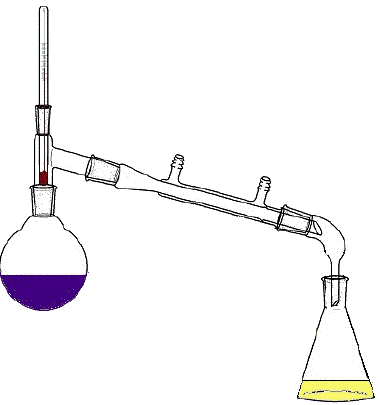
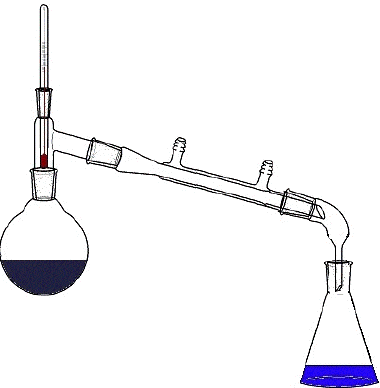
Which of the following pairs of substances may best be separated through distillation
a)
 sand and soil
b)
water and soil
c)
salt and sand
d)
 water and alcohol
69.
Which one of the following techniques would best be used to separate soil and water?
a)
Decanting
b)
distillation
c)
Filtration
d)
Chromatography
70.
Sodium chloride can be separated from rock salt by first adding water to the mixture to dissolve the sodium chloride. The separation then takes place in two stages:
a)
evaporation followed by filtration
b)
 distillation followed by decanting
c)
filtration followed by evaporation
d)
filtration followed by decanting
71.
Two or more substances mingled together, but not chemically combined are known as a
a)
residue
b)
solution
c)
distillate
d)
mixture
72.
Water and alcohol are easily separated by distillation because of their
a)
 different melting points
b)
different colours
c)
different densities
d)
different boiling points
73.
When different gases are mixed together to form air there is
a)
chemical reaction
b)
decomposition
c)
no physical reaction
d)
no chemical reaction
74.
Iron fillings can be separated from iron and Sulphur mixture by
a)
sedementation
b)
heating
c)
magnetic attraction
d)
seiving
75.

Which contains only elements?

a)

A

b)

B

c)

C

d)

D

76.

Which contains a pure substance? (Choose all)

a)

A

b)

B

c)

C

d)

D

77.

Which contains a solid? (Choose all)

a)

A

b)

B

c)

C

d)

D

78.

Which contains a pure substance? (Choose all)

a)

A

b)

B

c)

C

d)

D

79.

What type of change is this?

a)

Chemical

b)

Melting

c)

Evaporation

d)

Condensation

e)

Sublimation

80.

Which contains only elements? (Choose all)

a)

A

b)

B

c)

C

81.

What type of change?

a)

Chemical

b)

Evaporation

c)

Condensation

d)

Sublimation

e)

Melting

82.

The chemical symbol for Helium is

a)

H

b)

He

c)

O

d)

Hi

83.
What type of mixture is this?
a)
heterogeneous 
b)
homogeneous
84.
What type of mixture is this?
a)
heterogeneous 
b)
homogeneous
85.
Mixtures are always ___.
a)
pure
b)
mixed
86.
Which list is made of mixtures?
a)
soil, water, soup
b)
carbon dioxide, soil, soup
c)
salt, water, air
d)
atoms, cereal, pizza
87.
Which of the following is not a compound?
a)
HCl
b)
Cl
c)
NaCl
d)
CO2
88.
which one can be found on the periodic table
a)
Compound 
b)
Element
89.
Is water (H20) an element or a compound?
a)
Element
b)
Compound
90.
A _____________ is a substance that is made of 2 or more elements that are chemically combined.
a)
atom
b)
cell
c)
element
d)
compound
91.
Which of the following substances is a compound? 
a)
oxygen
b)
salt
c)
helium
92.
Which of the following is a sign that a chemical reaction has occurred?
a)
change in shape
b)
melting
c)
formation of a gas
d)
dissolving
93.
Is hammering wood together to build a house a chemical or physical change?
a)
chemical
b)
physical
94.
Photosynthesis is an example of a
a)
physical change
b)
chemical change
95.
Adding baking soda and vinegar together and it fizzes and creates carbon dioxide.
a)
Chemical
b)
Physical
96.
what is the definition of chemical change?
a)
any change that results in the formation of new chemical substances. 
b)
changing clothes
c)
matter cannot be created or destroyed, only change form
d)
changes affecting the form of a chemical substance, but not its chemical composition.
97.
which one is a chemical property?
a)
odor
b)
combustibility
c)
solubility
d)
all of the above
98.

Which of the following is not a clue that a chemical reaction has taken place?

a)

Changing size

b)

Changing color

c)

A gas being formed

d)

Formation of a precipitate

99.
Which of the following IS a clue that a chemical change has occurred? 
a)
State of matter change
b)
Size Change
c)
Change in temperature
d)
Shape change
100.
Using dye to change the color of a shirt green.
a)
Chemical Change
b)
Physical Change
101.
Green bananas turning yellow on their own as they ripen.
a)
Chemical Change
b)
Physical Change
102.
Baking a cake by mixing flour, sugar, chocolate powder, eggs, and milk, and then heating them in the oven.
a)
Chemical Change
b)
Physical Change
103.
Exploding Fireworks?
a)
Physical Change 
b)
Chemical Change 
104.
a copper penny turning greenish after a few years.
a)
Chemical Change
b)
Physical Change
105.
Substance that cannot be broken into simpler substances
a)
element
b)
molecule
c)
gram
d)
proton
106.
In a reaction A + B ----> AB,  reactant A has 4g and product  AB has 10g. How many grams does reactant B should have? 
a)
4g
b)
5g
c)
6g
d)
14g
107.
If a reaction produces 18 grams, and one of its reactants had 10 grams, how much did the other reactant had?
a)
28 grams
b)
18 grams
c)
10 grams
d)
8 grams
108.
Matter can not be created nor destroyed: it can only be
a)
Destroyed a little bit
b)
Invisible
c)
Transformed, rearrenged
d)
None of the above
109.
If a reaction starts with a total 75g of reactants it should produce 
a)
a total of 40g of products
b)
a total of 75g of products
c)
a total of 180 g of products
d)
None of the above