wayground logo

Free Printable Worksheets

Font size

S
M
L
XL
Worksheets

Unit 1 Test Review

Total questions: 109

Worksheet time: 2hrs 32mins

Name
Class
Date
1.

What letter on the diagram represents a gas?

a)

A

b)

B

c)

C

d)

D

2.

What letter on the diagram represents a liquid?

a)

A

b)

B

c)

C

d)

D

3.

What letter on the diagram represents a solid?

a)

A

b)

B

c)

C

d)

D

4.

What letter on the diagram represents the triple point?

a)

A

b)

B

c)

C

d)

D

5.

What is the melting point of this substance at 1 ATM of pressure?

a)

40

b)

60

c)

100

d)

110

6.

What is the boiling point of this substance at 1 ATM of pressure?

a)

40

b)

60

c)

100

d)

110

7.

What would the state of this substance be at 0.5 ATM of pressure at a 100 degrees Celsius?

a)

Solid

b)

Liquid

c)

Gas

d)

Michigan

8.

What would the state of this substance be at 1 ATM of pressure at a 80 degrees Celsius?

a)

Solid

b)

Liquid

c)

Gas

d)

Michigan

9.

The average atmospheric pressure in Michigan is close to 1 ATM. What state would this substance be in if it was a nice summer day with a temperature of 80 o F (27 o C)?

a)

Solid

b)

Liquid

c)

Gas

d)

Michigan

10.

Based on what you have learned... Is this substance likely water?

a)

Yes

b)

No

11.

What would the state of this substance be at 0.5 ATM of pressure at a 100 degrees Celsius?

a)

Solid

b)

Liquid

c)

Gas

d)

Michigan

12.
Water exists as a _____________ at 700 mmHg and 50 °C.
a)
solid
b)
liquid
c)
gas
d)
supercritical fluid
13.
The pressure is increased on a sample of water at 0 °C from 0 mmHg to 800 mmHg.  In order, what changes occur?
a)
deposition, melting
b)
sublimation, melting
c)
condensation, freezing
d)
deposition, freezing
14.
What phase change(s) may occur at pressures below 4.58 mmHg?
a)
sublimation/deposition
b)
melting/freezing
c)
all phase changes are possible at these pressures
d)
vaporization/condensation
15.
Based on its phase diagram, which is the most dense state for CO2?
a)
gas
b)
liquid
c)
solid
d)
supercritical fluid
16.

Matter is made of tiny particles called atoms and molecules.

a)

True

b)

False

17.

Which of the following statements about the particle theory of matter is incorrect?

a)

All matter is made up of tiny particles.

b)

All substances are made of the same particles.

c)

The particles can move when they are heated.

d)

Particles are held together by strong electrical forces.

18.

State of matter that takes the shape of it's container and has a definite volume.

a)

Solid state

b)

Liquid state

c)

Gas state

d)

Plasma state

19.

State of matter that can fill containers with no fixed shape or volume.

a)

Solid state

b)

Liquid state

c)

Gas state

d)

Plasma state

20.

State of matter in which materials have a definite shape and volume.

a)

Solid state

b)

Liquid state

c)

Gas state

d)

Plasma state

21.

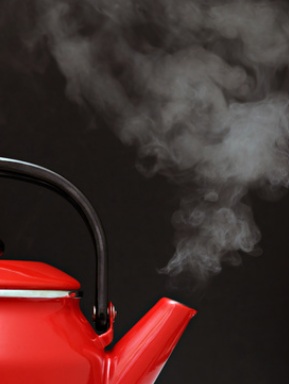
What change of state is taking place in this photograph?

a)

Condensation

b)

Freezing

c)

Vaporization

d)

Melting

22.

What change of state is taking place in this photograph?

a)

Condensation

b)

Freezing

c)

Vaporization

d)

Melting

23.

The diagram shows the changes in state of water (H2O). What is the process Z called?

a)

Condensation

b)

Freezing

c)

Vaporization

d)

Melting

24.

Which of the following is a property of gases?

a)

They have a definite volume.

b)

They are not compressible.

c)

They have no definite shape.

d)

They have no ability to flow.

25.

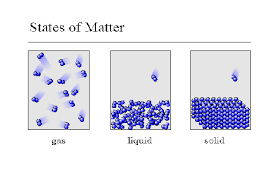
The diagram shows the way the particles of a solid occupy space. Select the property of a solid that is consistent with this micro-view.

a)

No define shape

b)

Cannot be compressed

c)

No definite volume

26.

When a beaker of water is heated its volume increases a little. What is happening to the particles in the liquid?

a)

They are getting bigger.

b)

They are moving slower.

c)

They are moving faster.

d)

They are getting smaller.

27.

When you place a bottle of water in the freezer its volume increases. What is happening to the particles in the liquid?

a)

They are getting bigger.

b)

They are moving slower.

c)

They are moving faster.

d)

They are getting smaller.

28.

Which is NOT a property of a solid?

a)

They do not flow.

b)

Definite volume.

c)

No definite shape.

d)

They are incompressible.

29.

Which state of matter is represented in the following diagram?

a)

Liquid

b)

Liquid and gas

c)

Gas

d)

Solid

30.

Which of the following states is correct?

a)

Gases cannot be compressed.

b)

Solids are easily compressed.

c)

Gases are easier to compress than solids.

d)

Liquids cannot be compressed or expanded.

31.

Which change of state occurs when particles in a solid begin to move slowly past each other?

a)

Melting

b)

Freezing

c)

Condensing

d)

Vaporizing

32.

Deposition is the change from

a)

solid to gas

b)

gas to solid

c)

liquid to solid

d)

solid to liquid

33.

Sublimation is the change from

a)

solid to liquid

b)

solid to vapor

c)

gas to solid

d)

liquid to vapor

34.

While a substance is boiling the kinetic energy

a)

increases

b)

deceases

c)

stays the same

35.

Temperature is a measure of

a)

energy

b)

average potential energy

c)

average kinetic energy

d)

heat

36.

In the PT graph shown, if a gas at 100 degrees C is placed under a higher pressure it will

a)

stay a gas

b)

turn into a liquid

c)

turn into a solid

d)

be at the triple point

37.

In the PT graph shown,if a gas at a low pressure of 0.4 kPa is heated from -100 to + 100 the sample will

a)

stay solid

b)

turn into a liquid

c)

turn into a vapor

d)

be at the critical point

38.

Above the critical point

a)

cannot distinguish liquid and gas

b)

cannot distinguish solid and liquid

c)

both solid and liquid exist

d)

both liquid and gas exist

39.

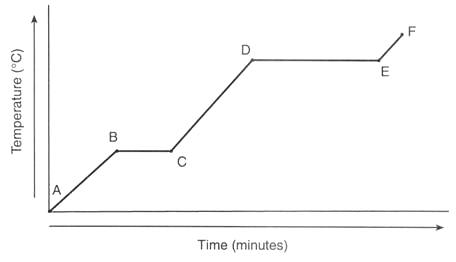
State at F

a)

solid

b)

liquid

c)

gas

d)

plasma

40.

phase change between b and c

a)

melting

b)

boiling

c)

vaporization

d)

condensation

41.

kinetic energy is changing between

a)

A and B

b)

B and C

c)

C and D

d)

D and E

e)

E and F

42.

heat is measure in

a)

Kelvin

b)

Celcius

c)

Joules

d)

Meters

43.

Water has a specific heat capacity of 4.18 J/g K and Aluminum has a specific heat capacity of 0.89 J/g K

If you add the same amount of heat to 1 g of each material, which heats up more?

a)

water

b)

aliuminum

44.
Convert 273 K to oC
a)
0oC
b)
100oC
c)
-273oC
d)
50oC
45.
Convert 300 K to oC
a)
27oC
b)
0oC
c)
-27oC
d)
573oC
46.
Convert -89 oC to K
a)
184K
b)
362K
c)
-362K
d)
-184K
47.
Convert 5900 K to oC
a)
6173 oC
b)
5627 oC
48.
Convert 180oC to K
a)
453 K
b)
-93 K
c)
93 K
d)
453 K
49.
What pressure in mmHg is equal to 1.43 kPa?
a)
1.43 mmHg
b)
10.7 mmHg
c)
101.325 mmHg
d)
760 mmHg
50.
What pressure in kPa is equal to 725mmHg?
a)
5350 kPa
b)
725 kPa
c)
96.7 kPa
d)
1450 kPa
51.
What pressure in kPa is equal to 2.65 atm?
a)
268 kPa
b)
0.0261 kPa
c)
39.0 kPa
d)
265 kPa
52.
What pressure in mmHg is equal to 1.4 atm?
a)
   1000 atm
b)
1100 atm
c)
1200 atm
d)
1400 atm
53.
What pressure in atm is equal to 98.7 kPa?
a)
980 atm
b)
10,000 atm
c)
0.987 atm
d)
0.974 atm
54.

Convert 540 mmHg to kPa; round your answer to correct sig figs.

a)

71.976 kPa

b)

72 kPa

c)

4051 kPa

d)

4100 kPa

55.

Convert 242 kPa to atm; show your answer to correct sig figs

a)

2.4 atm

b)

2.39 atm

c)

24500 atm

d)

24515 atm

56.

Convert 1350 mmHg to atm; round your answer to correct sig figs.

a)

1770 atm

b)

17.7 atm

c)

1026000 atm

d)

1.78 atm

57.
The theory that states that all particles in matter are constantly moving; helps to describe the phases of matter
a)
behavior of gases
b)
kinetic theory 
c)
matter matters
d)
temperature 
58.
Solids are described as having a 
a)
definite shape and indefinite volume
b)
indefinite shape and indefinite volume
c)
definite shape and definite volume
d)
indefinite shape and definite volume
59.
Liquids are described as having a 
a)
definite shape and indefinite volume
b)
indefinite shape and indefinite volume
c)
definite shape and definite volume
d)
indefinite shape and definite volume
60.
Gases are described as having a 
a)
definite shape and indefinite volume
b)
indefinite shape and indefinite volume
c)
definite shape and definite volume
d)
indefinite shape and definite volume
61.
Gas particles have the ________ kinetic energy because they move the fastest.
a)
least
b)
most
62.
When a liquid changes its phase and turns into a solid it is known as
a)
condensation.
b)
melting.
c)
vaporization.
d)
freezing or solidification.
63.
When a gas changes its phase and turns into a liquid it is known as
a)
condensation.
b)
sublimation.
c)
vaporization.
d)
freezing or solidification.
64.
When a gas changes its phase and turns into a solid it is known as
a)
deposition.
b)
sublimation.
c)
condensation.
d)
freezing or solidification.
65.
When a solid changes its phase and turns into a gas it is known as
a)
deposition.
b)
melting.
c)
condensation.
d)
sublimation.
66.
All phase changes are
a)
chemical changes
b)
chemical reactions
c)
physical changes
d)
irreversable
67.
During a phase change, the temperature remains the same
a)
True
b)
False
68.
What kind of energy is added to or removed from matter to cause a phase change?
a)
Radiation
b)
Heat
c)
Solar
d)
Wind
69.
Which state of matter take up ALL the space inside a container? 
a)
solid
b)
liquid
c)
gas
d)
all of the above
70.
Which state of matter has a definite shape?
a)
solid
b)
liquid 
c)
gas
d)
plasma
71.
What is happening in the statement below?
The ice cube melted.
a)
Matter is changing from a liquid to a solid.
b)
Matter is changing from a liquid to a gas.
c)
Matter is changing from a solid to a liquid.
d)
Matter is changing from a gas to a liquid.
72.
When heat is added to a solid, it ______________.
a)
freezes
b)
evaporates
c)
melts
d)
condenses
73.
Liquids and gases are similar because __________________________.
a)
they both take the shape of their container
b)
they both have their own shape
c)
liquids pour and gases don't
d)
liquids take the shape of the container but gases have their own shape
74.
The drops of water that appear on the outside of a glass of cold juice on a warm day are an example of?
a)
Sublimation: A solid turning into a gas.
b)
Condensation: A gas changing to a liquid.
c)
Evaporation: A liquid changing to a gas.
d)
Deposition: A gas changing to a solid.
75.
A substance that has a definite shape and volume.
a)
evaporation
b)
gas
c)
liquid
d)
solid
76.
Electrically charged state of matter similar to a gas.
a)
temperature
b)
liquid
c)
plasma
d)
gas
77.
At higher temperatures
a)
particles in an object have less energy
b)
particles in an object move faster
c)
a gas contracts
78.
How is a gas defined?
a)
Indefinite shape, indefinite volume
b)
Definite shape, definite volume
c)
Found in stars
d)
Definite volume, indefinite shape
79.

Particles of a liquid

a)

are tightly packed together and stay in a fixed position.

b)

are free to move around one another but still touch.
80.
5. What is it called when a solid turns directly into a gas?
a)
Sublimation
b)
Condensation
c)
Liquid
81.
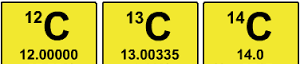
What do these isotopes of carbon all have in common?
a)
neutrons & mass number
b)
atomic number and neutrons
c)
atomic number and electrons
d)
protons, atomic number, and mass number
82.
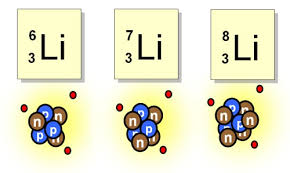
How many neutrons does the isotope of lithium have?
a)
8
b)
3
c)
4
d)
5
83.
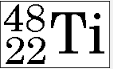
How many protons does this isotope of titanium have?
a)
48
b)
22
c)
26
d)
70
84.
In a correctly written symbol what would be located in the "A" position?
a)
number of neutrons
b)
atomic number
c)
number of electrons 
d)
mass number
85.
What quantities vary between isotopes of an element?
a)
protons, electrons, and atomic mass
b)
protons, electrons, and atomic number
c)
neutrons and electrons
d)
neutrons and atomic mass
86.
which atom has  4 neutrons?
a)
Li-6
b)
Li-7
c)
Li-8
d)
they have the same # of neutrons
87.
How many neutrons in C-14?
a)
6
b)
7
c)
14
d)
8
88.
Isotopes are atoms of the same element with different #’s of __________ & therefore different __________.
a)
n0 ;  atomic #’s
b)
p+ ; atomic #’s
c)
e- ; atomic masses
d)
n0 ; atomic masses
89.
How many neutrons does the isotope below have?     89 36Kr
a)
53
b)
36
c)
89
d)
125
90.
If X is the symbol for an element, which of the following two symbols represent    isotopes of the same element?     I. 7735X  II. 7733X  III. 8137X  IV. 8135 X
a)
I and II
b)
III and IV
c)
I and IV
d)
I and III
91.
How many neutrons does an atom of the isotope Neon-22 have?
a)
12
b)
10
c)
22
d)
20
92.
Four isotopes of lead include lead-204, lead-206, lead-207, and lead-208.  The average atomic mass of lead is 207.2.  Which isotope of lead is likely to be the most abundant.
a)
204
b)
206
c)
207
d)
208
93.
An atom is electrically neutral when
a)
protons and neutrons are the same
b)
protons and electrons are the same
c)
neutrons and electrons are the same
d)
neutrons balance the protons and electrons
94.
Two isotopes of carbon are carbon-12 and carbon-14.  These isotopes differ from one another by two protons.
a)
true
b)
false
95.

To calculate average atomic mass, you need

a)

the atomic mass of each isotope

b)

the percent abundance of each isotope

c)

the atomic mass and percent abundance of each isotope

d)

to find the average of the atomic masses of each isotope
96.
4.35% of all X atoms have a mass of 39.946 amu. 83.79% have a mass of 41.941 amu, 9.50% have a mass of 42.941 amu, and 2.36% have a mass of 43.939 amu. What is the average atomic mass of atom X?
a)
41.97 amu
b)
42.19 amu
c)
10.43 amu
d)
40.04 amu
97.
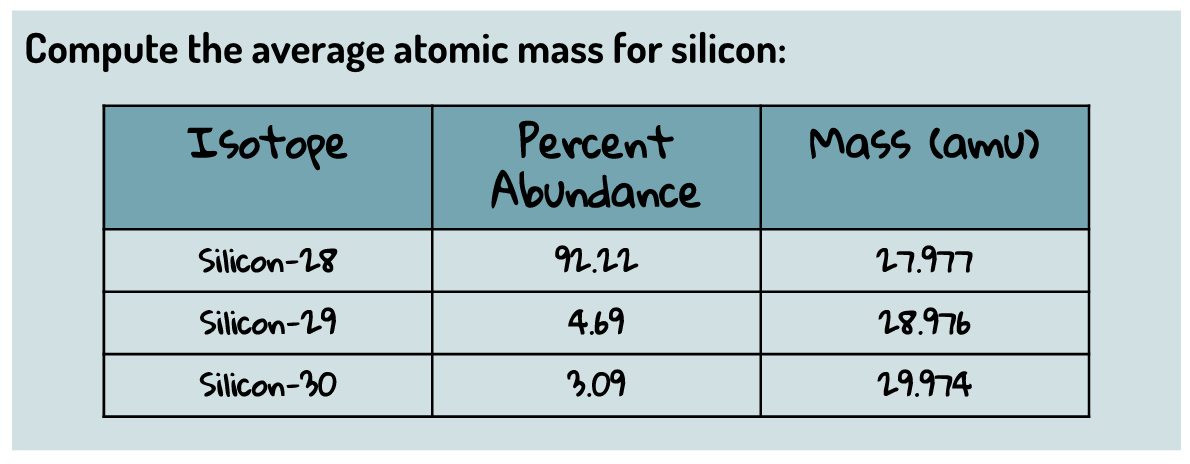
Compute the average atomic mass for silicon:
a)
27.977
b)
28.09
c)
28.976
d)
The average mass cannot be determined from provided information.
98.
24.1% of all the isotopes of a an element have a mass of 75.23 amu, 48.7% have a mass of 74.61 amu, and 27.2% have a mass of 75.20 amu.
How many protons does this element have?
a)
32
b)
33
c)
34
d)
no way to know
99.
An isotope has three forms.  30% have a mass of 4 amu, 20% have a mass of 5 amu and 50% have a mass of 3 amu.  Average atomic mass will be closest to
a)
2 amu
b)
3 amu
c)
4 amu
d)
5 amu
100.
An element has two naturally occurring isotopes. One is 10.013 amu and is 19.9% abundant. The other is 11.01 amu and is 80.1% abundant. What is the average atomic mass? What element is it?
a)
9.012, Beryllium
b)
12.011, Carbon
c)
6.941, Lithium
d)
10.812, Boron
101.
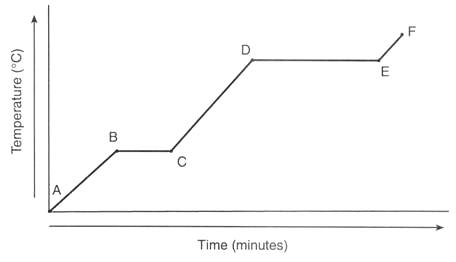
What line segment represents only the solid state?
a)
A-B
b)
B-C
c)
C-D
d)
D-E
102.
Which segment represents the heat of fusion?
a)
A-B
b)
B-C
c)
C-D
d)
D-E
103.
In which segment is the kinetic energy remaining constant?
a)
A-B
b)
B-C
c)
C-D
d)
E-F
104.
Which process takes the longest to occur?
a)
melting
b)
boiling
c)
freezing
d)
heating the solid
105.
What state(s) of matter are present at D-E?
a)
Solid-liquid
b)
Liquid
c)
Liquid-gas
d)
Gas-Solid
106.
Between which points is the temperature of the substance remaining constant?
a)
A-B only. 
b)
A-B, C-D, E-F
c)
B-C only. 
d)
B-C, D-E
107.
Between which points is the temperature of the substance increasing?
a)
A-B only. 
b)
A-B, C-D, E-F
c)
B-C only. 
d)
B-C, D-E
108.
Between which points is the substance changing state?
a)
A-B only. 
b)
A-B, C-D, E-F
c)
B-C only. 
d)
B-C, D-E
109.
This type of graph is called a:
a)
Phase diagram
b)
Heating curve
c)
State of matter
d)
Temperature chart