wayground logo

Free Printable Worksheets

Font size

S
M
L
XL
Worksheets

Roe Chem Unit 1 Review

Total questions: 110

Worksheet time: 2hrs 49mins

Name
Class
Date
1.
According to the octet rule most elements need _______ valence electrons.
a)
2
b)
8
c)
6
d)
18
2.
Hydrogen needs _____ electrons in its valence shell to be stable.
a)
4
b)
6
c)
8
d)
2
3.

How many electrons can fit on the 1st energy level (orbital) for any Bohr Model?

a)

2

b)

6

c)

8

d)

10

4.

What is matter?

a)

anything that has mass and takes up space

b)

anything that can be felt

c)

anything that can behave in many different ways

d)

anything that exist on Earth

5.
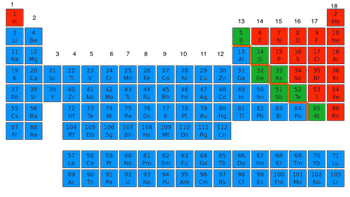
Where are metals located on the periodic table?
a)
Blue
b)
Green
c)
Red
6.
What part of an atom is involved in chemical bonding?
a)
protons
b)
neutrons
c)
electrons
d)
nucleus
7.

An ionic bond is between

a)

metal and metal

b)

metal and nonmetal

c)

nonmetal and nonmetal

8.

Is this the correct lewis dot for Chlorine?

a)

yes

b)

no

9.

Which one is the least reactive group?

a)

Alkali metal

b)

Alkali earth metal

c)

Halogens

d)

Noble Gases

10.

1s22s22p63s23p63d104s24p3

Which element does this configuration belong to?

a)

Arsenic

b)

Calcium

c)

Lithium

d)

Aluminum

11.

Which of the following substances are elements?

a)

water

b)

salt

c)

carbon dioxide

d)

hydrogen

12.

If an element has 11 protons and 12 Neutrons, what is it's atomic mass?

a)

12

b)

11

c)

23

d)

1

13.
What is an isotope? 
a)
A charged atom
b)
An atom with different amounts of neutrons
c)
An atom with different amounts of protons
d)
A neutral atom
14.

Smallest particle you can break a substance into and still be that element

a)

Element

b)

Atom

c)

Molecule

15.

What determines the chemical properties of an atom?

a)

The number of protons in the nucleus

b)

The number of neutrons in the nucleus

c)

The arrangement of electrons in orbitals

d)

The total mass of the nucleus

16.

Isotopes of an element have the same number of __________ but different numbers of __________.

a)

protons, neutrons

b)

neutrons, protons

c)

electrons, neutrons

d)

electrons, protons

17.
Atoms of the same element must always have the same number of _________
a)
electrons
b)
neutrons
c)
isotopes
d)
protons
18.
What is true about an atom?
a)
Most of the space in an atom is taken up by the nucleus
b)
Atoms are mostly empty space
c)
Atoms have no mass
d)
Electrons have much more mass that protons or neutrons.
19.
If I gain electrons I become
a)
Positive because I've added to my atom
b)
negative because I've added electrons
c)
same because i'm balanced
d)
equal because now I have electrons
20.
A anion will be a ____ ion.
a)
negative
b)
positive
c)
neutral
d)
ficticious
21.

What charge does magnesium take on?

a)

+1

b)

+2

c)

+3

22.

In the periodic table, as you move from left to right across a period, how does electronegativity change?

a)

It decreases

b)

It increases

c)

It remains constant

d)

It first increases, then decreases

23.

According to Hund's rule, how are electrons distributed in the 3d3d subshell?

a)

Electrons fill each orbital singly before any orbital gets a second electron.

b)

Electrons pair up in each orbital before filling the next orbital.

c)

Electrons fill the highest energy orbital first.

d)

Electrons are distributed randomly among the orbitals.

24.

Which element has the highest electronegativity value?

a)

Sodium (Na)

b)

Chlorine (Cl)

c)

Fluorine (F)

d)

Oxygen (O)

25.

Which of the following is the electron configuration for Sulfur (S)?

a)

1s22s22p63s23p41s^2 2s^2 2p^6 3s^2 3p^4

b)

1s22s22p63s13p51s^2 2s^2 2p^6 3s^1 3p^5

c)

1s22s22p63s23p31s^2 2s^2 2p^6 3s^2 3p^3

d)

1s22s22p43s23p41s^2 2s^2 2p^4 3s^2 3p^4

26.

What is the electron configuration of Silicon (Si)?

a)

1s22s22p63s23p21s^2 2s^2 2p^6 3s^2 3p^2

b)

1s22s22p63s13p11s^2 2s^2 2p^6 3s^1 3p^1

c)

1s22s22p43s21s^2 2s^2 2p^4 3s^2

d)

1s22s22p63s23p31s^2 2s^2 2p^6 3s^2 3p^3

27.

The atomic mass of Beryllium is 9.012 g. Which isotope of Beryllium is most abundant?

a)
b)
c)
d)

None of these

28.

What things will you need to calculate the atomic mass of an element? (Select all that apply)

a)

Number of protons and neutrons

b)

Abundance of every isotope in nature

c)

Mass number of every isotope in nature

d)

None of these

29.

What happens if you change the number of protons in an atom?

a)

The atomic mass will change

b)

A new element will form

c)

Energy will be destroyed

d)

None of these

30.

Why do we not include electrons when we calculate the mass number of an element?

a)

Electrons are so small, they don't contribute much to the mass of an atom

b)

Electrons have a negative charge, and we do not want to subtract from the mass

c)

Protons and electrons cancel each other's charges out. To avoid the cancelling, electrons aren't included

d)

None of these

31.

What is the difference between the isotopes Nitrogen-14 and Nitrogen-15?

a)

Their position on the Periodic Table

b)

The number of neutrons in the nucleus

c)

The number of protons in the nucleus

d)

The charge of each isotope

32.

What is the charge of a Magnesium atom with 10 electrons?

a)

-2

b)

-1

c)

+1

d)

+2

33.

Which sub atomic particle has a positive charge?

a)

Protist

b)

Neutron

c)

Electron

d)

Proton

34.

What three subatomic particles make up an atom?

a)

Protists, Neurons, Electrodes

b)

Protons, Neutrons, Electrons

c)

Protons, Neurons, Electrodes

d)

Protists, Neutrons, Electrodes

35.

How many protons are in one oxygen atom?

a)

8

b)

7

c)

15.999

d)

23.999

36.

How many electrons are in one neutral Lithium atom?

a)

3

b)

4

c)

6.941

d)

9.941

37.

How many neutrons are in one neutral Lithium atom?

a)

3

b)

4

c)

6.941

d)

9.941

38.

J.J. Thomson discovered negatively charged particles called __________________ and developed the ________________________ model to try to explain their existence in a neutral atom.

a)

electrons; Rutherfordian

b)

electrons; Plum-Pudding

c)

protons; proton

d)

protons; Plum-Pudding

39.

Rutherford's gold-foil experiments concluded that all atoms have a small, dense, positively charged nucleus which makes up nearly all of the ______________ of an atom.

a)

volume

b)

mass

40.

The Bohr model of the atom showed that electrons can have different energy values and restricted the electrons positions to be ______________________

a)

in an electron cloud

b)

inside the nucleus

c)

in distinct energy levels (or orbits)

41.

In the nuclear symbol shown, how many protons are there?

a)

36

b)

17

c)

-1

d)

19

42.

In the nuclear symbol shown, how many neutrons are there?

a)

14

b)

6

c)

8

d)

20

43.

Use the image to help. How many neutrons would there be in an atom of silver-107?

a)

107

b)

47

c)

60

d)

61

44.

Use the image to help you recall the definition of isotopes. Isotopes are atoms of the same element with

a)

different numbers of neutrons, and therefore, different masses

b)

different numbers of protons, and therefore, different masses

c)

different numbers of electrons that lead to a charge

45.
What particle provided the positive charge for an atom?
a)
proton 
b)
neutron
c)
electron
d)
nucleus
46.
The dense center region of an atom
a)
electron cloud
b)
core
c)
nucleus
d)
centrino
47.
In the isotope name, Hydrogen-3, what does the 3 represent?
a)
charge
b)
mass
c)
atomic number
d)
number of electrons
48.
What element is represented in this Bohr Model? 
a)
Carbon
b)
Hydrogen
c)
Aluminum
d)
Lithium
49.
Which subatomic particle has a negative (-) charge?
a)
Proton
b)
Electron
c)
Neutron
50.
Which subatomic particle has a neutral or no charge?
a)
Proton
b)
Electron
c)
Neutron
51.
24.1% of all the isotopes of a an element have a mass of 75.23 amu, 48.7% have a mass of 74.61 amu, and 27.2% have a mass of 75.20 amu.
What is the average mass of this element?
a)
74.92 amu
b)
24.97 amu
c)
75.01 amu
d)
74.51 amu
52.
What does the 1.00794 stand for?
a)
Hydrogen
b)
atomic number
c)
atomic mass
d)
atomic explosion
53.
4.35% of all X atoms have a mass of 39.946 amu. 83.79% have a mass of 41.941 amu, 9.50% have a mass of 42.941 amu, and 2.36% have a mass of 43.939 amu. What is the average atomic mass of atom X?
a)
41.97 amu
b)
42.19 amu
c)
10.43 amu
d)
40.04 amu
54.
Electronegativity is...
a)
the ability of an atom to attract/ accept electrons
b)
the ability of an atom to lose electrons
c)
the energy required to remove an electron from a specific atom
d)
how easy it is to make friends. 
55.
As atoms of elements in group 16 are considered in order from top to bottom, the electronegativity of each successive element....
a)
decreases
b)
increases
c)
remains the same
d)
none of the above
56.
Which periodic group has the smallest atomic radius?
a)
Alkali metals
b)
Halogens
c)
Noble Gases
d)
Transition metals
57.

What are the vertical columns on the periodic table called?

a)

groups

b)

periods

c)

protons

d)

valence electrons

58.
The period for Bromine is ___________.
a)
3
b)
2
c)
4
59.
Beryllium is in group number______.
a)
Group 2
b)
Group 3
c)
Group 4
d)
Group 7
60.
The majority of elements on the periodic table are
a)
man made.
b)
nonmetals.
c)
metals.
d)
gases.
61.
Ionization energy is the...
a)
energy needed to remove the outermost electron.
b)
ability of an atom to attract electrons from another atom.
62.
Electronegativity is the...
a)
energy needed to remove the outermost electron.
b)
ability of an atom to attract electrons from another atom.
63.
As you move down the periodic table atoms get bigger.  This is because ____________.
a)
The atoms have more mass.
b)
The atoms have more protons.
c)
The atoms have more energy levels
d)
The atoms have more nuetrons
64.
Which statement correctly and completely identifies a trend?
a)
Atomic radius decreases across a period and increases down a group.
b)
Electronegativity decreases across a period and decreases down a group.
c)
Ionization energy increases across a period and increases down a group.
d)
Ionic radius increases across a period and increases down a group.
65.
Families all have similar 
a)
Names
b)
atomic numbers
c)
atomic masses
d)
properties
66.

When an atom gains an electron, the size of atom

a)

will increase

b)

will decrease

c)

will not change

67.

What are valence electrons?

a)

Electrons in the outermost energy level.

b)

Electrons closest to the nucleus.

c)

Electrons that identify the atom as that of a particular element.

d)

Electrons that release photons and move from a higher to lower energy level.

68.

When drawing Lewis structures, only __________ electrons are used.

a)

inner shell

b)

core

c)

valence

d)

stable

69.
This is a correct dot diagram for fluorine (F)
a)
true
b)
false
70.

How many valence electrons does Carbon have

a)

1

b)

4

71.

How many valence electrons does Argon have

a)

8

b)

11

72.
How many valence electrons?
a)
2
b)
3
c)
5
d)
10
73.
Which elements have the most similar chemical properties?
a)
K and Na
b)
K and Ca
c)
K and Cl
d)
K and S
74.

Name group 1 on the periodic table.

a)

alkali metals

b)

alkaline earth metals

c)

noble gases

noble gases

d)

halogens

75.

Name group 2 on the periodic table.

a)

alkali metals

b)

alkaline earth metals

c)

noble gases

d)

transition metals

76.
Name groups 3B - 12B on the periodic table.
a)
noble gases
b)
halogens
c)
metalloids
d)
transition metals
77.
Which group has the most reactive nonmetals?
a)
alkali metals
b)
noble gases
c)
metalloids
d)
halogens
78.
Where are the nonmetals located on the periodic table?
a)
top left corner
b)
bottom left corner
c)
top right corner
d)
bottom left corner
79.
What statement is true about ALL of the elements in Group 18 OR Group 8A?
a)
They ALL have 6 valence electrons.
b)
They ALL are gases at room temperature.
c)
They ALL react easily with other elements.
d)
They ALL form +2 charges.
80.

Name group 17 on the periodic table.

a)

transition metals

b)

metalloids

c)

halogens

d)

alkali metals

81.
A charged particle that has gained or lost electrons is called a _____.
a)
molecule
b)
ion
c)
isotope
d)
element
82.
A cation is a ____ ion.
a)
negative
b)
positive
c)
neutral
d)
ficticious
83.
A anion will be a ____ ion.
a)
negative
b)
positive
c)
neutral
d)
ficticious
84.
Beryllium will ____ valence electrons when forming an ionic bond.
a)
lose 4
b)
gain 4
c)
lose 2
d)
gain 2
85.

How many energy levels does a sodium (Na) atom have?

a)

1

b)

2

c)

3

d)

11

86.
An atom becomes _________ when it gains electrons.
a)
Positive
b)
Negative
c)
Neutral
d)
Invinsible
87.
Why do elements bond?
a)
To be friends
b)
To create a new element
c)
To become stable
88.
Atoms are most stable when their outer shell is complete.
a)
true
b)
false
89.

What kind of element forms covalent bond?

a)

metals

b)

semi -metals

c)

non metals

d)

metal and non metal

90.

who discovered the first scientific and systematic periodic table

a)

Henry Mosley

b)

Dmitri Mendeleev

c)

John Dalton

d)

sir Isaac Newton

91.

Which one is correct about mendeleev's periodic law

a)

Properties of elements are periodic function of their atomic mass

b)

the physical and chemical properties of elements are periodic function of their atomic number.

c)

physical properties of elements are periodic function of their atomic weight.

d)

chemical properties of elements are periodic function of their atomic number.

92.

D block elements are known as .............

a)

Actinides

b)

Transition elements

c)

Lanthanides

d)

Noble gases

93.

how many electrons can d orbital accommodate? (keep)

a)

2

b)

6

c)

10

d)

14

94.

Periodic law states that the elements are arranged according to their atomic ________ so that elements with similar chemical properties are in the same ________ and properties repeat periodically.

a)

numbers, rows

b)

masses, rows

c)

masses, column

d)

numbers, column

95.

Metals (select all that apply)

a)

are found on the right side of the periodic table.

b)

are found on the left side of the periodic table.

c)

are good conductors of heat and electricity.

d)

are brittle.

e)

are malleable and ductile.

96.

Nonmetals (select all that apply)

a)

are found on the right side of the periodic table.

b)

are found on the left side of the periodic table.

c)

are good conductors of heat and electricity.

d)

are brittle.

e)

can be solid, liquids, or gases at room temperature.

97.

Which element is found in group 2, period 6?

a)

Oxygen (O)

b)

Barium (Ba)

c)

Selenium (Se)

d)

Carbon (C)

98.
What atom matches this electron configuration?
1s2s2p3s2
a)
Neon
b)
Magnesium
c)
Aluminum
d)
Potassium
99.
How many p orbitals are there in a sublevel?
a)
2
b)
1
c)
4
d)
3
100.
How many electrons can the d sublevel hold?
a)
8
b)
10
c)
2
d)
4
101.
How many electrons can the first energy level hold?
a)
1
b)
2
c)
8
d)
0
102.
How many valence electrons does Chlorine have?
a)
5
b)
2
c)
7
d)
5
103.
Which element is pictured?
a)
neon
b)
fluorine
c)
magnesium
d)
argon
104.
What noble gas should be used to write the shorthand configuration for Te?
a)
Ar
b)
Kr
c)
Xe
d)
Sb
105.
What element in Period 4 has 5 valence electrons?
a)
Zr
b)
As
c)
V
d)
Sb
106.
Which of the following is a p block element?
a)
Ca
b)
Ar
c)
Re
d)
Au
107.
What do you start electron configuration with?
a)
1s2
b)
1d10
c)
1f14
d)
1p6
108.
There are 4 different types of subshells (orbitals) s,p,d,f.
a)
true
b)
false
109.
Which periodic table family could have electrons filling orbitals in the s-block?
a)
Alkaine Earth 
b)
Halogens
c)
Noble Gases
d)
Transition Metals
110.
Which periodic family would have electrons in the f-block?
a)
Transition metals
b)
Rare Earth Elements (Inner Transitions Metals)
c)
Alkali Metals
d)
Halogens