
 Worksheets
3.1.2 Amount of substance
Total questions: 110
Worksheet time: 55mins
The relative molecular mass (Mr) of benzene-1,4-dicarboxylic acid is
164
166
168
170
How many protons are there in 6.0 g of nitrogen gas?
Avogadro constant, L = 6.022 × 10²³ mol–1
1.3 × 10²³
9.0 × 10²³
1.8 × 1024
3.6 × 1024
A solution of volume 500 cm3 contains 150 g of ammonia.
What is the concentration, in mol dm–3, of ammonia in this solution?
0.51
8.82
16.7
17.6
A gas cylinder contains 5.0 kg of propane.
How many propane molecules are in the cylinder?
The Avogadro constant, L = 6.022 × 10²³ mol–1
6.8 × 10²²
7.2 × 10²²
6.8 × 1025
7.2 × 1025
Which sample of liquid has the greatest volume?
500 mg of pentane (density = 0.63 g cm–3)
650 mg of propan-1-ol (density = 0.80 g cm–3)
1.20 g of dichloromethane (density = 1.33 g cm–3)
1.30 g of trichloromethane (density = 1.48 g cm–3)
Which of these contains the greatest number of atoms?
127 mg of iodine
1.54 × 10⁻⁴ kg of phosphorus
81.0 mg of carbon dioxide
1.70 × 10⁻⁴ kg of ammonia
Which sample contains the most molecules?
The Avogadro constant, L = 6.022 x 10²³ mol−1
2.10 × 10²² molecules of methane, CH4
1.00 g of oxygen, O2
65.0 mg of hydrogen, H2
0.0300 mol of ethane, C2H6
Analysis of a sample of a chemical with formula C22H30N6O4S, showed that it contained 0.0195 mol of carbon.
What mass of nitrogen was present in the sample?
0.041 g
0.057 g
0.074 g
0.420 g
A solution of lead(ll) chloride (Mr = 278.2) contains 1.08 g of PbCl2 in 100 cm3 of solution. In this solution, the lead(ll) chloride is fully dissociated into ions.
What is the concentration of chloride ions in this solution?
3.88 × 10⁻³ mol dm−3
7.76 × 10⁻³ mol dm−3
3.88 × 10⁻² mol dm−3
7.76 × 10⁻² mol dm−3
What is the number of atoms in 0.0100 mol of NH3?
(The Avogadro constant L = 6.022 × 10²³ mol−1)
6.02 × 1025
1.20 × 10²³
1.81 × 10²²
2.41 × 10²²
Which of the following contains the most chloride ions?
15 cm3 of 3.40 × 10⁻² mol dm−3 aluminium chloride solution
30 cm3 of 5.50 × 10⁻² mol dm−3 calcium chloride solution
40 cm3 of 2.30 × 10⁻² mol dm−3 hydrochloric acid
45 cm3 of 2.20 × 10⁻² mol dm−3 sodium chloride solution
Which of these contains the most molecules?
0.0311 kg of carbon dioxide, CO2
29.6 g of carbon monoxide, CO
2.22 × 10⁴ mg of oxygen, O2
13.3 g of ozone, O3
Which of the following contains the most chloride ions?
10 cm3 of 3.30 × 10⁻² mol dm−3 aluminium chloride solution
20 cm3 of 5.00 × 10⁻² mol dm−3 calcium chloride solution
30 cm3 of 3.30 × 10⁻² mol dm−3 hydrochloric acid
40 cm3 of 2.50 × 10⁻² mol dm−3 sodium chloride solution
In an experiment to identify a Group 2 metal (X), 0.102 g of X reacts with an excess of aqueous hydrochloric acid according to the following equation.
X + 2HCl --> XCl2 + H2
The volume of hydrogen gas given off is 65 cm3 at 99 kPa pressure and 303 K. The gas constant is R = 8.31 J K–1 mol–1. Which is X?
Barium
Calcium
Magnesium
Strontium
There are 392 mol of pure gold in a bar measuring 10 cm by 10 cm by 40 cm.What is the density of gold in kg dm−3?
193
19.3
1.93
0.193
In a car airbag, sodium azide (NaN3) decomposes to form sodium metal and nitrogen gas.
2NaN3(s) → 2Na(s) + 3N2(g)
The sodium metal then reacts with potassium nitrate to produce more nitrogen gas.
10Na(s) + 2KNO3(s) → N2(g) + 5Na2O(s) + K2O(s)
If 2.00 mol of sodium azide react in this way, how many molecules of N2 will be formed? (The Avogadro constant L = 6.022 × 10²³ mol–1)
2.41 × 1024
1.93 × 1024
1.81 × 1024
9.63 × 10²³
The Mr of hydrated copper sulfate (CuSO4.5H2O) is 249.6.
Which of the following is the mass of hydrated copper sulfate required to make 50.0 cm3 of a 0.400 mol dm−3 solution?
3.19 g
3.55 g
3.71 g
4.99 g
The removal of silicon dioxide with limestone in a blast furnace can be represented by the following equation.
CaCO3(s) + SiO2(s) → CaSiO3(l) + CO2(g)
The minimum mass of calcium carbonate needed to remove 1.00 tonne (1000 kg) of silicon dioxide is
0.46 tonne
0.60 tonne
1.67 tonne
2.18 tonne
The removal of silicon dioxide with limestone in a blast furnace can be represented by the following equation.
CaCO3(s) + SiO2(s) → CaSiO3(l) + CO2(g)
The volume of carbon dioxide, measured at 298 K and 1.01 × 10⁵ Pa, formed in this reaction during the removal of 1.00 tonne (1000 kg) of silicon dioxide is
24.5 dm3
408 dm3
24.5 m3
408 m3
When 0.10 g of propane was burned the quantity of heat evolved was 5.0 kJ. The enthalpy of combustion of propane in kJ mol−1 is
−800
−1500
−2200
−2900
Silver oxide, Ag2O, can be reduced by passing hydrogen gas over the heated oxide. The maximum mass of silver that could be obtained from 2.32 g of silver oxide is
2.02 g
2.06 g
2.12 g
2.16 g
In a reaction which gave a 27.0% yield, 5.00 g of methylbenzene were converted into the explosive 2,4,6-trinitromethylbenzene (TNT) (Mr = 227.0). The mass of TNT formed was
1.35 g
3.33 g
3.65 g
12.34 g
Use the information below to answer this question.
A saturated solution of magnesium hydroxide, Mg(OH)2, contains 0.1166 g of Mg(OH)2 in 10.00 dm3 of solution. In this solution the magnesium hydroxide is fully dissociated into ions.
Which one of the following is the concentration of Mg2+(aq) ions in the saturated solution?
2.82 × 10⁻² mol dm−3
2.00 × 10⁻³ mol dm−3
2.82 × 10⁻³ mol dm−3
2.00 × 10⁻⁴ mol dm−3
Which one of the following contains the greatest number of moles of methanol? (The Avogadro number (L) is 6.02 × 10²³, the relative molecular mass (Mr) of methanol is 32.)
6.6 × 10²² molecules
3.3 g of methanol
2.5 × 10⁻³ m3 of methanol vapour at 300 K and 100 kPa
70 cm3 of 1.5 M aqueous methanol
Two sealed flasks with the same volume are left side by side.
Flask A contains 4.0 × 10⁻³ mol of methane.
Flask B contains 340 mg of a different gas.
Both gases are at the same temperature and pressure.
Which gas could be in Flask B?
CH2Cl2
HBr
Kr
PF3
A 385 cm3 sample of carbon dioxide at 100 kPa and 25 °C was mixed with 2.89 × 10⁻² mol of argon. The gas constant, R = 8.31 J K−1 mol−1
What is the mole fraction of carbon dioxide in the mixture?
0.35
0.46
0.54
0.65
A student is provided with 5.00 cm3 of 1.00 mol dm−3 ammonia solution. The student was asked to prepare an ammonia solution with a concentration of 0.050 mol dm−3
What volume of water should the student add?
45.0 cm3
95.0 cm3
100 cm3
995 cm3
130 cm3 of oxygen and 40 cm3 of nitrogen, each at 298 K and 100 kPa, were placed into an evacuated flask of volume 0.50 dm3.
What is the pressure of the gas mixture in the flask at 298 K?
294 kPa
68.0 kPa
34.0 kPa
13.7 kPa
Which of these samples of gas contains the largest number of molecules?
The gas constant R = 8.31 J K–1 mol–1.
5.0 × 10⁻⁴ m3 at 1.0 × 10⁶ Pa and 300 K
4.0 × 10⁻³ m3 at 2.0 × 10⁵ Pa and 400 K
3.0 × 101 dm3 at 3.0 × 10⁴ Pa and 500 K
2.0 × 10² dm3 at 4.0 × 10³ Pa and 600 K
A sample of 2.18 g of oxygen gas has a volume of 1870 cm3 at a pressure of 101 kPa.
What is the temperature of the gas? The gas constant is R = 8.31 J K–1 mol–1.
167 K
334 K
668 K
334 000 K
In an experiment to identify a Group 2 metal (X), 0.102 g of X reacts with an excess of aqueous hydrochloric acid according to the following equation.
X + 2HCl --> XCl2 + H2
The volume of hydrogen gas given off is 65 cm3 at 99 kPa pressure and 303 K.
The gas constant is R = 8.31 J K–1 mol–1.
Which is X?
Barium
Calcium
Magnesium
Strontium
30 cm3 of xenon are mixed with 20 cm3 of fluorine. The gases react according to the following equation. Assume that the temperature and pressure remain constant.
Xe(g) + F2(g) → XeF2(g)
What is the final volume of gas after the reaction is complete?
50 cm3
40 cm3
30 cm3
20 cm3
2 mol of ideal gas X are stored in a flask of fixed volume.
Which of the following changes would lead to the greatest increase in pressure inside the flask?
Increasing the temperature from 20 °C to 200 °C
Adding another 1 mol of gas X into the flask at fixed temperature
Adding 0.5 mol of argon gas and increasing the temperature from 20 °C to 150 °C
Removing 0.5 mol of gas X and increasing the temperature from 20 °C to 300 °C
The removal of silicon dioxide with limestone in the Blast Furnace can be represented by the following equation.
CaCO3(s) + SiO2(s) → CaSiO3(l) + CO2(g)
The volume of carbon dioxide, measured at 298 K and 1.01 × 10⁵ Pa, formed in this reaction during the removal of 1.00 tonne (1000 kg) of silicon dioxide is
24.5 dm3
408 dm3
24.5 m3
408 m3
An equation for the incomplete combustion of butane in oxygen is
C4H10 + 4.5O2 → 4CO + 5H2O
The volume in dm3 of oxygen at 295 K and 100 kPa required to burn 0.1 mol of butane to form steam and carbon monoxide only is
8.6
11
12
16
Sodium hydrogencarbonate decomposes on heating as shown by the equation below.
2NaHCO3 → Na2CO3 + H2O + CO2
The volume of carbon dioxide, measured at 298 K and 101 kPa, obtained by heating 0.0500 mol of sodium hydrogencarbonate is
613 cm3
1226 cm3
613 dm3
1226 dm3

This question is about the reaction between propanone and an excess of ethane-1,2-diol, the equation for which is given. In a typical procedure, a mixture of 1.00 g of propanone, 5.00 g of ethane-1,2-diol and 0.100 g of benzenesulphonic acid, C6H5SO3H, is heated under reflux in an inert solvent. Benzenesulphonic acid is a strong acid.
If 1.00 g of propanone was vapourised at 100 °C and 100 kPa pressure, the volume in m3 of gas formed would be
31.0
8.31
0.534
5.34 × 10⁻⁴

This question relates to the equilibrium gas-phase synthesis of sulphur trioxide:
2SO2(g) + O2(g) ⇌ 2SO3(g)
Thermodynamic data for the components of this equilibrium are given in the table.
This equilibrium, at a temperature of 585 K and a total pressure of 540 kPa, occurs in a vessel of volume 1.80 dm3. At equilibrium, the vessel contains 0.0500 mol of SO2(g), 0.0800 mol of O2(g) and 0.0700 mol of SO3(g).
At equilibrium in the same vessel of volume 1.80 dm3 under altered conditions, the reaction mixture contains 0.0700 mol of SO3(g), 0.0500 mol of SO2(g) and 0.0900 mol of O2(g) at a total pressure of 623 kPa. The temperature in the equilibrium vessel is
307 °C
596 K
337 °C
642 K
Which one of the following contains the smallest number of moles of carbon dioxide gas?
2.65 g
0.0150 m3 at 1000 K and 33.0 kPa
1.50 dm3 at 327 °C and 200 kPa
1500 cm3 at 300 K and 100 kPa
On complete combustion, 0.0150 mol of an organic acid produced 735 cm3 of carbon dioxide (measured at 101 kPa and 298 K). The same amount of acid required 15.0 cm3 of 2.00 M sodium hydroxide solution for neutralisation. Which one of the following could be the formula of the acid?
HCOOH
CH3COOH
HOOCCOH
HOOCCH2CH2COOH
Which one of the following samples of gas, when sealed into a vessel of volume 0.10 m3, is at the highest pressure?
1.6 g of helium (He) at 100 K
1.6 g of methane (CH4) at 100 K
1.6 g of oxygen (O2) at 600 K
1.6 g of sulphur dioxide (SO2) at 1200 K
What is the volume occupied by 10.8 g of the freon CCl2F2 at 100 kPa and 273 K?
2.02 dm3
2.05 dm3
2.02 cm3
2.05 cm3
Which one of the following samples of gas occupies the largest volume?
1.0 g of ozone (O3) at l00 kPa and 300 K
1.0 g of oxygen at 100 kPa and 300 K
1.0 g of water vapour at 250 kPa and 450 K
1.0 g of methane at 333 kPa and 500 K
What is the empirical formula of an oxide of nitrogen that contains 26% nitrogen by mass?
NO2
N2O3
N2O5
N4O5
2.40 g of an explosive, J, contains 0.473 g of nitrogen. J also contains 33.8% carbon and 1.41% hydrogen by mass. The remainder of J is oxygen.
What is the empirical formula of J?
C4HNO2
CH2N2O
C2HNO2
CHNO
What is the empirical formula of 4-hydroxypent-2-ene?
C5H12O
C5H10O
CH2O
C5H9OH
An organic compound is found to contain 40.0% carbon, 6.7% hydrogen and 53.3% oxygen.
Which of the following compounds could this be?
Ethanol
Ethanoic acid
Methanol
Methanoic acid
Propanoic acid reacts with methanol in the presence of a small amount of concentrated sulphuric acid. The empirical formula of the ester formed is
CH2O
C2H6O2
C2H4O2
C2H4O
An alkane contains 30 hydrogen atoms per molecule. Its empirical formula is
C6H15
C7H15
C14H30
C15H30
CH2O is the empirical formula of
methanol
methyl methanoate
ethane-1,2-diol
butanal
When TiCI4 is reduced with hydrogen under certain conditions, a new compound is produced which contains 68.9% chlorine by mass. Which one of the following could be the formula of the new compound?
TiH2Cl2
TiCl
TiCl2
TiCl3

A 30 cm3 sample of nitrogen was reacted with a 60 cm3 sample of fluorine according to the equation
What is the volume of the gas mixture after the reaction, at constant temperature and pressure?
20 cm3
30 cm3
40 cm3
50 cm3
A student devised an experiment to find the concentration of sulfuric acid in a sample of battery acid.
• A measuring cylinder was used to transfer 10 cm3 of battery acid to a volumetric flask.
• Distilled water was added to the volumetric flask until the volume reached 250 cm3
• A 25.0 cm3 sample of diluted acid was transferred from the volumetric flask to a conical flask using a pipette.
• A few drops of methyl orange indicator were added to the acid in the conical flask before titrating the acid with sodium hydroxide.
• The titration was repeated five times but concordant results were not obtained. (Note: Methyl orange is red in acid and yellow in alkali.)
Which suggestion would improve the chances of obtaining concordant titres?
Invert the volumetric flask several times after adding the distilled water.
Wash the pipette with distilled water between each titration.
Add extra drops of indicator to the sample when nearing the end point in each titration.
Use a more concentrated solution of sodium hydroxide in the burette.
A student devised an experiment to find the concentration of sulfuric acid in a sample of battery acid.
• A measuring cylinder was used to transfer 10 cm3 of battery acid to a volumetric flask.
• Distilled water was added to the volumetric flask until the volume reached 250 cm3
• A 25.0 cm3 sample of diluted acid was transferred from the volumetric flask to a conical flask using a pipette.
• A few drops of methyl orange indicator were added to the acid in the conical flask before titrating the acid with sodium hydroxide.
• The titration was repeated five times but concordant results were not obtained. (Note: Methyl orange is red in acid and yellow in alkali.)
Which suggestion about rinsing the conical flask between each titration would improve the accuracy of the titrations?
Rinsing with acid.
Rinsing with alkali.
Rinsing with water.
No rinsing with any liquid.
A student devised an experiment to find the concentration of sulfuric acid in a sample of battery acid.
• A measuring cylinder was used to transfer 10 cm3 of battery acid to a volumetric flask.
• Distilled water was added to the volumetric flask until the volume reached 250 cm3
• A 25.0 cm3 sample of diluted acid was transferred from the volumetric flask to a conical flask using a pipette.
• A few drops of methyl orange indicator were added to the acid in the conical flask before titrating the acid with sodium hydroxide.
• The titration was repeated five times but concordant results were not obtained. (Note: Methyl orange is red in acid and yellow in alkali.)
Which suggestion would reduce the overall measurement uncertainty in the titration?
Use less concentrated alkali in the burette.
Use phenolphthalein indicator instead of methyl orange.
Use smaller samples of the diluted acid in each titration.
Begin each titration with the burette filled to the 0.00 cm3 mark.
A student devised an experiment to find the concentration of sulfuric acid in a sample of battery acid.
• A measuring cylinder was used to transfer 10 cm3 of battery acid to a volumetric flask.
• Distilled water was added to the volumetric flask until the volume reached 250 cm3
• A 25.0 cm3 sample of diluted acid was transferred from the volumetric flask to a conical flask using a pipette.
• A few drops of methyl orange indicator were added to the acid in the conical flask before titrating the acid with sodium hydroxide.
• The titration was repeated five times but concordant results were not obtained. (Note: Methyl orange is red in acid and yellow in alkali.)
Which of these is important in ensuring that the student’s experiment is safe?
Do the titration in a fume cupboard.
Wear gloves when measuring out the battery acid.
Wash hands before doing the titration.
Carry the burette horizontally when collecting the apparatus.
A student devised an experiment to find the concentration of sulfuric acid in a sample of battery acid.
• A measuring cylinder was used to transfer 10 cm3 of battery acid to a volumetric flask.
• Distilled water was added to the volumetric flask until the volume reached 250 cm3
• A 25.0 cm3 sample of diluted acid was transferred from the volumetric flask to a conical flask using a pipette.
• A few drops of methyl orange indicator were added to the acid in the conical flask before titrating the acid with sodium hydroxide.
• The titration was repeated five times but concordant results were not obtained. (Note: Methyl orange is red in acid and yellow in alkali.)
Which colour change is observed at the end point in each titration?
Yellow to red
Red to orange
Yellow to orange
Red to yellow
Ethanol can be made from glucose by fermentation.
C6H12O6 → 2C2H5OH + 2CO2
In an experiment, 268 g of ethanol (Mr = 46.0) were made from 1.44 kg of glucose (Mr = 180.0).
What is the percentage yield?
18.6%
36.4%
51.1%
72.8%
Some 1.0 mol dm–3 solutions were mixed using equal volumes of each solution.
Which pair of solutions would give the greatest mass of solid?
Ba(OH)2 and MgCl2
Ba(OH)2 and MgSO4
Ba(OH)2 and NaCl
Ba(OH)2 and Na2SO4
A 4.85 g sample of anhydrous sodium sulfate is dissolved in water and the solution made up to 250 cm3 in a volumetric flask.
What is the concentration in mol dm−3 of sodium sulfate in the solution?
0.0341
0.137
0.163
0.273
25.0 cm3 samples of NaOH solution were taken by pipette from a beaker. These were then titrated with an aqueous solution of ethanoic acid. The concentration of ethanoic acid calculated from the experimental results was found to be lower than the actual value.
Which of these could explain the difference?
Rinsing the pipette with distilled water before filling with NaOH
Rinsing the burette with distilled water before filling with ethanoic acid
Rinsing the walls of the conical flask with distilled water during the titration
Rinsing the beaker with distilled water before filling with NaOH
A 20.0 cm3 sample of a 0.400 mol dm−3 aqueous solution of a metal bromide (MBrn) reacts exactly with 160 cm3 of 0.100 mol dm−3 aqueous silver nitrate.
What is the formula of the metal bromide?
MBr
MBr2
MBr3
MBr4
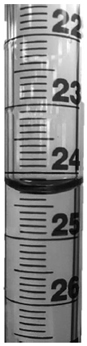
What is the burette reading for this transparent liquid?
24.10 cm3
24.30 cm3
25.70 cm3
25.90 cm3

A volumetric flask was used to prepare 250 cm3 of a solution.
The solute was added from a plastic weighing container.
Each reading from the balance has an uncertainty of ±0.005 g
What is the percentage uncertainty in the mass of the solute used?
0.09%
0.11%
0.18%
0.22%
A sample of 2.0 mol dm−3 acid has a volume of 100 cm3
What volume of water, in cm3, should be added to this acid to dilute the sample to a concentration of 1.5 mol dm−3?
25
33.3
50
66.7
What is the mass, in mg, of carbon formed when 3.0 × 10⁻³ mol of propene undergoes incomplete combustion?
2C3H6 + 3O2 ⟶ 6C + 6H2O
9.0 × 10⁻³
3.6 × 10⁻²
1.08 × 10²
2.16 × 10²
The equation for the reaction between zinc and hydrochloric acid is
Zn + 2HCl ⟶ ZnCl2 + H2
What is the minimum mass, in mg, of zinc (Ar = 65.4) needed to react with 50.0 cm3 of 1.68 mol dm−3 hydrochloric acid?
2.75
5.49
2.75 × 10³
5.49 × 10³

Phenylethanone can be prepared by the reaction between ethanoyl chloride and benzene.
In a preparation, with an excess of benzene, the mass of ethanoyl chloride (Mr = 78.5) used was 5.7 × 10⁻² kg.
The percentage yield of phenylethanone was 62%.
What mass, in grams, of phenylethanone was produced?
35 g
54 g
87 g
102 g
What is the volume of 0.200 mol dm−3 Ba(OH)2 (aq) required to neutralise exactly 30.0 cm3 of 0.100 mol dm−3 HCl(aq)?
150.0 cm3
75.0 cm3
15.0 cm3
7.50 cm3
Which reaction has the largest atom economy for the production of hydrogen?
C + H2O ⟶ CO + H2
Zn + 2HCl ⟶ ZnCl2 + H2
CH4 + H2O ⟶ CO + 3H2
CO + H2O ⟶ CO2 + H2
After reaction of some zinc metal with excess sulfuric acid, a student collected 40.8 g of ZnSO4.7H2O crystals. The yield of crystals was 70.0%.
What was the original mass of zinc used?
9.28 g
13.3 g
23.6 g
58.3 g
The equation for the hydrogenation of ethyne is
C2H2 + 2H2 ⟶ C2H6
The experimental yield is 65.0%.
What is the mass in grams of ethane that can be produced from 16.20 g of hydrogen?
42.53 g
78.98 g
121.5 g
527.7 g
Which of these pieces of apparatus has the lowest percentage uncertainty in the measurement shown?
Volume of 25 cm3 measured with a burette with an uncertainty of ±0.1 cm3.
Volume of 25 cm3 measured with a measuring cylinder with an uncertainty of ±0.5 cm3.
Mass of 0.150 g measured with a balance with an uncertainty of ±0.001 g.
Temperature change of 23.2 °C measured with a thermometer with an uncertainty of ±0.1 °C.
What is the total volume of gas remaining after 20 cm3 ethane are burned completely in 100 cm3 oxygen?
All volumes are measured at the same pressure and the same temperature, which is above 100 °C.
C2H6 + 3.5O2 --> 2CO2 + 3H2O
40 cm3
100 cm3
120 cm3
130 cm3
An ester is hydrolysed as shown by the following equation.
RCOOR/ + H2O --> RCOOH + R/OH
What is the percentage yield of RCOOH when 0.50 g of RCOOH (Mr = 100) is obtained from 1.0 g of RCOOR/ (Mr = 150)?
33%
50%
67%
75%
A saturated aqueous solution of magnesium hydroxide contains 1.17 × 10⁻³ g of Mg(OH)2 in 100 cm3 of solution. In this solution, the magnesium hydroxide is fully dissociated into ions.
What is the concentration of Mg2+(aq) ions in this solution?
2.82 × 10⁻² mol dm–3
2.01 × 10⁻³ mol dm–3
2.82 × 10⁻³ mol dm–3
2.01 × 10⁻⁴ mol dm–3
Magnesium reacts with hydrochloric acid according to the following equation.
Mg + 2HCl --> MgCl2 + H2
A student calculated the minimum volume of 2.56 mol dm–3 hydrochloric acid required to react with an excess of magnesium to form 5.46 g of magnesium chloride (Mr = 95.3).
Which of the following uses the correct standard form and the appropriate number of significant figures to give the correct result of the calculation?
4.476 × 10⁻² dm3
4.48 × 10⁻² dm3
4.50 × 10⁻² dm3
44.8 × 10⁻³ dm3
The following equation represents the oxidation of vanadium(IV) ions by manganate(VII) ions in acid solution.
5V4+ + MnO4– + 8H+ 5V5+ + Mn2+ + 4H2O
What volume of 0.020 mol dm–3 KMnO4 solution is required to oxidise completely a solution containing 0.010 mol of vanadium(IV) ions?
10 cm3
25 cm3
50 cm3
100 cm3
Refer to the unbalanced equation below when answering this question.
K2Cr2O7 + 3H2C2O4 + _H2SO4 → Cr2(SO4)3 + _H2O + 6CO2 + K2SO4
In the balanced equation the mole ratio for sulfuric acid to water is
1 : 4
1 : 2
4 : 7
4 : 9
In a molecule of a hydrocarbon, the fraction by mass of carbon is 9/11
What is the empirical formula of the hydrocarbon?
CH
CH3
C3H8
C5H12
30 cm3 of xenon are mixed with 20 cm3 of fluorine. The gases react according to the following equation. Assume that the temperature and pressure remain constant.
Xe(g) + F2(g) → XeF2(g)
What is the final volume of gas after the reaction is complete?
50 cm3
40 cm3
30 cm3
20 cm3
Which of the following solutions would react exactly with a solution containing 0.0500 mol sulfuric acid?
50.0 cm3 of 1.00 mol dm−3 KOH
100.0 cm3 of 2.00 mol dm−3 KOH
100.0 cm3 of 2.00 mol dm−3 Ba(OH)2
50.0 cm3 of 1.00 mol dm−3 Ba(OH)2
In a car airbag, sodium azide (NaN3) decomposes to form sodium metal and nitrogen gas.
2NaN3(s) → 2Na(s) + 3N2(g)
The sodium metal then reacts with potassium nitrate to produce more nitrogen gas.
10Na(s) + 2KNO3(s) → N2(g) + 5Na2O(s) + K2O(s)
If 2.00 mol of sodium azide react in this way, how many molecules of N2 will be formed?
(The Avogadro constant L = 6.022 × 10²³ mol–1)
2.41 × 1024
1.93 × 1024
1.81 × 1024
9.63 × 10²³
Propene can be made by the dehydration of propan-2-ol.
What is the percentage yield when 30 g of propene (Mr = 42.0) are formed from 50 g of propan-2-ol (Mr = 60.0)?
60%
67%
81%
86%
The removal of silicon dioxide with limestone in the Blast Furnace can be represented by the following equation.
CaCO3(s) + SiO2(s) → CaSiO3(l) + CO2(g)
The minimum mass of calcium carbonate needed to remove 1.00 tonne (1000 kg) of silicon dioxide is
0.46 tonne
0.60 tonne
1.67 tonne
2.18 tonne
The removal of silicon dioxide with limestone in the Blast Furnace can be represented by the following equation.
CaCO3(s) + SiO2(s) → CaSiO3(l) + CO2(g)
The volume of carbon dioxide, measured at 298 K and 1.01 × 10⁵ Pa, formed in this reaction during the removal of 1.00 tonne (1000 kg) of silicon dioxide is
24.5 dm3
408 dm3
24.5 m3
408 m3

Ethanoyl chloride reacts with methylbenzene forming compound X according to the equation in the image.
If the experimental yield is 40.0%, the mass in grams of X (Mr = 134.0) formed from 18.4 g of methylbenzene (Mr = 92.0) is
26.8
16.1
10.7
7.4
25.0 cm3 of ethanedioic acid required 22.5 cm3 of 0.100 mol dm−3 potassium hydroxide solution for complete neutralisation.
The concentration of ethanedioic acid is
0.0225 mol dm−3
0.0450 mol dm−3
0.0560 mol dm−3
0.0900 mol dm−3
Silver oxide, Ag2O, can be reduced by passing hydrogen gas over the heated oxide. The maximum mass of silver that could be obtained from 2.32 g of silver oxide is
2.02 g
2.06 g
2.12 g
2.16 g
In a reaction which gave a 27.0% yield, 5.00 g of methylbenzene were converted into the explosive 2,4,6-trinitromethylbenzene (TNT) (Mr = 227.0). The mass of TNT formed was
1.35 g
3.33 g
3.65 g
12.34 g
A 0.0720 g sample of reducing agent R was dissolved in water and acidified with an excess of dilute H2SO4. The resulting solution was found to react with exactly 18.0 cm3 of a 0.0200 mol dm−3 solution of KMnO4.
In this reaction, 5 mol of R react with 3 mol of KMnO4. The Mr of R is
120
167
240
333
The percentage by mass of carbon is 83.3% in
propane.
butane.
pentane.
hexane.

This question is about the following reaction scheme which shows the preparation of polymer P.
If 1.0 kg of benzene gave 0.98 kg of J, the percentage yield of J was
64
66
68
70
A particular sample of iron ore contains 85% by mass of Fe2O3 (Mr= 159.6) and no other iron compound. The maximum mass of iron that could be extracted from 1.0 tonne of this ore is
0.59 tonne
0.66 tonne
0.75 tonne
0.85 tonne
Butan-1-ol was converted into butyl propanoate by reaction with an excess of propanoic acid. In the reaction, 6.0 g of the alcohol gave 7.4 g of the ester. The percentage yield of ester was
57
70
75
81
The percentage of copper in a copper(II) salt can be determined by using a thiosulphate titration. 0.305 g of a copper(II) salt was dissolved in water and added to an excess of potassium iodide solution, liberating iodine according to the following equation:
2Cu2+(aq) + 4I−(aq) → 2CuI(s) + I2(aq)
The iodine liberated required 24.5 cm3 of a 0.100 mol dm−3 solution of sodium thiosulphate:
2S2O32-(aq) + I2(aq) → 2I−(aq) + S4O62-(aq)
The percentage of copper, by mass, in the copper(II) salt is
64.2
51.0
48.4
25.5
On heating, magnesium reacts vigorously with element X to produce compound Y. An aqueous solution of Y, when treated with aqueous silver nitrate, gives a white precipitate that is readily soluble in dilute aqueous ammonia. What is the minimum mass of X that is needed to react completely with 4.05 g of magnesium?
11.83 g
5.92 g
5.33 g
2.67 g

1,3-dinitrobenzene can be prepared by heating nitrobenzene with a mixture of fuming nitric acid and concentrated sulphuric acid. The reaction can be represented by the following equation.
If the yield of the reaction is 55%, the mass of 1,3-dinitrobenzene produced from 12.30 g of nitrobenzene is
16.90 g
16.80 g
9.30 g
9.24 g
Which one of the following compounds contains the smallest percentage, by mass, of oxygen?
CH3OCH2CH3
CH3OCH2NH2
COS
C4H9Al(OH)2
When one mole of ammonia is heated to a high temperature, 50% dissociates according to the following equilibrium.
2NH3(g) ⇌ N2(g) + 3H2(g)
What is the total number of moles of gas present in the equilibrium mixture?
1.5
2.0
2.5
3.0
Aqueous C2O42- ions react with MnO4- ions in acidic solution according to the equation
5 C2O42- + 2MnO4- + 16H+ → 2Mn2+ + 10CO2 + 8H2O
Under the same conditions Fe2+ ions also react with MnO4- ions. How many moles of MnO4- ions are required to react exactly with one mole of Fe(C2O4).2H2O?
0.4
0.6
2.5
7.5
On complete combustion, 0.0150 mol of an organic acid produced 735 cm3 of carbon dioxide (measured at 101 kPa and 298 K). The same amount of acid required 15.0 cm3 of 2.00 M sodium hydroxide solution for neutralisation. Which one of the following could be the formula of the acid?
HCOOH
CH3COOH
HOOCCOH
HOOCCH2CH2COOH
An excess of methanol was mixed with 12 g of ethanoic acid and an acid catalyst. At equilibrium the mixture contained 8 g of methyl ethanoate. The percentage yield of ester present was
11
20
54
67
In a titration, 0.52 g of a diprotic acid, H2X, reacts exactly with 100 cm3 of 0.10 M sodium hydroxide.
H2X + 2NaOH → Na2X + 2H2O
The acid could be
ethanedioic
propanedioic
butanedioic
pentanedioic
0.00125 mol of a compound was heated with an excess of a solution of potassium hydroxide and the ammonia evolved required 17.0 cm3 of 0.220 M hydrochloric acid for neutralisation. Which one of the following could be the formula of this compound?
BF3NH3
VCl3(NH3)3
CrCl2(NH3)2
[Be(NH3)4]Cl2
Hydrolysis of the ester, CH3COOCH2CH2CH3, produces ethanoic acid. In an experiment, 2.04 g of the ester was used and 0.90 g of ethanoic acid was produced. The percentage yield of ethanoic acid was:
44
59
75
90
Copper(II) ions can be estimated volumetrically by the addition of an excess of potassium iodide followed by titration of the liberated iodine with sodium thiosulphate solution. The following equations apply:
2Cu2 + 4I− → 2CuI + I2
I2 + 2S2O32- → S4O62- + 2I
What volume (in cm3) of 0.1 M Na2S2O3 would be required to react with the iodine produced from 1.249 g of CuSO45H2O (Mr 249.7)?
10
25
50
100
A “drink-driving” offence is committed if the blood alcohol level of a driver is over 80 mg of ethanol per 100 cm3 of blood.
What is the concentration (in mol dm3) of ethanol if there are 80 mg of ethanol per 100 cm3 of blood?
0.0017
0.017
0.080
0.80
When vanadium reacts with chlorine at 400°C, a brown compound is obtained. When an aqueous solution containing 0.193 g of this compound was treated with aqueous silver nitrate all the chlorine in the compound was precipitated as silver chloride. The mass of silver chloride (AgCl) produced was 0.574 g. Which one of the following could be the formula of the brown compound?
VCl
VCl2
VCl3
VCl4
The oxidation of ethanedioate (oxalate) ions by manganate(VII) ions can be represented by the half equations:
C2O42-(aq) → 2CO2(g) + 2e−
MnO4- (aq) + 8H+(aq) + 5e− → Mn2+(aq) + 4H2O(l)
What volume (in cm3) of 0.02 M KMnO4 is required to oxidise completely a solution containing 0.02 mol of ethanedioate ions?
25
40
250
400

