
 Worksheets
22-23 Midterm Review (ACP)
Total questions: 107
Worksheet time: 2hrs 23mins
All matter is made up of tiny building blocks called:
mass
atoms
cells
legos
Atoms of a particular "type" are known as:
Cells
Elements
Molecules
Compounds
Does the following represent an "Atom" or a "Molecule"?
C6H12O6
atom
molecule containing all the same element
molecule containing different elements
Does the following represent an "Atom" or a "Molecule"?
S8
atom
molecule containing all the same element
molecule containing different elements
In this class, "particles" can refer to:
atoms only
molecules only
both atoms and molecules

You can separate the sugar and water from this sample of lemonade by:
passing it through filter paper
boiling off the water
using a magnet
a chemical reaction

Physical properties are
properties that can be observed or measured without changing the identity of the substance
properties that describe how a substance may change into a completely different substance

Over time, a piece of metal appeared to be covered in rust. Which best describes the change to the metal?
It was a chemical change, because the bike was a different color.
It was a chemical change, because the new atoms were created.
It was a chemical change, because rust is a new substance with a different composition than the original metal.
It was a physical change, because rust can be removed from the metal.
A precipitate forms when:
a liquid freezes into a solid
two liquids dissolve in one another to form a solution
a solid forms when two liquids are mixed
a substance undergoes a phase change
What is H2SO4 made up of?
2 hydrogen, 1 sulfur, 4 oxygen
1 hydrogen, 2 sulfur, 4 oxygen
2 hydrogen & 4 sodium
1 hydrogen & 6 sodium
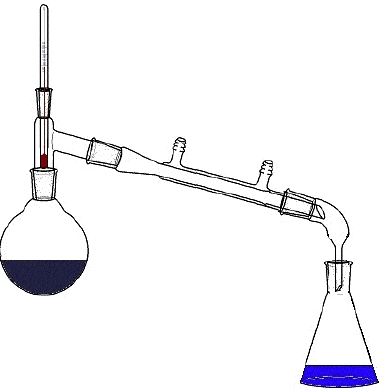

Filtrate
Dessicant
Centrifuge
Filtrant
Decanted liquid

Distillation
Centrifugation
Filtration
Chromatography

C, H6, O7
CH4, 2O2, H2O
CH6O7
CH4, 4O, H2O

2MgCl2
Mg2Cl4
2Mg, 4Cl
2Mg4Cl
Mixture (A & B) Mass: 3.0g
Mass of dry filter paper: 1.0g
Mass of filter paper with B on it: 2.5g
What is the mass of B?
(a)
Mixture (A & B) Mass: 2.0g
Mass of A: 1.2g
Mass of B: 0.8g
What is % composition of A?
(a)
Which is NOT a sign of a chemical reaction?
Color change
Melting
Production of gas bubbles
Releasing an odor
Select all characteristics that can apply to a MIXTURE
Not chemically bonded together
One chemical symbol can describe it
Looks like one substance
Composition of each particle is the same

Select all that apply.
Atoms
Molecules
Element
Compound

Select all that apply.
Atoms
Molecules
Element
Compound
Which of the following determines the identity of an element?
number of protons
atomic mass
number of neutrons
number of shells
An atom has 10 protons, 15 neutrons and 10 electrons what is its mass number.
20
10
35
25
The NUCLEUS has a _____ charge because it contains p+ and no.
positive
neutral
negative
The ELECTRON CLOUD has a _____ charge because it contains e- .
positive
neutral
negative

This is a STABLE nucleus
This is an UNSTABLE nucleus

This atom has a STABLE nucleus
This atom has an UNSTABLE nucleus
What determines the amount of space an atom takes up?
the nucleus
the electron cloud
Consider what makes up the majority of the MASS of an atom and the VOLUME of an atom. Which combination is correct?
MASS = nucleus; VOLUME = e- cloud
MASS = e- cloud; VOLUME = nucleus
The more protons in an atom, the ____ the attraction between the nucleus and the electrons in the e- cloud.
weaker
stronger

Atoms on the right (->) side are SMALLER because these atoms have ___ protons which exert a ______ pull on the electrons and pull them in closer.
less, stronger
less, weaker
more, weaker
more, stronger

This IS the MASS NUMBER of a Cu atom.
This is NOT the same as the MASS NUMBER of a Cu atom.

True or False: The ground state is the highest energy state of an atom.
True
False

What is the light that you can see called?
observatory light
ultraviolet light
visible light
infrared light

Diagram below shows
Emission spectrum
Absorption spectrum
Line absorption spectrum


Which element(s) is/are in Unknown W?
Cadmium, Potassium, and Helium
Hydrogen, Potassium, and Lithium
Cadmium and Sodium
Only Sodium

The unknown emissions spectra belongs to the element
Hydrogen
Mercury
Neon
Sodium

The unknown emissions spectra belongs to the element
Hydrogen
Mercury
Neon
Helium


Look carefully at the picture. It shows an electron in the excited state on the left, and the electron returning to its ground state on the right. When the electron return to the ground state it emits a_______________________.
blast of cold air
electrostatic charge
proton
photon (light)

The color of emitted light with lowest energy is
violet
green
red
indigo
What number should you always write on the left of the unit "mole"?
the mass on the periodic table
22.4
1
6.02x10²³
What number should you always write on the left of the unit "g"?
the mass from the periodic table
22.4
1
6.02x10²³
You should write the unit you want to cancel out on the ___ of the conversion factor.
top
bottom

1 mole
1 g
24.3 g
6.02x10²³ g

1 mole
1 g
136.4 g
6.02x10²³ g

1 mole
1 molecule
6.02x10²³ moles
6.02x10²³ molecules

1 mole
63.5 g
6.02x10²³ moles
6.02x10²³ g

1 mole
207.2 g
207.2 moles
6.02x10²³ g

1 mole
27.0 atoms
6.02x10²³ atoms
6.02x10²³ moles

1 mole
38.0 L
6.02x10²³ moles
22.4 L

1 mole
18.0 L
6.02x10²³ moles
22.4 L
According to the Law of Conservation of Matter, which of the following occurs during a chemical reaction?
Matter is not created or destroyed, atoms just rearrange themselves.
New atoms are created as new products form.
Original atoms are destroyed as new products form.
Chemical bonds can never be broken.
Which of the following CAN be broken apart or formed during a chemical reaction?
atoms
Molecules and compounds
protons
H2 + O2 -> H2O
H2 + O2 -> H2O
Name the part in red:
H2 + O2 -> H2O
Coefficient
Product
Reactant


In an endothermic reaction, the products have
more energy than the reactants
less energy than the reactants
the same energy as the reactants
no energy

In an exothermic reaction, the products have
more energy than the reactants
the same energy as the reactants
less energy than the reactants
no energy
Which of the following is considered a CHEMICAL change?
combining sodium and chlorine to form sodium chloride
melting a solid iron to form liquid iron
dissolving sodium chloride in water
boiling water to produce water vapor
When substances react, you expect to observe
change in color
a release of gas or precipitate
release of heat or light in the products
all of the above as possibilities
In a chemical equation, the symbol (aq) indicates that the substance is:
water
dissolved in water
an acid
insoluble in water
The chemical symbol of an element written over the arrow in a chemical equation signifies:
a byproduct
the formation of a gas
a catalyst for the reaction
an impurity
Exothermic reactions occur when additional energy is _____ as the new products form.
absorbed
released
Which of the following is used to indicate a precipitate has formed during a chemical reaction?
(aq)
(p)
(s)
(🌨)
Which of the following is used to indicate that a substance is insoluble in water?
(aq)
(p)
(s)
(🌨)
Imagine a reaction in which water vapor is formed. How would you indicate this?
H2O(g)
H2O(v)
W.V.(g)
H2O(aq)
Information about energy written on the LEFT side of a chemical equation indicates that a reaction is:
exothermic
endothermic
Select the reactant(s) of the following reaction:
"A solution of NH4OH will form when NH3 gas is mixed with H2O. "
NH4OH only
NH3 & H2O
NH3 only
H2O only
What state of matter should follow the formula for Cu(NO3)2?
"Crystals of Ag and a blue solution of Cu(NO3)2 are formed when a piece of Cu metal is added to aqueous AgNO3."
(s)
(aq)
(l)
(sol)
What coefficient belongs on the line:
C4H6 + 3O2 ---------> ___CO2 + 3H2O
3
4
6
10
What coefficient belongs on the line:
Mg + 2AgCl ------------> MgCl2 + ___Ag
1
2
4
6
Which of the following reactions is balanced?
2Na + Cl2-------> 2NaCl
2Na + 2Cl2 ------> 2NaCl
Na + 2Cl2 --------> NaCl
What coefficient belongs on the line?
1N2 + 3H2 --> __NH3
2
1
3
5
How many Hydrogen atoms are in 4H2O?
6
8
2
4
What coefficient belongs on the line?
Mg + __HCl ---> MgCl2 + H2
1
2
3
4
How many atoms of aluminum are on each side of the following equation:
4Al + 3O2 --> 2Al2 O3
2
6
1
4
Fe + S --> FeS
Al + O2 --> 2Al2O3
What coefficient belongs on the line?
P4 + 3O2 --> ___P2O3
1
2
3
4
Which element has chemical properties most similar to calcium, Ca?
Be
K
Ti
Y
Which element has chemical properties most similar to calcium, Ca?
Be
K
Ti
Y
Nuclear pull on valence electrons is strongest __________.
at the top of a group.
in the middle of a group.
at the bottom of a group.
Nuclear pull on valence electrons is strongest ________ .
on the left side of a period.
in the middle of a period.
on the right side of a period.
As you move down a group, atomic radius increases because -
more and more neutrons
more and more protons
more and more full energy levels
more protons, so nuclear attraction is stronger
Why do atoms get smaller as you move across a period (left to right)?
the number of protons increases, so attraction to electrons increases
the number of energy levels increases
the number of electrons increases
the atomic mass increases
Which group has the smallest atomic radius?
Alkali metals
Halogens
Noble Gases
Transition metals
Atomic radius is smallest:
B
F
O
Li
Which atom would be the largest?
Li
Na
K
Rb

