wayground logo

Free Printable Worksheets

Font size

S
M
L
XL
Worksheets

TEST # PRACTICE-ATOMIC STRUC. & PT

Total questions: 106

Worksheet time: 2hrs 26mins

Name
Class
Date
1.
Discovered the electron
a)
J J thomson
b)
Dalton
c)
Chadwick
d)
Rutherford
2.
Created a model of the atom with electrons moving around the nucleus in fixed orbits
a)
Neils Bohr
b)
Dalton
c)
Heisenberg
d)
J J thomson
3.
Did the gold foil experiment
a)
Rutherford
b)
Dalton
c)
Democritus
d)
Heisenberg
4.
Hypothesized that the atom was a tiny indestructible particles.
a)
Dalton
b)
Rutherford
c)
Democritus
d)
J J thomson
5.
Discovered that the atom is mostly empty space
a)
Rutherford
b)
Dalton
c)
Democritus
d)
J J Thomson
6.
Transformed Democritus's ideas on atom into a scientific atomic theory
a)
Democritus
b)
J J thomson
c)
Schrodinger
d)
Dalton
7.
Transformed Democritus's ideas on atom into a scientific atomic theory
a)
Democritus
b)
J J thomson
c)
Schrodinger
d)
Dalton
8.
Greek Philosopher
a)
J J Thompson
b)
Dalton
c)
Democritus 
d)
Rutherford
9.
Who's model of the atom is this?
a)
Bohr
b)
Thomson
c)
Rutherford
d)
Shrodinger
10.
Who created this model of the atom?
a)
Chadwick
b)
Shrodinger
c)
Bohr
d)
Dalton
11.
What particle of the atom is positively charged?
a)
Electron
b)
Proton
c)
Neutron
12.
Whose model of the atom is pictured here?
a)
Bohr
b)
Rutherford
c)
Thomson
d)
Schrodinger
13.
The __________ is the smallest particle of an element.
a)
Atom
b)
Proton
c)
Electron
d)
Molecule
14.
The ___________ is a negatively charged particle of an atom.
a)
Proton
b)
Neutron
c)
Electron
d)
Atom
15.
The __________ contains the protons and neutrons of an atom, and is most of the mass of an atom
a)
Nucleus
b)
Atomic Number
c)
Atomic Mass
d)
Electrons
16.
The ______________________ is that same as the number of protons in an atom
a)
Atomic Mass
b)
Atomic Number
c)
Neutron Number
d)
Mass Number
17.
The __________________ is the sum of the protons and the neutrons in an atom.
a)
Atomic Number
b)
Mass Number
c)
Protons
d)
Neutrons
18.
The weighted average of the masses of all the naturally occurring isotopes of an element
a)
ATOMIC NUMBER
b)
MASS NUMBER
c)
ATOMIC MASS
d)
ATOMIC MASS UNIT
19.
How did Rutherford discover the proton?
a)
Cathode tube ray experiment
b)
Gold Foil Experiment
c)
Planetary Model
d)
Plum Pudding Model
20.
What contribution did John Dalton make to atomic theory? 
a)
He discovered that every atom was positively charged. 
b)
He discovered that every element consisted of one type of atom.  
c)
He discovered that atoms had nuclei. 
d)
He discovered that atoms could be divided into smaller parts. 
21.
What is the formula for density? 
a)
D= Volume/ Distance
b)
D= Distance/ Mass
c)
D= Volume/ Mass
d)
D = Mass/ Volume
22.
the tiny, dense central portion of an atom, composed of protons and neutrons
a)
electron
b)
neutron
c)
nucleus
d)
brain
23.
a subatomic particle with no charge and a mass of 1 amu; found in the nucleus of an atom
a)
nucleus
b)
brain
c)
neutron
d)
electron
24.
a negatively charged subatomic particle
a)
neutron
b)
nucleus
c)
proton
d)
electron
25.
a particle smaller than an atom 
a)
compound
b)
element
c)
molecule
d)
subatomic
26.
the number of protons in the nucleus of an atom of an element
a)
atomic mass
b)
atomic number
c)
isotopes
27.
the smallest particle of an element that retains its identity in a chemical reaction
a)
proton
b)
electron
c)
atom
d)
isotope
28.
Which of the following is the philosopher credited with coining the term "atom"?
a)
Aristotle
b)
Democritus
c)
Plato
29.
What is the name of the scientist credited with reviving Democritus' ideas regarding matter and atoms?
a)
John Dalton
b)
JJ Thomson
c)
Neil Bohr
30.
An explanation of observable facts and phenomena
a)
Theory
b)
Model
c)
Hypothesis
31.
According to Rutherford's experiment, most of the atom is
a)
a dense core
b)
empty space
32.
the word atom means
a)
invisible
b)
visible
c)
indivisible
d)
divisible
33.

Which law is John Dalton credited with?

a)

Law of inertia

b)

Law of Conservation of Mass

c)

First law of thermodynamics

d)

None of the above

34.
Each column in the periodic table is called a 
a)
period
b)
group
c)
cluster
d)
unit
35.
The yellow atoms are called 
a)
metals
b)
nonmetals
c)
metalloids
d)
noble gases
36.
The period for Bromine is ___________.
a)
3
b)
2
c)
4
37.
Beryllium is in group number______.
a)
Group 2
b)
Group 3
c)
Group 4
d)
Group 7
38.
The periodic table has __ periods.
a)
18
b)
8
c)
2
d)
7
39.
An element's identity is determined by the number of
a)
electrons.
b)
protons.
c)
neutrons.
d)
valence.
40.
Elements in the same ________ are more chemically similar.
a)
group
b)
period
c)
club
d)
table
41.
The majority of elements on the periodic table are
a)
man made.
b)
nonmetals.
c)
metals.
d)
gases.
42.
Which of the following is not a property of metals?
a)
brittle
b)
malleable
c)
lustrous
d)
conductive
43.
Rows on the period table are called _____ while columns are called _____.
a)
groups, families
b)
groups, periods
c)
periods, groups
d)
families, groups
44.
The periodic table has __ groups.
a)
8
b)
7
c)
18
d)
2
45.
a)
Metals
b)
Nonmetals
c)
Metalloids
46.
a)
Metals
b)
Nonmetals
c)
Metalloids
47.
What do these isotopes of carbon all have in common?
a)
neutrons & mass number
b)
atomic number and neutrons
c)
atomic number and electrons
d)
protons, atomic number, and mass number
48.
In a correctly written symbol what would be located in the "A" position?
a)
number of neutrons
b)
atomic number
c)
number of electrons 
d)
mass number
49.
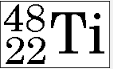
How many protons does this isotope of titanium have?
a)
48
b)
22
c)
26
d)
70
50.
How many neutrons does the isotope below have?     89 36Kr
a)
53
b)
36
c)
89
d)
125
51.
If X is the symbol for an element, which of the following two symbols represent    isotopes of the same element?     I. 7735X  II. 7733X  III. 8137X  IV. 8135 X
a)
I and II
b)
III and IV
c)
I and IV
d)
I and III
52.
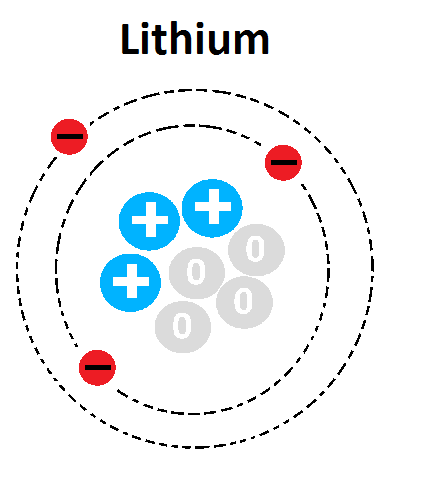
What is the mass number of this atom?
a)
1
b)
3
c)
4
d)
7
53.
Each column in the periodic table is called a 
a)
period
b)
group
c)
cluster
d)
unit
54.
Which group of the periodic table is composed of inert (not reactive)  gases?
a)
alkali metals
b)
alkaline earth metals
c)
halogens
d)
noble gases
55.
Which is an alkali metal?
a)
Magnesium
b)
Iron
c)
Sodium
d)
Europium
56.
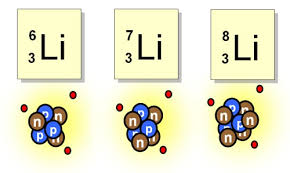
How many neutrons does the isotope of lithium have?
a)
8
b)
3
c)
4
d)
5
57.
How many neutrons does an atom of the isotope Neon-22 have?
a)
12
b)
10
c)
22
d)
20
58.
which atom has  4 neutrons?
a)
Li-6
b)
Li-7
c)
Li-8
d)
they have the same # of neutrons
59.
How many neutrons in C-14?
a)
6
b)
7
c)
14
d)
8
60.

Hydrogen-2

a)

Deuterium

b)

Tritium

c)

Protium

61.

Mass number minus the atomic number

a)

Equals atomic number

b)

Equals number of protons

c)

Equals number of neutrons

d)

Equals number of protons and neutrons

62.

Name of element-mass number

a)

Nuclear symbol notation

b)

hyphen notation

c)

shorthand notation

63.

Why were there blank spaces left in Mendeleev's periodic table?

a)

He didn't know what to put there.

b)

Undiscovered elements not yet known.

c)

Multiple elements could have fit

d)

He forgot to add the elements in.

64.

In the modern periodic table elements are arranged by:

a)

atomic mass

b)

atomic number

c)

valence electrons

d)

number of isotopes

65.

Who arranged the periodic table by increasing atomic number?

a)

Mendeleev

b)

Rutherford

c)

Bohr

d)

Mosely

66.

_______________ developed the first periodic table and arranged the elements in order of increasing atomic mass.

a)

Stevie Wonder

b)

Sasha Vujacic

c)

Dmitri Mendeleev

d)

James Mosely

67.
Which atom has the SMALLEST atomic radius?
a)
Cs
b)
Na
c)
Fr
68.
Which atom is the MOST electronegative?
a)
Si
b)
Cl
c)
S
69.
Which element is inert?
a)
Nitrogen
b)
Krypton (Kr)
c)
Manganese (Mn)
d)
Plutonium (Pu)
70.
In which group would you find the Noble Gases?
a)
5
b)
6
c)
7
d)
8
71.
Atomic radius is ______.
a)
the distance from the center of the nucleus to the outermost electron.
b)
the distance from one outer electron to another outer electron.
c)
the distance from center of the nucleus to the first energy level.
d)
the distance from one proton to one electron.
72.
Chlorine is a member of which group?
a)
Alkali metals
b)
Rare earth metals
c)
Halogens
d)
Noble gases
73.
Electronegativity is...
a)
how good an atom is at attracting electrons
b)
the ability of an atom to lose electrons
c)
the energy required to remove an electron from a specific atom
d)
how easy it is to make friends. 
74.
Ionization energy is...
a)
the energy required to add an electron to a specific atom
b)
how much energy it takes to remove an electron from an atom
c)
the energy required to shield the outer electrons from the nucleus
d)
a measure of the ability of an atom to attract electrons
75.
The vertical columns in the periodic table are called __________
a)
groups
b)
periods
c)
columns
d)
rows
76.
The horizontal rows in the periodic table are called __________
a)
groups
b)
periods
c)
columns
d)
rows
77.
Which of these grouping of elements could have the characteristic of brittle?
a)
Metal
b)
Nonmetal
78.
Which of the following is a good conductor of heat?
a)
Metal
b)
Nonmetal
c)
Metalloid
79.
All of the following would classify an element as a metal except?
a)
Dull
b)
Luster
c)
Malleable
d)
Hard
80.
Anytime you see the word SEMICONDUCTOR - what substance do you have?
a)
Metal
b)
Nonmetal
c)
Metalloid
81.
What element in Group 1 is not a metal but a nonmetal?
a)
Helium
b)
Lithium
c)
Hydrogen
d)
Oxygen
82.
What does malleable mean?
a)
able to bend
b)
will break easily
c)
can be used for wire
d)
is shiny
83.
What does ductile mean?
a)
electricity flows easily
b)
quacks like a duck
c)
can be drawn into a wire
d)
able to bend
84.
Which has a higher density?
a)
metal
b)
nonmetal
85.
Periodic repetition of of chemical and physical properties 
a)
periodic law 
b)
octet rule
c)
groups
d)
period 
86.
A charged atom. 
a)
metalloid 
b)
hydrogen
c)
halogen
d)
ion
87.

Which statement is true about metals?

a)

They are all liquids.

b)

They are all found in nature.

c)

They are all very reactive.

d)

They are all found to the left of the zigzag line.

88.
the central region of an atom where its neutrons and protons are is its 
a)
nucleus 
b)
electron cloud
c)
core 
d)
center 
89.
What is the atomic number for an element with three protons?
a)
2
b)
1
c)
3
d)
6
90.
What is the atomic symbol for sodium?
a)
Na
b)
So
c)
NaCl
d)
S
91.
True or False? Neutrons have a negative charge
a)
True
b)
False
92.
A particle that moves around the nucleus is a(n)...
a)
Proton
b)
Neutron
c)
Electron
d)
Quark
93.

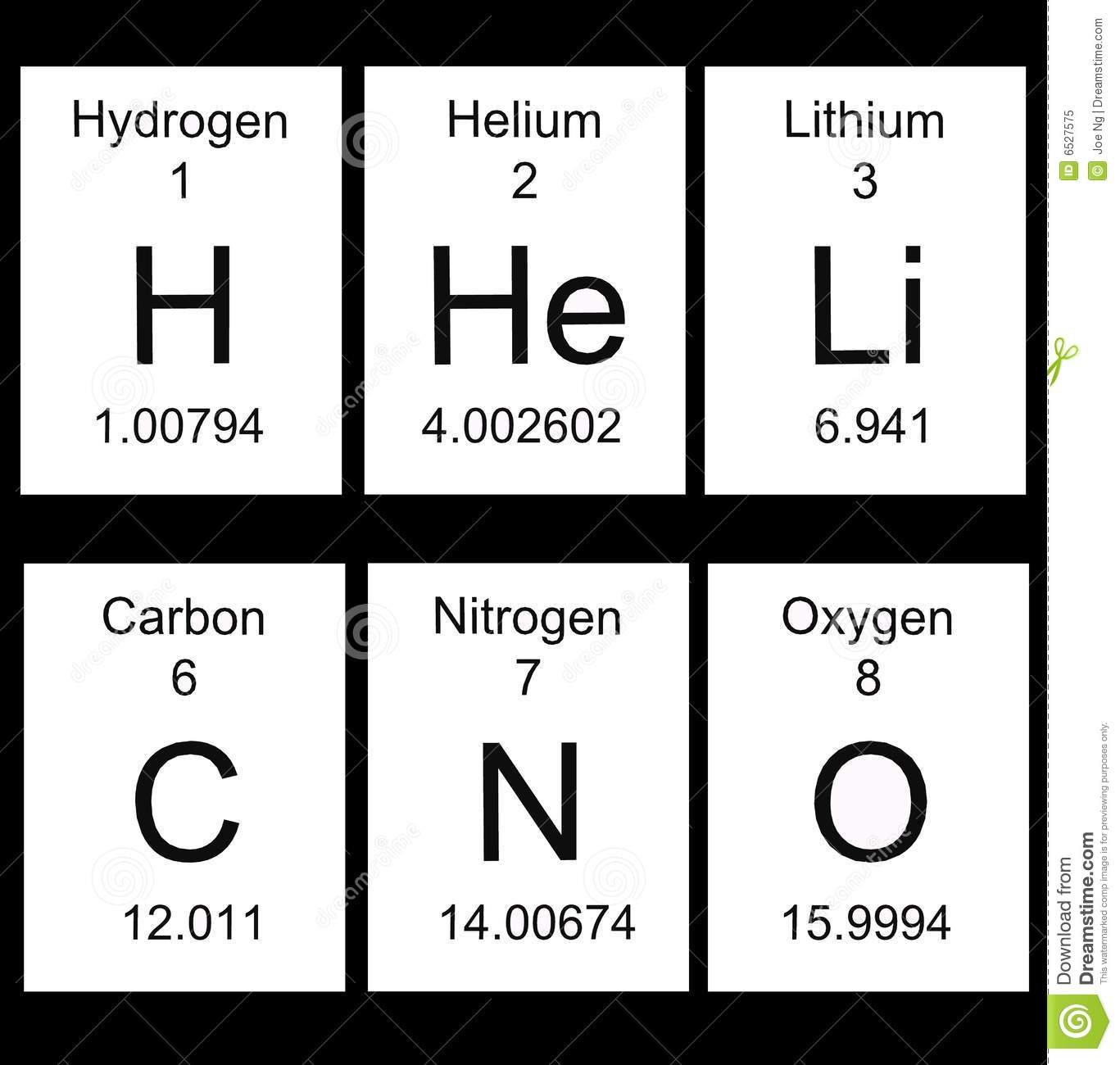
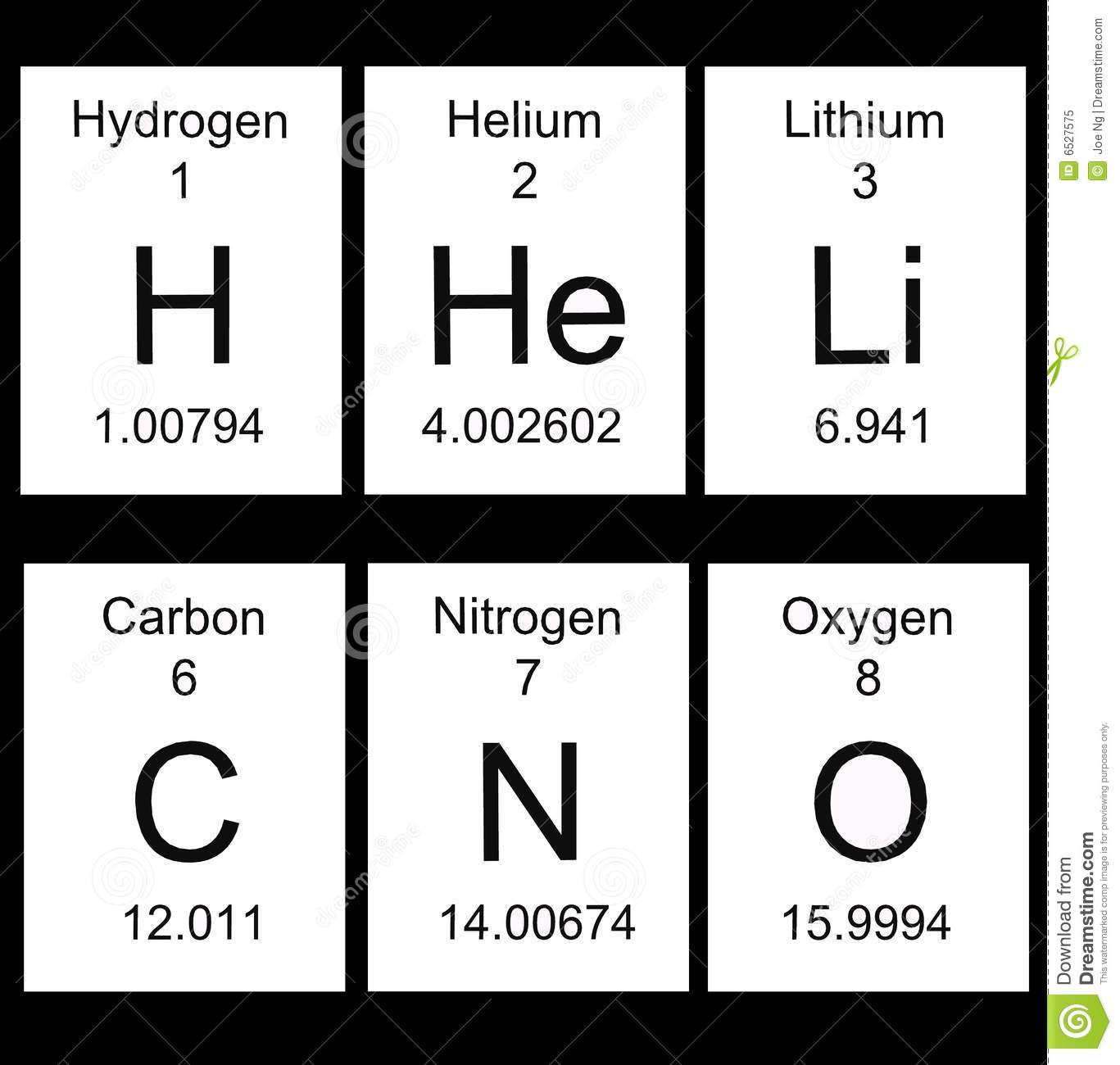
What does the 1.00794 stand for?

a)

Hydrogen

b)

atomic number

c)

atomic mass

d)

atomic explosion

94.
A vertical column is called...
a)
group
b)
tower
c)
period
d)
crew
95.
The number at the top of each square on the periodic table is the ...
a)
atomic number
b)
atomic mass
c)
Chemical Symbol
d)
Element Name
96.
What is the chemical symbol for Lithium?
a)
H
b)
He
c)
Li
d)
N
97.
How many protons, neutrons and electrons?
a)
47P, 47N, 47E
b)
47P, 61N, 47E
c)
47P, 61N, 61E
d)
108P,47N, 108E
98.
Which subatomic particle has the least mass?
a)
protons
b)
neutrons
c)
electrons
d)
nucleus
99.
Who arranged the periodic table by increasing atomic mass?
a)
Democritus
b)
Mendeleev
c)
Bohr
d)
Einstein
100.
What do the elements in a group have in common?
a)
the same number of valence electrons
b)
the same number of energy levels
c)
the same number of protons
d)
the same number of neutrons
101.
What do the elements in the same period have in common?
a)
the same number of valence electrons
b)
the same number of energy levels
c)
the same number of protons
d)
the same number of neutrons
102.
How is the modern periodic table arranged?
a)
alphabetical order
b)
increasing atomic mass
c)
increasing atomic number
d)
by the number of neutrons
103.
Elements that are dull, brittle and insulators are _______
a)
metals
b)
nonmetals
c)
metalloids
d)
noble gases
104.
As atoms of elements in group 16 are considered in order from top to bottom, the electronegativity of each successive element....
a)
decreases
b)
increases
c)
remains the same
d)
none of the above
105.
Which atom has the largest atomic radius?
a)
potassium
b)
rubidium 
c)
francium
d)
cesium
106.
Electronegativity is...
a)
how good an atom is at attracting electrons
b)
the ability of an atom to lose electrons
c)
the energy required to remove an electron from a specific atom
d)
how easy it is to make friends.