wayground logo

Free Printable Worksheets

NEW

Font size

S
M
L
XL
Worksheets

The Cell Cycle

Total questions: 80

Worksheet time: 1hrs 20mins

Name
Class
Date
1.
During which phase of the cell cycle does the following event happen:The sister chromatids are moving apart.
a)
Prophase
b)
Interphase
c)
Telophase
d)
Metaphase
e)
Anaphase
2.
During which phase of the cell cycle does the following event happen: A new nuclear membrane is forming around the chromosomes.
a)
Prophase
b)
Interphase
c)
Telophase
d)
Metaphase
e)
Anaphase
3.
During which phase of the cell cycle does the following event happen:The cytoplasm of the cell is being divided.
a)
Prophase
b)
Interphase
c)
Telophase
d)
Metaphase
e)
Anaphase
4.
During which phase of the cell cycle does the following event happen:The chromosomes are located at the equator of the cell.
a)
Prophase
b)
Interphase
c)
Telophase
d)
Metaphase
e)
Anaphase
5.
During which phase of the cell cycle does the following event happen:The nuclear membrane begins to fade from view.
a)
Prophase
b)
Interphase
c)
Telophase
d)
Metaphase
e)
Anaphase
6.
During which phase of the cell cycle does the following event happen:The chromosomes start moving towards the poles of the cell.
a)
Prophase
b)
Interphase
c)
Telophase
d)
Metaphase
e)
Anaphase
7.
During which phase of the cell cycle does the following event happen:Cytokinesis is complete.
a)
Prophase
b)
Interphase
c)
Telophase
d)
Metaphase
e)
Anaphase
8.
During which phase of the cell cycle does the following event happen:The cleavage furrow appears.
a)
Prophase
b)
Interphase
c)
Telophase
d)
Metaphase
e)
Anaphase
9.
During which phase of the cell cycle does the following event happen:Chromosomes are replicated.
a)
Prophase
b)
Interphase
c)
Telophase
d)
Metaphase
e)
Anaphase
10.
During which phase of the cell cycle does the following event happen:The cell is growing in preparation for division.
a)
Prophase
b)
Interphase
c)
Telophase
d)
Metaphase
e)
Anaphase
11.
During which phase of the cell cycle does the following event happen:The chromatin condenses into chromosomes.
a)
Prophase
b)
Interphase
c)
Telophase
d)
Metaphase
e)
Anaphase
12.
During which phase of the cell cycle does the following event happen:This is the last phase that the chromatids are together.
a)
Prophase
b)
Interphase
c)
Telophase
d)
Metaphase
e)
Anaphase
13.
What is the longest phase of the cell cycle?
a)
Prophase
b)
Interphase
c)
Telophase
d)
Metaphase
e)
Anaphase
14.
What is the longest phase of Mitosis?
a)
Prophase
b)
Interphase
c)
Telophase
d)
Metaphase
e)
Anaphase
15.
What type of cells do not undergo mitosis?
a)
Somatic Cells
b)
Gametes
c)
Skin Cells
d)
Red Blood Cells
e)
Pancreatic Cells
16.
Which part of the cell cycle is not part of interphase
a)
G1
b)
S
c)
G2
d)
M phase
e)
G0
17.
Cells that rarely divide, if at all, will spend most of their time in what phase of the cell cycle?
a)
G1
b)
S
c)
G0
d)
G2
e)
M phase
18.
What is the correct order of the stages of mitosis? 1-Metaphase 2-Telophase 3-Anaphase 4-Prophase
a)
4,1,2,3
b)
2,3,1,4
c)
1,2,3,4
d)
1,3,2,4
e)
4,1,3,2
19.
This cell is in which of the following stages?
a)
Metaphase
b)
Interphase
c)
Anaphase
d)
Telophase
e)
Prophase
20.
This cell is in which of the following stages?
a)
Metaphase
b)
Interphase
c)
Anaphase
d)
Telophase
e)
Prophase
21.
This cell is in which of the following stages?
a)
Metaphase
b)
Interphase
c)
Anaphase
d)
Telophase
e)
Prophase
22.
This cell is in which of the following stages?
a)
Metaphase
b)
Interphase
c)
Anaphase
d)
Telophase
e)
Prophase
23.
This cell is in which of the following stages?
a)
Metaphase
b)
Interphase
c)
Anaphase
d)
Telophase
e)
Prophase
24.
What is the next phase of mitosis?
a)
Metaphase
b)
Interphase
c)
Anaphase
d)
Telophase
e)
Prophase
25.
What is the previous phase of mitosis?
a)
Metaphase
b)
Interphase
c)
Anaphase
d)
Telophase
e)
Prophase
26.
How many chromosomes do human cells have? (Not repoductive cells)
a)
23
b)
6
c)
46
d)
92
e)
42
27.
During interphase, a cell grows, dublicates organelles, and...
a)
copies DNA
b)
divides the cytoplasm
c)
divides the nucleus
d)
produces a new cell
e)
creates spindles
28.

Which organelle is known as the "brain" or "control center" of the cell and controls the cell's activities and processes.

a)

mitochondria

b)

nucleolus

c)

ribosome

d)

nucleus

29.

This genetic material is found floating in the DNA of eukaryotic cells.

a)

chlorophyll

b)

cytoplasm

c)

chromatin

d)

cytokinesis

30.

This organelle is the storage facility in a cell. Plant cells usually contain one large one and animal cells may contain many small ones.

a)

vacuole

b)

cytoplasm

c)

lysosome

d)

chloroplast

31.

These organelles are found in the cells of autotrophs and capture sunlight to convert it into food for the cell.

a)

cell wall

b)

cell membrane

c)

mitochondria

d)

chloroplast

32.

Each part of a cell that performs a specific function inside the cell is called an __________.

a)

atom

b)

organ

c)

organelle

d)

system

33.

This organelle produces energy for the cell during cellular respiration and is known as the "powerhouse" of the cell.

a)

cytoplasm

b)

nucleolus

c)

nucleus

d)

mitochondria

34.

This series of passageways through the cell transports ribosomes through the cell.

a)

Golgi bodies

b)

endoplasmic reticulum

c)

chromatin

d)

nucleus

35.

This clear gel like fluid fills in the space between the cell organelles.

a)

chromatin

b)

cytoplasm

c)

chloroplast

d)

chlorophyll

36.

This organelle serves as the "gate keeper" of the cell and determines what may enter or leave the cell.

a)

cell membrane

b)

Lysosome

c)

nuclear membrane

d)

chromatin

37.

This organelle provides rigid structure and support in plant cells.

a)

cell membrane

b)

cell wall

c)

nucleus

d)

mitochondria

38.

Which of the following organelles is found in plant cells but not animal cells?

a)

nucleus

b)

mitochondria

c)

cell membrane

d)

cell wall

39.

Which of the following statements is NOT part of cell theory.

a)

all living things are made of cells

b)

all cells contain the same organelles

c)

cells are the smallest unit of living things

d)

all cells come from other living cells

40.

Which of the following is in the correct order

a)

tissue, cell, organ, organ system

b)

cell, organ, tissue, organ system

c)

organ, cell, tissue, organ system

d)

cell, tissue, organ, organ system

41.

Which of the following is a prokaryotic cell?

a)

plant cell

b)

bacteria cell

c)

animal cell

d)

fungi cell

42.

Which invention allowed scientists to discover and study the cell?

a)

graduated cylinder

b)

glasses

c)

microscope

d)

hand lens

43.

Tissues with the same function will form...

a)

cells

b)

organs

c)

systems

d)

organisms

44.

Which of the following are found in plant cells and not animal cells?

a)

chloroplast

b)

nucleus

c)

E.R.

d)

mitochondria

45.

Which of the following is a unicellular organism?

a)

sunflower

b)

panda bear

c)

mushroom

d)

E. Coli bacteria

46.

The smallest simplest unit of a living thing, that is able to carry out all the processes of life is a

a)

system

b)

cell

c)

tissue

d)

organism

47.

What is the difference between a eukaryote and a prokaryote?

a)

prokaryotes have a nucleus, eukaryotes do not

b)

both prokaryotes and eukaryotes have a nucleus

c)

eukaryotes have a cell wall, prokaryotes have a cell membrane

d)

eukaryotes have a nucleus, prokaryotes do not

48.

Which of the following is not a specialized cell?

a)

Stem cell

b)

Red Blood Cell

c)

Pancreatic Cell

d)

Smooth Muscle Cell

49.

Guard Cells serve what purpose in plant cells.

a)

Wear heavy armor

b)

performs photosynthesis

c)

regulate the exchange of gases

d)

lets the sunlight in

50.
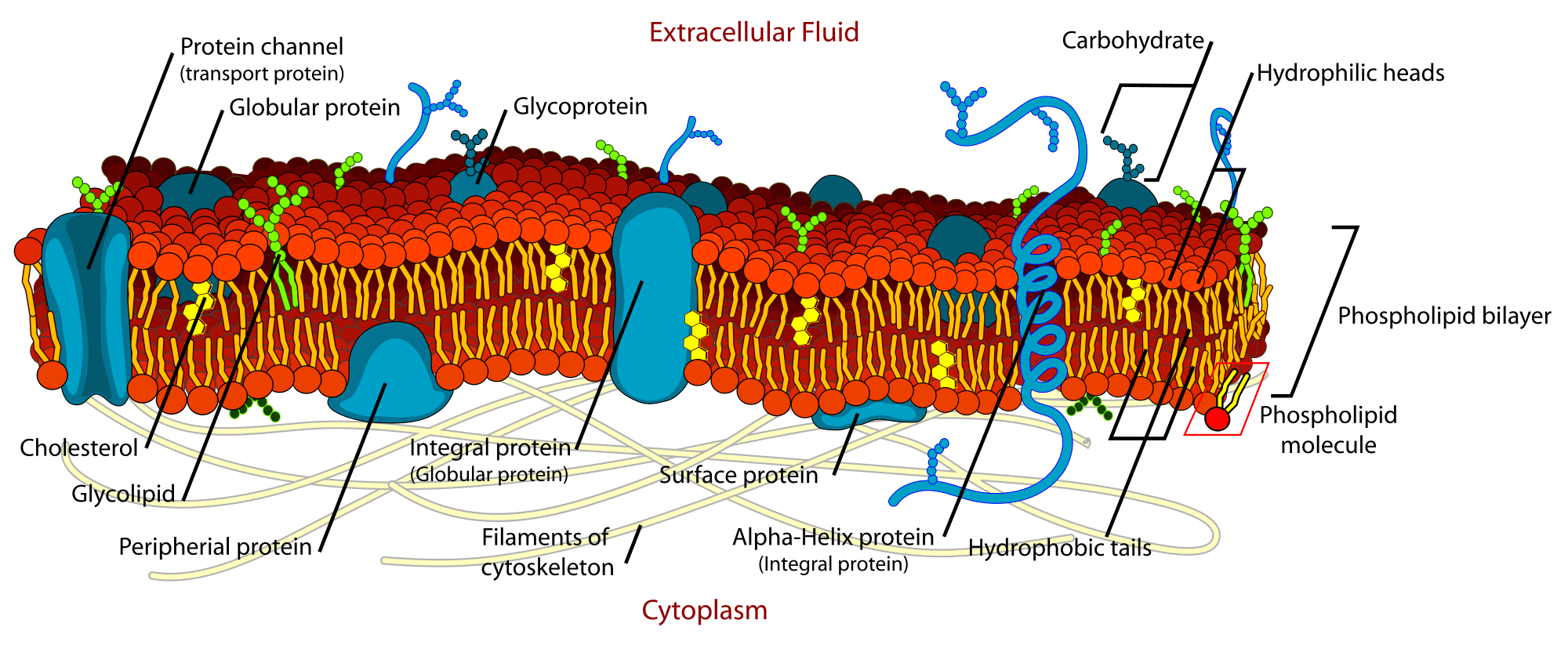
A phospholipid has 2 parts. What are they called? 
a)
Hydrophilic Head, Hydrophobic Tail 
b)
Hydrophobic Head, Hydrophilic Tail 
51.
A ______________ is composed of a phosphate and glycerol head and 2 fatty acid chain tails. 
a)
phospholipid 
b)
Carbohydrate
c)
Cholesterol 
d)
Protein 
52.
"Water Loving"
a)
Hydrophobic
b)
Hydrophilic 
c)
Hydroelectric 
d)
Hydroloric
53.
"Water Fearing" 
a)
Hydrophobic
b)
Hydrophilic 
c)
Hydroelectric 
d)
Hydroloric
54.
Describes the arrangement of the cell membrane as bendable and made of many parts. 
a)
The Fluid Mosaic Model 
b)
The Major Mobility Model 
c)
The Crazy Cell Model
d)
The Maze Model
55.
___________ allow cells to recognize each other and act like ID tags. 
a)
Carbohydrates 
b)
Proteins
c)
Phospholipids 
d)
Cholesterol
56.
___________ strengthens and stabilizes the cell membrane.
a)
Carbohydrates 
b)
Proteins 
c)
Phospholipids 
d)
Cholesterol
57.
___________ form the two layers of the cell membrane. 
a)
Carbohydrates 
b)
Proteins 
c)
Phospholipids 
d)
Cholesterol
58.
It forms a boundary between the inside of the cell and the outside of the cell. 
a)
Cell Membrane
b)
Lipid Cleric Layer
c)
Membrane Gate
d)
Protein Receptors 
59.
Something is ___________ ____________
when some molecules can cross the membrane while others cannot. 
a)
Selectively (or Semi) Permeable 
b)
Totally Transparent
c)
Liquid Licorice 
d)
Heavily Patrolled 
60.
This is a picture of which type of receptor? 
a)
Intracellular
b)
Extracellular
61.
What is this image?
a)
cell membrane
b)
proteins
c)
carbohydrates
d)
lipids
62.
The function of the plasma membrane is....
a)
to regulate what enters and leaves the cell.
b)
fight bacteria and viruses that enter the cell.
c)
provide rigid support and protection to the cell.
d)
make sure each cell can move
63.
What is NOT TRUE about the cell membrane
a)
It controls what enters and leaves the cell
b)
Semipermeable
c)
Phospholipid bilayer
d)
Contains digestive enzymes
64.
What does "bilayer" mean?
a)
one layer
b)
two layers
c)
laminated
d)
bilateral
65.
What do the brown structures represent?
a)
Phospholipids
b)
Glycoproteins
c)
Channel Proteins 
d)
Cyctoskeleton Filaments
66.
What is embedded in the phospholipid bilayer?
a)
proteins
b)
salt
c)
water
d)
trapped animals
67.
What forms the channels and pumps in the phospholipid bilayer?
a)
carbohydrates
b)
proteins
c)
hydrophilic heads 
d)
lipids
68.
Hydrophobic region of the cell membrane?
a)
E
b)
B
c)
C
d)
69.
Hydrophilic portion of cell membrane?
a)
A
b)
C
c)
D
d)
70.

What is the actual name of the S phase?

a)

Symbiosis

b)

Secondary

c)

Synthesis

d)

Simple

71.

What happens during G1?

a)

The cell grows and carries out normal functions

b)

The DNA in the cell is copied

c)

The cell grows even more

d)

The cell divides itself

72.

What happens during S?

a)

The cell grows and carries out normal functions

b)

The DNA in the cell is copied

c)

The cell grows even more

d)

The cell divides itself

73.

What happens during G2?

a)

The cell grows and carries out normal functions

b)

The DNA in the cell is copied

c)

The cell grows even more

d)

The cell divides itself

74.

What happens during M phase?

a)

The cell grows and carries out normal functions

b)

The DNA in the cell is copied

c)

The cell grows even more

d)

The cell divides itself

75.

Which 3 phases make up interphase?

a)

G1, S, & G2

b)

G1, G2, & M

c)

G2, S, & M

d)

G1, M, & G2

76.

Which of the following best represents a replicated chromosome?

a)
b)
c)
d)
77.

Which of the following best represents a sister chromatid?

a)
b)
c)
d)
78.

Which of the following is true about chromosomes and cell division?

a)

The number of chromosomes stays the same

b)

The number of chromosomes and chromatids changes

c)

The number of chromosomes changes but the number of chromatids stay the same

d)

The number of chromosomes stays the same but the number of chromatids changes

79.
Cellular reproduction in multicellular organisms occurs through the process of mitosis.  What is the purpose of mitosis?
a)

to improve old cells such as red blood cells

b)
to replace old chromosomes
c)
to form gametes (e.g. sperm and ova)
d)
to form new somatic cells
80.
Each of the animal cells shown in the diagram is in a different stage of mitosis. 
Select the cell that is currently in telophase.

a)
A
b)
C
c)
D
d)
E