wayground logo

Free Printable Worksheets

NEW

Font size

S
M
L
XL
Worksheets

Unit 3 Periodic Table Practice Test

Total questions: 55

Worksheet time: 3hrs 5mins

Name
Class
Date
1.
What atom matches this electron configuration?
1s22s22p63s23p64s23d10
a)
Zinc
b)
Copper
c)
Nickel
d)
Germanium
2.
What atom matches this electron configuration?
1s22s22p63s2
a)
Neon
b)
Magnesium
c)
Aluminum
d)
Potassium
3.
What electron configuration matches an oxygen atom?
a)

1s22s22p63s23p64s23d104p5

b)
1s22s22p4
c)
1s22s22p6
d)
1s22s22p63s23p64s23d1
4.
What is this element?
1s22s22p63s2
a)
Neon
b)
Magnesium
c)
Aluminum
d)
Potassium
5.
Which electron configuration belongs to Chlorine (Cl)?
a)
1s2s2p3s3p5
b)
1s2s2p3s3p6
c)
1s2s2p3s3p7
6.
Which electron configuration belongs to Copper (Cu)?
a)
1s2 2s2 2p6 3s2 3p6 4s2 3d8
b)
1s2 2s2 2p6 3s2 3p6 4s2 3d9
c)
1s2 2s2 2p6 3s2 3p6 4s2 3d10
7.
Identify the Electron Configuration for Aluminum (Al)
a)
1s2s2p3s3p1
b)
1s2s2p3s3p3
c)
1s2s2p3s4p1
8.
How many valence electrons are represented here?
a)
7
b)
5
c)
2
d)
8
9.
What atom matches this electron configuration?
[Xe] 6s2 4f14 5d9
a)
Mercury
b)
Gold
c)
Platinum
d)
Thallium
10.
What is the shorthand electron configuration for Sulfur atom?
a)
[Ar] 3p4
b)
[He] 3s23p4
c)
[Ne] 3s23p4
d)
[Na] 3s23p3
11.
How many valence electrons does Chlorine have?
a)
5
b)
2
c)
7
d)
5
12.
How many valence electrons does phosphorus have?
a)
5
b)
2
c)
8
d)
15
13.
What element in Period 4 has 5 valence electrons?
a)
Zr
b)
As
c)
V
d)
Sb
14.

What is the shape of a p orbital?

a)

sphere

b)

it's just too complex to think about it

c)

dumbbell

d)

clover

15.

What is the shape of an s orbital?

a)

sphere

b)

dumbbell

c)

clover

d)

TOO COMPLEX TO KNOW IT.

16.

This is a correct dot diagram for fluorine (F)

a)

true

b)

false

17.

This is a correct dot diagram for oxygen (O)

a)

true

b)

false

18.

Each row on the periodic table represents:

a)

an energy level

b)

a sublevel

c)

an electron

d)

an orbital

19.

What are valence electrons?

a)
electrons in the second energy level
b)
electrons in the outermost energy level
c)
the atomic number
d)
electrons in the first level
20.

Choose the correct shortcut configuration for iodine.

a)

[Ar]4s24d104p5

b)

[Kr]5s24d105p5

c)

[Xe]5s25d105p5

d)

none of the above

21.
This orbital diagram represents:  
a)
C
b)
B
c)
N
d)
O
22.

Rows on the periodic table are called ___________.

a)

Periods

b)

Sentences

c)

Fences

23.

The columns in the periodic table are called ___________.

a)

Towers

b)

Herds

c)

Groups

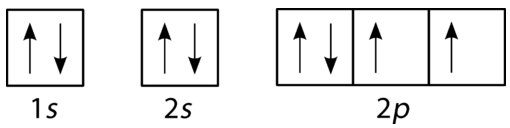
24.
What is incorrect about this orbital diagram?
a)

Both arrows should be pointing up in the same 2p orbital box.

b)
There is nothing incorrect with this diagram
c)
In the there should only be 1 orbital in the first 2p box and one in the 2nd 2p box
d)
All the arrows should be pointing up.
25.

What is the name of group number 1?

a)

halogens

b)

noble gases

c)

alkali metals

d)

alkaline earth metals

26.

What is the name of group number 2?

a)

transition metals

b)

halogens

c)

metaloids

d)

alkaline earth metals

27.

where are the metaloids found

a)

far left, vertical

b)

stair step/diagonal

c)

far right horizontal

d)

at the bottom

28.

What group number are the halogens found?

a)

18 (8A)

b)

1

c)

2

d)

17 (7A)

29.
__________ would have some characteristics of metals and some characteristics of nonmetals.
a)
Gold
b)
Sodium
c)
Arsenic
d)
Bismuth
30.

Which halogen is found in period 4?

a)

Krypton (Kr)

b)

Xenon (Xe)

c)

Bromine (Br)

d)

Iodine (I)

31.

Name this group: These metals contain familiar metals such as gold, iron, and copper.

a)
b)
c)
d)
32.

What happens to the atomic numbers as you move from left to right on the periodic table?

a)

Increase

b)

Decrease

c)

Stay the same

d)

Nothing

33.

In which group would an element that is not reactive most likely be located?

a)

1

b)

2

c)

16

d)

18

34.

In which group would an element that is very reactive most likely be located?

a)

1

b)

5

c)

15

d)

18

35.

Which of the following elements is most likely a poor conductor of electricity?

a)

Beryllium (Be)

b)

Gold (Au)

c)

Phosphorus (P)

d)

Copper (Cu)

36.

Which of the following elements is an alkali metal?

a)

calcium

b)

magnesium

c)

mercury

d)

sodium

37.

Most elements are

a)

metals.

b)

nonmetals.

c)

metalloids.

d)

semiconductors.

38.

Metals tend to be

a)

gases.

b)

dull.

c)

brittle.

d)

good conductors.

39.

Which group is very stable due to the fact that they have a full outermost energy level?

a)

alkali metals

b)

halogens

c)

alkaline-earth metals

d)

noble gases

40.
Which of the following will have a larger radius than Zinc?
a)
Gallium
b)
Aluminum
c)
Magnesium
d)
Strontium
41.
As you move down a group, atomic radius increases because - 
a)
you add more and more neutrons
b)
you add more and more protons
c)
you add more and more shells (energy levels)
d)
you add more atomic mass
42.
Which of the following will have a lower ionization energy than Scandium (Sc)?
a)
Helium (He)
b)
Titanium (Ti)
c)
Calcium (Ca)
d)
Magnesium (Mg)
43.
Electronegativity is...
a)
the ability of an atom to attract/ accept electrons
b)
the ability of an atom to lose electrons
c)
the energy required to remove an electron from a specific atom
d)
how easy it is to make friends. 
44.
Which has the greater Electronegativity: 
N or C?
a)
C
b)
N
45.
As atoms of elements in group 16 are considered in order from top to bottom, the electronegativity of each successive element....
a)
decreases
b)
increases
c)
remains the same
d)
none of the above
46.
Which of the following will have a higher electronegativity than arsenic (As)?
a)
Carbon (C)
b)
Neon (Ne)
c)
Antimony (Sb)
d)
Germanium (Ge)
47.
Ionization energy is...
a)
the energy required to add an electron to a specific atom
b)
how much energy it takes to remove an electron from an atom
c)
the energy required to shield the outer electrons from the nucleus
d)
a measure of the ability of an atom to attract electrons
48.
The atom with the largest atomic radius in Group 18 is - 
a)
Ar
b)
He
c)
Kr
d)
Rn
49.

The distance between nucleus and outermost shell occupied electron

a)

Atomic Radii

b)

Ionization Energy

c)

Electronegativity

d)

Oxidation Number

50.

Which element has bigger atomic radii?

a)

Beryllium is bigger than Fluorine

b)

Oxygen is bigger than Sulphur

c)

Litihium is bigger than Sodium

d)

Phosphorus is bigger than Bromine

51.

Which element has smaller atomic radii?

a)

Beryllium is smaller than Fluorine

b)

Sulphur is smaller than Oxygen

c)

Litihium is smaller than Sodium

d)

Potassium is smaller than Bromine

52.

Which element has higher ionization energy?

a)

Chlorine is higher than Sodium

b)

Phosphorus is higher than Nitrogen

c)

Silicon is higher than Carbon

d)

Magnesium is higher than Aluminium

53.

Which element has lower ionization energy?

a)

Chlorine is lower than Sodium

b)

Phosphorus is lower than Nitrogen

c)

Carbon is lower than Silicon

d)

Aluminium is lower than Magnesium

54.

Which element has higher electronegativity?

a)

Fluorine is higher than Oxygen

b)

Potassium is higher than Sodium

c)

Aluminium is higher than Boron

d)

Phosphorus is higher than Chlorine

55.

Which element has lower electronegativity?

a)

Fluorine is lower than Oxygen

b)

Potassium is lower than Sodium

c)

Boron is lower than Aluminium

d)

Chlorine is lower than Phosphorus