Wayground logo

Free Printable Worksheets

Font size

S
M
L
XL
Worksheets

Protein Synthesis

Total questions: 40

Worksheet time: 39mins
Name
Class
Date
1.
In RNA, Uracil pairs with ______. 
a)
cytosine
b)
adenine
c)
guanine
d)
thymine
2.
The process to go from DNA to mRNA is _______
a)
translation
b)
transcription
c)
replication
3.
In RNA, Uracil pairs with ______. 
a)
cytosine
b)
adenine
c)
guanine
d)
thymine
4.
The process to go from mRNA to a protein is called ____
a)
transcription
b)
rRNA
c)
replication
d)
translation
5.
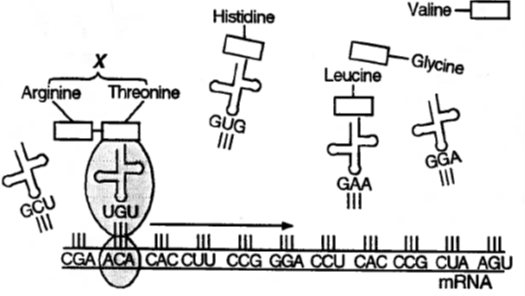
What process is going on in this photo? 
a)
Transcription 
b)
Translation 
c)
Replication 
d)
All the above 
6.
How many amino acids are coded for by this sequence of nucleotides:
ATG GGA ACT CCA
a)
4
b)
2
c)
6
d)
12
7.
What is the three base sequence of mRNA that codes for a single amino acid?
a)
Anticodon
b)
Codon
c)
Protein
8.
The mRNA leaves the ________ to find the ribosome to make proteins.
a)
cell
b)
nucleotide
c)
nucleus
9.
DNA sequence ACCTG produces which mRNA strand? 
a)
UGGAC
b)
TGGAC
c)
GTCCA
10.
Contains the bases adenine, uracil, cytosine and guanine
a)
DNA
b)
RNA
c)
Both
11.

When using your codon chart, what sequence can you use to find the correct amino acid?

a)

DNA

b)

mRNA

c)

tRNA

d)

Any of these will do

12.
The codon CCU codes for what amino acid?
a)
Isoleucine
b)
Stop
c)
Methionine
d)
Proline
13.
Which amino acid pairs with the codon AGA
a)
Thr
b)
Arg
c)
Ala
d)
Glu
14.

what does tRNA do?

a)

carry amino acids

b)

carry glucose

c)

carry lipids

d)

carry ribosomes

15.
Most gene regulation happens at which step along the way?
a)
translation
b)
transcription
c)
signal transduction
d)
DNA replication
16.
Why are insertion and deletion mutations so harmful?
a)
They change all of the codons from the mutation on down the line, which changes the amino acid sequence
b)
They insert things that an organism doesn't need.
c)
They often delete things that organisms need.
d)
Insertion and deletions are not any more harmful than substitution mutations.
17.
What is the name given to part of a DNA molecule that codes for a protein?
a)
Glucose
b)
Chromosome
c)
Gene
d)
Phosphate
18.
Which of the following statements regarding mRNA is correct?
a)
Exons are included in the protein sequence, while introns are left out
b)
Introns are included in the protein sequence, while exons are left out
c)
Exons and Introns can both be included or left out depending on the protein
d)
Exons and Introns are both part of the mRNA sequence, but only exons are part of the rRNA and tRNA
19.
Which of the following statements regarding mRNA is correct?
a)
Exons are included in the protein sequence, while introns are left out
b)
Introns are included in the protein sequence, while exons are left out
c)
Exons and Introns can both be included or left out depending on the protein
d)
Exons and Introns are both part of the mRNA sequence, but only exons are part of the rRNA and tRNA
20.
A protein that binds to the operator and blocks the RNA polymerase
a)
regulator
b)
repressor
c)
activator
d)
corepressor
21.

What is the name of the stretch of DNA where RNA polymerase binds?

a)

operator

b)

promoter

c)

enhancer

d)

regulatory gene

22.

The "on/off" switch for an operon is called the

a)

promoter

b)

enhancer

c)

operator

d)

gene

23.
A small molecule that binds to a repressor and makes it active
a)
repressor
b)
regulator
c)
activator
d)
corepressor
24.
A small molecule that binds to the repressor and makes it inactive is
a)
corepressor
b)
inducer
c)
promoter
d)
operator
25.

In order for a gene to be expressed, ___ must bind to the gene's ___, a specific sequence of nucleotides at one end of the gene, thus initiating transcription.

a)

DNA polymerase, promotor

b)

DNA polymerase, operator

c)

RNA polymerase, promotor

d)

RNA polymerase, operator

26.

Genes can be shut off (not expressed) when a ___ binds to the ____.

a)

activator, operator

b)

repressor, operator

c)

corepressor, operator

d)

repressor, promotor

27.

What mutation has occurred here?

T-G-A-C-C-A

T-G-A-G-C-A

a)

Substitution

b)

Deletion

c)

Insertion

d)

Frameshift

28.
Any change in the sequence of DNA is...
a)
transgenic shift
b)
Single Genotype
c)
Monohybrid Trait
d)
Mutation
29.

Which organelle is DNA usually found in?

a)

cell membrane

b)

vacuole

c)

chloroplast

d)

nucleus

30.

What are the building blocks of proteins called?

a)

DNA

b)

RNA

c)

Ribosomes

d)

Amino Acids

31.

ATT-TGA-GCC- Original

ATT-GAG-CC - Mutated

The example above is an example of a

a)

Insertion- Frameshift

b)

Deletion- Substitution

c)

Deletion -Frameshift

d)

All of the above

32.

Why are insertion and deletion mutations so harmful?

a)

They change all of the codons from the mutation on down the line, which changes the amino acid sequence

b)

They insert things that an organism doesn't need.

c)

They often delete things that organisms need.

d)

Insertion and deletions are not any more harmful than substitution mutations.

33.

Mutations are__________

a)

Harmful

b)

Harmful or beneficial

c)

Neutral

d)

Harmful, neutral, or beneficial

34.
DNA molecule segment is : TTACGCAAG
The mutated DNA segment is TTCGCAAG. This is an example of ___ mutation.
a)
Substitution
b)
Deletion
c)
Insertion
d)
Inversion
35.
What causes mutations?
a)
Mistakes in replication or environmental substances
b)
The amino acids
c)
Passed down by genetics
d)
It's how your born
36.

A nucleotide base is inserted or deleted shifting the entire DNA sequence. Entire protein will be changed.

a)

Substitution Mutation

b)

Silent Mutation

c)

Frameshift Mutation

d)

Translocation

37.
A type of substitution in which no  amino acids change is called 
a)
Missense
b)
Nonsense
c)
Silent
d)
Deletion
38.
This type of substitution codes for a stop codon
a)
Missense
b)
Nonsense
c)
Silent
d)
Deletion
39.
In a point mutation, this would have the worst effect on the function of the protein 
a)
an insertion or deletion near the end of a gene
b)
an insertion or deletion at the beginning of the gene
c)
an insertion at the middle of the gene
d)
a base substitution
40.
A missense mutation results from...
a)
a base substiution that causes no change in amino acid
b)
a base substitution that causes a change in one amino acid
c)
a base change that codes for a stop 
d)
a base insertion or deletion