Wayground logo

Free Printable Worksheets

Font size

S
M
L
XL
Worksheets

Quarter 2 2021

Total questions: 102

Worksheet time: 2hrs 16mins

Name
Class
Date
1.
Cell phones and televisions use this type of EM wave.  It has the longest wavelength with the lowest frequency.
a)
radio wave
b)
tv wave
c)
Gamma wave
d)
ultra violet
2.
Which portion of the electromagnetic spectrum includes the range of light that can be detected by the human eye? 
a)
ultraviolet light
b)
visible light
c)
infrared light
d)
x-rays
3.
If the wavelength of an electromagnetic wave is longer, what is true about the energy? 
a)
Energy is higher.
b)
Energy is lower. 
c)
Energy is not dependent on wavelength. 
d)
energy is cancelled out
4.
Which part of the electromagnetic spectrum has high enough energy to cause damage to eyes and skin, and sometimes even cancer? 
a)
infrared light
b)
visible light
c)
ultraviolet light
d)
microwaves
5.
Which part of the electromagnetic spectrum has high enough energy to cause damage to eyes and skin, and sometimes even cancer? 
a)
infrared light
b)
visible light
c)
ultraviolet light
d)
microwaves
6.
Which of the following electromagnetic waves is given off as heat? 
a)
ultraviolet light
b)
x-rays
c)
gamma rays
d)
infrared rays
7.
A wave with a large wavelength will have a ______ frequency and _____ energy
a)
high, low
b)
high, high
c)
low, high
d)
low, low
8.
These are the waves that are used to penetrate solids and are used to create medical images.
a)
visible light
b)
gamma rays
c)
x rays
d)
microwaves
9.
The distance between one point of a wave to the same point on the next wave.
a)
frequency
b)
wavelength
c)
amplitude
d)
crest
10.
The type of wave with the shortest wavelength and highest frequency.  This type of wave is extremely harmful.
a)
radio
b)
infrared
c)
gamma
d)
x ray
11.
The type of EM wave that is used to cook food.  It has a higher frequency than radio waves.
a)
radio
b)
microwave
c)
gamma
d)
visible light
12.
This type of EM wave has the 3rd longest wavelength. 
a)
Radio
b)
microwave
c)
x rays
d)
infrared
13.
Which type of electromagnetic radiation has the shortest wavelength?
a)
Radio Waves
b)
Visible Light
c)
Microwaves
d)
Gamma Rays
14.
Which type of radiation has a frequency closest to 105?
a)
Radio
b)
Infrared
c)
Ultraviolet
d)
X-Ray
15.
Which type of electromagnetic radiation has a wavelength near 10-8?
a)
Microwave
b)
Infrared
c)
Visible
d)
Ultraviolet
16.
Which of the following types of radiation has the shortest wavelength and the highest frequency?
a)
Radio Waves
b)
Infrared
c)
Visible
d)
X-Rays
17.
Which of the following types of electromagnetic radiation has a wavelength near 10-5?
a)
Radio
b)
Microwave
c)
Infrared
d)
Visible 
18.
What wavelength of light can the human eye perceive? 
a)
103
b)
10-6
c)
10-10
d)
1013
19.
Which type of radio wave has a larger wavelength?
a)
FM
b)
AM
20.

Which wavelength is about the size of a baseball?

a)

Radio waves

b)

Infrared

c)

Ultraviolet

d)

X-Rays

21.

Which wavelength is about the size of a typed period?

a)

Radiowaves

b)

Microwaves

c)

Ultraviolet

d)

X-Rays

22.

Which has a wavelength about the size of a water molecule?

a)

Radiowaves

b)

Microwaves

c)

Ultraviolet

d)

X-rays

23.

Which wavelengths can be the size of a soccer field?

a)

Radio waves

b)

Microwaves

c)

Infrared

d)

Ultraviolet

24.

Which wavelength can humans see?

a)

Microwaves

b)

Radio waves

c)

Visible light

d)

Gamma rays

25.

When frequency increases, __________ increases.

a)

energy

b)

wavelength

c)

strength

d)

color

26.

the most familiar type of EM wave is

a)

ultraviolet waves

b)

x-rays

c)

light

d)

microwaves

27.

24) Place the following pictures in order. THis images show the formation of our Solar System.

a)

A) D,F,C

b)

B) A,E,B,D,F,C

c)

C) D,F,C,A,E,B

d)

D) D,F,C,A,B, E

28.
What does the word accretion mean? 
a)
gradual accumulation of additional layers or matter.
b)
separating out different constituents of a planetary body
c)
gradual break down of a planet
d)
none of these
29.
A celestial cloud of dust and gas is called . . .
a)
nebula
b)
supernova
c)
accretion disc
d)
bombardment
30.
How old is our solar system?
a)
4.6 billion years
b)
13.8 billion years
c)
6,000 years
d)
15,000 years
31.
A massive explosion of a star is called . . .
a)
supernova
b)
nebula
c)
pulsar
d)
black hole
32.
What celestial body eventually evolved into our modern solar system?
a)
a nebula
b)
a supernova
c)
a quasar
d)
a galaxy
33.
Smaller particles collecting together into larger and larger objects is called . . .
a)
accretion
b)
contraction
c)
explosion
d)
rotation
34.
When you spin any mass, what shape will it likely take?
a)
Sphere
b)
Disc
c)
Cylinder
d)
Cloud
35.
The sun and all the planets and other bodies that revolve around it make up the
a)
universe
b)
galaxy
c)
solar system
d)
neighborhood
36.
Which of the following is NOT true of all the inner planets?
a)
they are made of solid rock     
b)
they are called gas giants     
c)
they have no rings     
d)
they have impact craters      
37.
Impact craters are caused by n>
a)
solar bursts
b)
atmospheric changes
c)
exploding volcanoes
d)
collisions with objects in space
38.
the planets of the solar system formed as 
a)
the center of the gas cloud cooled
b)
planetesimals flattened into a rotating disk
c)
planetesimals collided into one another
d)
the sun absorbed extra gas and dust from the solar system
39.
One of the main differences between the outer and inner planets is __________.
a)
The inner planets all have water
b)
the inner planets are much bigger than the outer planets
c)
the outer planets are gas planets
d)
the outer planets have rings, and the inner planets don't
40.
 The .................... is a natural satellite that travels around the Earth.
a)
sun
b)
star
c)
moon
d)
sky
41.
Which of these affects tides the most?
a)
Mars
b)
the Sun
c)
the stars
d)
the Moon
42.
the planets of the solar system formed as 
a)
the center of the gas cloud cooled
b)
planetesimals flattened into a rotating disk
c)
planetesimals collided into one another
d)
the sun absorbed extra gas and dust from the solar system
43.
Planets form by a process called...
a)
accretion
b)
dark matter interactions
c)
electromagnetic radiation
d)
sun-dropping
44.
The moon probably formed when...
a)
A piece of the Earth broke off due to it's fast rotation
b)
A Mars-sized object rammed into the Earth
c)
Earth captured the moon gravitationally as it attempted to pass by.
d)
the molten bubble of the Earth budded.
45.
The solar system began as a...
a)
giant molecular cloud
b)
a red giant
c)
a gas giant
d)
a sun-sized black hole
46.
What formed from the process of accretion?
a)
Hubble's telescope
b)
Black holes 
c)
Pulsars
d)
Planets
47.
The Nebular Theory is:
a)
A theory on how the Milky Way galaxy was formed
b)
A theory on how the universe was formed
c)
A theory on how the solar system will be destroyed
d)
A theory on how the solar system was formed
48.
A nebula starts to collapse because of:
a)
A nearby star shining it's light
b)
A passing spaceship
c)
A passing comet
d)
Gravity
49.
As a nebula collapses it also begins:
a)
Expand
b)
Rotate
c)
Shake
d)
Turn to ice
50.
What is forming in the accretion disk away from the center?
a)
Light
b)
Protostars
c)
Planetesimals
d)
Hydrogen
51.
The group of inner planets are known as:
a)
The Terrestrial Planets
b)
The Gas Giants
c)
The Outer Planets
d)
The Hallow Planets
52.
The group of outer planets are known as:
a)
The Terrestrial Planets
b)
The Gas Giants
c)
The Inner Planets
d)
The Rocky Planets
53.
What caused the lighter elements to leave the terrestrial planets?
a)
Gravity from the Gas Giants
b)
Nothing, the lighter elements stayed
c)
Gravity from the Sun
d)
Heat from the Sun
54.
How long ago did these nebular processes start?
a)
4.6 years ago
b)
4.6 light years ago
c)
5.6 billion years ago
d)
4.6 billion years ago
55.
Intense pressure in the protosun (protostar) caused:
a)
Fire in the Sun to start
b)
Helium to break down into Hydrogen
c)
Nuclear Fusion to start
d)
Nuclear Fusion to end
56.
What percentage of the nebula will the Sun accumulate?
a)
99%
b)
1%
c)
50%
d)
75%
57.
What two objects do scientists study to learn about the formation of the solar system?
a)
Comets & Asteroids
b)
Comets & Exoplanets
c)
Exoplanets & Asteroids
d)
Asteroids & Distant Stars
58.
A massive explosion of a star is called . . .
a)
supernova
b)
nebula
c)
pulsar
d)
black hole
59.
 The .................... is a natural satellite that travels around the Earth.
a)
sun
b)
star
c)
moon
d)
sky
60.
the planets of the solar system formed as 
a)
the center of the gas cloud cooled
b)
planetesimals flattened into a rotating disk
c)
planetesimals collided into one another
d)
the sun absorbed extra gas and dust from the solar system
61.
Nuclear fusion is the ______ of lighter elements into ________ ones.
a)
separation, heavier
b)
separation, lighter
c)
explosion, heavier
d)
combining, heavier
62.
What is a PLANET?
a)
A large object in space that orbits a star, such as the sun.
b)
A small plan that is made ahead of time
c)
An object in space
d)
A natural satellite that orbits a planet
63.
What is a MOON?
a)
Something you see in the night sky
b)
Something in space that is made of cheese
c)
a large object in space that orbits a star
d)
A natural satellite that orbits a planet
64.

The remnants of a Red Giant star after shedding its outer layers are the _______________ and ________________.

a)

Planetary Nebula and a White Dwarf

b)

Neutron Star and a Pulsar

c)

Neutron Star and a Black Hole

d)

Stellar Nebula and a Main sequence star

65.

A collection of gas and dust where new stars are born is known as a...

a)

Planetary Nebula

b)

Black Hole

c)

Supernova

d)

Stellar Nebula

66.

Most stars of lower mass are more stable, and more common in our universe. These average stars are known as...

a)

Main Sequence stars

b)

White Dwarfs

c)

Red Giants

d)

Pulsars

67.

What type of star is the Sun classified as?

a)

A red giant star

b)

A red supergiant star

c)

A neutron star

d)

A main sequence star

68.

Which category of stars are very hot, but not very bright?

a)

Blue Giants

b)

Red Giants

c)

White Dwarfs

d)

Red Supergiants

69.

Massive stars life cycles come to a close with an explosive Supernova phase which leads to which two outcomes?

a)

A black hole and a neutron star

b)

A black hole and a Red Supergiant

c)

A pulsar and a main sequence star

d)

A planetary nebula and a new planet

70.

What star phase happens when an average star expands its outer layers to increase in size and luminosity (brightness)?

a)

Neutron star

b)

White Dwarf star

c)

Red Giant star

d)

Black Hole

71.

Which phase of a star results in an explosion sending dust, gas, and radiation into space?

a)

Red Giant

b)

Supernova

c)

Black Hole

d)

White Dwarf

72.

Which of the following pieces of information are given by an H-R diagram? Check all that apply.

a)

Temperature of the star

b)

Color of the star

c)

Planets around the star

d)

Location of the star

73.

Which group of stars is not very hot, but is extremely bright?

a)

White Dwarfs

b)

Blue Giants

c)

Red Supergiants

d)

Main Sequence

74.

Which category of star is the Sun found in on an H-R Diagram?

a)

Red Giants

b)

Main Sequence

c)

Blue Giants

d)

White Dwarfs

75.

What determines the life cycle path that a star will take?

a)

Mass of the star

b)

Temperature of the star

c)

Location of the star

d)

Speed of a star's rotation

76.
In the diagram given, what happens as we move to the left?
a)
Stars Get Larger
b)
Stars get Colder
c)
Stars get Hotter
d)
Stars get Brighter
77.
Which color of star is the coolest?
a)
Yellow Star
b)
Red Star
c)
Orange Star
d)
Blue Star
78.
As a whole, Giants are considered hotter than White Dwarfs.
a)
True
b)
False
79.
Red stars are the _____________.
a)
hottest
b)
coolest
c)
biggest
d)
brightest
80.
Blue stars are the _____________.
a)
hottest
b)
coolest
c)
smallest
81.
Look at the H-R diagram. Which star is
sort of cool, dim (not too much light), and red?
a)
Betelguse
b)
Sirius B
c)
Procyon B
d)
Barnard's star
82.
What is found on the x axis of an H-R diagram?
a)
Luminosity
(or brightness)
b)
Temperature
c)
Star Size
d)
Distance
83.
Which star has the lowest temperature?
a)
A
b)
B
c)
C
d)
D
84.
Which is an example of a Main Sequence star?
a)
Betelgeuse
b)
our Sun
c)
Sirius B
d)
Polaris
85.

According to the diagram, what is the best description of the star located a position B?

a)

The hottest and brightest star

b)

The coolest and dimmest star

c)

The star is of average brightness and average temperature

d)

The star is very bright but the coolest star

86.
In the diagram given, what happens as we move to the left?
a)
Stars Get Larger
b)
Stars get Colder
c)
Stars get Hotter
d)
Stars get Brighter
87.
Which of the following refers to the change in wavelength that occurs when an object moves toward or away from a source?
a)
doppler effect
b)
chromatic aberration
c)
spectroscopy
d)
wave theory of light
88.

Simplify completely (2x2y-3)-4

a)

(2y12)/x8

b)

y12/(16x8)

c)

2x-8y12

d)

(16x8)/y12

89.
Which of the following is evidence of the Big Bang Theory?
a)
Cavemen heard a loud bang at the beginning of time.
b)
The universe isn't moving
c)
The universe is expanding
d)
The universe is getting smaller
90.

Which statement is true?

a)

The galaxies are moving toward us.

b)

The galaxies are moving away from us.

c)

The universe remains static or unchanged in motion.

d)

None of the above

91.

Light emitted from a star or galaxy can be separated into a band of colors, called a ________.

a)

Red Shift

b)

Wave Length

c)

Spectrum

d)

Microwave

92.
How old do scientists think the Universe is?
a)
13.8 billion years old
b)
4.5 billion years old
c)
24,000 years old
d)
5 years old
93.

Most scientists believe the Big Bang Theory explains which of the following questions?

a)

How our planets and moons formed

b)

How our universe began

c)

How the sun turns hydrogen into helium

d)

How fast light travels through space

94.

As galaxies move away from our galaxy

a shift on the electromagnetic spectrum

(EMS) is noticed. This phenomena is

called _____________.

a)

redshift

b)

blueshift

c)

unshift

d)

blackshift

95.
The universe is expanding!  This means that:
a)
all of the galaxies are spreading out.
b)
the universe must have started from a single point.
c)
the universe is cooling down.
d)
all of the above.
96.

Which elements are most

abundant in the visible

universe?

a)

Hydrogen and Carbon

b)

Carbon and Helium

c)

Hydrogen and Oxygen

d)

Hydrogen and Helium

97.
What is true about these two galaxies?
a)
The Sombrero Galaxy is closer to us.
b)
The Pinwheel Galaxy is moving away from us more slowly.
c)
The Pinwheel Galaxy is moving towards us.
d)
The Sombrero Galaxy is not moving.
98.
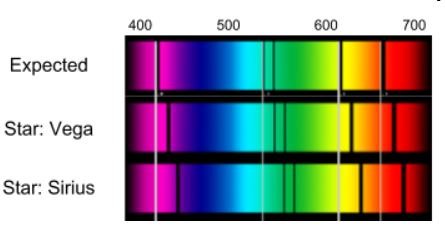
What is true about these stars?
a)
Both of these stars are moving away from us.
b)
Both of these stars are moving towards us.
c)
Both of these stars are blueshifted.
d)
The star Sirius is closer to us.
99.
The universe is expanding.  This means that:
a)
Galaxies are getting bigger.
b)
Atoms are getting bigger.
c)
The universe is creating more matter.
d)
The amount of space between galaxies is increasing.
100.
Distance measurement used by astronomers for distant objects.
a)
Kilometers
b)
Light Years
c)
Miles
d)
Light Seconds
101.

What is the Doppler Effect?

a)

A change in frequency due to the relative motion of a wave source and an observer

b)

When a wave overlaps with another wave

c)

When a wave bounces off of another object

d)

When a wave bends due to traveling through a different medium

102.

An astronomer looks at a star in the night sky. Based on his calculations the star's light is shifting towards the color blue. What does this mean about the star?

a)

It's moving towards the astronomer

b)

It's moving away from the astronomer

c)

It's not moving at all