Worksheets
Fossils
Total questions: 107
Worksheet time: 1hrs 16mins
Describes a group of living things that are no longer living.
fossil
extinct
endangered
dinosaur
The hardened remains of a living thing that died long ago.
fossil
extinct
endangered
minerals
Why are there more animal fossils than plant fossils?
Animals are smaller than plants.
Plants have harder bodies than animals.
Plans have softer bodies than animals.
Animals eat plants.
Which type of fossil would look just like the body part of a once-living thing?
mineral
footprint
cast
petrified wood
Which is an imprint fossil?
bone
a cast
an animal track
amber fossil
Describes a group of living things that are no longer living.
fossil
extinct
endangered
dinosaur
The hardened remains of a living thing that died long ago.
fossil
extinct
endangered
minerals


A solid copy of the shape of an organism is...
a fossil record
a mold
a carbon film
a cast
The gradual change in living things over time is..
transition
evolution
age
revolution
Most fossils form when living things die and are buried by _______________ that hardens into rock over time.
sediment
people
cement
ants
What type of fossils provide evidence of the activities of ancient organisms?
molds and casts
petrified fossils
trace fossils
carbon films
An organism is ______________ if it no longer exits and will never live again on Earth.
rare
extinct
plentiful
missing
What is an extremely thin coating of carbon on rock?
sediment
sap
tar
carbon film
A hollow area in sediment in the shape of an organism or part of an organism is.....
a cast
a mold
a trace fossil
a petrified fossil
A ______________________ is a scientist who studies fossils.
biologist
chemist
paleontologist
astronomer
Scientist study the ____________________ to learn about the history of life, past environments on Earth, and how different groups of organisms have changed over time.
fossil record
animal record
historical record
Earth record
A ______________________ is a scientist who studies fossils.
biologist
chemist
paleontologist
astronomer
Scientist study the ____________________ to learn about the history of life, past environments on Earth, and how different groups of organisms have changed over time.
fossil record
animal record
historical record
Earth record
Scientist study the ____________________ to learn about the history of life, past environments on Earth, and how different groups of organisms have changed over time.
fossil record
animal record
historical record
Earth record
A ______________________ is a scientist who studies fossils.
biologist
chemist
paleontologist
astronomer
Scientist study the ____________________ to learn about the history of life, past environments on Earth, and how different groups of organisms have changed over time.
fossil record
animal record
historical record
Earth record
Which of the following substances is not able to preserve entire organisms?
sticky tar
water
amber
ice
The remains of an organism studied by scientists is called a ____________.
paleontologist
fossil
dinosaur
shark
When something is _____________________ it no longer
exists.
extinct
preserved
endangered
rotting
Which is NOT a reason scientists study fossils?
They tell us how long a species existed on Earth.
To learn how organisms are related to each other.
How organisms communicated with each other.
Fossils tell scientists the types of environments that organisms lived in.
Which would be an example of a fossil?
Sedimentary Rock
Dinosaur Footprint
Oyster Pearl
Rotting Log
Which rock type would be best to find fossils?
Igneous Rock
Sedimentary Rock
Metamorphic Rock
Which type of fossil is created when an organism gets trapped in tree resin?
Trace
Mold/Imprint
Amber
Cast
Which is NOT a way an organism could become a fossil?
It can be frozen in ice.
It can be quickly buried in sediment after death.
It can be trapped in the resin of a tree.
It can be left out in the sun to decompose.
An organism should be buried quickly after it dies if it has a chance of becoming a fossil
True
False
How do scientists learn about dinosaurs?
by studying fossils
by reading about them
by watching movies
by looking at pictures
Which is NOT a step in the process an organism goes through to become a fossil?
Layers of sediment build up on the buried body.
A organism dies and is buried quickly.
Minerals fill the spaces of the decaying bone.
An organism becomes extinct.
Fossils can tell us how organisms communicated with each other.
True
False






What does petrified mean?
turned to stone
turned to fire
decompose
turned to ashes
What happens to insects when they become trapped in amber?
they form molds
they are preserved (they stay the same)
they decay
they form casts
Which statement BEST describes how the fossil bones of a dinosaur are formed?
The dinosaur stepped in wet mud.
The dinosaur was covered in sediment.
The dinosaur became trapped in amber.
The dinosaur was frozen in ice.
Which of the following is NOT an example of a fossil?
an insect stuck in amber
a petrified dinosaur bone
a seashell found on the beach
a footprint captured in mud
A paleontologist finds a fossil of a fish on top of a mountain. She can infer that the area was once ___________________________.
much cooler
underwater
much warmer
a desert
Long ago, small organisms became trapped in sticky tree sap that hardened. What is the hardened sap called?
a cast
an imprint
a mold
amber
The preserved remains of a plant or animal that lived long ago are called ____________.
soil
fossils
rocks
humus
Scientists can study fossils to learn about
the ___________.
past
present
future
none of the above

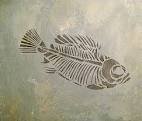
What most likely made this fossil?
Plant
Animal
Footprint
Bone

What most likely made this fossil?
Plant
Animal
Footprint
Bone
A fossil of a fish is found on top of a
mountain. You can argue that the area
was once
underwater
a desert
much colder
much warmer
Over millions of years, trees may become fossilized when they turn into_____
paper
soil
rock
water
Which is a fossil?
bone from a chicken dinner
a live plant
the preserved remains of a plant or animal that lived long ago
a piece of pottery

The body parts of this fossil tell you that this animal _________.
Flew
Hopped
Swam
Crawled

What is the correct listing of steps for a fossil?
1) Pressure created a rock.
2) Plant or animal is buried.
3) Plant or animal is left alone for years.
4) Plant or animal dies.
1) Plant or animal dies.
2) Plant or animal is left alone for years.
3) Pressure created a rock.
4) Plant or animal is buried.
1) Plant or animal dies.
2) Plant or animal is left alone for years.
3) Plant or animal is buried.
4) Pressure created a rock.
1) Plant or animal dies.
2) Plant or animal is buried.
3) Plant or animal is left alone for years.
4) Pressure created a rock.
Scientists discovered the fossilized remains of an unidentified animal. They can tell from its remains that it had gills and fins, but no legs. What conclusion about the animal can they draw from the evidence?
It was a land mammal.
It lived in the water all the time.
It had legs that did not fossilize.
It lived in the water and on land.
How did scientists first learn about dinosaurs?
by studying their fossils
by reading about them
by watching movies
by looking at pictures
What must happen to an organism's body for it to become a fossil?
It must remain above ground.
It must dry out in the sunlight.
It must be buried right after death.
It must be eaten by other animals.
Where are most fossils formed?
near volcanoes, because the high heat of the lava helps to form fossils
in glaciers, because fossils are created when an organism is frozen quickly
in sedimentary rock, because being buried in sediment helps to form fossils
near earthquakes, because the shaking ground traps organisms to create fossils
Which type of scientist studies life that existed
long ago, mostly by studying fossils?
biologist
zoologist
botanist
paleontologist

The picture shows a tooth fossil of the extinct
Megalodon shark next to teeth from a great white
shark, which is still found today.
Which of the following best explains the
difference in the size of the teeth?
Sharks were once larger than the sharks that are living today.
The fossilized tooth was filled with water, which made it grow in size.
Sharks alive today do not live long enough to grow very large teeth..
The fossilized tooth had extra sediment around it, which became a part of it

Which feature helps the most to identify the organism as a plant?
size
color
smell
shape

Which property of the leaf can be learned from
the fossil?
the size of the leaf
the color of the leaf
how fast the leaf grew
which animals ate the leaf

What is the best explanation for the location of the fossil?
This kind of fish was often eaten by land animals.
This kind of fish had once lived on land.
The area used to be filled with water.
The area used to be very cold.

The organism represented in this fossil
fed mostly on fish and algae.
moved by using many tiny legs.
lived in an environment that required a hard shell for protection.
had an internal skeleton that was used to maintain the organism's shape.