wayground logo

Free Printable Worksheets

Font size

S
M
L
XL
Worksheets

Midterm Review

Total questions: 105

Worksheet time: 2hrs 28mins

Name
Class
Date
1.
The changes to water when it cycles the earth is called
a)
the moon cycle
b)
the sun cycle
c)
the water cycle
d)
the wind cycle
2.
When water vapor s cooled and forms droplets-
a)
Condensation
b)
Evaportation
c)
Transpiration
d)
Run-off
3.
Forms of precipitation are-
a)
only sleet and snow
b)
rain, sleet, hail, and snow
c)
only dew and rain 
d)
only snow and rain
4.
Water in lakes and rivers that does not contain salt-
a)
recycled water
b)
new water
c)
salt water
d)
fresh water
5.
What is it called when plants give off water vapor as a waste product?
a)
condensation
b)
evaporation
c)
sublimation
d)
transpiration
6.
What is precipitation?
a)
The part of the water cycle when the sun heats up water, turning it from a liquid into water vapor or steam. It rises from the ground into the air.
b)
The part of the water cycle when the water vapor in the air gets cold. The water turns back into a liquid and forms clouds.
c)
The part of the water cycle when clouds get heavy and can no longer hold the liquid water. This causes the water to fall from the sky to the earth as rain, snow, sleet, or hail.
7.
On which kind of day would you expect the most evaporation from the surface of a pond?
a)
cold, rainy
b)
cold, sunny
c)
warm, rainy
d)
warm, sunny
8.
What is water vapor?
a)
Water on the land (geosphere)
b)
Water in the air (atmosphere)
c)
Water in plants
d)
Water in the water (hydrosphere)
9.
Which of these is not an example of precipitation?
a)
rain
b)
clouds
c)
sleet
d)
snow
10.

What is the role of the sun in the water cycle?

a)

provide heat energy for evaporation

b)

provide heat energy for condensation

c)

dry out the soil for runoff to occur

d)

provide thermal energy for accumulation

11.
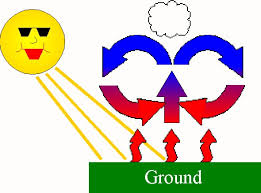
What part of the water cycle does this picture show?
a)
condensation
b)
precipitation
c)
evaporation
12.
When water _________, dew forms.
a)
Melts
b)
Evaporates
c)
Condenses
d)
Precipitates
13.
What is the primary source of energy that generates most ocean waves?
a)
earthquakes
b)
wind
c)
asteriods falling in the ocean
d)
volcanic eruptions
14.
Stronger winds create __________ waves.
a)
larger
b)
smaller
15.
A wave can make a leaf bob up and down on the water, but it cannot move the leaf toward the shore. This is because waves only transfer ________
a)
A. matter  
b)
B. energy  
c)
C. media 
d)
D. crests
16.
Ocean water is more dense than fresh water at the same temperature due to differences in:  
a)
Wind patterns
b)
 Lifeforms
c)
Currents
d)
Salinity
17.
Which of the following is caused by differences in ocean water density?
a)
surface currents
b)
 deep currents
c)
waves
d)
Coriolis effect
18.

Which body has the greater effect on Earth's tides?

a)

Sun

b)

Saturn

c)

Moon

d)

Venus

19.
What is a difference between spring and neap tides?
a)
Spring tides occur when the earth and sun are IN LINE with the new or full moon. 
b)
Spring tides occur when moon in 3rd or 1st quarter phases
c)
Spring tides are LOWER than neap tides
20.
Wha type of tide would this arrangement of earth-moon-sun create?
a)
full moon tide
b)
new moon tide
c)
neap tide
d)
spring tide
21.
What type of tides would this arrangement of earth-moon-sun create?
a)
neap tide
b)
spring tide
c)
new moon tide
d)
full moon tide
22.
What are tides?
a)
More water filling up the ocean
b)
The rising and falling of the water on the earth surface
c)
Jupiter orbiting the moon
d)
Waves in the oceans 
23.
As we go deeper into the ocean, salinity ___________. 
a)
Doubles
b)
Decreases 
c)
Increases
d)
Remains the same 
24.
Why do we need to conserve water?
a)
It is an unlimited resource. 
b)
It is a limited resource. 
c)
There is a lot of water. 
d)
There is no need to conserve water.
25.
Which of the following is a way to conserve water?
a)
Turn the faucet off when you brush your teeth.
b)
Water the lawn during the day.
c)
Let leaky faucets drip.
d)
Take baths instead of showers.
26.
Which of the following is an example of conserving (using less of a resource)?
a)
Collect water from warming up the shower to water plants.
b)
Recycle your plastics, glass, and metals.
c)
Shorten your showers by 1 minute.
d)
Reuse sink water to wash the car tires.
27.

Which most often occurs when a pot of water boils?

a)

Condensation

b)

freezing

c)

melting

d)

evaporation

28.

Which shows an example of convection?

a)

Jose cooks an egg in a pot of boiling water.

b)

Clara burns her hand by touching a light bulb.

c)

Lucy wraps herself in an electric blanket to keep warm.

d)

Ben holds the end of a metal rod in a fire to cook hot dogs.

29.

Which is an example of radiated heat for cooking?

a)

cooking a pot of soup

b)

scrambling eggs on the stove

c)

grilling hot dogs over a campfire

d)

frying hamburgers in a frying pan

30.

Which is an example of radiation?

a)

boiling a pot of noodles for dinner

b)

getting hot from lying in the sun

c)

feeling warm while taking a shower

d)

burning yourself after touching a hot plate

31.

Which is the best example of conduction?

a)

boiling a pot of water

b)

feeling heat from a fireplace

c)

a hot air balloon rising and falling

d)

touching a hot handle and getting burned

32.

Which best describes the transfer of heat due to the movement of gases and liquids?

a)

radiation

b)

convection

c)

evaporation

d)

condensation

33.

Which is an example of heat being transferred by conduction?

a)

a furnace heating the air in a school

b)

an ice cube melting in a person's hand

c)

a pot of water on a stove boiling

d)

the sun heating water in a swimming pool

34.

How does heat energy from the Sun reach Earth?

a)

radiation

b)

solar wind

c)

conduction

d)

convection

35.

Sarah is stirring her hot chocolate with a metal spoon, and she notices that the spoon is getting hot. This is most likely caused by which type of heat?

a)

conduction

b)

convection

c)

radiation

d)

insulation

36.
What kind of heat transfer happens when the sun heats your body?
a)
Conduction
b)
Radiation
c)
Convection
d)
Density
37.
Warm air rises and the cool air sinks demonstrates this type of heat transfer. 
a)
conduction
b)
convection
c)
radiation
d)
Insolation 
38.
When you iron a shirt, the shirt gets warm.  This type of heat transfer is an example of
a)
condensation
b)
conduction
c)
convection
d)
radiation
39.
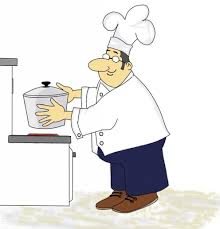
The man takes the hot pot off the stove with his bare hands and his hands get burned.  This is an example of 
a)
conduction
b)
convection
c)
radiation
40.
What is the definition of CONDUCTION?
a)
When heat is transferred from objects like rays of light or electromagnetically.
b)
a  hot liquid or air that  expands, becomes less dense, and rises or becomes more dense, and sinks.
c)
When heat transfers from objects that are touching.
d)
When heat transfers through the heater or AC in your house.
41.
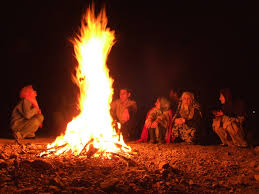
A group of friends gather around a fire to stay warm.  This is an example of
a)
conduction
b)
convection
c)
radiation
42.
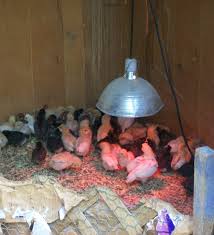
The baby chickens are kept warm from the heat lamps. This demonstrates what kind of heat transfer? 
a)
conduction
b)
convection
c)
radiation
43.
The transfer of heat by currents through liquids of gases is called
a)
Perspiration
b)
Radiation
c)
Conduction
d)
Convection
44.
A metal spoon heated by hot soup.  This is an example of
a)
Conduction
b)
Transpiration
c)
Convection
d)
Radiation
45.
You lay on a hot rock and keep warm from the rock by
a)
conduction
b)
convection
c)
radiation
46.
A huge rock at the state park gets hot during the day. The rock was warmed from the Sun by
a)
conduction
b)
convection
c)
radiation
47.
Cold air sinks.  True or false? 
a)
true
b)
false
48.
A front is
a)
where warm air is cooling at earth's surface
b)
a line where hot and cold air are separating
c)
a line where two different air masses meet
d)
where cold air is rising and forming rain clouds
49.
If an air mass is rising, it must be
a)
cold and less dense
b)
cold and more dense
c)
warm and more dense
d)
warm and less dense
50.
If an air mass is sinking, it must be
a)
cold and less dense
b)
cold and more dense
c)
warm and more dense
d)
warm and less dense
51.
When a cold front or a warm front stays in place for several days without invading another front, it is called a ______. 
a)
stationary front 
b)
 cold front 
c)
occluded front
d)
warm front 
52.
This is the symbol for which type of front?
a)
cold front
b)
warm front
c)
stationary front
d)
occluded front
53.
What does this symbol on a weather map indicate? 
a)
High pressure system
b)
Low pressure system
c)
Cold Front
d)
Warm Front
54.
Winds are caused by differences in 
a)
precipitation
b)
humidity
c)
air pressure
d)
turbulance
55.
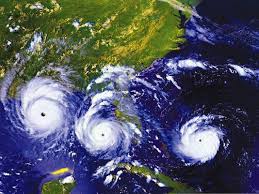
What storm is a funnel shaped cloud?
a)
tornado
b)
hurricane
c)
thunderstorm
56.
Which storm forms over water?
a)
tornado
b)
hurricane
c)
thunderstorm
57.
During a ___________, lightning is common, which can cause fires!
a)
thunderstorm
b)
hurricane
c)
tornado
58.
which stage of the water cycle do clouds form?
a)
evaporation
b)
condensation
c)
cloudation
59.
Hurricanes form near areas close to the equator. Why? 
a)
Solar heating is greatest near the equator.
b)
The Moon's plane of orbit is close to the equator.
c)
Earth's volcanic activity is clustered around the equator.
d)
the rate of rotation of Earth's surface is less at the equator.
60.
How do the conditions for a tornado differ from the conditions for a hurricane?
a)
Tornadoes never form when there is rain, while hurricanes always form with rain.
b)
Tornadoes form under low pressure, while hurricanes form under high pressure
c)
Tornadoes form in a stable atmosphere, while hurricanes form in an unstable atmosphere 
d)
Tornadoes form over land, while hurricanes form over bodies of water
61.

Where are hurricanes formed?

a)

On cold water

b)

On Warm water

c)

Anywhere near the ocean

d)

In the clouds

62.

Where are hurricanes most common

a)

North

b)

South

c)

Near the Equator

d)

East

63.

What is a seamount?

a)

Continuous underwater mountain range

b)

A geyser on the ocean floor

c)

At the edge of the shelf, the ocean floor drops down an incline

d)

Underwater, inactive volcanic mountains

64.

What is a trench?

a)

Gently sloping, shallow area

b)

A deep, steep-sided canyon at a subduction zone

c)

A smooth and flat area on the ocean floor

d)

At the edge of the shelf, the ocean floor drops down an incline

65.

What is the Mid-Ocean Ridge?

a)

Continuous underwater mountain range

b)

A geyser on the ocean floor

c)

Mountains that reach the ocean surface

d)

Underwater, inactive volcanoes

66.

What is an abyssal plain?

a)

A smooth, flat area on the ocean

b)

Mountains that reach the ocean surface

c)

Gently sloping, shallow area

d)

At the edge of the shelf, the ocean floor drops down an incline

67.

What is a continental shelf?

a)

Gently sloping, shallow area

b)

Underwater, inactive volcanic mountains

c)

A smooth, flat area on the ocean floor

d)

A geyser on the ocean floor

68.

What is a continental slope?

a)

A gently sloping, shallow area

b)

A continuous underwater mountain range

c)

At the edge of the shelf, the ocean floor drops down an incline

d)

Underwater, inactive volcanic mountains

69.
If you are walking into the ocean you would be on the continental...
a)
shelf
b)
slope
c)
rise
70.

What is the difference between a volcanic island & a seamount?

a)

A volcanic island rises above the surface of the water & a seamount does not

b)

A seamount rises above the surface of the water & a volcanic island does not

c)

Both the seamount & volcanic island are underwater

d)

Both the seamount & the volcanic island rise above the water

71.

Oceans cover about ______ of the surface of the earth.

a)

60%

b)

70%

c)

80%

d)

90%

72.
The total amount of dissolved salts in a sample of water is its
a)
strength
b)
salinity
c)
pressure
d)
effect
73.

Water that is colder is _______________ dense than warmer water.

a)

more

b)

less

74.

The amount of Earth's water that is salt water is:

a)

1%

b)

3%

c)

70%

d)

97%

75.

What happens to density as salinity increases?

a)

Density decreases

b)

Density increases

c)

Density stays the same

76.

Which type of ocean movement is a large-scale pattern that can circulate across all the oceans?

a)

Current

b)

Wave

c)

Tide

77.

Which type of ocean movement is a repeated up and down motion, generally caused by wind?

a)

Current

b)

Wave

c)

Tide

78.

Which type of ocean movement can be described as the rise and fall of sea level, mostly due to the gravitational influence of the moon?

a)

Current

b)

Wave

c)

Tide

79.

Which type of ocean movement can be caused by wind or differences in density and can also be diverted by the Coriolis effect?

a)

Current

b)

Wave

c)

Tide

80.

Which type of tides happen twice every day in most places?

a)

High/Low

b)

Spring

c)

Neap

81.

Which type of tides have a larger tidal range due to the Earth, Moon, and Sun forming a line?

a)

High/Low

b)

Spring

c)

Neap

82.

A tsunami is a large __________ typically caused by a shallow seafloor earthquake.

a)

Current

b)

Wave

c)

Tide

83.

What 2 factors largely impact the density of ocean water?

a)

Density and Pressure

b)

Temperature and Coriolis Effect

c)

Temperature and Salinity

d)

Pressure and Salinity

84.
A _____________ tide occurs when the moon, sun, and Earth are aligned.  This is a period of the highest high tides and lowest low tides.
a)
neap
b)
spring
c)
slack water
d)
ebb
85.
Tides are caused by __________.
a)
wind
b)
density differences
c)
gravity
d)
salinity differences
86.
What are ocean tides?
a)
Long waves due to the gravitational pull of the moon only.
b)
Long period waves caused by wind.
c)
Short period waves caused by wind. 
d)
Long waves due to the gravitational pull between the Earth,sun and the moon
87.

What is a high tide?

a)

Sea pulled TOWARD the moon where Earth is CLOSEST to the moon

b)

Sea pulled AWAY from the moon where Earth is FARTHEST to the moon

c)

Sea pulled AWAY from the moon where Earth is CLOSEST to the moon

88.
Which body has the greater effect on Earth's tides?
a)
Sun
b)
Saturn
c)
Moon 
d)
Venus
89.
When the moon is at full moon or new moon, what type of tide will we experience?
a)
rip tide
b)
spring tide
c)
neap tide
d)
breaker tide
90.
What happens when there is a spring tide
a)
high tides 
b)
really high tides
c)
low tides
91.

What is severe weather?

a)

Dangerous acts of weather that puts animals, people, or buildings at risk.

b)

Bad weather like a rainstorm

c)

Weather caused by the water cycle that is dangerous

d)

Deadly weather that happens every single day

92.
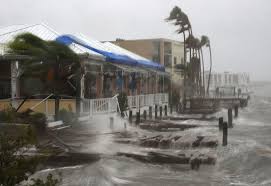
A severe storm that involves high winds and forms over water is:
a)
tornado
b)
thunderstorm
c)
hurricane
d)
blizzard
93.

Hurricanes begin to form when water temperature is???

a)

80 degrees F

b)

50 degrees F

c)

100 degrees F

94.

Which is necessary for a Hurricane to get stronger?

a)

Warm ocean water

b)

Wind

c)

water at 80 degrees F

d)

ALL of the above

95.

What can cause a Hurricane to get weak?

a)

Cooler Air/Water

b)

Reaching land

c)

Both

96.

Where do Hurricanes form?

a)

NEAR the Equator

b)

Away from the Equator

c)

NEAR the North/South Poles

97.

Hurricanes develop in ________ regions.

a)

Arctic/Polar

b)

Tropical

98.

Where do hurricanes form?

a)

In the warm waters of the Atlantic Ocean near the equator

b)

In the cool waters of the North Sea

99.

What happens as a hurricane moves further in-land?

a)

It speeds up and gets stronger

b)

It turns around and goes back to sea

c)

It slows down and gets weaker

100.

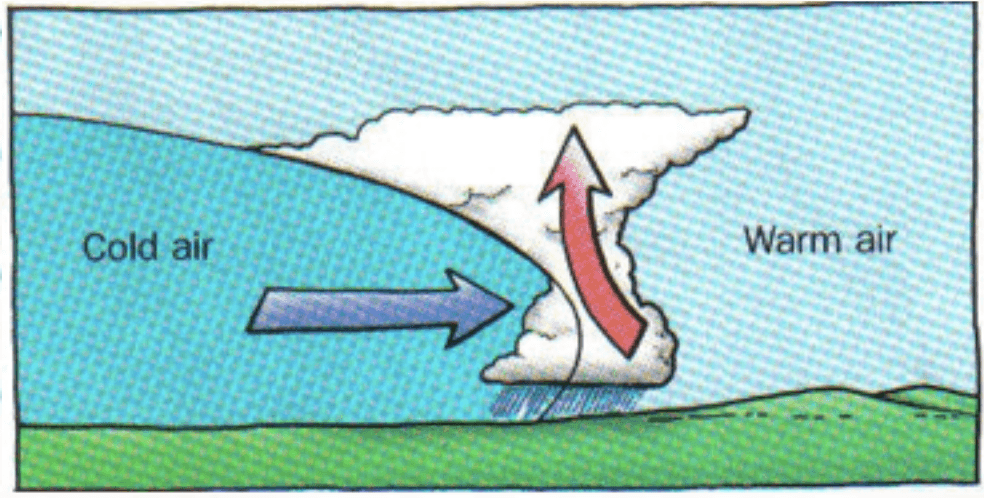
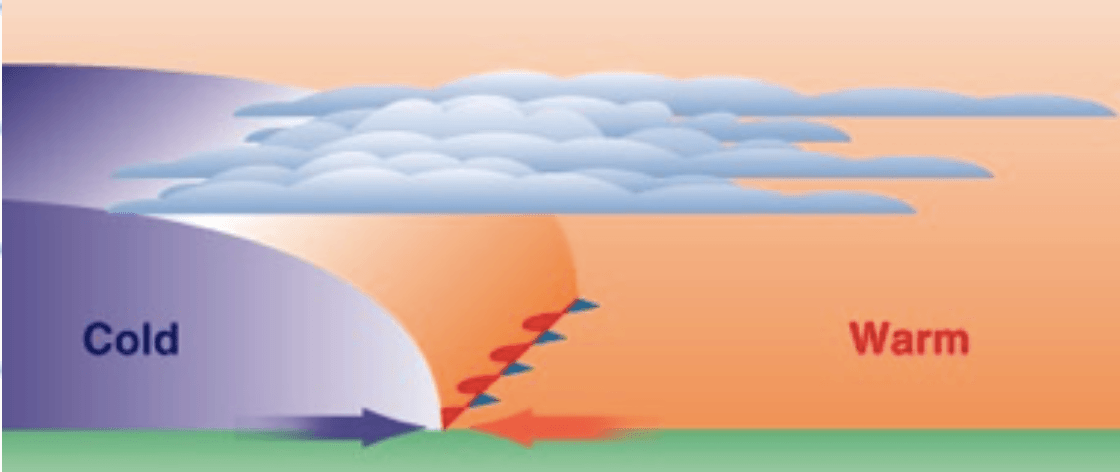
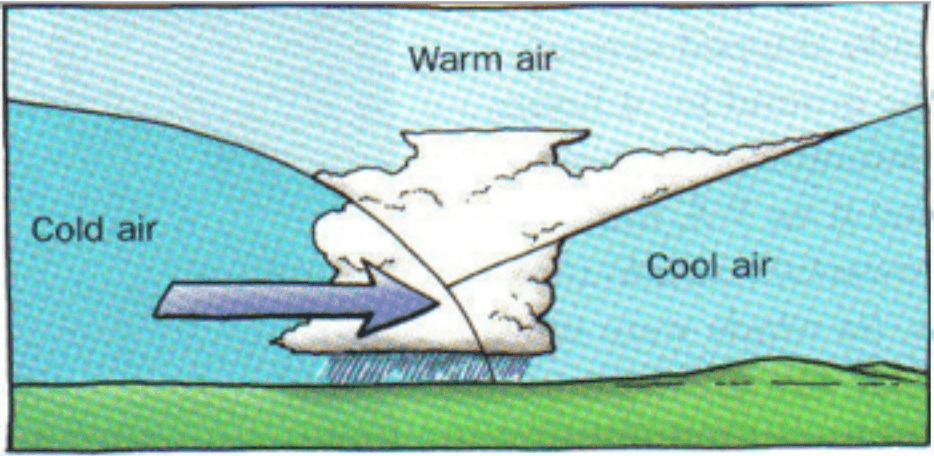
Name that front.

a)

Cold Front

b)

Warm Front

c)

Stationary Front

d)

Occluded Front

101.

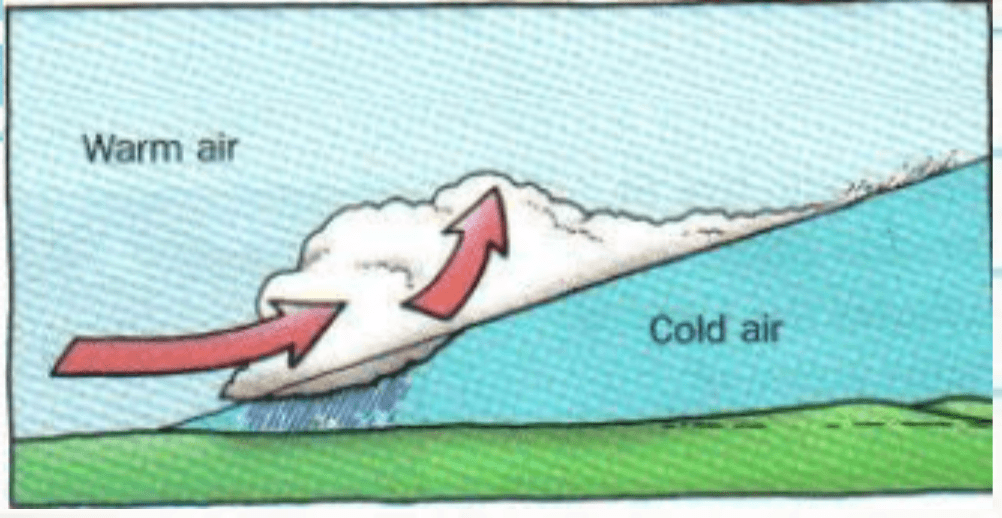
Name that front.

a)

Cold Front

b)

Warm Front

c)

Stationary Front

d)

Occluded Front

102.

Name that front.

a)

Cold Front

b)

Warm Front

c)

Stationary Front

d)

Occluded Front

103.

Name that front.

a)

Cold Front

b)

Warm Front

c)

Stationary Front

d)

Occluded Front

104.

Name that symbol.

a)

Cold Front

b)

Warm Front

c)

Stationary Front

d)

Occluded Front

105.

Temperature drops quickly. Strong winds, heavy precipitation.

a)

Cold Front

b)

Warm Front

c)

Stationary Front

d)

Occluded Front