
 Worksheets
Interim Review
Total questions: 72
Worksheet time: 2hrs 17mins


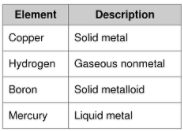
Use the table.
An unknown substance is a semi-conductor and is very brittle. This unknown substance could be which of the following elements form the table?
Copper
Mercury
Boron
Hydrogen
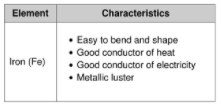
Iron (Fe) is most likely a
nonmetal
gas
metal
metalloid





Scientists use many ___________ to find weather patterns and forecast how weather will change.
tools
books
What instrument is used to measure temperature?
Thermometer
Rain Gauge
Wind Sock
What instrument is used to measure temperature?
Thermometer
Rain Gauge
Wind Sock

What does the following weather symbol represent?
Sunny with clear skies
Partly cloudy
Overcast

What does the following weather symbol represent?
Sunny with clear skies
Partly cloudy
Overcast

What does this image represent?
sunny
Thunderstorms
Rain
Partly cloudy

Is wind a biotic or abiotic factor?
biotic
abiotic

Is soil a biotic or abiotic factor?
biotic
abiotic

Are rocks biotic or abiotic factors?
biotic
abiotic

Is pH a biotic or abiotic factor?
biotic
abiotic

Is precipitation a biotic or abiotic factor?
biotic
abiotic

Is competition within a species a biotic or abiotic factor?
biotic
abiotic

Is disease a biotic or abiotic factor?
biotic
abiotic

Is predation a biotic or abiotic factor?
biotic
abiotic


The atomic number identifies the number of __________.
electrons
atoms
protons
neutrons
Subatomic particles that have a negative charge
electrons
protons
quarks
neutrons

The number 16 for the atomic element sulfur is the
ionic number
isotope
atomic mass
atomic number

How many protons does sulfur have?
32
16
48
12
The name of this particle means indivisible and it is the building block of matter
molecule
compound
atom
isotope
Subatomic particle that has a positive charge
electron
poitron
neutron
proton
The center of an atom is called the ________________.
electron cloud
nucleus
neutrion
nuetron
In what part of an atom can the protons and neutrons be found?
nucleus
neutrine
electron cloud
proton cloud
Which parts of the atom move around the nucleus?
electrons
protons
electrode particles
neutrons

