
NEW
Font size
S
M
L
XL
 Worksheets
ENV SCI Chapter 8- Populations
Total questions: 35
Worksheet time: 21mins
Name
Class
Date
1.
Density, distribution, and growth rate are characteristics used to classify which one of the following?
a)
Biomes
b)
Populations
c)
Limiting Factors
d)
Age Structure
2.
Which of the following involves a situation in which a density-dependent factor influences a population?
a)
Several seasons passed during which rainfall was ample, winters were not severe and food for snow hares was in good supply.
b)
A hurricane severely disrupted a salt marsh and uprooted most of the marsh grass in an estuary.
c)
A forest fire on the north side of a mountain forced the white-tailed deer from the north side to move into the range of the white-tailed deer on the south side of the mountain, making food more scarce.
d)
After a heavy rain, pesticides that were applied to a cotton crop to control weevils ran off into a waterway that flows next to a field.
3.
American bison, which are large grazing mammals, are most often found clumped in small groups. What might you infer about the spatial distribution of American bison?
a)
A clumped group provides better protection from predators.
b)
A clumped group attracts more prey.
c)
A clumped group can graze a larger area.
d)
A clumped group takes better advantage of water resources.
4.
Which of the following statements is correct?
a)
Population size of predators increases when their prey is scarce.
b)
Competition for resources is density-independent when food is plentiful.
c)
Disease is density-dependent because transmission occurs more easily when a population is large.
d)
A change in average temperature is a density-dependent factor because fewer organisms can acclimate to variations in temperature.
5.
To assess a population’s growth rate, an ecologist must know how many individuals are born, how many died, and how many move away in a given period of time. What else must an ecologist know?
a)
how many individuals find mates
b)
how many individuals move in from somewhere else
c)
how many individuals carry communicable diseases
d)
how many individuals are young or old
6.
A population’s ____________________ is the amount that a population’s size changes in a given period of time.
a)
Carrying Capacity
b)
Limiting Factor
c)
Growth Rate
d)
Biome
7.
The size of a population will decrease if mortality ____________________.
a)
Increases
b)
Decreases
c)
Stays the same
8.
Which symbols best describe mutualism?
a)
+,+
b)
+,-
c)
+,0
d)
-,0
9.
Which symbols best describe parasitism?
a)
+,+
b)
+,-
c)
+,0
d)
-,0
10.
Which symbols best describe commensalism?
a)
+,+
b)
+,-
c)
+,0
d)
0,0
11.
A tick and a dog have this type of relationship.
a)
mutualism
b)
commensalism
c)
neutralism
d)
parasitism
12.
Cattle egrets are birds that forage in fields among cattle. The egrets get easy access to food and the cattle don't care if they are there or not.
a)
mutualism
b)
commensalism
c)
competition
d)
parasitism
13.
Red-billed oxpeckers are birds that feed on parasites found on an impala. The impala gets rid of parasites and the red-billed oxpeckers get a yummy dinner. This is an example of _______.
a)
commensalism
b)
mutualism
c)
neutralism
d)
competition
14.
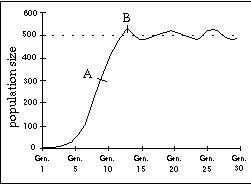
What is the carrying capacity of the graph?
a)
around 500
b)
more than 500
c)
less than 500
d)
around 600
15.
The approximate population of the world today is..
a)
7.6 Million
b)
6.7 Billion
c)
6.7 Million
d)
7.6 Billion
16.
What is the world's most populous country?
a)
India
b)
China
c)
U.S.
d)
Mexico
17.
Which of the following is the world's fastest growing country?
a)
India
b)
China
c)
U.S.
d)
Mexico
18.
One reason the world is growing so quickly is because...
a)
The world has infinite resources for everyone
b)
Birth rate is higher than death rate
c)
There are more and more places for people to live
d)
Death rate is higher than birth rate
19.
The average number of people per square mile is...
a)
Birth rate
b)
Land area
c)
Population density
d)
too many
20.

This population pyramid shows...
a)
Rapid growth
b)
Slow growth
c)
Negative growth
21.
Which of the following involves a situation in which a density-dependent factor influences a population?
a)
Several seasons passed during which rainfall was ample, winters were not severe and food for snow hares was in good supply.
b)
A hurricane severely disrupted a salt marsh and uprooted most of the marsh grass in an estuary.
c)
A forest fire on the north side of a mountain forced the white-tailed deer from the north side to move into the range of the white-tailed deer on the south side of the mountain, making food more scarce.
d)
After a heavy rain, pesticides that were applied to a cotton crop to control weevils ran off into a waterway that flows next to a field.
22.
On ten acres of native forest there are eight white-tailed deer, seven coyotes, 45 armadillos, and 231 loblolly pine trees. Which population has the highest density?
a)
white-tailed deer
b)
coyotes
c)
armadillos
d)
loblolly pine trees
23.
American bison, which are large grazing mammals, are most often found clumped in small groups. What might you infer about the spatial distribution of American bison?
a)
A clumped group provides better protection from predators.
b)
A clumped group attracts more prey.
c)
A clumped group can graze a larger area.
d)
A clumped group takes better advantage of water resources.
24.
A previously rapidly growing population of green tree frogs in the city park has suddenly leveled off, and is presently neither increasing or decreasing in numbers. You can probably infer that the tree frog population has reached its ____________________ _________________________.
a)
Limiting Factor
b)
Carrying Capacity
c)
Population Total
d)
Nap Time
25.
Complete:________ ________ – death rate + immigration rate – emigration rate = growth rate
a)
Growth Rate
b)
Birth Rate
c)
Capacity Rate
d)
Tax Rate
26.

What decreases the size of a population
a)
immigration
b)
emigration
27.

A mite lives in the base of the eyelashes of people who use mascara. It feeds on the mascara; it does not seem to harm people. What type of symbiotic relationship is this?
a)
mutualism
b)
commensalism
c)
parasitism
d)
predation
28.

A coyote captures, kills, and eats a rabbit. What type of symbiotic relationship is this?
a)
mutualism
b)
commensalism
c)
parasitism
d)
predation
29.

A tapeworm lives in the intestines of a dog. It absorbs food the dog has eaten and grows larger in the process. The dog becomes weaker from malnutrition. What type of symbiotic relationship is this?
a)
mutualism
b)
commensalism
c)
parasitism
d)
predation
30.

The flower of the yucca plant provides the only location where the yucca moth can lay her eggs. In the process, the moth pollinates the yucca flower. What type of symbiotic relationship is this?
a)
mutualism
b)
commensalism
c)
parasitism
d)
predation
31.

Cleaner shrimp living in the ocean eat ectoparasites (parasites on the outer surface of the animal) off of fish. What type of symbiotic relationship is this?
a)
mutualism
b)
commensalism
c)
parasitism
d)
predation
32.

Bacteria that live on the surface of our teeth require sugar from our food to survive. A by-product of their metabolism (body processes) decays the enamel of teeth. What type of symbiotic relationship is this?
a)
mutualism
b)
commensalism
c)
parasitism
d)
predation
33.

Bass found in warm water lakes of Colorado eat gizzard shad, a small fish grown and raised by the Colorado Division of Wildlife. What type of symbiotic relationship is this?
a)
mutualism
b)
commensalism
c)
parasitism
d)
predation
34.

NItrogen-fixing bacteria live in the roots of some plants. They provide nitrogen in a form the plants need and obtain a "home" and nourishment from the plants. What type of symbiotic relationship is this?
a)
mutualism
b)
commensalism
c)
parasitism
d)
predation
35.

Nematodes (a round worm) live in plants and gain nourisment from the plant but do not seem to harm it. What type of symbiotic relationship is this?
a)
mutualism
b)
commensalism
c)
parasitism
d)
predation
Reset

