
 Worksheets
Cellular Processes Past exams
Total questions: 89
Worksheet time: 47mins
The plasma membrane of a cell is a phospholipid bilayer. What portion of the phospholipid is on the outer surface of the cell?
the hydrophobic portion
the alpha-helical portion
the hydrophilic portion
the delta loop portion
Which of the following is NOT true about an enzyme
they are consumed in the reaction
they catalyze a reaction
they lower the energy activation
all of these are truw
Which of the following CANNOT be determined from a Michaelis-Menten plot?
the VMax
the Km
the effective substrate concentration range
all of these can be determined
Sam makes an inhibitor drug that binds the enzyme in the same pocket as the precursor protein. What kind of inhibitor is the drug?
Non-competitive
competitive
isotopic
none of these
Bri told us a news story about nerve cell repair. What was the reagent used for repair?
a nanobot that responded to a magnet
a new enzyme configuration
an upregulated gene using CRISPR
An amino acid-based drug
sophia's news story revealed that scientists have found a gene product that is more prevalent in cancer cells with ruptured cell nuclei. What gene product did she mention?
Trex-1
TRAP-2
Trbl-5
mTOR-3
Which category of enzymes can be described as joining two molecules together with covalent bonds?
Ligases
Isomerases
Lyases
Transferases
What type of enzyme is responsible for phosphorylation?
phosphatases
kinases
oxidoreductases
phosphodiesterases
Hydrolysis of GTP can act as an important molecular switch. Which is NOT true about how this switch works?
GTP binds to a protein
GTP is hydrolyzed to make GDP
bound GDP is phosphorylated to make GTP
GDP leaves the protein
Which of the following can get through the phospholipid bilayer without the aid of a transport protein?
amino acids
CO2
NA+
glucose
Which movement of a phospholipid takes the most energy?
lateral diffusion
flip-flop
rotation
flexion
Which of these is a technique that can prove that membrane proteins move within the phospholipid bilayer?
ultracentrifuge
gel electrophoresis
fluorescence recovery after photobleaching
TEM
Every cell has an electrical gradient across its plasma membrane. Which of the following would NOT change this gradient?
movement of glucose across the membrane
movement of sodium ions across the membrane
movement of potassium ion across the membrane
movement of protons across the membrane
what determines ion channel specificity?
amino acid side chains in the pore
ion charge
electrochemical gradients
lipid bilayer concentration
this organelle contains oxidative enzymes that convert fatty acids to sugars
lysosomes
peroxisome
rough endoplasmic reticulum
ribosomes
if a protein is made in the cytosol, what does it need in order to get transported into the nucleus?
just a nuclear localization signal sequence (NLS)
an NLS AND a nuclear transport receptor
both items in B AND a voltage-gated ion channel translocator
just a nuclear transport receptor
Which of the following is NOT a step in endocytosis
cargo binds to receptors
receptors recruit dynamin
adaptin recruit clathrin
dynamin helps pinch off vescile
Which two proteins must interact in order for a vesicle's contents to be exocytosed?
V-SNARE and Z-SNARE
C-SNARE and T-SNARE
T-SNARE and V-SNARE
C-SNARE and Z-SNARE
What voltage-gated ion channel plays a big role in getting neurotransmitter-containing vesicles to release their content?
sodium
calcium
potassium
chloride
which of the following is NOT a mode of gating ion channels?
voltage
ligase
ligand
mechanical
how is resting membrane potential maintained?
the sodium channels
the potassium channels
the sodium/chloride pump
the sodium/potassium pump
which phospholipid is more prevalent in the outer leaflet of the cell membrane
phosphatidylserine
phosphatidylethanolamine
phosphatidylcholine
phosphatidylinositol
What protein helps maintain the lateral register of the muscle sarcomere and prevent overstretch?
myosin
actin
alpha-actinin
titin
How does the protein "know" which parts are supposed to be in the membrane?
It has a hydrophobic start and stop sequences
it has nuclear transport receptor motifs
it will always be a beta-sheet
it has an ER signal sequence
You're working for a big Pharma and they have asked you to test a new drug they've created that is supposed to inhibit calcium ion channels by binding to one of its cytoplasmic loops. Which patch clamping patch would be the most efficient one for you to use to test this drug?
whole cell
inside-out patch
outside-out patch
cell attached
How wide is the average ribosome?
2um
10nm
20nm
10um
which of the following is the proper descending order of prefixes for measurement?
micro - milli - pico - nano - femto
nano - pico - micro - femto - milli
milli - micro - nano - pico - femto
femto - milli - nano - micro - pico
how wide is the average mitochondria?
2 um
10 nm
10 nm
10 um
True or false? Only green plant and bacterial cells are photosynthetic
true
false
model genetic organisms are used a lot in cell biology research. Which of the following is yeast?
Drosophila melanogaster
Escherichia coli
Saccharomyces cerevisiae
Caenorhabditis elegans
Which of the following relationships is INCORRECT?
amino acids --- peptide bonds --- protein
Fatty acid chains --- ionic bonds --- nearby fatty acid chains
Monosaccharides --- glycosidic bonds --- carbohydrates
Which element is most prevalent in the organisms?
H
O
C
N
Which model organism is a vertebrate with transparent embryos?
C. elegans
S. cerevisiae
D. rerio
E. coli
Which of the following is not true about the Rough Endoplasmic Reticulum?
It's a site of polysaccharide synthesis
It's a site of protein synthesis
It's a membrane is continuous with the nucleus membrane
most transmembrane proteins are made there
What type of chemical reaction is most commonly used to build up biomolecule chains?
phosphorylation
condensation/dehydration
hydrolysis
keto-enol tautomerization
Which of the following model genetic organism is a tiny, fast growing plant?
Arabidopsis thalania
Drosophilia melangaster
Caenorhabditis elegans
Danio rerio
What type of bond links together sugars in a disaccharide?
phosphodiester
peptide
glycosidic
hydrogen
which chemical bond/force type is the weakest?
hydrogen
covalent
ionic
van der Waals
Which of the folling is the Central Dogma of Cell and Molecular Biology?
protein --- mRNA --- DNA
mRNA --- DNA --- protein
DNA --- mRNA --- protein
DNA --- protein --- mRNA
In which organelle in the cell do proteins go in, get decorated, packaged and shipped out?
Rough Endoplasmic Reticulum
Nucleus
Golgi Apparatus
Nucleolus
In which organelle is rRNA synthesized?
Rough endoplasmic reticulum
nucleus
golgi apparatus
nucleolus
Which chemical bond/force type takes 90kcal/mol to break?
Hydrogen
Covalent
Ionic
Van de Waals
In the "How we Know" that you read about the Cdc2 gene, what was able to rescue the mutant DNA phenotype in S. pombe?
healthy S. cerevisiae Cdc2 protein
healthy human Cdc2 DNA
both of these
none of these
Which of the following is NOT part od the structure of an amino acid?
an amino end
a carbonyl end
an alpha carbon
all of these are parts
What distinguishes a triacylglycerol from a phospholipid?
beta carbon placement
fatty acid saturation
number of fatty acid chains
different side chains
In our Patrick paralyzed case, Patrick had a loss of function mutation in a gene for an enzyme that converts pyruvate to acetyl CoA. What enzyme is responsible for this reaction?
Pyruvate phosphatase
pyruvate lipase
pyruvate kinase
pyruvate dehydrogenase
In the Patrick case, what built up in Patrick's muscles?
acetyl CoA
Lactic acid
succinyl CoA
glucose
Knowing what you now know about Patrick's case and how nutrients enter the energy cycles, which nutrient type would Patrick's cells most readily metabolize without negative consequences?
sugar
lipids/fats
proteins
starch
what's special about endocrine signaling compared to the other types of cell signaling?
it's cell to cell contact-dependent
it utilizes the bloodstream
it's a special relationship between neighboring cells
it requires coupling with the nervous system
when activated by its signal molecule, which G alpha leads to an eventual increase in diacylglycerol?
Gas
Gat
Gaq
Gai
When activated by its signal molecule, which G alpha leads to an eventual increase in cAMP?
Gas
Gat
Gaq
Gai
which of the following is NOT a type of cytoskeletal filament?
actin
myosin
intermediate filaments
microtubules
What is the most abundant protein, whose responsibility is to "fix" carbon from carbon dioxide?
Crisco
Rubisco
San Francisco
None of these
Which cytoskeletal filament system comprises the "highways" next to which the ER exists?
Actin
intermediate filaments
microtubules
myosin
how many protofilaments come together to make a microtubule?
2
8
9
13
what cellular process uses ferrodoxin NADP reducatase?
Cell cycle
apoptosis
photosynthesis
respiration
The reaction A + B --- C + D proceeds spontaneously in the forward direction, therefore the reaction of A + B has a Gibbs free energy that is:
positive
negative
neutral
none of these
What are the products of mitochondria that can be used by chloroplast?
CO2 + C6H1206
O2 + H2O
H20 + CO2
O2 + CO2
The Gibbs free energy equation takes into account entropy, enthalpy, and what?
time
temperature
charge
ionic strength
The high energy phosphate bond in ATP is ___ and ___ energy to break the bond
easy to break, releases
hard to break, releases
hard to break, requires
easy to break, requires
You've now learned two different electron transport chains that involve cytochrome-based proteins. Which of these is the cytochrome "flavor" used in photosynthesis?
Cytochrome C
cytochrome oxidase
cytochrome bc-1
cytochrome b6-f
What 3 carbon molecule comes out of the Calvin cycle before they combine to make glucose?
NADPH
Glyceraldehyde 3- phosphate
pyruvate
glucocorticotropin
Which of the following is NOT a product of the anterior pituitary gland?
Growth hormone
prolactin
adrenocorticotrophic hormone
Antidiuretic hormone
If a patient is having problems with thyroid hormone levels, it could be a problem with their thyroid, but what other gland could also be most likely responsible?
adrenal
pineal
pituitary
pancreas
Which of the following is NOT a way in which a signal transduction cascade can be regulated?
receptor subtype
feedback loops
second messenger availability
all of these are regulatory possibilites
Which cytoskeletal filament uses GTP for polymerization?
actin
intermediate filaments
microtubules
myosin
Which cytoskeletal filament is the biggest with a diameter of 25 nm?
actin
intermediate filament
microtubules
myosin
According to Maddie's cell news presentation what was surprising to find out about what brain cells do for a few hours post mortem?
they create a lot of ATP
their gene expression goes up
their temperature goes up by several degrees
the golgi is the first organelle to die
According to Ski's news report, what two organisms have been recently investigated for their genetic differences and similarity?
dragonflies and damselflies
otters and beavers
sharks and whales
earthworms and nematodes

Enzyme that connects the DNA to the backbone (glues)
Ligase
Polymerase
Helicase
Primase
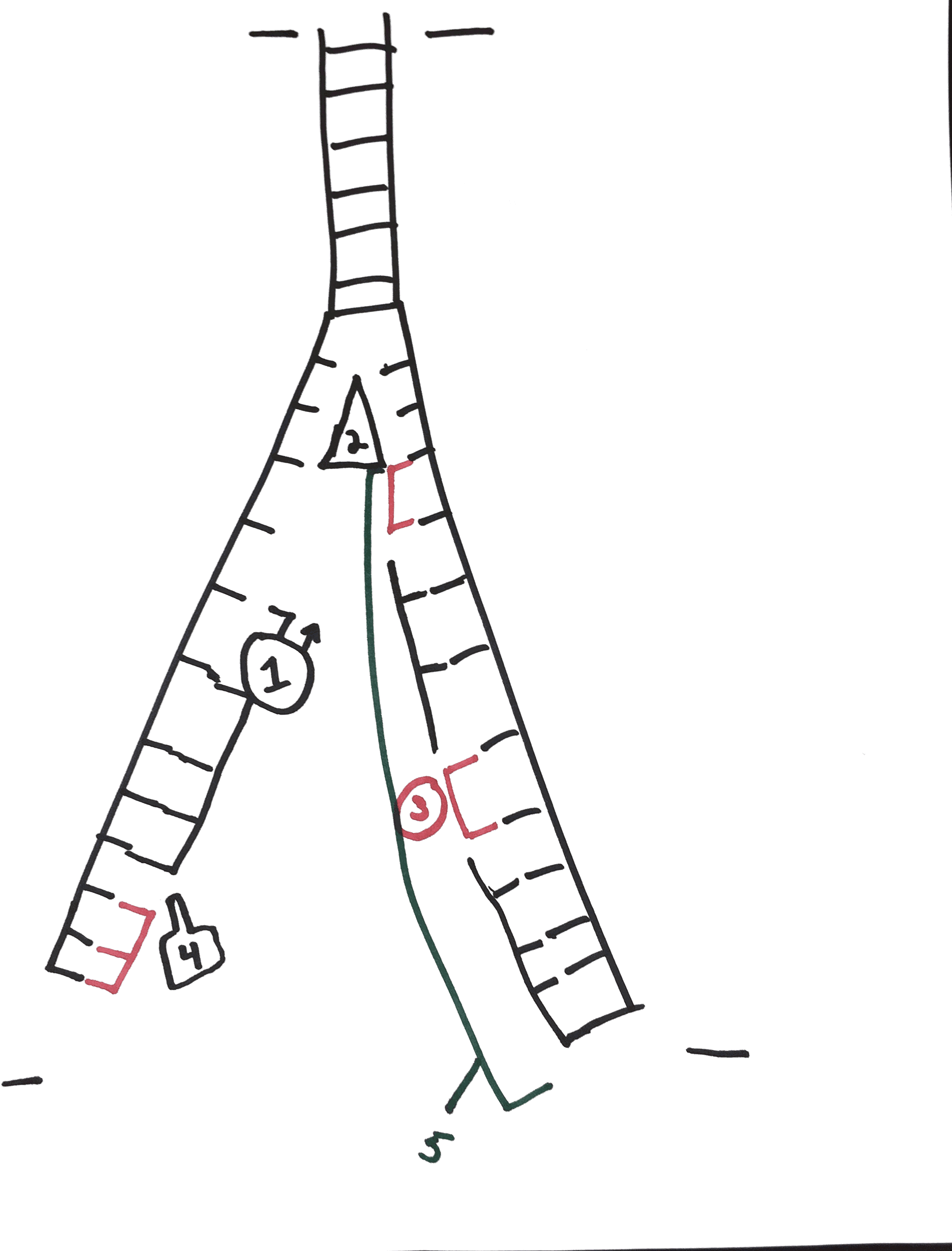
#1 in the picture above (builder)
Helicase
Primase
Polymerase
Ligase

What gray enzyme in the picture is shown removing the RNA primer?
DNA ligase
DNA Polymerase
Exonuclease
RNA Primase
The disc shaped protein core that DNA wraps around is called
histone
nucleosome
chromatin
gene
Direction that DNA is READ?
3' to 5'
5' to 3'

Structure C is
helicase
primase
DNA polymerase III
gyrase

Structure G is
primase
gyrase
DNA polymerase III
DNA polymerase I
what are the three components (enzymes and proteins) needed for the first step of DNA synthesis?
Helicase
DNA gyrase
DNAse
single-stranded binding proteins


Which RNA carries the message?
mRNA
rRNA
tRNA
What enzyme does transcription use?
DNA polymerase
ligase
RNA polymerase
helicase
RNA contains which sugar?
deoxyribose
Ribose
glucose
fructose
Which RNA forms part of the ribosomes?
tRNA
mRNA
rRNA

