
 Worksheets
AP Bio Chp 10 Photosynthesis
Total questions: 86
Worksheet time: 52mins
Name
Class
Date
1.
Which of the following are products of the light reactions of photosynthesis that are utilized in the Calvin cycle?
a)
CO2 and glucose
b)
H2O and O2
c)
electrons and H+
d)
ATP and NADPH
2.
Where does the Calvin cycle take place?
a)
stroma of the chloroplast
b)
thylakoid membrane
c)
outer membrane of the chloroplast
d)
interior of the thylakoid membrane
3.
When oxygen is released as a result of photosynthesis, it is a direct by-product of
a)
reducing NADP+
b)
splitting water molecules
c)
chemiosmosis
d)
electron transfer in photosystem II and I
4.
Which of the following events occurs in the light reactions of photosynthesis?
a)
NADP+ is produced
b)
ATP is consumed to yield ADP
c)
carbon dioxide is fixed in organic molecules
d)
light is absorbed and funneled to reaction-center chlorophyll a
5.
Which of the following is directly associated with Photosystem I?
a)
harvesting light energy to make ATP
b)
receiving electrons from the thylakoid membrane ETC
c)
generation of molecular oxygen
d)
extraction of hydrogen electrons from the splitting of water
6.
What is the primary function of cyclic electron flow?
a)
to produce additional NADPH
b)
to produce additional ATP
c)
to produce additional oxygen
d)
to produce additional carbon dioxide
7.
In a plant cell, where are ATP synthase complexes located?
a)
thylakoid membranes only
b)
inner mitochondrial membranes only
c)
thylakoid membrane and inner mitochondrial membranes
d)
thylakoid membrane and plasma membranes
8.
Which of the following statements about the relationship between photosynthesis and cellular respiration is true?
a)
In cellular respiration the biochemical pathways
of photosynthesis run in reverse.
b)
In photosynthesis the biochemical pathways of
cellular respiration run in reverse.
c)
Cellular respiration occurs only in animals and
photosynthesis occurs only in plants.
d)
Cellular respiration is catabolic and
photosynthesis is anabolic.
9.
Where are the molecules of the electron transport chain associated with photophosphorylation located in plant cells?
a)
thylakoid membanes of chloroplasts
b)
stroma of chloroplasts
c)
matrix of mitochondria
d)
outer membrane of chloroplasts
10.
In photosynthetic cells, synthesis of ATP by chemiosmosis occurs during
a)
photosynthesis only
b)
cellular respiration only
c)
both photosynthesis and cellular respiration
d)
photophosphorylation only
11.
What is the relationship between wavelength of light and the quantity of energy per photon?
a)
they have a direct, linear relationship
b)
they are inversely related
c)
they are logarithmically related
d)
they are only related in certain parts of the spectrum
12.
What is the primary function of the Calvin cycle?
a)
regenerate
ATP for use in the light reactions of photosynthesis
b)
produce carbon dioxide for use in the light
reactions of photosynthesis
c)
produce oxygen by oxidizing water
d)
produce simple sugars from carbon dioxide
13.
In C3 photosynthesis, the reactions that require ATP take place in
a)
the light reactions alone
b)
the calvin cycle only
c)
both the light reactions and the calvin cycle
d)
the citric acid cycle
14.
Reactions that consume CO2 take place in
a)
the light reactions of photosynthesis only
b)
the calvin cycle only
c)
the light reactions and the calvin cycle
d)
the calvin cycle and the citric acid cycle
15.
Which of the following statements best represents the relationships between the light reactions and the Calvin cycle?
a)
The
light reactions provide ATP and NADPH to the Calvin cycle, and the Calvin cycle
returns ADP, ℗i,
and NADP+ to the light reactions.
b)
The light reactions provide ATP and NADPH to the
carbon fixation step of the Calvin cycle, and the Calvin cycle provides water
and electrons to the light reactions.
c)
The light reactions supply the Calvin cycle with
CO2 to produce sugars, and the Calvin cycle
supplies the light reactions with sugars to produce ATP.
d)
The light reactions provide the Calvin cycle
with oxygen for carbon fixation, and the Calvin cycle provides the light
reactions with sugars to produce ATP.
16.
CAM plants keep stomata closed in daytime, thus reducing loss of water. They can do this because they
a)
fix CO2 into
organic acids during the night when temperatures are cooler.
b)
fix CO2 into by
combining it with RuBP in the Calvin cycle.
c)
obtain CO2 through their roots during the day.
d)
fix
CO2 into organic acids in the mesophyll cells,
which do not rely on stomata.
17.
Compared to C3 plants, C4 plants
a)
have higher rates of photorespiration.
b)
can continue to fix CO2 even at relatively low CO2 concentrations and high oxygen concentrations.
c)
do not use rubisco for carbon fixation.
d)
grow better under cool, moist conditions.
18.
In chemiosmosis in mitochondria, protons flow from the intermembrane space into the matrix, whereas in chemiosmosis in chloroplasts, protons flow from
a)
stroma into the cytosol
b)
stroma to the thylakoid space
c)
thylakoid space to the stroma
d)
intermembrane space to the stroma
19.
In mitochondria, the electron transport chain pumps protons from the matrix into the intermembrane space, whereas in chloroplasts, the electron transport chain pumps protons from
a)
matrix to stroma
b)
stroma to thylakoid space
c)
intermembrane space to stroma
d)
thylakoid space to stroma
20.
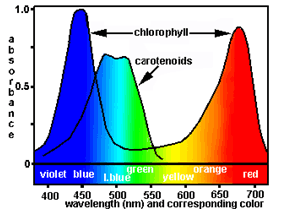
What is one function of the other pigments besides chlorophyll, in the chloroplast?
a)
to block damaging wavelengths of light
b)
to absorb different wavelengths than the chloroplasts
c)
to provide different colors to the leaves
d)
to transfer energy to a separate photosystem beside the one using chlorophyll a and b.
21.
What is the primary function of the light reactions of photosynthesis?
a)
To produce glucose
b)
To produce NADPH and ATP
c)
To use ATP
d)
To produce RuBP
22.

What supplies the electrons that are lost in PS I?
a)
the electrons from PS II
b)
water
c)
glucose
d)
oxygen
23.
What is the function of NADP+?
a)
It absorbs light
b)
It is an electron carrier
c)
It is a light-reflecting pigment
d)
It acts as long-term energy storage
24.

Which of the following molecules is not needed for the Calvin Cycle?
a)
CO2
b)
ATP
c)
NADPH
d)
H2O
25.
Green plants reflect ________ light.
a)
Red
b)
Green
c)
All
d)
Red and Violet
26.
The light reactions occur in the ________ and the dark reactions take place in the ________.
a)
Chloroplast / thylakoid membrane
b)
stroma / thylakoid
c)
mesophyl / stomata
d)
thylakoid membrane / stroma
27.
Where does the carbon come from that is used to form glucose?
a)
The soil
b)
CO2 in the air
c)
From other carbohydrates
d)
Calvin Cycle
28.
Where is glucose synthesized
a)
Photosystem II
b)
Photosystem I
c)
Calvin Cycle
d)
Glycolysis
29.

Plants with the largest amount of which pigment will be best suited for growing conditions where light has a green hue.
a)
Chlorophyll A
b)
Chlorophyll B
c)
Carotenoids
d)
A combination of all 3
30.
How many sugar molecules are produced from every six molecules of carbon dioxide that enter the Calvin cycle?
a)
1
b)
3
c)
6
d)
12
31.
The H+ concentration gradient is used to
a)
make NADPH
b)
split a water molecule
c)
generate ATP
d)
form water
32.
Which of the following are products of the light reactions of photosynthesis that are utilized in the Calvin cycle?
a)
ATP and NADPH
b)
H2O and O2
c)
CO2 and glucose
d)
ADP, Pi, and NADP+
33.
In a plant cell, where are the ATP synthase complexes located?
a)
In a plant cell, where are the ATP synthase complexes located?
b)
thylakoid membrane and plasma membrane
c)
plasma membrane only
d)
thylakoid membrane and inner mitochondrial membrane
34.
A plant has a unique photosynthetic pigment. The leaves of this plant appear to be reddish yellow. What wavelengths of visible light are being absorbed by this pigment?
a)
green and yellow
b)
blue, green, and red
c)
green, blue, and yellow
d)
blue and violet
35.
In mitochondria, chemiosmosis translocates protons from the matrix into the intermembrane space, whereas in chloroplasts, chemiosmosis translocates protons from
a)
the stroma to the thylakoid space.
b)
the thylakoid space to the stroma.
c)
the matrix to the stroma.
d)
the stroma to the photosystem II.
36.
The splitting of carbon dioxide to form oxygen gas and carbon compounds occurs during
a)
photorespiration
b)
photosynthesis.
c)
respiration.
d)
neither photosynthesis nor respiration.
37.
In metabolic processes of cell respiration and photosynthesis, prosthetic groups such as heme and iron–sulfur complexes are encountered in components of the electron transport chain. What do they do?
a)
act as reducing agents
b)
both oxidize and reduce during electron transport
c)
transport protons within the mitochondria and chloroplasts
d)
donate electrons
38.
When oxygen is released as a result of photosynthesis, it is a direct by–product of
a)
chemiosmosis.
b)
splitting water molecules.
c)
the electron transfer system of photosystem II.
d)
the electron transfer system of photosystem I.
39.
If photosynthesizing green algae are provided with CO2 synthesized with heavy oxygen (18O), later analysis will show that all but one of the following compounds produced by the algae contain the 18O label. That one is
a)
O2.
b)
3–phosphoglycerate.
c)
glucose
d)
glyceraldehyde 3–phosphate (G3P).
40.
In any ecosystem, terrestrial or aquatic, what group(s) is (are) always necessary?
a)
green plants
b)
autotrophs
c)
autotrophs and heterotrophs
d)
photosynthesizers
41.
When oxygen is released as a result of photosynthesis, it is a direct by-product of____
a)
reducing NADP+
b)
splitting water molecules
c)
chemiosmosis
d)
electron transfer in photosystem 1
42.
What is the main role of the pigment molecules in a light-harvesting complex in the thylakoid membranes?
a)
split water and release oxygen to te reaction-center chloropyll
b)
transfer light energy to the reaction-center chlorophyll
c)
synthesize ATP
d)
transfer electrons to NADPH
43.
Which of the following processes could still occur in a chloroplast in the presence of an inhibitor that prevents H+ from passing through ATP synthasecomplexes?
a)
photophosphorylation
b)
Calvin cycle
c)
oxidation of NADPH
d)
generation of proton-motive force
44.
T or F: Autotrophs, but not heterotrophs, can nourish themselves beginning with carbon dioxide and other nutrients that are entirely organic
a)
True
b)
False
45.
T or F: Chemiosmosis is unique to noncyclic photophophorylation.
a)
True
b)
False
46.
Which of the following processes is most directly driven by light energy?
a)
carbon fixation in stroma
b)
reduction of NADP molecules
c)
ATP Synthesis
d)
removal of electrons from membrane-bound chlorophyll molecules
47.
In what respect are the photosynthetic adaptations of C4 plants and CAM plants similar?
a)
an enzyme other than Rubisco carries out the first step in carbon fixation
b)
both types of plants make most of their sugar in the dark
c)
both types of plants make their sugar without the Calvin cycle
d)
Stomata normally close during the day
48.
T or F: The light reactions of photosynthesis suppley the calvin cyucle with ATP and NADPH
a)
True
b)
False
49.
What is the relationship between wavelngth of light and the quanitity of energy per photon?
a)
direct, linear relationship
b)
inversely related
c)
logarithmically related
d)
only related in certain parts of the spectrum
50.
The splitting of carbon dioxide to form oxygen gas and carbon compounds occurs during ______
a)
photosynthesis
b)
respiration
c)
neither photosynthesis or respiration
d)
both photosynthesis and respiration
51.
T or F: In photosynthetic cells, the electron transport chains are located in the thylakoid membranes and mitochondrial inener membranes.
a)
True
b)
False
52.
T or F: Photosynthesis is anabolic and Cellular respiration is catabolic
a)
True
b)
False
53.
In chemiosimosis in mitochondria, protons flow from the intermembrane space into the matrix, whearas in chemiosimosis in chloroplast, protons flow from __________
a)
the thylakoid space to the stoma
b)
the stoma to the thylakoid space
c)
the matrix into the stoma
d)
the stoma into the cytosol
54.
Which of the following events occurs in the light reactions of photosynthesis?
a)
NADP+ is produced
b)
ATP is consumed to yield ADP
c)
light is absorbed and funneled to chlorophyll a
d)
carbon dioxide is fixed in organic molecules
55.
________________ cells in leaves are specialized for photosynthesis.
a)
mesophyll
b)
schlerenchyma
c)
tracheid
d)
collenchyma
56.
T or F: Photorespiration lowers the efficiency of photosynthesis by removing RuBP molecules from the Calvin cycle.
a)
True
b)
False
57.
Which of the following activities is associated with photosystem II?
a)
light energy excites electrons in the thylakoid membrane ETC
b)
electrons released from P680 are replaced by electrons derived from water
c)
P680 donates a pair of electron to NADP+
d)
electrons are passed from P680 to molecular oxygen
58.
The color of light least effective in driving photosynthesis is _________
a)
blue
b)
red
c)
orange
d)
green
59.
Why are C4 plants able to photosynthesize with no apparent photorespiration?
a)
they do not participate in the Calvin cycle
b)
they use PEP carboxylase to initially fix carbon dioxide
c)
they conserve water more efficiently
d)
they exclude oxygen from their tissues
60.
Cyclic electron flow in the cloroplast produces________
a)
ATP
b)
NADPH
c)
both ATP and NADPH
d)
glucose
61.
T or F: CAM plants keep their stomates closed in daytime and fix carbon dioxide during the night , thus reducing loss of water.
a)
True
b)
False
62.
T or F: The light reactions of Photosynthesis requires ATP.
a)
True
b)
False
63.
What is the function of NADP+?
a)
It absorbs light
b)
It is an electron carrier
c)
It is a light-reflecting pigment
d)
It acts as long-term energy storage
64.

The enzyme responsible for Carbon Fixation in C3 Photosynthesis is
a)
RuBisCo
b)
PEP Carboxylase
c)
Hexokinase
d)
Pyruvate DeHydrogenase
65.

The loss of H2O through stomata is referred to as:
a)
Transpiration
b)
Respiration
c)
Evaporation
d)
Photorespiration
66.

Carbon fixation in CAM plants occurs during the:
a)
Day
b)
Night
67.
Which of the following molecules is not needed for the Calvin Cycle?
a)
CO2
b)
ATP
c)
NADPH
d)
H2O
68.
Where does the carbon come from that is used to form glucose?
a)
The soil
b)
CO2 in the air
c)
From other carbohydrates
d)
Calvin Cycle
69.
The light reactions occur in the ________ and the dark reactions take place in the ________.
a)
Chloroplast / thylakoid membrane
b)
stroma / thylakoid
c)
mesophyl / stomata
d)
thylakoid membrane / stroma
70.
Organisms, such as plants, that make their own food are called
a)
autotrophs
b)
heterotrophs.
c)
thylakoids.
d)
pigments.
71.

Use the diagram to answer the question. Between which parts of the molecule must the bonds be broken to form an ADP molecule?
a)
A and B
b)
A and C
c)
B and C
d)
C and D
72.
When oxygen is released as a result of photosynthesis, it is a direct by-product of
a)
reducing NADP+
b)
splitting water molecules
c)
chemiosmosis
d)
electron transfer in photosystem II and I
73.
Beyond Basics: Electrons become energized during photosynthesis when
a)
they are absorbed by water
b)
they undergo carbon fixation
c)
they are struck with light energy
d)
they are incorporated into oxygen
74.
The main source of energy for all life comes from ____.
a)
the Earth
b)
the moon
c)
the sun
d)
the food we eat/make
75.
Where does carbon dioxide enter plants
a)
The leaves
b)
Stomata
c)
Roots
d)
Stem
76.
Where does a plant absorb the water that it uses during photosynthesis?
a)
Leaves
b)
Stem
c)
Roots
d)
Petals
77.

a)
Grana
b)
Thylakoid
c)
Stroma
d)
Jelly Filling
78.

a)
Thylakoid Membrane
b)
Thylakoid Space
c)
Stroma
d)
Candy Coating
79.
Which of the following is the correct equation for PHOTOSYNTHESIS?
a)
CO2 + light + H2O --> O2 + glucose
b)
CO2 + glucose + H2O --> O2 + light
c)
O2 + light + H2O --> CO2 + glucose
d)
CO2 + O2 + H2O --> Light+ glucose
80.
How are cellular respiration and photosynthesis related, in terms of energy?
a)
The energy captured in photosynthesis is used to power cellular respiration.
b)
The energy transformed in cellular respiration is used to power photosynthesis.
c)
Photosynthesis and respiration perform the same task in terms of energy transformation
d)
Energy is not involved in either photosynthesis or cellular respiration.
81.

What is represented by the number 16?
a)
thylakoid
b)
stroma
c)
lumen
d)
inner membrane
82.
What happens to NADPH and ATP after they are used in the Calvin Cycle?
a)
they recycle back to the light reactions
b)
they are used to make G3P
83.
What is a stack of thylakoids called?
a)
lumen
b)
granum
c)
stroma
d)
lamella
84.
In green plants, the primary function of the Calvin cycle is to
a)
Use ATP to release carbon
b)
Split water to release oxygen.
c)
Construct simple sugars from carbon dioxide.
d)
Use NADPH to release carbon
85.
Which of the following is NOT a reactant of the light reactions?
a)
Light
b)
Water
c)
Carbon dioxide
86.
What is the purpose of splitting water in Photosystem II of the light dependent reaction?
a)
Provides e- for PS2 and H+ for the thylakoid space
b)
To produce Oxygen for animals
c)
There is no purpose
100 %

