wayground logo

Free Printable Worksheets

Font size

S
M
L
XL
Worksheets

HBS Fall Final 2018

Total questions: 85

Worksheet time: 1hrs 6mins

Name
Class
Date
1.

Dorsal

a)

front

b)

back

c)

side

d)

bottom

2.

Lumbar

a)

lower back

b)

thumb

c)

spinal column

d)

groin

3.

Thoracic

a)

chest

b)

back

c)

heart

d)

forehead

4.

Carpal

a)

ear

b)

wrist

c)

tail

d)

head

5.
What term means "toward the MIDLINE of the body?
a)
Medial 
b)
Lateral
c)
Intermediate
d)
Ipsilateral
6.
What term means AWAY from the midline of the body?
a)
Medial
b)
Lateral
c)
Contralateral
d)
Ipsilateral
7.

The elbow is __________ to the hand.

a)

Superior

b)

Distal

c)

Proximal

d)

Superficial

8.

The chest is __________ to the head.

a)

Inferior

b)

Deep

c)

Distal

d)

Superior

9.

The foot is _____________ to the knee.

a)

Inferior

b)

Distal

c)

Proximal

d)

Lateral

10.

Front Side.

a)

Posterior

b)

Anterior

c)

Lateral

d)

Superior

11.

Further from the midline:

a)

Lateral

b)

Medial

c)

Superficial

d)

Posterior

12.

The skin is __________ to the bone.

a)

Superficial

b)

Deep

c)

Superior

d)

Inferior

13.
 a fracture in which the bone breaks diagonally. 
a)
Oblique Fracture
b)
Fracture
c)
Diagonal Fracture
d)
Horizontal Fracture 
14.
Bone breaks into many fragments.
a)
Shattered Fracture
b)
Traction Fracture 
c)
Comminuted Fracture
d)
The Magic School Bus
15.
Bone breaks incompletely, occurs most commonly during the infantile stages of life.
a)
Greenstick Fracture
b)
Stable Fracture
c)
Bluestick Fracture
d)
Comminuted Fracture 
16.
a)
Compression Fracture
b)
Compound Fracture
c)
Greenstick Fracture
d)
Comminuted Fracture
17.
Using the photos on the screen, which Pelvis belongs to a male?
a)
1
b)
2
18.
Identify the 5 functions of the skeleton?
a)
Protection of vital organs, Muscle Attachment, Joints for Movement, Storing calcium and phosphorus, Red and white blood cell production
b)
Muscle Attachment, Joints for Movement, Storing calcium and phosphorus, Red and white blood cell production, Standing
c)
Muscle Attachment, Joints for Movement, Stability, Growth and development, Red and white blood cell production
19.

The highlighted bone(s) is/are known as the ________.

a)

Rib Cage

b)

Clavicle

c)

Mandible

d)

Vertebrae

20.

The highlighted bone(s) is/are known as the ________.

a)

pelvis

b)

tibia

c)

sternum

d)

sacrum

21.
Name the bone highlighted in red.
a)
Clavicle
b)
Rib Cage
c)
Humerus
d)
Femur
22.
skull, vertebral column, and thorax
a)
axial skeleton
b)
appendicular skeleton
c)
skeleton
d)
bones 
23.
Define tissue with regards to anatomy
a)
A group of structurally and functionally related cells that come together to perform common functions
b)
Multiple sheets of thin paper used to clean your nose
c)
A series of different cells in the same area
d)
The smallest structural and functional unit of an organism
24.
Which of the following is NOT one of the four primary tissue types?
a)
Gastric
b)
Connective
c)
Muscle
d)
Epithelial
25.
The common term for adipose tissue is
a)
Fat
b)
Blood
c)
Bone
d)
Cartilage
26.
What is the cell type in nervous tissue responsible for sending and receiving messages?
a)
Neurons
b)
Neuroglial cells
c)
Dendrites
d)
Axons
27.
Which of the following tissues binds everything together?
a)
Epithelial
b)
Connective
c)
Muscle 
d)
Nervous
28.
Which of the following tissues lines the interior and exterior of organs?
a)
Epithelial
b)
Connective
c)
Muscle 
d)
Nervous
29.

Number 4 is the

a)

Occipital lobe

b)

Frontal lobe

c)

Parietal lobe

d)

Temporal lobe

30.

Number 1 is the

a)

Occipital lobe

b)

Frontal lobe

c)

Parietal lobe

d)

Temporal lobe

31.

Number 2 is the

a)

Occipital lobe

b)

Frontal lobe

c)

Parietal lobe

d)

Temporal lobe

32.

Number 3 is the

a)

Occipital lobe

b)

Frontal lobe

c)

Parietal lobe

d)

Temporal lobe

33.

Number 6 is the

a)

Brain Stem

b)

Pons

c)

Cerebellum

d)

Medulla oblongata

34.

Which of the following areas of the brain is responsible for breathing and heart rate.

a)

Thalamus

b)

Hypothalamus

c)

Brain stem

d)

Cerebrum

35.
What is this?
a)
Cerebrum
b)
Cerebellum
c)
Brain Stem
d)
Diencephalon
36.
Controls vital functions such as breathing and heart rate
a)
Diencephalon
b)
Frontal Lobe
c)
Brain Stem
d)
Cerebellum
37.
If a head injury results in someone no longer being able to hear, which part of the brain may have been damaged?
a)
temporal lobe
b)
occipital lobe
c)
parietal lobe
d)
frontal lobe
38.
This lobe regulates memory creation and memory storage.
a)
Occipital Lobe
b)
Parietal Lobe
c)
Temporal Lobe
d)
Frontal Lobe
39.
This lobe receives and processes visual information and then sends it to other parts of the brain for further processing and storage.
a)
Occipital Lobe
b)
Parietal Lobe
c)
Temporal Lobe
d)
Frontal Lobe
40.
This lobe evolved most recently and is the last to fully develop in young adulthood.
a)
Occipital Lobe
b)
Parietal Lobe
c)
Temporal Lobe
d)
Frontal Lobe
41.
This lobe controls responses to complex problems through reasoning, judgment, decision making and planning.
a)
Occipital Lobe
b)
Parietal Lobe
c)
Temporal Lobe
d)
Frontal Lobe
42.
The brain stem controls automatic things like
a)
breathing, balance and heart rate
b)
temperature, breathing, and balance
c)
breathing, heart rate, and coordination
d)
temperature, breathing, and heart rate
43.
The cerebellum controls
a)
breathing, coordination and balance
b)
balance, coordination and temperature
c)
coordination and balance
d)
heart rate and coordination
44.
The corpus callosum
a)
Manages our understanding of speech and language
b)
cannot process messages sent from the left hand
c)
is a deep fissure in the cerebral cortex
d)
is a thick band of nerve fibres linking the two hemispheres of the brain
45.

A blow here can often make you see stars

a)

cerbellum

b)

occipital lobe

c)

frontal lobe

d)

temporal lobe

46.

The part of the neuron that receives incoming messages is the

a)

dendrite

b)

axon

c)

cell body

d)

axon terminal

47.

The part of the neuron that is protected by the myelin sheath is the

a)

cell body

b)

dendrites

c)

axon

d)

axon terminals

48.

The cell body contains the

a)

dendrites

b)

axon terminals

c)

nucleus and many organelles

d)

myelin sheath

49.

When a neuron is at REST,

a)

the inside of the neuron is negatively charged compared to the outside.

b)

the inside of the neuron is positively charged compared to the outside.

c)

there is no charge difference established

d)

none of these is true

50.

An electrical impulse within a single neuron is called a

a)

synapse

b)

membrane potential

c)

action potential

d)

cell body

51.

Depolarization occurs when

a)

sodium channels open

b)

potassium channels open

c)

sodium channels close

d)

potassium channels close

52.

Depolarization is occuring at number

a)

1

b)

2

c)

4

d)

5

53.

Sodium channels are open during

a)

1

b)

2

c)

4

d)

5

54.

What maintains the resting membrane potential in a neuron?

a)

sodium-potassium pumps

b)

sodium channels

c)

potassium channels

d)

gravity

55.

Which of the following uses ACTIVE transport?

a)

sodium-potassium pump

b)

sodium channel

c)

potassium channel

d)

diffusion

56.
This part of the neuron receives chemical messages from the neurotransmitters of other neurons.
a)
Axon Terminal
b)
Dendrites
c)
Myelin Sheath
d)
Cell Body
57.
The part of the neuron that insulates the axon and increases the speed of the neural message within the neuron.
a)
Synapse
b)
Dendrite
c)
Myelin Sheath
d)
Axon Terminal Button
58.
This part of the neuron stores then releases neurotransmitters into the synapse.
a)
Axon 
b)
Dendrite
c)
Myelin Sheath
d)
Axon Terminal
59.
The part of the neuron where action potentials take place.
a)
Axon Terminal Button
b)
Myelin Sheath
c)
Dendrite
d)
Axon
60.
The correct direction of the neural impulse within one neuron.
a)
Axon Terminal to Dendrite
b)
Dendrite to Axon Terminal
c)
Cell Body to Axon
d)
Axon Terminal to Cell Body
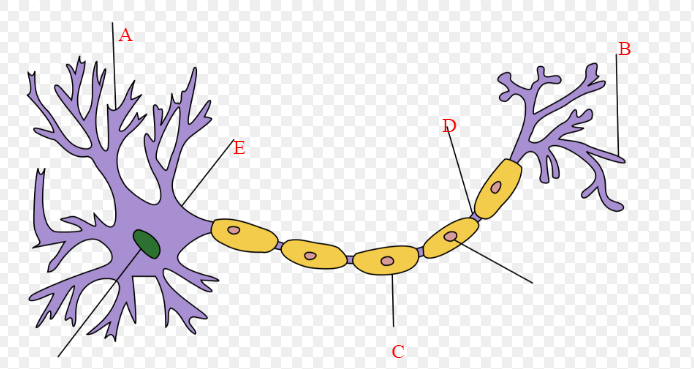
61.

What structure is labeled A

a)

Dendrite

b)

Axon

c)

Axon Terminal

d)

Cell Body

62.

What structure is labeled B

a)

Dendrite

b)

Axon

c)

Axon Terminal

d)

Cell Body

63.

What structure is labeled C

a)

Synapse

b)

Soma

c)

Axon Terminal

d)

Myelin Sheath

64.

What structure is labeled D

a)

Synapse

b)

Axon

c)

Axon Terminal

d)

Dendrite

65.

What structure is labeled E

a)

Synapse

b)

Cell Body

c)

Axon

d)

Dendrite

66.

Specialized group of cells and tissues that work together to produce and secrete substances such as hormones, enzymes or other bodily components

a)

Hormone

b)

Gland

c)

Thymus

67.

Functions of the endocrine System are to Regulate growth, Regulate metabolism, Regulate Reproduction

a)

True

b)

False

68.

Underactive thyroid

a)

PCOS

b)

Hyperthyroidism

c)

Hypothyroidism

d)

DM II

69.

Hyperthyroidism

a)

lower thyroid

b)

is the overactive thyroid

c)

is the underactive thyroid

70.

Signs and symptoms of hyperthyroidism are

a)

Fatigue, weight gain, muscle aches, bradycardia

b)

Polyuria, polydipsia, fatigue

c)

weight loss, tachycardia, Goiter

71.
What hormone regulates sugar level?
a)
insulin
b)
histamine
c)
estrogen
d)
thyroxin
72.
What does the endocrine system do?
a)
Responsible for digestion 
b)
Regulate bone growth
c)
Release homrones into the blooodstream
d)
Maintains immmun system
73.
Which gland is considered the master gland?
a)
Pitutiary Gland
b)
Pineal Gland
c)
Adrenal Gland
d)
Parathyroid 
74.
Which of the following are functions of the thyroid gland?
a)
Sleep Cycle
b)
Growth 
c)
Blood Glucose Levels 
d)
Metabolism and Energy 
75.
Where are the adrenal glands located? 
a)
Bottom of the kidneys
b)
In front of the kidneys 
c)
On top of the kidneys
d)
Lower abdomen 
76.
A tissue or group of tissues that make and releases hormones. 
a)
Endocrine System
b)
Pancreas
c)
Flight or Fight Response
d)
Glands
77.
The gland that stimulates secondary sex characteristics in females. 
a)
Thyroid
b)
testes
c)
ovary
d)
adrenal
78.
Gigantism is a disorder in which an individual has a very large body; caused by excess human growth hormons
a)
True 
b)
False
79.
Testosterone is produced in the 
a)
ovary
b)
testes
c)
pancrease
d)
thyroid 
80.

The endocrine system uses this system of turning hormones on and off to maintain homeostasis.

a)

Hypothalamus

b)

Thymus

c)

Negative Feedback

d)

Target Cells

81.
Which medical term is the result of prolonged exposure to high levels of cortisol?
a)
Cushing’s syndrome
b)
Conn’s syndrome
c)
Graves’ disease
82.
Which hormone stimulates milk production?
a)
Prolactin
b)
Oxytocin
c)
Antidiruetic Hormone
d)
Parathyroid Hormone
83.
Which hormone promotes retention of water by the kidneys?
a)
Parathyroid Hormone
b)
Follicle Stimulating Hormone
c)
Antidiruetic Hormone
d)
Calcitonin
84.
Which hormone reduces blood calcium level?
a)
Melatonin
b)
Calcitonin
c)
Growth Hormone
d)
Prolactin
85.
Which hormone raises blood glucose?
a)
Mineralocorticoids
b)
Glucagon
c)
Gluccocorticoids
d)
Insulin